Revival of Struck-Off Companies in India
Restore your struck-off company through the Section 252 NCLT process with end-to-end support from RegisterKaro, from eligibility assessment to post-restoration filings and return to Active status.
 Section 252 eligibility and time-limit assessmentNCLT petition and affidavit draftingEvidence collection and documentation supportCompletion of overdue annual filings, fees, and penaltiesGuidance on Income Tax, GST, PF, and ESIC dues

 What Sets Us ApartWhat Sets Us Apart
What is a Struck-Off Company and Can it Be Restored?
A struck-off company (also commonly searched as a "strike off company") is one whose name the ROC has removed from the register. When a company is marked "Struck Off," the ROC has removed its name from the register under the Companies Act, 2013. The company can no longer operate as a normal corporate entity, although certain liabilities and legal obligations may continue.
A struck-off company can, however, seek restoration through the NCLT under Section 252 within the prescribed time limits. If the Tribunal restores the company, it can resume its legal existence after completing the required ROC filings and pending compliances.
Why Do Companies Get Struck Off?
Common reasons for striking off a company include:
- Failure to commence business: The company does not commence business within one year of incorporation.
- Prolonged inactivity: It does not carry on business or operations for two consecutive financial years without applying for dormant status under Section 455.
- Non-filing as a sign of inactivity: Persistent failure to file annual returns or financial statements can indicate that a company is no longer carrying on business. The ROC may use such non-compliance as a basis for initiating strike-off proceedings.
- Failure to file INC-20A: A company required to file the commencement declaration does not submit Form INC-20A within 180 days of incorporation.
- ROC action: The ROC finds the company eligible for strike-off after following the prescribed process.
- Voluntary closure: The company applies for strike-off under Section 248(2).
If the company was still operating when it was struck off, or restoration is otherwise just and equitable, these circumstances may support an application for revival before the NCLT.
Struck Off vs Winding Up
Both processes can end a company's legal existence, but their purpose and procedure differ.
| Aspect | Struck Off Company | Winding Up of a Company |
| Nature | Administrative removal from the ROC register | Formal process for closing and liquidating the company |
| Initiated by | ROC or eligible company | Company, creditors, Tribunal, or other permitted parties |
| Typical use | Inactivity, non-compliance, or voluntary closure | Closure involving liquidation of assets and settlement of liabilities |
| Process | Generally simpler, with fewer steps | Involves liquidation, asset realization, and settlement of claims |
| Revival | Restoration can be sought before the NCLT under Section 252 | Depends on the stage and circumstances of the winding-up process |
| Cost and time | Generally lower and simpler | Usually more involved due to liquidation proceedings |
Who Can Apply for Revival of a Struck-Off Company?
Depending on the applicable provision under Section 252, an application may be made by:
- The company
- Any member
- Any creditor
- Any workman
- The ROC, in the circumstances provided under the Act
The restoration application is filed before the NCLT in the prescribed form, generally NCLT-9, with the required supporting documents.
Time Limit for Revival
The applicable time limit depends on the route used:
- Appeal under Section 252(1): An aggrieved person can appeal within three years from the date of the ROC’s order.
- ROC application under the proviso to Section 252(1): If the Registrar is satisfied that the company was struck off inadvertently or based on incorrect information, the ROC may apply to the Tribunal for restoration within three years from the date of the dissolution order under Section 248.
- Application under Section 252(3): The company, member, creditor, or workman can apply within 20 years from publication of the strike-off notice in the Official Gazette under Section 248(5).
Grounds for Revival of a Struck-off Company
The NCLT may restore the company if it is satisfied that the company was carrying on business or was in operation when it was struck off, or that restoration is otherwise just and equitable.
The following evidence can help establish the company’s operations, assets, rights, or liabilities:
- Property ownership: Title documents or other evidence of company-owned immovable property.
- Bank activity: Bank statements or records showing transactions before the strike-off.
- Tax and statutory records: GST, Income Tax, PF, or ESIC records showing continuing activity or compliance.
- Licenses and registrations: Relevant registrations such as trade license, professional tax registration, FSSAI license, or Shop & Establishment registration.
- Litigation or contracts: Pending cases, contractual rights, or obligations requiring the company’s continued existence.
- Income tax returns: Filed ITRs, including nil returns where applicable, supporting evidence of continued activity or compliance.
- Assets and liabilities: Records of loans, receivables, payables, or other outstanding obligations.
- Board resolution: Where applicable, a resolution authorizing the restoration proceedings.
Should You Revive a Struck-Off Company or Start a New Company?
If your company has been struck off, you can either apply for restoration through the NCLT under Section 252 or incorporate a new company. The practical choice depends on whether the existing company still has assets, rights, contracts, or obligations worth preserving.
Revival may make sense when the company still has:
- Assets: Property, bank balances, intellectual property, or other assets held by the company
- Contracts and licenses: Ongoing contracts, licenses, permits, or registrations linked to the existing entity
- Outstanding claims: Receivables, deposits, or pending litigation in the company's name
- Business history: An established brand, GST registration, customer relationships, or operating track record worth retaining
- Unresolved compliance issues: Director disqualifications, statutory dues, or other obligations that need to be regularized
A new company may be more practical when the struck-off company has no:
- Significant assets, contracts, or liabilities
- Important business history, registrations, or brand value to retain
- Need to preserve the existing company's legal identity
A new company can generally be incorporated faster than a restoration proceeding, while NCLT restoration may take several months and involve professional and filing costs. The actual timeline and cost depend on the company's circumstances and pending compliance.
Eligibility for Revival of a Struck-Off Company
Under Section 252 of the Companies Act, 2013, the NCLT may restore a company when the applicant and grounds meet the legal requirements.
A company may generally qualify for restoration when:
- The applicant is eligible: The company, a member, creditor, or workman can apply for restoration. An aggrieved person can also appeal against the ROC's strike-off order, while the ROC can seek restoration in certain cases.
- The application is filed on time: An appeal against the ROC's order must generally be filed within 3 years. A company, member, creditor, or workman can apply for restoration within 20 years from publication of the strike-off notice in the Official Gazette.
- The company was carrying on business or was in operation: Evidence such as financial statements, bank statements, ITRs, GST records, invoices, or active contracts can support this ground.
- Restoration is otherwise just and equitable: Pending litigation, company assets, contractual rights, liabilities, or other unresolved affairs may support the case for restoration.
Note: A company with no business activity, assets, or other legitimate reason for restoration may have a weaker case. The NCLT ultimately decides whether the statutory grounds for restoration are satisfied.
Documents Required (Checklist) for Revival of Struck-Off Companies
Before preparing the NCLT petition, keep the following documents ready:
- Petition in Form NCLT-9 and the affidavit verifying it in Form NCLT-6.
- Certified copy of the ROC's strike-off order/notice or the relevant Official Gazette publication.
- Memorandum and Articles of Association (MoA and AoA) and the Certificate of Incorporation.
- Board resolution authorizing the filing, where applicable.
- Financial statements for the years preceding the strike-off, including the balance sheet, profit and loss account, and auditor's report, as applicable.
- Bank statements for the relevant period to support evidence of business activity.
- Income Tax Returns, where filed.
- List of directors and shareholders.
- Proof of service of the petition on the ROC and Income Tax Department, where required.
- Vakalatnama or Memorandum of Appearance for the authorized representative.
- Supporting evidence for restoration, such as GST records, active licenses, property documents, contracts, or pending litigation records.
Tip: Prioritize documents that show the company was carrying on business or was in operation when it was struck off. Financial records, bank statements, ITRs, and GST records can be particularly useful for establishing this ground.
How to Revive a Struck-Off Company? Complete Procedure
Reviving a struck-off company requires submitting an application to the NCLT under Section 252 of the Companies Act, 2013, followed by ROC filings and completion of the compliances directed by the Tribunal.
Step 1: File the NCLT Petition
Prepare the restoration petition in Form NCLT-9 and file it with the appropriate NCLT bench. File it within the applicable time limit: 3 years for an appeal against the strike-off order, or 20 years for an application by the company, member, creditor, or workman.
- State why the company was struck off and why it should be restored.
- Attach financial statements, bank records, ITRs, GST records, or other evidence that the company was carrying on business.
- File the verifying affidavit in Form NCLT-6.
- Pay the prescribed NCLT filing fee to restoration application.
Step 2: Serve the Petition on the Concerned Authorities
Serve a copy of the petition and supporting documents on the ROC and the Income Tax Department, as required by the Tribunal.
- Service is generally completed at least 14 days before the hearing.
- Keep the proof of service for submission to the NCLT.
- The ROC or other authorities may submit their objections or observations, often through a report from the Registrar.
Step 3: Attend the NCLT Hearing
At the hearing, the petitioner or their authorized representative presents the case before the Tribunal. The NCLT considers:
- Evidence that the company was carrying on business or was in operation.
- The reasons given for restoration.
- Any objections or observations from the ROC or other authorities.
Step 4: Receive the Restoration Order
If the NCLT is satisfied with the grounds for revival, it may order the company's name to be restored. The order typically also requires the company to:
- File all pending annual returns and financial statements.
- Pay applicable filing fees, penalties, and any costs the Tribunal directs be paid to the ROC (commonly around ₹25,000, or as specified in the order).
- Complete any other conditions specified by the Tribunal.
Step 5: File the NCLT Order with the ROC
Under Section 252(2) of the Companies Act, 2013, file a certified copy of the restoration order with the ROC in Form INC-28, generally within 30 days of the order (or as directed).
- Attach the certified NCLT order.
- Pay the applicable filing fee.
- Follow any additional directions included in the order.
Step 6: Clear Pending Compliances
After restoration, complete the company's outstanding filings and compliances as directed by the NCLT. These may include:
- Form MGT-7 for pending annual returns and Form AOC-4 for pending financial statements, with the additional fees under Sections 92 and 137 (₹100 per day per form).
- DIR-3 KYC for the directors to reactivate their DINs.
After restoration, settle any pending Income Tax, GST, PF, or ESIC dues.
Step 7: Restoration of the Company by the ROC
Once the NCLT order and required filings are processed, the ROC gives effect to the restoration and the company's status on the MCA portal returns to "Active." The company can then complete pending filings and meet any other requirements specified in the Tribunal's order. It is generally restored to the position it would have occupied had its name never been struck off.
It can also approach its bank to reactivate accounts and restore other registrations, though reactivation is subject to each bank’s or authority's own rules and verification.
How Long Does the Revival Process Take?
Reviving a struck-off company through the NCLT generally takes 2 to 6 months. The timeline can be shorter or longer depending on the NCLT's schedule, the completeness of the petition, and whether any objections arise.
| Stage | What happens | Typical duration |
| Document preparation | Collect financial records, prepare Form NCLT-9 and NCLT-6, and compile supporting documents | 1–2 weeks |
| Filing the petition | File the restoration petition with the NCLT and pay the prescribed fee | 2–3 days |
| Notice to ROC and Income Tax Department | Serve the petition on the concerned authorities and allow the required response period | 2–3 weeks |
| NCLT hearing and order | The Tribunal hears the matter, considers any objections, and passes the restoration order | 1–3 months |
| Filing the order with ROC | File the certified NCLT order with the ROC in Form INC-28 | Within 30 days |
| Completing pending filings | File overdue returns such as AOC-4 and MGT-7/MGT-7A and pay applicable fees and penalties | 2–4 weeks |
The NCLT hearing stage usually determines the overall timeline. Delays may arise from incomplete documents, a heavy caseload, authority objections, or pending compliances. Key factors include:
- Documentation: Missing records can require further submissions.
- NCLT schedule: Hearing dates depend on the Tribunal’s caseload.
- Authority objections: ROC queries or objections may cause delays.
- Multiple hearings: Additional hearings may be required.
- Pending compliances: Overdue filings can extend post-restoration work.
Costs Involved in Revival of the Struck-Off Companies
Reviving a struck-off company typically costs ₹30,000 to ₹1,00,000 or more. The final amount depends mainly on professional charges, the ROC cost ordered by the NCLT, and accumulated late-filing penalties.
The main expenses are:
| Cost component | Typical amount | Notes |
| NCLT filing fee | ₹1,000 | Statutory fee for the petition in Form NCLT-9 |
| Cost payable to the ROC | Commonly around ₹25,000-₹50,000 (or as directed) | The NCLT usually orders this as a condition of restoration |
| Professional charges | ₹15,000 – ₹50,000+ | CS/CA/advocate fees for drafting, documentation, and NCLT representation; varies with complexity |
| Documentation & notarization | ₹2,000 – ₹5,000 | Notarizing affidavits, printing/compiling documents, POA, board resolutions |
| Additional fee on pending forms | ₹100 per day, per form (no cap) | Applies to overdue AOC-4, MGT-7/MGT-7A, etc. under Sections 92 and 137 |
| Normal ROC filing fees | ₹200 – ₹600 per form | Based on the company's nominal share capital |
Penalty and Late-Filing Fees on Pending ROC Returns
Once the company is restored, it must bring its overdue annual filings up to date. The additional fee is ₹100 per day of delay, per form, with no upper cap, in addition to the normal filing fee of ₹200–₹600 per form.
The key filings may include:
- AOC-4: Financial statements under Section 137.
- MGT-7: Annual return under Section 92.
- MGT-7A: Annual return for eligible small companies and OPCs.
As the additional fee accrues from the original due date until filing, a company with several years of pending returns can face substantial accumulated penalties. The final amount depends on the number of overdue forms and the length of the delay.
Post-Revival Compliances for Struck-Off Companies
After filing the NCLT restoration order with the ROC in Form INC-28, the company can resume its legal existence. Since it is treated as having continued in existence as if it had never been struck off, its old liabilities, pending dues, filings, and other obligations remain in place. The company must then complete its pending compliances and meet any conditions specified in the NCLT order.
Clearing Pending ROC Filings and Statutory Dues
The NCLT order makes these mandatory:
- File overdue annual returns: Submit Form MGT-7 (Annual Return) and Form AOC-4 (Financial Statements) for every pending year, along with late fees under Sections 92 and 137.
- Settle other statutory dues: Clear outstanding Income Tax, GST, PF, and ESIC dues to avoid further penalties.
- Meet NCLT directions: Pay any costs or penalties the tribunal ordered and file any compliance affidavits it required.
Reactivating Accounts and Registrations
With "Active" status restored, the company can resume operations by:
- Unfreezing bank accounts: Submit the NCLT order and proof of active status to the bank to release frozen accounts.
- Renewing licenses and registrations: Reactivate or renew registrations affected by the strike-off, such as GST and IEC.
- Updating KYC: Refresh company and director KYC (including DIR-3 KYC) with the MCA and banks.
- Informing stakeholders: Notify key clients, suppliers, and lenders of the revived status to resume business.
Connect with RegisterKaro and let our experts handle the legal hassle while you grow your business.
Frequently Asked Questions (FAQs)
Can a struck-off company be revived?
Yes, a struck-off company can be restored by applying to the NCLT under Section 252 of the Companies Act, 2013, if the application is within the prescribed time limit and the statutory grounds for restoration are met.
What is the time limit to revive a struck-off company?
The time limit depends on the route. An appeal under Section 252(1) can generally be filed within three years of the ROC's order. An application under Section 252(3) can generally be filed within 20 years from publication of the strike-off notice in the Official Gazette.
How much does it cost to revive a struck-off company?
Revival typically costs ₹30,000 to ₹1,00,000 or more, depending on professional fees, ROC costs, and pending filings. The NCLT filing fee is ₹1,000, while overdue filings may attract additional fees and penalties.
What happens to a company's old liabilities after restoration?
When the NCLT restores a company, it is generally treated as having continued in existence as if its name had never been struck off. This means its earlier liabilities, including loans, tax dues, and contractual commitments, continue to remain payable. Restoration also revives the company's obligation to complete pending filings and clear accumulated fees or penalties. The company therefore resumes its legal position with both its assets and liabilities intact.
How long does the revival process take?
Revival generally takes 2 to 6 months, depending on the NCLT's schedule, completeness of the petition, and any objections from the ROC or other authorities.
Who can apply for revival?
The company, a member, creditor, or workman can apply for restoration under Section 252(3). An aggrieved person can appeal against the ROC's order under Section 252(1), while the ROC can also seek restoration in specified circumstances.
What happens to the company's bank accounts and assets after strike-off?
Banks may restrict the company's accounts after receiving notice of the strike-off. The company also faces legal restrictions on dealing with its assets until restoration, subject to the provisions of the Companies Act.
Are directors of a struck-off company disqualified?
Directors may be disqualified under Section 164(2) if the company fails to file financial statements or annual returns for three consecutive financial years. Such disqualification is generally for five years, subject to the Act and applicable exceptions.
What if the NCLT rejects the restoration petition?
An applicant can generally appeal an NCLT order to the NCLAT within 45 days, subject to the applicable provisions of the Companies Act. A further appeal to the Supreme Court is available on a question of law.
Do pending returns have to be filed after restoration?
Yes, the company generally needs to complete its overdue MGT-7/MGT-7A and AOC-4 filings and pay applicable additional fees or penalties. Other pending statutory and tax compliances may also need to be completed as directed by the NCLT or required by law.
Can a company voluntarily struck off through STK-2 be revived?
Yes, a company voluntarily struck off under Section 248(2) can seek restoration under Section 252 where the statutory grounds are satisfied. Evidence of assets, liabilities, ongoing litigation, or other circumstances requiring restoration may support the application.

Reviewed by
Joel DsouzaJoel Dsouza is a Chartered Accountant (CA) and compliance expert with over 7 years of hands-on experience in company registration, tax structuring, GST, ROC filings, and MCA compliance. As a qualified member of the Institute of Chartered Accountants of India (ICAI) and Co-Founder at RegisterKaro, he has personally advised more than 1,000 startups and SMEs across India, helping founders navigate incorporation, regulatory frameworks, and financial planning from Day 1. With deep expertise across all three levels of Finance and Portfolio Management, Joel is committed to promoting financial literacy and simplifying India's startup ecosystem through clear, actionable guidance that entrepreneurs can act on immediately.
Why Choose RegisterKaro for Struck-Off Company Revival?
Reviving a struck-off company involves strict timelines, NCLT proceedings, and post-restoration compliance. RegisterKaro manages the Section 252 process from initial assessment through restoration and ROC compliance.
- Specialists in NCLT restoration: Corporate lawyers and company secretaries handle petition drafting, evidence preparation, and Tribunal representation.
- Built to handle objections: We prepare supporting documents and responses to address queries or objections from the ROC and other authorities.
- Eligibility checked upfront: Our experts assess the Section 252 route, applicable time limit, and available grounds before proceeding.
- Evidence-led petition preparation: We organize bank records, tax filings, licenses, contracts, property records, and other evidence relevant to the restoration case.
- Post-revival compliance support: Our team helps clear the compliance backlog and address requirements needed to bring the company back into regular operations.
- Transparent pricing: You receive a detailed quote covering professional fees, government charges, and any additional compliance costs required for restoration.

What Our Clients Say
View All
Ritesh Khamitkar
 Verified
One of the best Consultant in India!! The process was very smooth by Team!! And Special thanks To Hari Sir!! Great Guys, loved being the client of Reg... Read more

Suman Laha
VerifiedWe registered our company Kajkarma innovations private limited thorough registerkaro. They are very helpful. Specially Pranjal she helps me lot throug... Read more

Ronit Dhansoia
VerifiedProfessional, knowledgeable, and easy to work with. If you’re starting a company and want someone who genuinely cares about getting it right, Prayansh... Read more

ravindra kusampudi
VerifiedProfessional approach and timely response, nice experience working with registerkaro team..this is my second company I got registered through this com... Read more

Naman Mahendroo
VerifiedI'm seriously impressed with RegisterKaro's service, especially how rapidly they handled the registration. Himanshi Kalra is a superstar in getting th... Read more

Nawab Moazam Khan
VerifiedI had the pleasure of working with Muskan Jain from RegisterKaro, who assisted in incorporating my company. She was professional, efficient, and made... Read more

Nishkam Nagar
VerifiedGenuinely impressed with the help and immaculate assistance from registerkaro and Jiya ma’am , she was with me through the whole process and made it v... Read more

amit kumar
VerifiedRegisterKaro has been handling my **GST filing for 6 months** now and **all filings have been on time** without delays. Muskan Singla is **responsive*... Read more

Shivam Singh
VerifiedI had a great experience with RegisterKaro for incorporating my Private Limited Company. The entire process was smooth and well-managed. Sumit, in par... Read more

Suresh Pasupuleti
VerifiedWe are working with Regiser Karo for past 8 months and best team to work and especially Muskan Singla support us monthly GST filing and other complani... Read more
Related Blogs
View All
Virtual CFO Cost in India for Startups: Fees & Pricing
Accounting Outsourcing Cost in India: Complete Pricing Guide
Documents Required for GST Registration in India (Checklist)

How to Start a Scrap Business in India: Setup & Profit

How to Register a Media Company in India: Process & Licenses
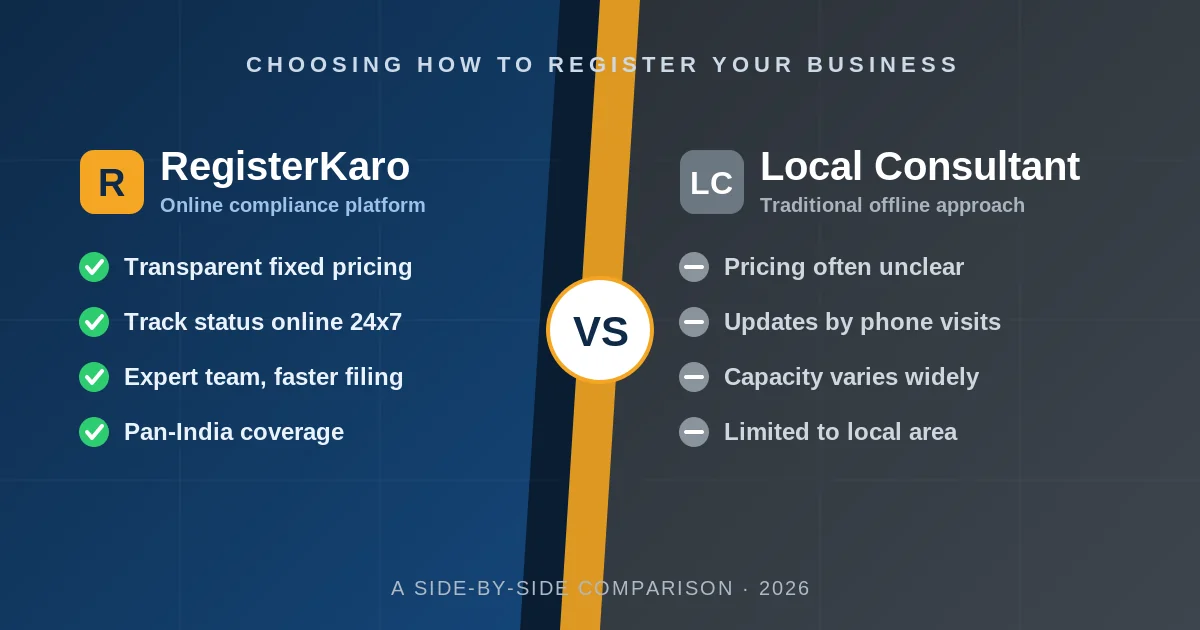
RegisterKaro vs Local Consultant: Which Compliance Partner Should You Pick?

Fees for Registration of a Private Limited Company in India

How to Start a Food Truck Business in India: Licenses & Cost
How to Download a PAN Card? E-PAN Card Download Steps

Company Registration Fees in India (2026): Cost Breakdown