FSSAI Registration (Food License) Online in India
Apply for FSSAI registration, a State License or a Central License with RegisterKaro. Our team checks your category under the 2026 limits, prepares documents, files on FoSCoS and handles queries.
 FSSAI Basic Registration, State and Central License FilingCategory Check Under the ₹1.5 Crore and ₹50 Crore LimitsDocument Preparation and FoSCoS Application FilingQuery Replies, Annual Fee and Annual Return SupportLicenses for Restaurants, Cloud Kitchens, Traders and Manufacturers


 What Sets Us ApartWhat Sets Us Apart
What Is an FSSAI License (Food License)?
An FSSAI license is the 14-digit approval a food business needs before it starts operating in India. The Food Safety and Standards Authority of India (FSSAI) issues it under the Food Safety and Standards Act, 2006. People also call it a food license or a food safety license.
It comes in three forms: Basic Registration, a State License, and a Central License. The form depends on the Kind of Business, annual turnover, and activity limits. Every application goes through the FoSCoS portal.
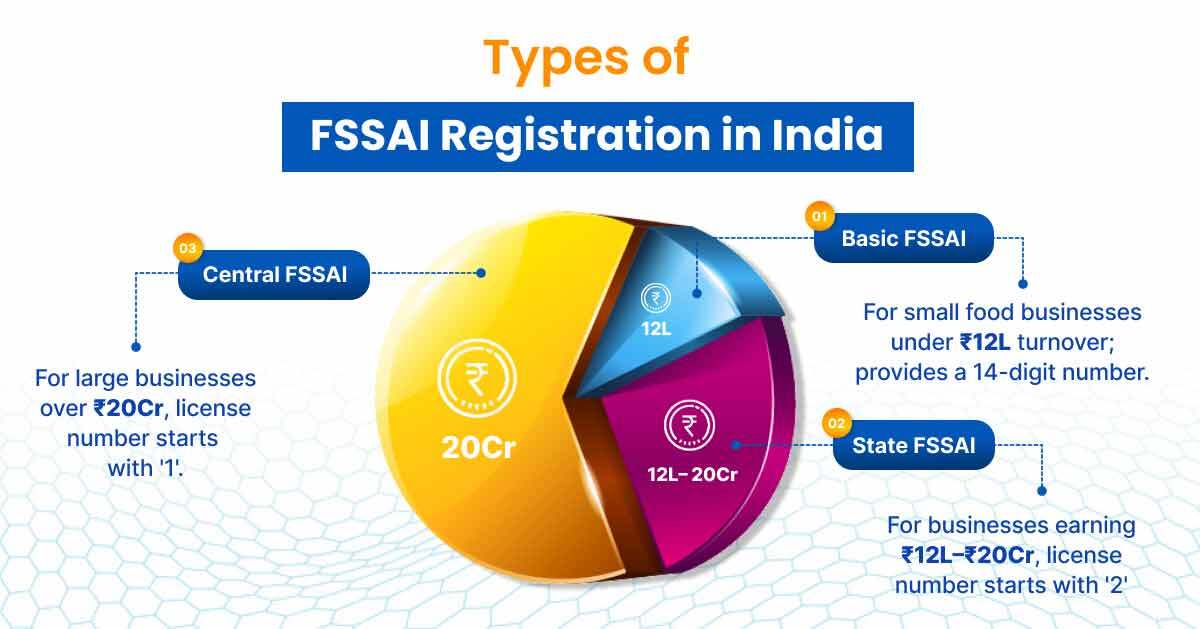
1. FSSAI Basic Registration
Basic FSSAI registration applies to food businesses with annual turnover up to ₹1.5 crore, unless their Kind of Business needs a license. It suits home kitchens, small cafés, bakeries, kiosks, small retailers, and caterers. The applicant files Form A, and the government fee is ₹100 per year. Hawkers and itinerant food vendors pay no fee since 28 September 2024.
2. State FSSAI License
A State FSSAI License applies to food businesses with annual turnover above ₹1.5 crore and up to ₹50 crore. The State Food Safety Department issues it for premises in that state. The applicant files Form B, and the government fee is ₹5,000 per year.
3. Central FSSAI License
A Central FSSAI License applies to food businesses with annual turnover above ₹50 crore. Importers, e-commerce food businesses, and the head office of a business operating in more than one state need it at any turnover. The government fee is ₹7,500 per year.
Important: Turnover alone does not determine the category. FoSCoS checks the Kind of Business and activity limits, such as dairy capacity or cold-storage size. A business below ₹1.5 crore may still need a State or Central License.
FSSAI License Requirement and Eligibility
The FSSAI license requirement depends on the Kind of Business, annual turnover, activity limits, and location. The table below shows the general applicable rule from 1 April 2026:
FSSAI Category | Annual Turnover | Typical Businesses |
FSSAI Registration | Generally applies to eligible food businesses with an annual turnover of up to ₹1.5 crore. | Home kitchens, petty retailers, small cafés, tiffin services, small caterers |
State FSSAI License | Generally applies to eligible food businesses with an annual turnover of more than ₹1.5 crore and up to ₹50 crore. | Restaurants, manufacturers, wholesalers, distributors, storage units |
Central FSSAI License | Generally applies to eligible food businesses with an annual turnover of more than ₹50 crore. Some businesses require a Central License based on their KoB. | Importers, exporters, e-commerce platforms, multi-state head offices |
Other eligibility rules:
- Multiple states: A business operating in two or more states takes a Central License for its head office. Each other premises takes the approval its own activity and turnover require.
- One premises, one approval: Each premises holds one registration or license. All food activities at that premises go on the same approval.
- Activity limits: Dairy, slaughterhouses, cold storage, warehouses and some processing units have capacity limits. Those limits can push a business into a higher category.
- Street food vendors: Vendors, hawkers, food carts and food trucks registered under the Street Vendors Act, 2014 are deemed registered under the FSS Act. They don’t need a separate FSSAI registration, but they must follow the Schedule 4 hygiene rules.
- High-risk foods: Dairy, meat, packaged drinking water, infant food, and fishery products follow stricter hygiene and testing rules. Packaged drinking water no longer needs BIS certification (omitted on 17 October 2024), but it needs third-party audits and a water testing report for FSSAI.
The applicable FSSAI category should be checked against the current FoSCoS eligibility criteria before applying.
Who Needs an FSSAI License in India?
Any business that makes, processes, stores, transports, sells, serves, imports, or exports food needs an FSSAI approval, often called a food business license. That includes home-based sellers, cloud kitchens, and food trucks.
- Manufacture or process food: Operate a bakery, flour mill, oil mill, beverage unit, food processing unit, or similar business. This also includes applicable repackers and relabellers.
- Serve food: Run a restaurant, cafe, hotel, cloud kitchen, canteen, mess, catering business, tiffin service, food truck, kiosk, or similar food service business. Such establishments usually also need a Gumasta License / Shops and Establishment registration.
- Trade or sell food: Operate as a wholesaler, distributor, retailer, supermarket, kirana store, direct seller, or other food trader. Most food traders also need GST registration based on turnover and activity.
- Sell food through e-commerce: Businesses covered under the E-Commerce Kind of Business require a Central License, regardless of turnover.
- Store or transport food: Operate a warehouse, cold storage facility, or food transportation business. The applicable category depends on the specific activity.
- Import or export food: Import food products or ingredients into India or operate as a merchant-exporter. These categories require a Central License without a turnover threshold, along with an Import Export Code (IEC) and AD Code registration to move goods and receive export proceeds.
- Operate food stalls or vending businesses: Run a petty food shop, hawker business, food cart, or other food vending activity. The applicable requirement depends on the business type and eligibility criteria.
- Provide food through institutions: Schools, hospitals, government institutions, and similar organisations may need FSSAI approval when they carry out applicable food preparation or food service activities.
The applicable FSSAI category should be checked against the current FoSCoS criteria before applying.
FSSAI License by Business Type
Business Type | Usual FSSAI Approval | Note |
FSSAI license for home kitchen (home bakers, tiffin services) | Basic Registration up to ₹1.5 crore | The home address is the registered premises |
FSSAI license for cloud kitchen | Registration or State License, by turnover | Delivery apps list only sellers with a valid FSSAI number |
FSSAI license for restaurant | Registration or State License, by turnover | Restaurants usually also need a Shop license registration and a Trade License |
Food truck license | Deemed registered if covered under the Street Vendors Act, 2014; otherwise Registration | Schedule 4 hygiene rules still apply |
FSSAI manufacturing license | Registration, State or Central, by turnover and capacity | Extra technical documents apply |
FSSAI license for export | Central License | Also needs an IEC |
Food importer | Central License at any turnover | Also needs an IEC |
E-commerce food business | Central License at any turnover | Sellers on the platform need their own approvals |
Documents Needed to Apply for an FSSAI License
The documents required for FSSAI license depend on the category. Basic Registration needs a photo, ID proof, and premises proof. A State or Central License adds business papers and, for manufacturers, technical documents.
Document | Registration (Form A) | State or Central License (Form B) |
Photo and government ID of the proprietor or signatory | Yes | Yes |
Proof of premises (rent agreement, sale deed or electricity bill) | Yes | Yes |
List of food products or categories | Yes | Yes |
Constitution proof (partnership deed, incorporation certificate) | No | Yes |
Form IX nomination and authority letter | No | Yes |
Layout plan, machinery list, water analysis report | No | Manufacturers |
IEC certificate | No | Importers and exporters |
FoSCoS shows the final list for each Kind of Business. See the full food license documents checklist by business type.
How to Apply for FSSAI License Online?
Businesses apply for an FSSAI license online on the FoSCoS portal (foscos.fssai.gov.in). The applicant picks the category, files Form A or Form B, uploads documents, pays the fee, and tracks the application.
Step 1: Check Your FSSAI Category
The applicant selects the Kind of Business and enters turnover on FoSCoS. The portal then shows whether Registration, a State License, or a Central License applies.
Step 2: Prepare the Required Documents
The applicant gathers the documents listed for that category and Kind of Business. Scans must be clear and in the format FoSCoS accepts.
Step 3: Submit the Application on FoSCoS
File Form A or Form B on FoSCoS. The applicant creates a FoSCoS account and opens “New License/Registration.” Form A covers registration, and Form B covers a license.
Step 4: Pay the Applicable Fee
The fee is paid online through FoSCoS. The portal then generates an application reference number.
Step 5: Track the Application
The applicant tracks the application with its reference number on FoSCoS. The authority may raise a query or order an inspection, and the applicant must reply within 30 days, or the application can be rejected.
Step 6: FSSAI Certificate After Approval
FoSCoS issues the certificate in the applicant's account once the authority approves the application. It shows the business name, premises, category, and the 14-digit FSSAI number, which the business displays at the premises and on labels. Follow the steps to download the FSSAI certificate, or confirm any number with the FSSAI License Number Check.
How Long Does FSSAI Registration Take?
FSSAI registration must be granted within 7 days of a complete application, or within 30 days if the authority orders an inspection. A State or Central License must be decided within 60 days of a complete application. FoSCoS also issues some approvals instantly (Tatkal) for eligible Kinds of Business.
Approval | Prescribed Timeline |
|---|---|
Basic Registration | 7 days; 30 days if an inspection is ordered |
State License | Up to 60 days |
Central License | Up to 60 days |
How to Get an FSSAI License With RegisterKaro
RegisterKaro files the application for the business and handles the authority's queries. The process takes four steps:
1. Category check: The team confirms Basic, State, or Central under the 2026 limits and the Kind of Business.
2. Document review: The team checks each document against the FoSCoS list before upload.
3. Filing: The team files Form A or Form B and pays the government fee on the client's behalf.
4. Follow-up: The team answers queries, coordinates any inspection, and shares the certificate on approval.
FSSAI License Fees: Government Cost and RegisterKaro Charges
The FSSAI license price has two parts: the government fee paid on FoSCoS and RegisterKaro's professional fee. The government fee is ₹100 a year for Registration, ₹5,000 a year for a State License, and ₹7,500 a year for a Central License. FoSCoS accepts the fee for any number of years at once. RegisterKaro's fee starts at ₹1,500 and goes up to ₹5,500 for a Central License.
FSSAI Category | Government Fee | RegisterKaro fee |
Basic FSSAI Registration | ₹100 per year | Starts at ₹1,500 |
State FSSAI License | ₹5,000 per year | Up to ₹5,500 |
Central FSSAI License | ₹7,500 per year | Up to ₹5,500 |
Central License for Railways and Central Government agencies | ₹2,000 per year | Up to ₹5,500 |
Modification of license details | ₹1,000 + applicable differential fee | Starts at ₹1,500 |
Hawkers (itinerant food vendors) | No fee since 28 September 2024 | ₹1,500 |
Note: FSSAI license fees for certain Kinds of Business categories may differ from these general fees. Missing a payment or return makes the license deemed suspended if annual fees or returns are not filed, and food businesses cannot operate during suspension.
See the FSSAI license fee for 1, 2 and 5 years by category.
Benefits of FSSAI License in India
Obtaining the applicable FSSAI License helps a food business meet its regulatory requirements and operate under the applicable food safety framework.
- Food businesses covered under the FSSAI framework must obtain the applicable Registration or License to carry out their food business activities legally.
- An FSSAI License provides the business with a 14-digit FSSAI number that identifies it within the food safety regulatory system.
- Registered and licensed food businesses must follow applicable food safety, hygiene, and sanitary requirements based on their business activity and license conditions.
- Displaying the applicable FSSAI number can help customers and business partners identify that the food business holds the required FSSAI approval.
- An FSSAI License may be required when dealing with certain retailers, distributors, marketplaces, and institutional buyers.
- Approvals issued from 1 April 2026 stay valid until suspended, cancelled, or surrendered. The business pays the annual fee instead of filing renewals.
Penalty for Running a Food Business Without an FSSAI License
Running a food business without the required license can lead to imprisonment of up to 6 months and a fine of up to ₹5 lakh under Section 63 of the FSS Act, 2006. Other offences carry their own penalties, listed in the guide to FSSAI offences and penalties.
FSSAI License Validity Under the 2026 Rules
FSSAI approvals issued from 1 April 2026 have perpetual validity, so they do not need renewal. Three duties continue:
- Pay the annual fee: FoSCoS accepts the fee for any number of years at once.
- File the annual return: Licensed manufacturers, importers and repackers file Form D-1 by 31 May.
- Keep details current: Changes to premises, products or partners need a modification application.
Read what replaced FSSAI license renewal for older licenses, the annual return, and restoring a suspended license.
Connect with RegisterKaro and let our experts handle the legal hassle while you grow your business.
Frequently Asked Questions (FAQs)
Who issues an FSSAI License in India?
The Food Safety and Standards Authority of India (FSSAI) regulates food safety in India. FSSAI Licenses are issued through the applicable food safety authorities using the FoSCoS system.
Does an FSSAI license have lifetime validity?
Yes, FSSAI licenses and registrations issued from 1 April 2026 have perpetual validity. They remain valid unless suspended, cancelled, or surrendered. The annual fee still applies, and an unpaid fee makes the license deemed suspended.
How long does FSSAI registration take?
FSSAI registration must be granted within 7 days of a complete application, or within 30 days if an inspection is ordered. A State or Central License must be decided within 60 days. Delays usually come from queries the applicant doesn’t answer within 30 days.
Is it difficult to get an FSSAI license?
No, not for most small businesses. Basic Registration needs one form, a photo, ID proof and premises proof. A State or Central License needs more documents and may involve an inspection. Choosing the right category up front avoids most rejections.
How can I modify my FSSAI License details?
The business files a modification application on FoSCoS for changes to products, partners, or contact details. A change of premises usually needs a fresh application because the approval belongs to the premises.
Can I transfer my FSSAI License to a new owner?
Transfer is permitted only in applicable circumstances under the FSSAI regulations. The transfer process and eligibility depend on the type of change and the existing approval. FoSCoS provides a separate transfer facility.
Can I apply for FSSAI License before starting my food business?
The application should be based on the food business activity and premises for which the FSSAI approval is required. The applicable eligibility and premises requirements should be checked before applying.
What happens if I operate a food business without the required FSSAI approval?
Operating a food business without the required FSSAI License can attract penalties under the Food Safety and Standards Act, 2006. The applicable penalty depends on the specific violation.
Is an FSSAI license valid across India?
FSSAI approvals are generally linked to the premises and business activity for which they are issued. Businesses operating from multiple locations may need separate approvals based on the applicable eligibility criteria.
Can I get FSSAI Registration based only on turnover?
No, turnover is not the only criterion. The applicable FSSAI category also depends on the Kind of Business (KoB) and activity-specific eligibility criteria. Some food businesses may require a State or Central License regardless of turnover.
Can I get an FSSAI license for a home kitchen?
Yes. A home kitchen with annual turnover up to ₹1.5 crore can take Basic FSSAI Registration using the home address as the premises. The fee is ₹100 per year, and the kitchen must follow the Schedule 4 hygiene rules.
Do I need an FSSAI license for a cloud kitchen?
Yes. A cloud kitchen needs Registration if turnover is up to ₹1.5 crore and a State License above that. Delivery apps list only kitchens that show a valid FSSAI number.
What is the difference between FSSAI registration and an FSSAI license?
FSSAI registration is for small food businesses with turnover up to ₹1.5 crore that use Form A and charges an annual fee of ₹100. An FSSAI license is for larger or higher-risk businesses using Form B for both state and central licenses. A State License costs ₹5,000 a year, and a Central License costs ₹7,500 a year.
Can I get instant (Tatkal) FSSAI registration?
Yes, you can get instant (Tatkal) FSSAI registration for certain categories. FSSAI enables instant issuance of licenses/registrations for specific categories such as wholesalers, distributors, retailers, transporters, and storage without atmospheric control. Instant issuance runs through FSSAI’s Food Safety Compliance System (FoSCoS) and is subject to digital verification through Goods and Services Tax (GST), Corporate Identification Number (CIN), Permanent Account Number (PAN), and Aadhaar.
Do I need a Food Safety Supervisor after getting an FSSAI license?
Yes, every State and Central license holder needs a trained Food Safety Supervisor. FSSAI states that all food businesses having Central Licences or State Licenses should have at least one trained and certified food safety supervisor for every 25 food handlers, or part thereof, on all their premises. The supervisor qualifies through FSSAI’s FoSTaC training program. Businesses with basic registration only are not covered by this requirement.
Is FSSAI registration free for street vendors and hawkers?
Street vendors already registered under the Street Vendors Act, 2014 need no separate FSSAI registration. Street food vendors, hawkers, food carts, food trucks, and similar food businesses registered under the Street Vendors (Protection of Livelihood and Regulation of Street Vending) Act, 2014 shall be deemed to be registered under the Food Safety and Standards Act. This applies only when they comply with hygiene and sanitary requirements prescribed in Schedule 4. Vendors not registered under that Act apply for basic registration on FoSCoS.
What happens to my existing FSSAI license under the 2026 limits?
The existing license stays valid, and FoSCoS moves it to the correct category under the new limits. FSSAI has said businesses will get enough time to migrate. The FSSAI number stays the same, and no modification fee applies.
Can RegisterKaro act as my FSSAI license consultant?
Yes. RegisterKaro works as an FSSAI license consultant for Basic Registration, State, and Central Licenses. The team checks the category, prepares documents, files on FoSCoS and answers the authority's queries until approval.

Reviewed by
Joel DsouzaJoel Dsouza is a Chartered Accountant (CA) and compliance expert with over 7 years of hands-on experience in company registration, tax structuring, GST, ROC filings, and MCA compliance. As a qualified member of the Institute of Chartered Accountants of India (ICAI) and Co-Founder at RegisterKaro, he has personally advised more than 1,000 startups and SMEs across India, helping founders navigate incorporation, regulatory frameworks, and financial planning from Day 1. With deep expertise across all three levels of Finance and Portfolio Management, Joel is committed to promoting financial literacy and simplifying India's startup ecosystem through clear, actionable guidance that entrepreneurs can act on immediately.
Why Choose RegisterKaro for FSSAI License Online?
RegisterKaro acts as a food license consultant from the category check to the final certificate.
- Eligibility Assessment: We help identify the applicable FSSAI License, State License, or Central License based on your business activity and turnover.
- Document Support: Get assistance in preparing and checking the documents required for your specific Kind of Business.
- FoSCoS Application Filing: We assist with preparing and submitting your FSSAI application through the FoSCoS portal.
- Application Support: We help track the application and respond to queries or deficiencies raised during processing.
- Post-Application Support: We continue to assist with applicable modifications and other FSSAI requirements after the approval is issued.
- Annual fee and return reminders: We track the annual fee and Form D-1 due dates, so the license never falls into deemed suspension.
Client Reviews for FSSAI Registration
See what founders and business owners say about their FSSAI Registration experience with RegisterKaro.

Prem Kumar
 Verified
I had an outstanding experience with RegisterKaro, especially with Chinmay, who assisted me with my FSSAI registration. He was extremely professional,... Read more

Abhishek Roy
VerifiedAbsolutely amazing people and super helpful. Highly recommended as the work execution is very systematic and transperancy is maintained all the time.... Read more

Acamus Retails
VerifiedI have taken services from registerkaro for company incorporation I was assigned with a good and promt team lead Bindiya Anand she was very helpfull w... Read more

Umar Abdullah
VerifiedRahul, and Shraddha were an absolute delight during my company registration process. Their assistance was invaluable in making the entire process quic... Read more

PARAKAM ENGINEERING
VerifiedI have incorporated my company from Register Karo and I'm very satisfied with their services. Their whole team is very supportive and cooperative with... Read more

Sanathkumar B
VerifiedRegister Karo offers a reliable and valuable service through its website platform, and with better responsiveness, clarity, and real-time support, it... Read more

Susmit Panja
VerifiedI had taken my PT registration service from Registerkaro and on overall basis it was a good experience. Both Harshita and Amarjeet had responded promp... Read more

Shivani Nagwanshi
VerifiedI really appreciate register karo because I am new in company incorporation process I don't know the procedure but register karo help me a lot and mak... Read more

RAJA CHAHAL
VerifiedI recently took company incorporation services through RegisterKaro, and I must say the entire process was smooth, professional, and hassle-free. My S... Read more

Anuj Kumar
VerifiedYour team is very polite and supportive, and you explain everything so well. I really enjoy working with you and your team. I would definitely love to... Read more