One Person Company (OPC) Registration Online in India
Complete your one person company registration online from ₹1,499. RegisterKaro's CA-led OPC registration delivers the Certificate of Incorporation, PAN, TAN, and DIN in one SPICe+ filing, typically within 10 to 15 business days.
 100% Online Registration with Digital DocumentationCustomized MOA and AOA Prepared for the BusinessCompany Name Approval & Documentation IncludedCA-Led Filing with Dedicated Expert SupportNRIs with Indian Citizenship Can Register an OPC

 What Sets Us ApartWhat Sets Us Apart
Select the Best OPC Registration Plan Built for Solo Founders
Basic
Standard
Premium
What is a One Person Company (OPC)?
A One Person Company (OPC) is a private company with only one member, defined under Section 2(62) of the Companies Act, 2013. OPC stands for One Person Company. Its registered name ends with "(OPC) Private Limited", which is why it is also called a one person private limited company. The structure came into force on 1 April 2014. Section 3(1)(c) of the Companies Act, 2013 allows one person to form a private company as an OPC. An OPC has exactly one member and can have 1 to 15 directors. It gives a solo founder a separate legal entity, limited liability, and full ownership control.
Before the OPC, solo entrepreneurs had to take on a sole proprietorship structure, which offered no separate legal identity, unlimited personal liability, and limited fundraising options. The OPC changed this by giving solo founders a corporate structure with the flexibility to remain an OPC or convert into a Private Limited Company as the business grows.
A defining feature of an OPC is the requirement of a nominee, who steps in as the founder if the original owner dies or becomes incapable of managing operations. This structure is ideal for freelancers, consultants, and solo founders who want corporate protection without the complexity of additional partners, multiple board meetings, etc.
Under the proviso to Section 12(3), the words "One Person Company" must appear in brackets below the company name wherever it is printed, affixed, or engraved. This includes letterheads, invoices, and the office name board.
In law, an OPC can be limited by shares, limited by guarantee, or unlimited. In practice, almost every OPC registers as a company limited by shares, where the member's liability stays limited to any unpaid amount on the shares held.
Note: All SPICe+ filings, including OPC registration, are processed centrally by the Central Registration Centre(CRC) under MCA notification G.S.R. 99(E).
Benefits and Limitations of One Person Company Registration
Online OPC registration gives solo founders these benefits:
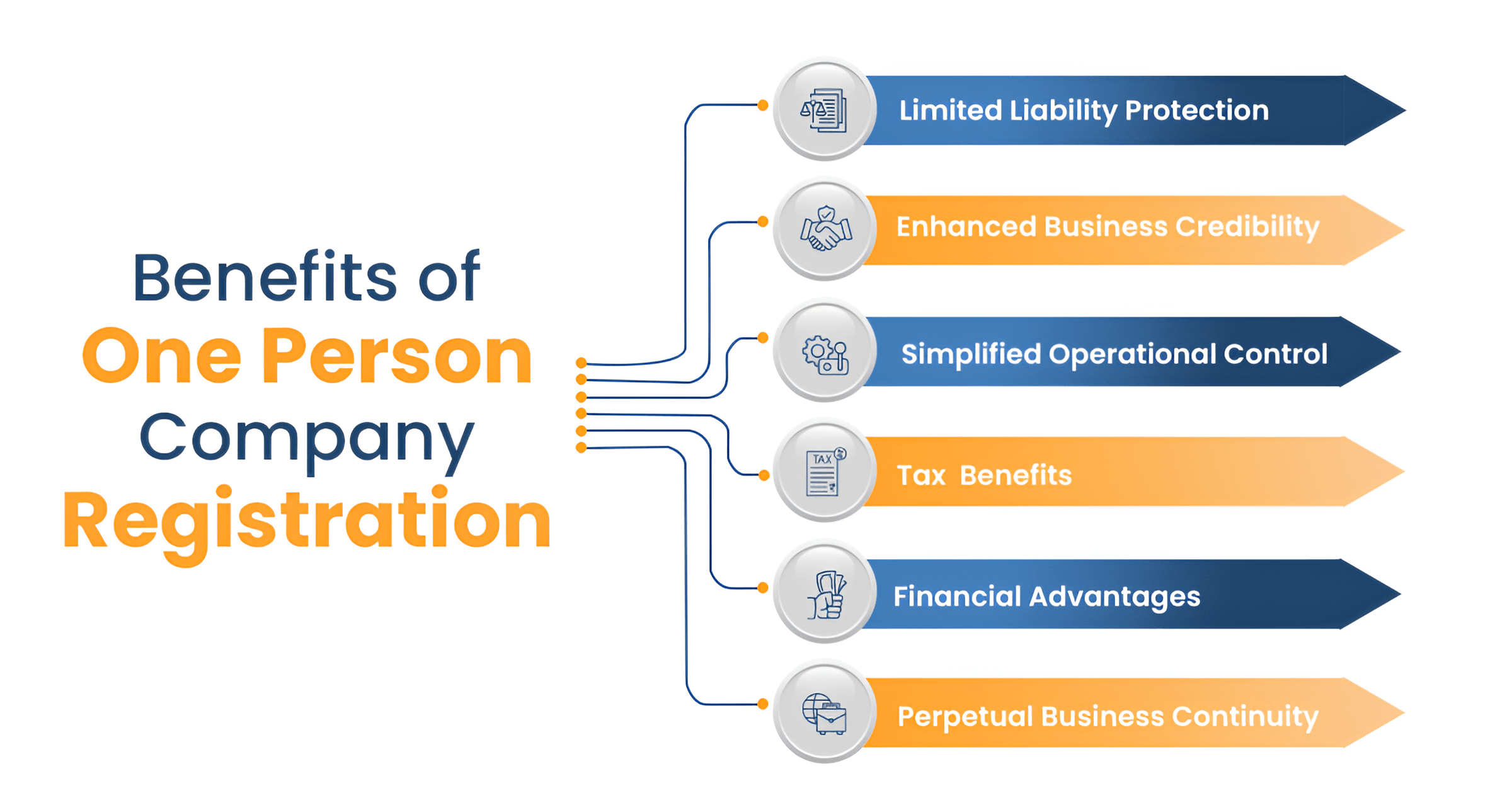
- Limited liability protection: Your personal assets are protected from business debts, and liability is limited to the amount you haven't paid for your shares.
- Single-owner control: One person holds 100% ownership and decision-making authority, with no co-founder dilution or partner disputes.
- Perpetual succession: The nominee automatically becomes a member on the death or incapacity of the OPC founder so that the company continues without dissolution.
- Lower compliance burden: An OPC does not hold an AGM (Section 96(1)) or prepare a cash flow statement (Section 2(40)). An OPC with a single director is also exempt from the board meeting rules under Section 173(5).
- Reduced penalties: Under Section 446B, an OPC pays up to half the prescribed penalty, capped at ₹2 lakh for the company and ₹1 lakh for an officer in default.
- Easier credit and corporate-grade trust: Banks, vendors, and enterprise clients onboard registered companies far more readily than non-registered entities like sole proprietorships.
- Tax structuring: An OPC is taxed at corporate tax rates and can claim deductions for eligible business expenses, such as director remuneration, depreciation, rent, and other operating costs. These tax benefits can reduce the overall liability compared to paying personal income tax rates on higher business profits.
- Easy future conversion: An OPC can convert into a Private Limited Company at any time through Form INC-6, once it has at least two members and two directors.
Limitations of an OPC
- No outside shareholders: An OPC cannot bring in an investor or co-founder without first converting into a Private Limited Company.
- One OPC per person: An individual can be a member of only one OPC and a nominee in only one OPC.
- Mandatory audit: Every OPC needs a statutory audit, whatever its turnover.
- Restricted activities: An OPC cannot carry out non-banking financial investment activities or convert into a Section 8 company.
- Higher running cost: Annual ROC filings, audit fees, and a separate company ITR cost more than running a sole proprietorship.
- Tax disadvantage at lower profits: Below roughly ₹52 lakh of annual profit, a sole proprietor usually pays less income tax.
Is an OPC the Right Structure?
| Situation | Better fit |
| A solo founder wants limited liability and a registered company for client contracts | One Person Company |
| The founder plans to raise angel or VC funding, or add co-founders soon | Private Limited Company |
| A small trader or freelancer wants the lowest cost and compliance | Sole Proprietorship |
| Two or more professionals want a partnership with limited liability | LLP |
| Annual profit is expected well above ₹50 lakh and will stay in the business | One Person Company |
How Is an OPC Taxed? OPC vs Sole Proprietorship Tax
An OPC is taxed as a domestic company, separately from its owner. It pays tax at 25% if its turnover in the relevant earlier year was up to ₹400 crore. It can instead opt for a concessional 22% rate under Section 200 of the Income-tax Act, 2025 (earlier Section 115BAA), plus a 10% surcharge and 4% cess. That makes an effective rate of 25.168%. The concessional rate requires giving up specified deductions and incentives. A sole proprietor pays tax at individual slab rates. Under the new regime, a ₹60,000 rebate makes income up to ₹12 lakh effectively tax-free. The top rate of 30% applies above ₹24 lakh.
The tax difference becomes more noticeable as business profits increase. The table below compares the tax at three levels of annual business profit:
| Annual business profit | Sole proprietor tax (new regime) | OPC tax (22% option) | Lower tax |
| ₹10 lakh | ₹0 | ₹2,51,680 | Sole proprietor |
| ₹50 lakh | ₹11,23,200 | ₹12,58,400 | Sole proprietor |
| ₹1 crore | ₹29,51,520 | ₹25,16,800 | OPC |
An OPC starts saving tax only when annual profit crosses roughly ₹52 to 53 lakh. Below that level, a sole proprietor usually pays less. Profit taken out of an OPC as dividend is taxed again at the owner's slab rate. A reasonable director salary, by contrast, is a deductible expense for the OPC. At lower profit levels, the case for an OPC rests on limited liability and credibility, not tax.
Figures assume new-regime slabs for tax year 2026-27, a 10% surcharge above ₹50 lakh with marginal relief, 4% cess, and profit retained in the OPC.
OPC Eligibility: Who Can Register a One Person Company?
A One Person Company is one of the simplest corporate structures for a solo founder. The Companies Act, 2013 and the Companies (Incorporation) Rules, 2014 set these conditions for one person company registration in India:
- Indian Citizen: Only a natural person who is an Indian citizen can incorporate an OPC or act as its nominee, whether resident in India or not. This follows Rule 3(1), as amended from 1 April 2021.
- Age Requirement: The applicant must be at least 18 years old.
- Resident director: At least one director must stay in India for 182 days or more during the financial year, under Section 149(3). An NRI sole director who does not meet this test needs a second, resident director.
- No minors: A minor cannot be a member or nominee of an OPC, or hold its shares with beneficial interest.
- One OPC Limit: An individual can be a member of only one OPC and a nominee in only one OPC at a time. A nominee who becomes a member of a second OPC must meet this limit within 180 days.
- Restricted Activities: An OPC cannot carry out non-banking financial investment activities, including investing in securities of other companies.
- Registered Office in India: The OPC must maintain a registered office address in India for official communication.
- No Minimum Capital: There is no minimum paid-up capital requirement, so an OPC can be started with any amount.
Note: Foreign nationals and OCI cardholders cannot incorporate an OPC or act as its nominee, because both roles require Indian citizenship. They can instead apply for foreign company registration, such as a wholly owned subsidiary. An NRI holding Indian citizenship can form an OPC following the 2021 amendment, subject to the 182-day resident director rule under Section 149(3).
Nominee in an OPC: Role, Change and Succession
An OPC has only one member, so the law mandates naming a nominee to ensure business continuity if the member dies or becomes unable to continue. The nominee is named in the Memorandum and gives consent through Form INC-3 during incorporation.
The nominee must meet the citizenship, age, and one-OPC conditions listed under OPC eligibility above.
The nominee's role changes depending on the circumstances:
- During the member's lifetime: The nominee has no ownership, control, or liability. They do not manage the company or receive its profits. They simply remain the designated successor.
- If the member dies: The nominee becomes the sole member of the OPC, allowing the business to continue under the existing corporate structure.
| Event | What happens | Deadline | MCA form |
| Incorporation | Nominee gives written consent | Filed with SPICe+ | INC-3 |
| Member changes the nominee | Member names a new nominee with consent | ROC intimation within 30 days | INC-4 |
| Nominee withdraws consent | Member names a new nominee | New nominee within 15 days; ROC intimation within 30 days | INC-4 |
| Member dies or becomes incapable of contracting | Nominee becomes sole member and names a new nominee | New nominee within 15 days; ROC intimation within 30 days | INC-4 |
Can an NRI Register a One Person Company in India?
Yes. Since 1 April 2021, a Non-Resident Indian (NRI) who holds Indian citizenship can incorporate an OPC and can also act as the nominee. The Companies (Incorporation) Second Amendment Rules, 2021 made this change. They replaced "and resident in India" with "whether resident in India or otherwise" in Rule 3(1). The same notification cut the definition of "resident in India" from 182 days to 120 days in the preceding financial year.
NRI OPC registration must still meet Section 149(3) of the Companies Act, 2013. Every company needs at least one director who stays in India for 182 days or more during the financial year. An NRI founder living abroad therefore appoints a second director who meets this test.
| Role | Resident Indian citizen | NRI (Indian citizen) | OCI cardholder or foreign national |
| Sole member | Allowed | Allowed | Not allowed |
| Nominee | Allowed | Allowed | Not allowed |
NRI applicants submit a passport as identity proof and an overseas address proof. Documents signed abroad need an apostille (Hague Convention countries) or attestation by the Indian embassy or consulate (other countries).
Documents Required for OPC Registration in India
Use this OPC registration checklist to gather the documents required for OPC registration in India:
| Category | Documents Required |
| Member / Director |
|
| Nominee |
|
| NRI Member / Director |
|
| Registered Office |
|
| Statutory (filed with SPICe+) |
|
Note: Keep all the documents required for OPC registration ready and self-attested before filing. Names, dates of birth, and addresses must match across PAN, Aadhaar, DSC, and the SPICe+ forms. Mismatched details or scans older than two months are the most common reasons applications get returned by the MCA.
OPC Registration Process: How to Register One Person Company Online in 6 Steps
OPC registration online runs through the SPICe+ (INC-32) form on the MCA V3 portal. The six steps below show how to register one person company online and complete OPC incorporation, from DSC to certificate.
Step 1. Apply for DSC
Apply for a Class 3 DSC for the proposed director to sign the incorporation forms electronically.
Step 2. Reserve the Company Name
Your OPC's name must clear the MCA's naming guidelines before it can be reserved. In short, the name must:
- End with the suffix "(OPC) Private Limited."
- Be unique, not identical or too similar to an existing company or LLP name.
- Not infringe a registered trademark, unless you hold a No Objection Certificate from the trademark owner.
- Avoid prohibited or restricted words (such as "National," "Bank," "Insurance," or "Stock Exchange") unless you have the required approval.
- Reflect your business activity, which improves the chances of approval.
You can propose up to two names through SPICe+ Part A, and an approved name stays reserved for 20 days. Checking availability using our free company name check tool before filing helps avoid a rejection and a repeat ₹1,000 fee.
Step 3. Draft MOA, AOA & SPICe+ Part B
Draft the required incorporation documents, including:
- Memorandum of Association (e-MOA, Form INC-33)
- Articles of Association (e-AOA, Form INC-34)
- Form INC-3 (nominee consent)
- Form INC-9 (director declaration)
Also prepare SPICe+ Part B, AGILE-PRO-S, and the integrated PAN and TAN applications.
Step 4. File SPICe+ on the MCA Portal
Submit the filled SPICe+ form through the MCA portal, which is processed by the Central Registration Centre (CRC).
If the proposed director does not already have a DIN, it is allotted through the SPICe+ application, so you do not need to file Form DIR-3 separately.
Along with the SPICe+ incorporation form, you can also file Form AGILE-PRO-S (INC-35) to:
- Apply for GST registration (optional) if your business requires a GSTIN.
- Open a company current bank account with the selected bank.
- Obtain Professional Tax registration, where applicable, in Maharashtra, Karnataka, and West Bengal.
- Complete EPFO and ESIC employer registrations, where applicable.
Note: GST registration becomes compulsory if your aggregate turnover exceeds ₹40 lakh for goods or ₹20 lakh for services (₹20 lakh and ₹10 lakh in special category states). GST registration is also required for an OPC if you engage in activities such as interstate taxable supplies, e-commerce, or other notified transactions.
Step 5. CRC Verification
The Central Registration Centre (CRC) reviews the application and may issue resubmission queries. If the CRC raises any such queries, submit the corrected documents or information promptly (usually within 15 days of the query) to avoid delays in incorporation.
Step 6. Certificate of Incorporation, PAN & TAN
On approval, the MCA issues the Certificate of Incorporation with a unique Corporate Identification Number (CIN). For an OPC, the CIN is a 21-character code made up of the listing status (U for unlisted), industry code, state code, year of incorporation, "OPC" as the company type, and the registration number. The company's PAN and TAN are issued together with the COI.
Note: Within 180 days of incorporation, the OPC files Form INC-20A, the declaration for commencement of business, to confirm receipt of the subscription money. Missing this deadline attracts a penalty of ₹50,000 on the company and ₹1,000 per day on each officer in default, up to ₹1 lakh. For an OPC, Section 446B reduces these amounts to one-half.
How Long Does One Person Company Registration Take?
From DSC to COI, one person company registration online takes 10–15 business days. Here's how that time is typically spread across each stage:
| Stage | Estimated Time |
| Class 3 DSC | Within 1 day |
| Name approval (SPICe+ Part A) | 1–3 business days |
| Document preparation (MOA, AOA, INC-3, INC-9) | 2–4 business days |
| Filing SPICe+ Part B with the CRC | 1 business day |
| CRC verification and MCA approval | 5–7 business days |
| Issue of Certificate of Incorporation, PAN & TAN | 1–2 business days |
| Total | 10–15 business days |
Note: Document preparation runs alongside name approval, so the two stages overlap. The timeline assumes accurate documents and no MCA resubmission queries. It may take longer to register an OPC if the proposed name is rejected, DSC verification is delayed, or the MCA requests corrections.
Common Reasons for OPC Resubmission
The CRC sends an application back for resubmission when documents or details do not line up. The most frequent causes are:
- Name conflict: The name is similar to an existing company, LLP, or trademark.
- Stale address proof: The utility bill is older than two months, or its address differs from the rent agreement.
- Missing owner NOC: Rented or family-owned premises have no signed no-objection certificate.
- Identity mismatch: The name or date of birth differs across PAN, Aadhaar, and DSC.
- Incomplete nominee papers: INC-3 is unsigned, or the nominee's proof is missing.
- Object clause mismatch: The main objects in the MOA do not match the selected NIC code.
How to Check OPC Registration Status
The OPC registration status can be tracked on the MCA V3 portal. Under MCA Services, select 'Track SRN/Transaction Status' and enter the SRN generated on filing SPICe+. The portal shows the application as under processing, pending for resubmission, approved, or rejected. A resubmission status means the CRC has raised a query, which must be answered within 15 days.
One Person Company Registration Fees and Total Cost
One person company registration fees depend on four components:
- Government filing fees,
- DSC charges,
- State-wise stamp duty, and
- Professional fees.
Here’s a detailed breakdown of the total cost of OPC registration in India:
| Fee component | Approximate amount | Notes |
| Government filing fees | ₹0 up to ₹15 lakh authorized capital; from ₹1,000+ above that | OPC registration government fees are waived under the MCA's zero-fee scheme |
| Name reservation (SPICe+ Part A) | ₹1,000 | Payable for each name application, including under the zero-fee scheme |
| DSC (Class 3) | ₹2,500 per DSC | One token for the proposed director |
| DIN allotment | Included in SPICe+ | Allotted free through SPICe+ at no additional cost |
| PAN and TAN | ₹155 in total (PAN ₹78 + TAN ₹77, including GST) | Issued along with the COI |
| State-wise stamp duty (MOA + AOA) | Varies by state and capital (From ₹135 to ₹15,020 for capital up to ₹1 lakh) | Varies sharply by state and authorized capital; check the exact figure on the company incorporation fees calculator |
| Professional / consultancy fees | ₹1,499 | Drafting, filing, MCA query handling, and post-incorporation kit |
| Typical total (cap up to ₹15 lakh) | From ₹5,800 | Bundled fixed pricing available with RegisterKaro |
Note: For NRI applicants, notarization, apostille, or consular attestation of overseas documents is an additional out-of-pocket expense and is not included in the professional fee.
Annual Cost of Running an OPC
An OPC carries recurring costs after incorporation. These cover the mandatory statutory audit, AOC-4 and MGT-7A filings with the ROC, the ITR-6 income tax return, DIR-3 KYC once every three years, and DSC renewal. RegisterKaro's OPC annual compliance package covers these filings from ₹25,000 per year.
Restrictions on OPC Activities
Although an OPC offers the benefits of a company, the Companies Act, 2013 imposes certain restrictions on its incorporation and operations:
- Non-banking financial activities, including investment in the securities of any body corporate, are not permitted.
- Persons disqualified under Section 164 of the Companies Act, 2013 cannot incorporate or manage an OPC.
- Conversion into a Section 8 (non-profit) company is not permitted.
Note: These restrictions are prescribed under the Companies Act, 2013, and cannot be modified through the MOA and AOA. If your business involves NBFC activities, charitable objectives, or multiple founders, consider registering a Private Limited Company, LLP, or Section 8 Company, as appropriate.
OPC Compliance After Registration: First 30 Days and Annual Filings
After incorporation, an OPC must complete a few immediate formalities, followed by ongoing annual compliance to stay in good standing.
Immediate Compliance After OPC Incorporation
- Open the current account and deposit the member's subscription money.
- Appoint the first auditor within 30 days of incorporation (Section 139(6)).
- Issue the share certificate to the member within two months of incorporation (Section 56(4)).
- Display the company name with "One Person Company" in brackets on the office board, letterheads, and invoices.
- Register for GST, Udyam, Professional Tax, FSSAI, IEC, or a trade license where the business activity requires it.
- Maintain statutory registers and books of accounts from the first day.
- File Form INC-20A within 180 days of incorporation.
Annual ROC and Tax Compliance for an OPC
| Form | Due date | Penalty |
| AOC-4 | Within 180 days of the financial year-end (27th September for a 31st March year-end) | ₹100 per day additional fee |
| MGT-7A | Within 60 days from the date the AGM would have been due (file by 29th November) | ₹100 per day additional fee |
| DIR-3 KYC | Once every three years, by 30th June after the third financial year (directors already compliant file next by 30th June 2028) | ₹5,000 late fee; DIN deactivated until filed |
| DPT-3 | 30th June each year where the OPC has outstanding loans or deposits (FY 2025-26 extended to 31st July 2026 by General Circular 02/2026) | ₹100 per day additional fee |
| ITR-6 | 31st October (audit cases) | Late fee under the Income-tax Act, 2025 (earlier Section 234F) plus interest |
Late filing of AOC-4 or MGT-7A attracts an additional fee of ₹100 per day per form, with no upper cap. Under Section 446B, penalties on an OPC are capped at half the prescribed amount: ₹2 lakh for the company and ₹1 lakh for an officer in default. Continued default can still lead to strike-off and director disqualification. The full filing calendar is covered in the OPC annual compliance guide.
An OPC also follows three rules specific to its structure:
- Board meetings: An OPC with a single director is exempt from holding board meetings. With two or more directors, it must hold at least one meeting in each half of the calendar year, with a gap of at least 90 days between meetings (Section 173(5)).
- Cash flow statement: An OPC may leave out the cash flow statement from its financial statements (Section 2(40)).
- Contracts with the sole member: An OPC may sign a contract, outside the ordinary course of business, with its sole member who is also its director. Unless the contract is in writing, its terms must appear in the memorandum or be recorded in the minutes of the next board meeting. The OPC must inform the ROC within 15 days of board approval (Section 193).
OPC vs Private Limited vs LLP vs Sole Proprietorship
The table below compares an OPC with the three structures founders most often consider.
| Parameter | OPC | Sole Proprietorship | Private Limited Company | LLP |
| Legal Status | Separate legal entity | No separate legal identity from the owner | Separate legal entity | Separate legal entity |
| Owners Required | 1 member + 1 nominee | 1 proprietor | Minimum 2 shareholders + 2 directors | Minimum 2 designated partners, at least one resident in India |
| Liability | Limited to unpaid share value | Unlimited personal liability | Limited to unpaid share value | Limited to agreed contribution |
| Compliance Burden | Moderate compliance (ROC filings + ITR; no AGM) | Lowest compliance (mainly tax filings) | Higher compliance (ROC filings, AGM, statutory records, ITR) | Moderate compliance (Form 8, Form 11 + ITR; no AGM or board meetings) |
| Taxation | 25% corporate rate; optionally 22% under Section 200 of the Income-tax Act, 2025 (earlier Section 115BAA), plus surcharge and cess | Taxed as individual income at applicable slab rates | 25% corporate rate; optionally 22% under Section 200 of the Income-tax Act, 2025 (earlier Section 115BAA), plus surcharge and cess | 30% flat rate, plus surcharge above ₹1 crore income and cess; no concessional rate option |
| Owner Remuneration | Director salary allowed as business expense | Not applicable | Director salary allowed as business expense | Partner remuneration allowed as business expense within Income-tax Act limits |
| External Funding | Cannot add shareholders or issue equity without converting to a Private Limited Company | Difficult to raise external funds | Suitable for angel funding, VC investment, and equity fundraising | Cannot issue equity shares; capital comes through partner contribution |
| Conversion to Private Limited Company | Voluntary conversion allowed by filing Form INC-6 | Requires fresh incorporation | Already operates as a private company | Allowed under Section 366 of the Companies Act, 2013 through Form URC-1 |
| Audit Requirement | Mandatory statutory audit every year | Required only if tax audit limits apply | Mandatory statutory audit every year | Required only if turnover exceeds ₹40 lakh or contribution exceeds ₹25 lakh |
| Nominee Requirement | Mandatory nominee appointment | Not required | Not required | Not required |
| Best Suited For | Solo founders seeking corporate status and limited liability | Small businesses, freelancers, and low-compliance setups | Startups and businesses planning growth, investment, and expansion | Two or more partners, professional firms, and service businesses seeking limited liability with lower compliance |
An OPC suits a single founder who wants company status. An LLP suits two or more founders who want limited liability with lower compliance than a company, through LLP registration.
What Changed for OPCs: 2021 to 2026
- 1 April 2021: NRIs with Indian citizenship allowed as members and nominees. The resident definition was cut from 182 to 120 days. The ₹50 lakh paid-up capital and ₹2 crore turnover limits were removed. The two-year wait before voluntary conversion ended.
- 31 March 2026: DIR-3 KYC moved from every year to once every three years.
- 1 April 2026: The Income-tax Act, 2025 came into force. The 22% company tax option is now Section 200.
Proposed (not yet in force): The draft Companies (Incorporation) Amendment Rules, 2026 propose merging Forms INC-4 and INC-6 into new forms.
Connect with RegisterKaro and let our experts handle the legal hassle while you grow your business.
MCA Registered One Person Companies in India
The MCA register holds 91,431 one person companies in India, of which 85,978 are currently active. Here is what the register looks like before you add yours to it.
Latest One Person Companies Incorporated in India
| Company | CIN | Incorporated | Type |
|---|---|---|---|
| SPORTSYU (OPC) PRIVATE LIMITEDManufacturing (Others) | U32300HR2026OPC146201 | 1 Jun 2026 | One Person Company |
| BRILLIANT PRODUCTS AND SYSTEMS (OPC) PRIVATE LIMITEDManufacturing (Machinery and Equipments) | U26101TS2026OPC217173 | 1 Jun 2026 | One Person Company |
| ALETHOS TECHNOLOGIES (OPC) PRIVATE LIMITEDBusiness Services | U62011PN2026OPC256321 | 1 Jun 2026 | One Person Company |
| BRIJHOMES INFRA (OPC) PRIVATE LIMITEDConstruction | U43300KL2026OPC103631 | 1 Jun 2026 | One Person Company |
| SCIENCERT (OPC) PRIVATE LIMITEDBusiness Services | U62011KL2026OPC103623 | 1 Jun 2026 | One Person Company |
| APKA STALLION AIRCRAFT MANUFACTURING (OPC) PRIVATE LIMITEDManufacturing (Machinery and Equipments) | U30305KA2026OPC221776 | 1 Jun 2026 | One Person Company |
| WAFILL (OPC) PRIVATE LIMITEDManufacturing (Food stuffs) | U11043TN2026OPC193837 | 1 Jun 2026 | One Person Company |
| VFAITH (OPC) PRIVATE LIMITEDBusiness Services | U62011TN2026OPC193830 | 1 Jun 2026 | One Person Company |
| BUILDMARTINFRA (OPC) PRIVATE LIMITEDConstruction | U41001MR2026OPC477190 | 1 Jun 2026 | One Person Company |
| PRACTITIONIST (OPC) PRIVATE LIMITEDBusiness Services | U62012HR2026OPC146217 | 1 Jun 2026 | One Person Company |
Frequently Asked Questions (FAQs)
Is there a minimum capital requirement to form an OPC?
No, the Companies Act, 2013, does not enforce a minimum capital requirement to initiate an OPC registration. Founders can launch their single-owner business structure with any nominal authorized share capital suited to their financial strategy, such as ₹10,000 or ₹1 lakh.
Is a nominee mandatory for an OPC?
Yes. Section 3(1) of the Companies Act, 2013 and Rule 4 of the Companies (Incorporation) Rules, 2014 require every OPC to name a nominee. The nominee must be an Indian citizen aged 18 or above and gives consent in Form INC-3. The nominee has no ownership or control while the member is alive. The nominee becomes the sole member only if the member dies or becomes incapable of contracting.
Who is eligible to incorporate an OPC in India?
Any natural person who is an Indian citizen and at least 18 years old can incorporate an OPC, whether resident in India or not. Minors, foreign nationals and OCI cardholders are not eligible. Each OPC also needs at least one director who stays in India for 182 days or more during the financial year.
Are there any turnover or capital caps for an OPC?
No, there are no statutory caps on annual turnover or paid-up share capital for an OPC. Effective April 1, 2021, the Ministry of Corporate Affairs (MCA) completely removed the previous ceilings of ₹50 lakh paid-up capital and ₹2 crore annual turnover, allowing single-owner corporate entities to grow without mandatory structural conversion triggers.
How to register one person company online in India?
The OPC registration process involves five integrated digital steps on the MCA V3 portal:
- Obtain a Class 3 DSC for the sole director and subscriber.
- Reserve a unique name through Part A of the SPICe+ form.
- Complete the integrated SPICe+ Part B e-form alongside the AGILE-PRO-S form (for GSTIN, EPFO, ESIC, and bank account setup).
- Draft and attach the electronic Memorandum of Association (e-MoA) and Articles of Association (e-AoA) along with the nominee's Form INC-3 consent.
- Upon verification, the Registrar of Companies (RoC) issues the fresh Certificate of Incorporation alongside corporate PAN and TAN.
Is an OPC exempt from holding an Annual General Meeting (AGM)?
Yes, an OPC is completely exempt from holding an Annual General Meeting (AGM) under Section 96(1) of the Companies Act, 2013. Any corporate resolution or ordinary decision required to be passed at an AGM is considered legally executed once it is signed by the sole member and formally entered into the official minutes book of the corporate entity.
Can an OPC be converted into a Private Limited corporate structure later?
Yes. Since 1 April 2021, an OPC can convert into a Private Limited Company at any time, with no waiting period or turnover trigger. The OPC first increases its members and directors to at least two each. It then alters its MOA and AOA by special resolution, files the resolution in Form MGT-14 and files Form INC-6 with the ROC.
Does an OPC registration require a physical office address?
Yes. Every OPC needs a registered office in India to receive notices from the Ministry of Corporate Affairs, and a residential address can be used. Proof includes a utility bill not older than two months. Where the premises are rented or owned by someone else, a rent agreement and a no-objection certificate from the owner are also required.
How many OPCs can one person form?
One. An individual can be a member of only one OPC and a nominee in only one other OPC at a time. If a nominee becomes the member of a second OPC after the original member's death, that person has 180 days to give up membership of one OPC.
How long does online OPC registration take in India?
OPC incorporation typically takes 10 to 15 business days. That timeline covers getting your Class 3 Digital Signature Certificate (DSC) on Day 1, reserving your name through SPICe+ Part A within 2–4 days, drafting the MOA and AOA, and receiving Central Registration Centre (CRC) approval with your Certificate of Incorporation by around Day 13–15.
Can OPC registration online be completed without visiting the ROC?
Yes. OPC registration online runs fully on the MCA V3 portal. The director signs the SPICe+ forms, the INC-3 nominee consent, and the MOA and AOA with a DSC, and the Certificate of Incorporation arrives by email.
Are OPCs required to hold board meetings?
An OPC with only one director is completely exempt from holding board meetings. However, if an OPC appoints two or more directors, it must hold at least one board meeting in each half of a calendar year, ensuring that the gap between the two meetings is not less than 90 days.
Can a salaried employee register an OPC in India?
Yes. The Companies Act, 2013 does not stop a salaried employee from incorporating an OPC or acting as its director. The main check is the employment contract, since many employers restrict outside business interests or directorships. Salary and OPC income are taxed separately, the salary in the employee's hands and business profit in the OPC's.
What happens if the OPC nominee withdraws consent?
The member must name a new nominee within 15 days of receiving the withdrawal notice, along with the new nominee's written consent. The OPC then files Form INC-4 with the ROC within 30 days to record the change. Until the change is filed, the OPC stays out of compliance with Rule 4.
Can an OPC have more than one director?
Yes. An OPC needs at least one director and can appoint up to 15 under Section 149(1), or more by special resolution. The sole member is usually the first director. An OPC with two or more directors must hold at least one board meeting in each half of the calendar year, at least 90 days apart.
Is an audit mandatory for an OPC with low turnover?
Yes. Every OPC must appoint a statutory auditor and file audited financial statements, whatever its turnover or profit. The first auditor is appointed within 30 days of incorporation, and Form ADT-1 records the five-year appointment. A tax audit under the Income-tax Act applies separately once turnover crosses the prescribed limit.
Can a sole proprietorship be converted into an OPC?
No direct conversion route exists under the Companies Act, 2013. The proprietor incorporates a new OPC and transfers the business assets, liabilities and contracts to it through a business transfer agreement. GST registration, bank accounts and licences are then moved into the OPC's name.
Is GST registration mandatory for an OPC?
Not always. An OPC needs GST registration once aggregate turnover crosses ₹40 lakh for goods or ₹20 lakh for services, with lower limits in some special category states. Registration is compulsory regardless of turnover in certain cases, such as inter-state supply of goods and most sales of goods through e-commerce operators.
How can I check my OPC registration status online?
Log in to the MCA V3 portal and open "Track SRN/Transaction Status" under MCA Services. Enter the SRN from your SPICe+ filing. The portal shows whether the application is being processed, pending resubmission, approved, or rejected.
Is OPC registration free on the MCA portal?
No. MCA waives the incorporation filing fee when authorized capital is up to ₹15 lakh. You still pay for DSC, state stamp duty on MOA and AOA, PAN and TAN charges, and professional fees for OPC registration.
Can a foreign national be a nominee in an OPC?
No. Rule 3(1) allows only a natural person who is an Indian citizen to be a nominee. The citizen can be resident in India or an NRI. Foreign nationals, OCI cardholders, companies, and minors cannot act as nominees.
Can one person be a nominee in more than one OPC?
No. Rule 3(3) of the Companies (Incorporation) Rules, 2014 bars any person from being a nominee in more than one OPC. The same rule bars a person from incorporating more than one OPC.
Does an OPC need to prepare a cash flow statement?
No. Section 2(40) of the Companies Act, 2013 lets an OPC leave out the cash flow statement from its financial statements. The OPC still prepares a balance sheet, profit and loss account, and notes to accounts.
What is the liability of the member in an OPC?
The member's liability is limited to the unpaid amount on shares held. Creditors cannot recover company debts from the member's personal assets, except in cases of fraud or personal guarantees.
How do I close a one person company?
An OPC can close through strike off by filing Form STK-2 with the ROC. Before filing, it must clear all liabilities, close the bank account, and file pending annual returns and financial statements.

Reviewed by
Joel DsouzaJoel Dsouza is a Chartered Accountant (CA) and compliance expert with over 7 years of hands-on experience in company registration, tax structuring, GST, ROC filings, and MCA compliance. As a qualified member of the Institute of Chartered Accountants of India (ICAI) and Co-Founder at RegisterKaro, he has personally advised more than 1,000 startups and SMEs across India, helping founders navigate incorporation, regulatory frameworks, and financial planning from Day 1. With deep expertise across all three levels of Finance and Portfolio Management, Joel is committed to promoting financial literacy and simplifying India's startup ecosystem through clear, actionable guidance that entrepreneurs can act on immediately.
Why Choose RegisterKaro for One Person Company Registration?
The right incorporation partner reduces filing errors, speeds up approvals, and simplifies OPC company registration online. RegisterKaro does just that by providing professional support from documentation to post-incorporation compliance.
- Dedicated Compliance Expert: One expert handles your application, keeps you updated, and helps resolve filing queries.
- Pre-Filing Document Review: We verify your documents before SPICe+ submission to reduce errors and resubmissions.
- MCA Query Support: If the CRC raises a query, we prepare and submit the required response promptly.
- State-Specific Guidance: We help you meet applicable stamp duty, documentation, and incorporation requirements for your state.
- Post-Incorporation Support: Get guidance on opening your current account, GST registration, and ongoing OPC compliance.

What Our Clients Say
View All
Bhushan Kumar
 Verified
We have had a very good experience with RegisterKaro when availing their services for registering our OPC company. A big shout out specially to Mitush... Read more

Rajiv Kumar
VerifiedAshwin done very good job, I am really appreciated that we are in that situation that lots of mca portal issues but he worked hard and completed comme... Read more

Garikepati Rammohano...
VerifiedOPC company registration was very quick all work completed within 5 days I strongly recommended Mr Hitan Verma the guy behind to complete the process.

Ayush Chand
VerifiedHie had a fantastic experience with Registerkaro me and my friend incorporated our OPC private limited within a month Thanks Manish Bisht and Register... Read more

dileep kaibadi
VerifiedI had a great experience with RegisterKaro for my OPC registration. The entire process was smooth and well-managed from start to finish. A special tha... Read more

Alok Jha
Verified"Excellent service by Registration karo for ROC compliances. The team is very supportive special vibha and his platform is very easy to use. They’re... Read more

Dhanashree Verma
VerifiedI had a great experience with RegisterKaro. A special thanks to Devashish for his exceptional support, professionalism, and dedication throughout the... Read more

ganesh patil
VerifiedI'm glad to write that RegisterKaro provided helpful services for the registration of Prakriya International Private Limited. Special thanks to Himans... Read more

Rahul Menaria
VerifiedGreat team ! Everything handled smoothly. All of our procedures were completed by Ankita matta ,Shivansh and Naveen sharam who did a great job of keep... Read more

Subir Kumar Choudhur...
VerifiedThe company 'REGISTER KARO' is an excellent service provider. The difficult job of incorporating a new entity who have zero knowledge is done with SMI... Read more
One Person Company Across India
Related Blogs
View All
Procedure for Conversion of Private Company into OPC (2026 Guide)
How to Get a Digital Signature Certificate (DSC) in India

What are the Documents Required for OPC Incorporation in India? 2026 Guide
OPC Registration Fees in India 2026: Govt Charges & Total Cost

Top 10 One Person Companies in India: 2026 List

OPC vs LLP – Key Differences, Which Business Structure Should You Choose? (2026)

Difference Between OPC and Sole Proprietorship in India

What is the Difference Between an OPC and a Private Limited Company?

How the OPC Turnover Limit Impacts Small Business Growth?

Form INC-3: Purpose, Application, and Importance for OPC