One Person Company Registration Online in India
Complete your one person company registration online from ₹1,499. RegisterKaro's CA-led OPC registration delivers the Certificate of Incorporation, PAN, TAN, and DIN in one SPICe+ filing, typically within 10 to 15 business days.
 100% Online Registration with Digital DocumentationCustomized MOA and AOA Prepared for the BusinessCompany Name Approval & Documentation IncludedCA-Led Filing with Dedicated Expert SupportNRIs with Indian Citizenship Can Register an OPC

 What Sets Us ApartWhat Sets Us Apart
Select the Best OPC Registration Plan Built for Solo Founders
Basic
Standard
Premium
Overview of a One Person Company (OPC)
An OPC, which stands for One Person Company, is a type of Private Limited Company with a single member. Introduced in April 2014 and defined under Section 2(62) of the Companies Act, 2013, OPC allows a solo entrepreneur to run a business as a separate legal entity while retaining full ownership and the benefit of limited liability. Any Indian citizen, including a Non-Resident Indian (NRI), can incorporate a One Person Company without a minimum capital requirement.
Features of a One Person Company
The OPC makes company registration possible for a single individual who needs the legal standing of a company without bringing in additional shareholders or directors. Before 2014, a solo entrepreneur could only operate as a sole proprietor. An OPC has these features:
- Single member: One natural person who is an Indian citizen holds 100% of the shares.
- Separate legal entity: The company has its own legal identity, distinct from its owner, and can own property, sign contracts, and sue in its own name.
- Limited liability: The member’s liability is limited to any unpaid amount on their shares, so personal assets stay protected from business debts.
- Mandatory nominee: The member names a nominee, who becomes the member if the owner dies or becomes incapable of contracting.
- Perpetual succession: Due to the nominee, the company continues beyond its founder instead of closing.
- Directors: An OPC needs at least 1 director and can appoint up to 15, and the sole member can also be the sole director.
- No minimum capital: The company can start with any amount of capital.
- Distinct name: The name ends with “(OPC) Private Limited”. Under Section 12(3), “One Person Company” must appear in brackets below the name on letterheads, invoices, and the name board.
- Flexible growth: An OPC can convert into a Private Limited Company at any time when it needs investors or more shareholders.
These features make One Person Company registration in India a practical choice for freelancers, consultants, and solo founders.
Privileges of One Person Companies
Beyond its structure, the Companies Act, 2013 gives an OPC several compliance relaxations that other companies don’t get:
- No AGM: An OPC does not have to hold an annual general meeting (Section 96(1)).
- Resolutions without meetings: The member passes resolutions by entering them in the minutes book and signing them (Section 122(3)). A single director does the same for board decisions (Section 122(4)).
- Fewer board meetings: An OPC needs only one board meeting in each half of the calendar year, instead of four a year. A single-director OPC is fully exempt (Section 173(5)).
- No cash flow statement: Its financial statements need not include a cash flow statement (Section 2(40)).
- One signature on key filings: A single director can sign the financial statements and the annual return (Sections 134(1) and 92(1)).
- Simpler annual return: An OPC files the abridged Form MGT-7A instead of MGT-7.
- No auditor rotation: The mandatory rotation of auditors under Section 139(2) does not apply to an OPC.
- Lower penalties: Under Section 446B, penalties for most defaults are capped at half the prescribed amount.
OPC Eligibility: Who Can Register a One Person Company?
The Companies Act, 2013 and Rule 3 of the Companies (Incorporation) Rules, 2014 set the following requirements for One Person Company registration in India:
- Indian Citizen: Only a natural person who is an Indian citizen can incorporate an OPC or act as its nominee. Both resident and non-resident Indian citizens (NRIs) are eligible under Rule 3(1), as amended with effect from April 1, 2021.
- Age Requirement: A minor under 18 years of age cannot be a member or nominee of an OPC, or hold its shares with beneficial interest (Rule 3(4)).
- Mandatory Nominee: The sole member must name a nominee, who gives written consent in Form INC-3.
- Directors: An OPC must have at least 1 director and can appoint up to 15 under Section 149(1). It can appoint more than 15 by passing a special resolution.
- Resident director: At least one director must stay in India for 182 days or more during the financial year, under Section 149(3). The applicable number of days is proportionate to the period for which the business operates during its first financial year.
- One OPC Limit: An individual can be a member of only one OPC and a nominee in only one OPC at a time (Rule 3(2)). If a person becomes a member of another OPC through nomination, they must meet this requirement within 180 days.
- No Capital or Turnover Limits: There is no minimum paid-up capital requirement for an OPC.
- Registered Office in India: The OPC must maintain a registered office address in India for official communication.
Documents Required for One Person Company (OPC) Registration in India
The following checklist covers the OPC company registration documents needed to file SPICe+:
| Category | Documents Required |
| Member / Director |
|
| Nominee |
|
| NRI Member / Director |
|
| Registered Office |
|
| Statutory (filed with SPICe+) |
|
Note: Before filing, check that the name, date of birth, and address are identical across all the documents required for OPC registration. Even minor discrepancies or expired proofs can lead the MCA to request resubmission.
OPC Registration Process: How to Register a One Person Company Online
The One Person Company registration process runs online through the SPICe+ (INC-32) form on the MCA V3 portal. This is the standard procedure to incorporate an OPC.
Here’s how to register a One Person Company via the MCA V3 portal:
Step 1. Apply for DSC
Apply for a Class 3 DSC for the proposed director to sign the incorporation forms electronically.
Step 2. Reserve the Business Name
Your OPC's name must clear the MCA's naming guidelines before it can be reserved. In short, the name must:
- End with the suffix "(OPC) Private Limited."
- Be unique, not identical or too similar to an existing company or LLP name.
- Not infringe a registered trademark, unless you hold a No Objection Certificate from the trademark owner.
- Avoid prohibited or restricted words (such as "National," "Bank," "Insurance," or "Stock Exchange") unless you have the required approval.
- Reflect your business activity, which improves the chances of approval.
You can propose up to two names through SPICe+ Part A, and an approved name stays reserved for 20 days. The MCA charges a ₹1,000 name reservation fee for each Part A application, under the Companies (Registration Offices and Fees) Rules, 2014. This fee applies even when the incorporation filing fee is waived. If both names are rejected after the one allowed resubmission, a fresh application and another ₹1,000 fee are needed. Checking availability with our free company name check tool before filing helps avoid this.
Step 3. Draft MOA, AOA & SPICe+ Part B
Draft the required incorporation documents, including:
- Memorandum of Association (e-MOA, Form INC-33)
- Articles of Association (e-AOA, Form INC-34)
- Form INC-3 (nominee consent)
- Form INC-9 (declaration by subscriber and first director)
- Form DIR-2 (consent to act as director)
After that, complete SPICe+ Part B, AGILE-PRO-S, and the integrated PAN and TAN applications.
Step 4. File SPICe+ on the MCA Portal
Submit the filled SPICe+ form through the MCA portal for processing. The application is handled by the Central Registration Centre (CRC), established under MCA Notification G.S.R. 99(E) and S.O. 218(E), dated January 22, 2016, under the Companies (Incorporation) Amendment Rules, 2016.
Along with this form, also file Form AGILE-PRO-S (INC-35) to:
- Apply for GST registration (optional) if your business requires a GSTIN.
- Open a current business bank account with the selected bank.
- Obtain Professional Tax registration, where applicable, in Maharashtra, Karnataka, and West Bengal.
- Obtain Shops and Establishment registration, where applicable, for companies with a registered office in Delhi. OPCs in other states must apply separately through the relevant state labor department after incorporation.
- Complete EPFO and ESIC registration numbers; contributions apply once employee thresholds are met.
Note: GST registration becomes compulsory if your aggregate turnover exceeds ₹40 lakh for goods or ₹20 lakh for services (₹20 lakh and ₹10 lakh in special category states). GST registration is also required for an OPC if you engage in activities such as interstate taxable supplies, e-commerce, or other notified transactions.
Step 5. CRC Verification
The CRC reviews the application and may issue resubmission queries. If it raises any such queries, submit the corrected documents or information promptly (within 15 days of the query) to avoid delays in incorporation.
Step 6. Certificate of Incorporation, PAN & TAN
On approval, the MCA issues the Certificate of Incorporation with a unique 21-character Corporate Identification Number (CIN), along with the entity’s PAN and TAN. For an OPC, the CIN contains “OPC” as the business type code.
Note: Within 180 days of incorporation, file Form INC-20A, the declaration for commencement of business, to confirm receipt of the subscription money. Missing this deadline attracts a penalty of ₹50,000 on the company and ₹1,000 per day on each officer in default, up to ₹1 lakh. For an OPC, Section 446B reduces these amounts to one-half.
How Long Does One Person Company Registration Online Take?
Starting from getting a DSC to issuing the COI, the online registration process of One Person Company registration takes 10–15 business days. Here's how that time is typically spread across each stage:
| Stage | Estimated Time |
| Class 3 DSC | Within 1 day |
| Name approval (SPICe+ Part A) | 1–3 business days |
| Document preparation (MOA, AOA, INC-3, INC-9) | 2–4 business days |
| Filing SPICe+ Part B with the CRC | 1 business day |
| CRC verification and MCA approval | 5–7 business days |
| Issue of Certificate of Incorporation, PAN & TAN | 1–2 business days |
| Total | 10–15 business days |
Note: Prepare the incorporation documents while the name approval is in progress to save time. Rejection of the proposed name, delays in DSC verification, or resubmission queries from the CRC can extend the overall timeline.
What Changed for OPCs in 2021?
The 2021 amendment to the Companies (Incorporation) Rules made the OPC easier to start and to grow out of. These changes apply from April 1, 2021:
| Rule | Before April 2021 | From April 2021 |
| Who can form an OPC | Only resident Indian citizens | Any Indian citizen, including NRIs |
| Residency test for directors (Section 149(3)) | At least one director in India for 182 days or more during the financial year | Unchanged: at least one director in India for 182 days or more during the financial year |
| Residency test for members and nominees (Rule 3) | 182 days or more in India in the preceding calendar year | 120 days or more in India in the preceding financial year (not required for NRIs) |
| Capital and turnover limits | Mandatory conversion above ₹50 lakh paid-up capital or ₹2 crore turnover | No limits |
| Voluntary conversion | Only after two years from incorporation | Any time |
As a result, an NRI can now own an Indian business, and a growing OPC can also convert to a Private Limited Company whenever it needs investors or co-founders. With these wider options, India had 97,706 OPCs on record as of May 31, 2026.
Note: G.S.R. 880(E), dated December 1, 2025, raised the small-company thresholds under the Companies Act, 2013, to ₹10 crore in paid-up capital and ₹100 crore in turnover, effective December 1, 2025. Eligible OPCs that meet these limits may benefit from reduced compliance requirements.
OPC Registration Fees and Government Charges
The total cost of One Person Company registration includes government charges, the DSC, state stamp duty, and professional fees.
Here's how the OPC registration fees break down across different components:
| Fee component | Approximate amount | Notes |
| Government filing fees | ₹0 up to ₹15 lakh authorized capital;
From ₹1,000+ above that | OPC registration government fees are waived under the MCA's zero-fee scheme |
| Name reservation (SPICe+ Part A) | ₹1,000 | Payable for each name application, including under the zero-fee scheme |
| DSC (Class 3) | ₹2,500 per DSC | One token for the proposed director |
| DIN allotment | Included in SPICe+ | Allotted free through SPICe+ at no additional cost |
| PAN and TAN | ₹155 in total (PAN ₹78 + TAN ₹77, including GST) | Issued along with the COI |
| State-wise stamp duty (MOA + AOA) | Varies by state and capital | Varies sharply by state and authorized capital; check the exact figure on the company incorporation fees calculator |
| Professional / consultancy fees | ₹1,499 | Drafting, filing, MCA query handling, and post-incorporation kit |
| Typical total (authorized capital up to ₹15 lakh) | Over ₹5,000 | Bundled fixed pricing available with RegisterKaro |
Note: The total cost of OPC registration in India depends mainly on the authorized capital, the state of registration, and the number of directors. NRI applicants should also budget for notarization, apostille, or consular attestation of overseas documents, as these costs are not included in the professional fee.
Nominee in an OPC: Role, Change and Succession
An OPC must name a nominee in its Memorandum of Association during registration of an OPC. The nominee must meet the same citizenship, age, and other OPC requirements as the sole member. The nominee has no ownership or control while the member is alive and capable of contracting for the One Person Company. If the member dies or becomes incapable of contracting, the nominee takes their place and becomes the sole member, allowing the business to continue operating.
The transition of the OPC’s owner has to be reported to relevant authorities. The required form and filing deadline for the same depend on the event, as outlined below:
| Event | What Happens | Deadline | MCA Form |
| Incorporation | The nominee gives written consent to the nomination. | Submit with the SPICe+ incorporation application. | INC-3 |
| Member changes the nominee | The member appoints a new nominee who provides consent. | Notify the RoC within 30 days of the change. | INC-4 |
| Nominee withdraws consent | The member must appoint a replacement nominee. | Appoint a new nominee within 15 days of receiving the withdrawal notice and notify the RoC within 30 days of the change. | INC-4 |
| Member dies or becomes incapable of contracting | The nominee becomes the sole member and must nominate another person. | The new member must nominate someone within 15 days and notify the RoC within 30 days of the change. | INC-4 |
For eligibility, the change process, and succession rules in detail, read the guide on OPC nominee rules.
Can an NRI Register a One Person Company in India?
Since April 1, 2021, an NRI who holds Indian citizenship can register an OPC and act as its nominee. Eligibility for each role depends on citizenship status:
| Role | Resident Indian Citizen | NRI (Indian Citizen) | OCI Cardholder or Foreign National |
| Sole member | Allowed | Allowed | Not allowed |
| Nominee | Allowed | Allowed | Not allowed |
NRI applicants submit their PAN, passport, and proof of overseas address as part of the OPC incorporation application. Documents signed abroad must be apostilled in countries that are parties to the Hague Apostille Convention or attested by the Indian embassy or consulate, as applicable.
Note: OCI cardholders and foreign nationals cannot register an OPC in their own names. They may explore other business structures in India, such as a wholly owned subsidiary, through foreign company registration.
Compliance After Incorporating a One Person Company (OPC)
After OPC formation, founders must complete key formalities within the prescribed deadlines and meet its annual ROC and tax filing requirements.
Immediate Compliance After OPC Incorporation
Complete these formalities within the applicable deadlines after forming an OPC:
- Open a bank account: Deposit the member’s subscription money into the business’s account.
- Appoint the first auditor: Appoint an auditor within 30 days of incorporation under Section 139(6).
- Issue the share certificate: Issue the member’s share certificate within two months under Section 56(4).
- Display the business name: Include “One Person Company” in brackets below the entity name on its office signboard, letterheads, and invoices.
- Obtain applicable registrations: Register for GST, Udyam, Professional Tax, or other licenses required for the business.
- File Form INC-20A: Submit the commencement of business declaration within 180 days of incorporation, where applicable.
Annual Compliance for an OPC
Meet these recurring ROC and tax deadlines every year after OPC registration with the MCA in India:
- AOC-4: File financial statements within 180 days of the financial year-end, generally by September 27.
- MGT-7A: File the annual return within 60 days from the end of the prescribed AGM period, generally by November 29.
- ITR-6: File the income tax return by October 31 following the tax year (extended to November 21 for AY 2026-27).
- DPT-3: File by June 30 if the OPC has reportable outstanding loans, deposits, or other covered receipts.
Other Periodic Compliance for an OPC
Beyond annual filings, an OPC must also meet compliance requirements at six-monthly or multi-year intervals and when specific events occur, including:
- DIR-3 KYC: Directors must complete KYC by June 30 once every three years.
- ADT-1: File Form ADT-1 within 15 days of appointing the auditor for a five-year term under Section 139(1).
- MSME-1: File a half-yearly return by April 30 (for October to March) and October 31 (for April to September), if the OPC owes payments to micro or small enterprise suppliers for more than 45 days.
- Board meetings: An OPC with more than one director must hold at least one meeting in each half of the calendar year, with a gap of at least 90 days. An OPC with only one director is exempt.
Late AOC-4 and MGT-7A filings generally attract an additional fee of ₹100 per day per form, with no upper cap. For filing deadlines and penalties, read the OPC annual compliance guide.
How is an OPC Taxed? OPC vs Sole Proprietorship Tax
An OPC pays corporate tax at 25% (turnover up to ₹400 crore), or 22% under Section 200 of the Income Tax Act, 2025 (formerly Section 115BAA), for an effective rate of 25.168%. In contrast, a sole proprietor pays personal slab rates of up to 30%. Here’s how the tax compares at three profit levels:
| Annual Profit | Sole Proprietor | OPC (No Salary) | OPC (With Director Salary) |
| ₹10 lakh | ₹0 | ₹2,51,680 | ₹0 |
| ₹50 lakh | ₹11,23,200 | ₹12,58,400 | ₹9,37,508 |
| ₹1 crore | ₹29,51,520 | ₹25,16,800 | ₹21,95,908 |
A director’s salary lowers the OPC’s taxable profit, but the overall saving depends on how the owner withdraws the rest. Read our guide to OPC tax benefits for more details.
Note: Figures assume AY 2026-27, the new personal tax regime, the 22% OPC tax rate, and a director’s salary of ₹12.75 lakh, reduced to ₹10 lakh for the ₹10 lakh profit example.
Common Reasons for OPC Resubmission
The CRC sends the OPC application back for resubmission when documents or details do not line up. Common reasons are:
- Name conflict: The name is similar to an existing firm, LLP, or trademark.
- Missing owner NOC: Rented or family-owned premises have no signed no-objection certificate.
- Identity mismatch: The name or date of birth differs across PAN, Aadhaar, and DSC.
- Incomplete nominee papers: INC-3 is unsigned, or the nominee's proof is missing.
- Object clause mismatch: The main objects in the MOA do not match the selected NIC code.
- Utility bill in the wrong name: The bill must be in the owner’s name. A common rejection is a bill in a tenant’s or relative’s name that doesn’t match the NOC.
- Ineligible nominee: The nominee is already a member or nominee of another OPC, is a minor, or isn’t an Indian citizen.
- DSC errors: The DSC has expired, belongs to someone other than the signatory, or doesn’t match the PAN details.
- Capital mismatch: The subscribed capital in the e-MOA is more than the authorized capital, or the figures differ across SPICe+ forms.
How to Check OPC Registration Status?
Here's how to track the status of OPC registration online on the MCA V3 portal:
- Go to MCA Services and select Track SRN/Transaction Status.
- Enter the SRN generated when SPICe+ was filed.
- Check the status shown: under processing, pending for resubmission, approved, or rejected.
If the status shows pending for resubmission, respond to the CRC’s query within 15 days.
Benefits and Limitations of One Person Company Registration
One Person Company Registration Online gives solo founders these benefits:
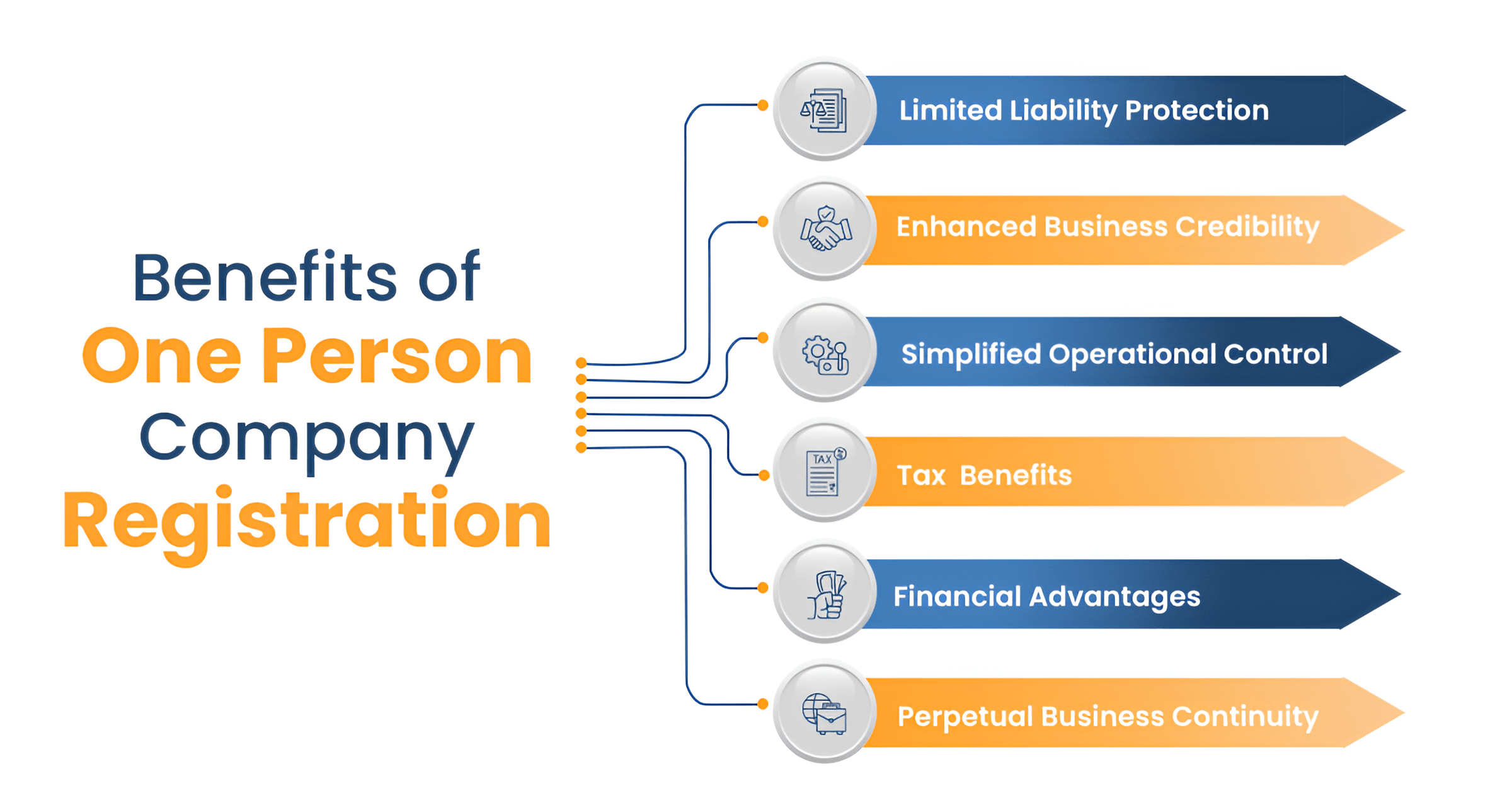
- Limited liability protection: Your personal assets are protected from business debts, and liability is limited to the amount you haven't paid for your shares.
- Single-owner control: One person holds 100% ownership and decision-making authority, with no co-founder dilution or partner disputes.
- Perpetual succession: The nominee automatically becomes a member on the death or incapacity of the OPC founder so that the business continues without dissolution.
- Lower compliance burden: An OPC does not hold an AGM (Section 96(1)) or prepare a cash flow statement (Section 2(40)). An OPC with a single director is also exempt from the board meeting rules under Section 173(5).
- Reduced penalties: Under Section 446B, an OPC pays up to half the prescribed penalty, capped at ₹2 lakh for the business and ₹1 lakh for an officer in default.
- Easier credit and corporate-grade trust: As a registered entity, an OPC has a verifiable CIN and public MCA records. This makes bank onboarding, vendor registration, and enterprise contracts easier than for an unregistered business.
- Tax structuring: An OPC is taxed at corporate tax rates and can claim deductions for eligible business expenses, such as director remuneration, depreciation, rent, and other operating costs. These tax benefits can reduce the overall liability compared to paying personal income tax rates on higher business profits.
- Easy future conversion: An OPC can convert into a Private Limited Company at any time through Form INC-6 and MGT-14, once it has at least two members and two directors.
OPC Limitations and Restrictions
The Companies Act, 2013 places restrictions on an OPC that the MOA and AOA cannot override. These, along with its practical limitations, include:
- No outside shareholders: An OPC cannot bring in an investor or co-founder without first converting into a Private Limited Company.
- Restricted activities: An OPC cannot carry out non-banking financial investment activities, including investing in the securities of any body corporate.
- No Section 8 conversion: An OPC cannot convert into a Section 8 (non-profit) company.
- Disqualified directors: A person disqualified under Section 164 cannot act as a director of an OPC.
- Mandatory audit: Every OPC needs a statutory audit, whatever its turnover.
- Higher running cost: Annual ROC filings, audit fees, and a separate business ITR cost more than running a sole proprietorship.
- Tax disadvantage at lower profits: At lower profit levels, a sole proprietor often pays less income tax, especially when the OPC pays its owner little or no salary.
OPC vs Private Limited vs LLP vs Sole Proprietorship
An OPC gives a single founder limited liability and business status without a partner. The table below compares it with the three structures founders most often consider:
| Parameter | OPC | Private Limited Company | LLP | Sole Proprietorship |
| Governing Law | Companies Act, 2013 | Companies Act, 2013 | LLP Act, 2008 | No separate law |
| Legal Status | Separate legal entity | Separate legal entity | Separate legal entity | No separate identity from the owner |
| Owners Required | 1 member + 1 nominee | 2–200 shareholders, minimum 2 directors | Minimum 2 designated partners, at least one resident in India | 1 proprietor |
| Liability | Limited to unpaid share value | Limited to unpaid share value | Limited to agreed contribution | Unlimited personal liability |
| Compliance Burden | Moderate (ROC filings + ITR; no AGM) | Higher (ROC filings, AGM, board meetings, statutory records, ITR) | Lower (Form 8, Form 11 + ITR; no AGM or board meetings) | Lowest (mainly tax filings) |
| Taxation | 22% under Section 200 of the Income-tax Act, 2025 (formerly 115BAA), or 25% for turnover up to ₹400 crore, plus surcharge and cess | Same as OPC | 30%, plus 12% surcharge above ₹1 crore of income and cess; no concessional option | Personal slab rates of up to 30% |
| Owner Remuneration | Director salary deductible as a business expense | Director salary deductible as a business expense | Remuneration to working partners deductible within Income-tax Act limits | Drawings not deductible |
| External Funding | No outside shareholders or equity without converting to a Private Limited Company | Suitable for angel, VC and equity funding | No equity shares; capital through partner contribution | Limited to the owner’s funds and loans |
| Foreign Ownership | Indian citizens only, including NRIs | FDI allowed under the automatic route in most sectors | FDI allowed in sectors with 100% automatic-route FDI | Not available to foreign nationals |
| Conversion to Private Limited | Voluntary conversion through MGT-14 and Form INC-6 | Already a private company | Allowed under Section 366 of the Companies Act, 2013 through Form URC-1 | Fresh incorporation and transfer of the business |
| Audit Requirement | Mandatory statutory audit every year | Mandatory statutory audit every year | Required only if turnover exceeds ₹40 lakh or contribution exceeds ₹25 lakh | Tax audit only above Income-tax Act limits |
| Nominee Requirement | Mandatory | Not required | Not required | Not required |
| Best Suited For | Solo founders who need a registered business for client contracts and plan to keep profits in the business | Startups planning angel or VC funding, or adding co-founders soon | Two or more professionals forming a firm through LLP registration | Small traders and freelancers |
Connect with RegisterKaro and let our experts handle the legal hassle while you grow your business.
MCA Registered One Person Companies in India
The MCA register holds 91,431 one person companies in India, of which 85,978 are currently active. Here is what the register looks like before you add yours to it.
Latest One Person Companies Incorporated in India
| Company | CIN | Incorporated | Type |
|---|---|---|---|
| SPORTSYU (OPC) PRIVATE LIMITEDManufacturing (Others) | U32300HR2026OPC146201 | 1 Jun 2026 | One Person Company |
| BRILLIANT PRODUCTS AND SYSTEMS (OPC) PRIVATE LIMITEDManufacturing (Machinery and Equipments) | U26101TS2026OPC217173 | 1 Jun 2026 | One Person Company |
| ALETHOS TECHNOLOGIES (OPC) PRIVATE LIMITEDBusiness Services | U62011PN2026OPC256321 | 1 Jun 2026 | One Person Company |
| BRIJHOMES INFRA (OPC) PRIVATE LIMITEDConstruction | U43300KL2026OPC103631 | 1 Jun 2026 | One Person Company |
| SCIENCERT (OPC) PRIVATE LIMITEDBusiness Services | U62011KL2026OPC103623 | 1 Jun 2026 | One Person Company |
| APKA STALLION AIRCRAFT MANUFACTURING (OPC) PRIVATE LIMITEDManufacturing (Machinery and Equipments) | U30305KA2026OPC221776 | 1 Jun 2026 | One Person Company |
| WAFILL (OPC) PRIVATE LIMITEDManufacturing (Food stuffs) | U11043TN2026OPC193837 | 1 Jun 2026 | One Person Company |
| VFAITH (OPC) PRIVATE LIMITEDBusiness Services | U62011TN2026OPC193830 | 1 Jun 2026 | One Person Company |
| BUILDMARTINFRA (OPC) PRIVATE LIMITEDConstruction | U41001MR2026OPC477190 | 1 Jun 2026 | One Person Company |
| PRACTITIONIST (OPC) PRIVATE LIMITEDBusiness Services | U62012HR2026OPC146217 | 1 Jun 2026 | One Person Company |
Frequently Asked Questions (FAQs)
Is there a minimum capital requirement to form an OPC?
No, the Companies Act, 2013, does not prescribe a minimum capital requirement for a One Person Company (OPC). A founder can choose an appropriate capital amount based on the business's needs. Companies with authorized capital of up to ₹15 lakh are also eligible for the applicable MCA filing fee exemption, although other incorporation costs may apply.
Is a nominee mandatory for an OPC?
Yes, every OPC must nominate a person in its Memorandum of Association at incorporation. The nominee must be an adult Indian citizen and provide written consent in Form INC-3. If the sole member dies or becomes incapable of entering into a contract, the nominee becomes the member.
Who is eligible to incorporate an OPC in India?
An adult Indian citizen, whether resident in India or living abroad as an NRI, can incorporate an OPC. Foreign nationals, OCI cardholders, minors, and corporate entities cannot become its members. An individual can also be a member of only one OPC at a time.
Are there any turnover or capital limits for an OPC?
No, an OPC has no prescribed turnover or paid-up capital limits that require mandatory conversion into another business structure. The earlier thresholds of ₹50 lakh in paid-up capital and ₹2 crore in turnover were removed effective April 1, 2021. An OPC can therefore continue operating as an OPC as its business grows.
How do I register a One Person Company online in India?
You can complete OPC registration online through the MCA V3 portal by following these steps:
- Obtain a Digital Signature Certificate (DSC) for the proposed director.
- Reserve the business name through SPICe+ Part A.
- Prepare the e-MOA, e-AOA, INC-3, and INC-9, as applicable.
- File SPICe+ Part B with the required AGILE-PRO-S application and supporting documents.
- Receive the Certificate of Incorporation and the entity’s PAN and TAN after approval.
Is an OPC exempt from holding an Annual General Meeting (AGM)?
Yes, Section 96(1) of the Companies Act, 2013, exempts an OPC from holding an AGM. Instead, the sole member records the resolutions passed in the minutes book and signs and dates the entries as required by law.
Can an OPC be converted into a Private Limited Company later?
Yes, an OPC can voluntarily convert into a Private Limited Company at any time, without a minimum waiting period. The business must meet the minimum membership and directorship requirements, pass the necessary resolution, and file the applicable forms, including MGT-14 and INC-6, where required.
Does OPC registration require a physical office address?
Yes, every OPC must have a registered office in India. The address can be residential or commercial, provided the entity can submit the required address proof. Common documents include a recent utility bill and, for rented premises, a rent agreement and the owner's No Objection Certificate (NOC).
How many OPCs can one person form?
An individual can be a member of only one OPC at a time and can also act as a nominee in only one OPC at a time. Under Rule 3(3) of the Companies (Incorporation) Rules, 2014, a nominee who becomes a member of another OPC must comply with the prescribed 180-day period to resolve the overlapping membership.
How long does online OPC registration take in India?
OPC registration generally takes around 10 to 15 business days, from preparing the application and obtaining the DSC to receiving the Certificate of Incorporation. The timeline depends on document readiness, name approval, and MCA processing. Resubmission requests or name objections can cause delays.
Can OPC registration be completed without visiting the ROC?
Yes, OPC registration can be completed online through the MCA V3 portal, so a physical visit to the Registrar of Companies (RoC) is generally unnecessary. The required forms are digitally signed, and the Certificate of Incorporation is issued electronically after approval.
Are OPCs required to hold board meetings?
An OPC with only one director is not required to hold board meetings. If it has more than one director, it must follow the applicable provisions of Section 173(5) of the Companies Act, 2013, including holding at least one board meeting in each half of the calendar year and maintaining the prescribed gap between meetings.
Can a salaried employee register an OPC in India?
Yes, a salaried employee can generally incorporate an OPC, as the Companies Act, 2013, does not impose a blanket restriction on employees doing so. However, the employee should review their employment contract and workplace policies for restrictions on outside business activities. Salary and OPC income are taxed according to the applicable tax rules.
What happens if the OPC nominee withdraws consent?
If the nominee withdraws consent, the sole member must appoint a replacement nominee within 15 days of receiving the notice. The OPC must then notify the RoC of the change in Form INC-4 within the prescribed period, generally 30 days.
Can an OPC have more than one director?
Yes, an OPC can have up to 15 directors under Section 149(1) of the Companies Act, 2013. It can appoint more than 15 directors by passing a special resolution. However, it must continue to have only one member, and appointing additional directors does not give them ownership in the company.
Is an audit mandatory for an OPC with low turnover?
Yes, every OPC must undergo an annual statutory audit, regardless of its turnover. Under Section 139(6) of the Companies Act, 2013, the board must appoint the first auditor within 30 days of registration. If the board fails to do so, the members must appoint the auditor within the prescribed period.
Can a sole proprietorship be converted into an OPC?
There is no direct statutory conversion process for changing a sole proprietorship into an OPC. Instead, the owner must incorporate a new OPC and transfer the proprietorship's relevant assets, liabilities, and contracts to the business through the appropriate legal and business transfer arrangements.
Is GST registration mandatory for an OPC?
No, GST registration is not mandatory for every OPC. It generally becomes compulsory when aggregate turnover exceeds the applicable threshold, commonly ₹40 lakh for eligible suppliers of goods and ₹20 lakh for services, subject to state-specific rules and exceptions. Certain businesses, including some interstate suppliers and e-commerce operators or sellers, may need to register regardless of turnover, depending on the applicable provisions.
How can I check my OPC registration status online?
You can check the application status through the MCA V3 portal by using the SRN generated when you filed SPICe+. Open the relevant application tracking option under MCA services and enter the SRN to view the status, such as processing, resubmission, approval, or rejection.
Is OPC registration free on the MCA portal?
No, OPC registration is not entirely free. Companies with authorized capital of up to ₹15 lakh are generally eligible for an exemption from the applicable MCA incorporation filing fees. However, costs such as state stamp duty, DSC charges, name reservation fees where applicable, and other service or professional fees may still apply.
Can a foreign national be a nominee in an OPC?
No, a foreign national cannot act as the nominee of an OPC. The nominee must be an Indian citizen. An NRI who retains Indian citizenship can serve as a nominee, subject to the applicable requirements.
Can one person be a nominee in more than one OPC?
No, under Rule 3(3) of the Companies (Incorporation) Rules, 2014, an individual can act as a nominee in only one OPC at a time. The rule also limits an individual to membership in one OPC at a time.
Does an OPC need to prepare a cash flow statement?
No, an OPC is exempt from including a cash flow statement in its financial statements under Section 2(40) of the Companies Act, 2013. However, it must still prepare the other required financial statements, including a balance sheet, a statement of profit and loss, and notes to accounts, as applicable.
What is the liability of the member in an OPC?
A member's liability is generally limited to the amount unpaid on the shares they hold. The member's personal assets are therefore generally protected from the OPC’s debts. However, this protection may not apply in cases involving fraud or where the member has separately provided a personal guarantee.
How do I close a One Person Company?
An OPC can apply to the RoC for removal of its name from the register by filing Form STK-2, subject to the applicable eligibility conditions and fee. Before applying, the business must settle its liabilities, complete the required pending filings, and close its bank account where applicable. It must also submit the prescribed declarations and supporting documents.

Reviewed by
Joel DsouzaJoel Dsouza is a Chartered Accountant (CA) and compliance expert with over 7 years of hands-on experience in company registration, tax structuring, GST, ROC filings, and MCA compliance. As a qualified member of the Institute of Chartered Accountants of India (ICAI) and Co-Founder at RegisterKaro, he has personally advised more than 1,000 startups and SMEs across India, helping founders navigate incorporation, regulatory frameworks, and financial planning from Day 1. With deep expertise across all three levels of Finance and Portfolio Management, Joel is committed to promoting financial literacy and simplifying India's startup ecosystem through clear, actionable guidance that entrepreneurs can act on immediately.
Why Choose RegisterKaro for OPC Registration?
RegisterKaro manages One Person Company Registration Online end to end, from document preparation to incorporation, so solo founders get registered while they focus on building their businesses.
- Transparent pricing: OPC registration starts at ₹1,499, with government fees and state stamp duty explained upfront.
- End-to-end registration: We handle Digital Signature Certificates (DSCs), name approval, MOA and AOA drafting, SPICe+ filing, PAN, TAN, and bank account application through AGILE-PRO-S.
- Support for NRI founders: Our team guides NRIs with Indian citizenship through document apostille or consular attestation requirements and the process of appointing a resident director.
- Post-registration compliance: We help track and manage applicable filings, including INC-20A, AOC-4, MGT-7A, ITR-6, and DIR-3 KYC, and support conversion into a Private Limited Company when the business needs additional shareholders.
- Dedicated support: Each client gets a single point of contact for progress updates, document verification, and questions throughout the registration process.

What Our Clients Say
View All
Bhushan Kumar
 Verified
We have had a very good experience with RegisterKaro when availing their services for registering our OPC company. A big shout out specially to Mitush... Read more

Rajiv Kumar
VerifiedAshwin done very good job, I am really appreciated that we are in that situation that lots of mca portal issues but he worked hard and completed comme... Read more

Garikepati Rammohano...
VerifiedOPC company registration was very quick all work completed within 5 days I strongly recommended Mr Hitan Verma the guy behind to complete the process.

Ayush Chand
VerifiedHie had a fantastic experience with Registerkaro me and my friend incorporated our OPC private limited within a month Thanks Manish Bisht and Register... Read more

dileep kaibadi
VerifiedI had a great experience with RegisterKaro for my OPC registration. The entire process was smooth and well-managed from start to finish. A special tha... Read more

Alok Jha
Verified"Excellent service by Registration karo for ROC compliances. The team is very supportive special vibha and his platform is very easy to use. They’re... Read more

Dhanashree Verma
VerifiedI had a great experience with RegisterKaro. A special thanks to Devashish for his exceptional support, professionalism, and dedication throughout the... Read more

ganesh patil
VerifiedI'm glad to write that RegisterKaro provided helpful services for the registration of Prakriya International Private Limited. Special thanks to Himans... Read more

Rahul Menaria
VerifiedGreat team ! Everything handled smoothly. All of our procedures were completed by Ankita matta ,Shivansh and Naveen sharam who did a great job of keep... Read more

Subir Kumar Choudhur...
VerifiedThe company 'REGISTER KARO' is an excellent service provider. The difficult job of incorporating a new entity who have zero knowledge is done with SMI... Read more
One Person Company Across India
Related Blogs
View All
Annual Compliance for One Person Company (OPC): Guide

What are the Documents Required for OPC Incorporation in India? 2026 Guide
OPC Registration Fees in India 2026: Govt Charges & Total Cost

How the OPC Turnover Limit Impacts Small Business Growth?

OPC vs LLP – Key Differences, Which Business Structure Should You Choose? (2026)

One Person Company Funding: How Can an OPC Raise Funds in India?
One Person Company (OPC) Tax Benefits in India 2026

Top 10 One Person Companies in India: 2026 List

Procedure for Conversion of Private Company into OPC (2026 Guide)
How to Get a Digital Signature Certificate (DSC) in India