
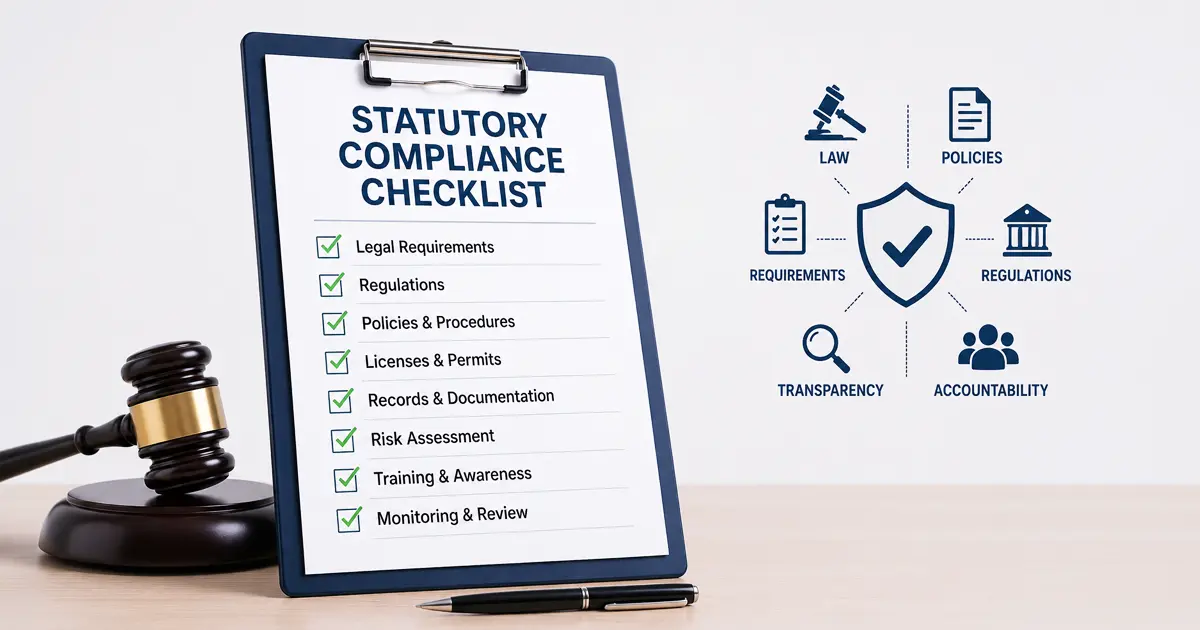
Statutory compliance for Indian businesses means following every legal obligation under Central and State laws, including ROC filings under the Companies Act, 2013 (AOC-4, MGT-7, ADT-1, DIR-3 KYC, DPT-3, MSME-1), GST returns under the CGST Act, 2017 (GSTR-1, GSTR-3B, GSTR-9), TDS compliance under the Income Tax Act, 1961, EPF contributions under the EPF & MP Act, 1952, ESIC contributions under the ESI Act, 1948, and labour law obligations across 30+ Central and State statutes.
Government authorities now monitor compliance through digital platforms, GSTN (for GST), MCA21 / MCA V3 portal (for ROC filings), EPFO Unified Portal (for PF), ESIC portal (for ESIC), and TRACES (for TDS), with automated cross-matching, AI-flagged anomalies, and tighter enforcement. The cost of missing a single deadline is no longer just the late fee; it includes interest at 12-24% per annum, director disqualification under Section 164(2), ITC reversal, e-way bill blocking under Rule 138E, and in serious cases, prosecution.
This statutory compliance checklist for FY 2026-27 covers every recurring obligation Indian businesses must track, corporate (ROC), tax (GST, TDS, income tax), employee (EPF, ESIC, professional tax, gratuity, bonus, POSH), and industry-specific filings, with form names, statutory anchors, due dates, and penalty amounts. The guide is structured for business owners, HR teams, accounts and finance staff, and compliance officers managing legal obligations for private limited companies, LLPs, OPCs, MSMEs, and startups.
Key Takeaways
- 2026-27 update: The four Labour Codes (Wages, Industrial Relations, Social Security, OSH&WC) are progressively being notified, and Central and State rules under each Code take effect in phases.
- Statutory compliance covers ROC, GST, TDS, income tax, EPF, ESIC, professional tax, and 30+ labour law obligations; the specific obligations depend on entity type, employee count, turnover, and state of operation.
- Monthly cycle: TDS deposit by 7th; PF and ESIC contributions by 15th; GSTR-1 by 11th; GSTR-3B by 20th; ECR with EPFO by 15th.
- Annual deadlines (FY 2025-26): GSTR-9/9C by 31 December 2026; AOC-4 within 30 days of AGM; MGT-7 within 60 days of AGM; DIR-3 KYC by 30 September 2026; DPT-3 by 30 June 2026.
- Section 16(4) ITC cut-off: Last date to claim ITC for FY 2025-26 is 30 November 2026; missed ITC permanently lapses.
- EPF threshold: 20+ employees (once registered, compliance continues regardless of headcount). ESIC threshold: 10+ employees earning up to ₹21,000/month (₹25,000 for employees with disabilities).
- Penalty severity: ROC late fees compound at ₹100 per day per form (no upper cap); EPF damages range from 5-25% under Section 14B; non-deduction of TDS attracts interest + penalty equal to the TDS amount under Section 271C.
What is Statutory Compliance?
Statutory compliance refers to fulfilling all legal obligations applicable to businesses under Indian tax, labor, corporate, and regulatory laws. It includes GST filings, ROC returns, PF deposits, payroll deductions, and regulatory reporting requirements.
In practice, statutory compliance in India includes filing tax returns, depositing EPF contributions, and maintaining labor law registers. Companies also hold board meetings and submit ROC returns under the Companies Act, 2013.
Who Needs Statutory Compliance in India?
The specific obligations depend on the type of entity, the number of employees, the industry sector, and the turnover of the business. The following types of entities must maintain statutory compliance in India:
- Private Limited Companies and One Person Companies (OPC) under the Companies Act, 2013.
- Limited Liability Partnerships (LLP) under the LLP Act, 2008.
- Sole proprietorships and partnership firms are subject to applicable tax and labor laws.
- Startups registered under DPIIT, with specific FEMA compliance and ESOP compliance needs.
- MSMEs and e-commerce businesses with GST and labor law obligations.
- All employers with staff, regardless of entity type, for PF, ESIC, and payroll compliance.
In short, every business entity registered in India must follow some form of statutory compliance requirements regularly.
Types of Statutory Compliance in India
Businesses follow multiple statutory compliance categories to meet operational, tax, labor, and regulatory obligations across India:
1. Corporate Compliance
Corporate compliance covers obligations under the Companies Act, 2013, and the LLP Act, 2008. Businesses:
- File annual financial statements through Form AOC-4 and annual returns through Form MGT-7/MGT-7A.
- Complete DIR-3 KYC for directors annually.
- Conduct at least four board meetings each financial year, while OPCs conduct a minimum of two board meetings.
- Appoint statutory auditors through Form ADT-1.
- Maintain statutory registers and complete event-based ROC filings within prescribed timelines.
2. Tax Compliance
Tax compliance includes obligations under the Income Tax Act, 1961, and GST laws. Businesses:
- File GST returns such as GSTR-9, GSTR-1 and GSTR-3B.
- Deduct and deposit TDS within statutory due dates.
- File quarterly TDS returns and annual income tax returns.
- Pay advance tax installments during the financial year.
- Reconcile GST data regularly through GSTN systems to avoid notices and ITC mismatches.
3. Statutory Compliance in HR and Labor Laws
HR and labor law compliance covers employee-related obligations under Central and State laws. Employers:
- Register under the applicable Shops and Establishments Acts.
- Follow minimum wage, gratuity, bonus, maternity benefit, and POSH regulations.
- Maintain wage, attendance, leave, and statutory registers.
- Comply with EPF, ESIC, and contract labor requirements where applicable.
- Prepare for the implementation of the new Labour Codes covering wages, industrial relations, occupational safety, and social security.
4. Statutory Compliance in Payroll
Payroll compliance focuses on employee deductions and statutory contributions. Employers:
- Deposit EPF, ESIC, professional tax, and TDS on salary within due dates.
- File monthly ECR returns with EPFO.
- Issue salary slips and maintain payroll records for audits and inspections.
5. Industry-Specific Statutory Compliance
| Sector | Key Compliance Requirements | Regulatory Authority |
|---|---|---|
| Food & beverage | FSSAI Registration (Basic / State / Central) based on turnover; FSSAI annual returns by 31 May | FSSAI |
| Pharma & cosmetics | Drugs & Cosmetics Act, 1940 licensing; manufacturing licence; bioequivalence reporting | CDSCO; State Drug Controllers |
| Import-export | IEC from DGFT; export documentation; AD Code registration with Customs | DGFT; Customs |
| Foreign investment | FEMA compliance; FC-GPR (inbound FDI); APR for outbound ODI; FLA Return by 15 July | RBI |
| Listed companies | SEBI LODR Regulations, 2015 (quarterly results, BRSR, corporate governance reports) | SEBI |
| NBFCs | RBI registration; periodic NBFC returns; KYC/AML compliance | RBI |
| Payment aggregators | RBI PA-PG Licence; Nodal account compliance; merchant onboarding KYC | RBI |
| Manufacturing | Factories Act, 1948 registration; pollution clearances (CPCB/SPCB); BIS standards, where applicable | State Factories Inspectorate; CPCB |
| Construction | RERA registration (project-wise); BOCW Cess; labour licences | State RERA; State Labour Departments |
| Insurance & broking | IRDAI Licence; annual returns to IRDAI; KYC norms | IRDAI |
| E-commerce | GST registration regardless of turnover; TCS under Section 52 of the CGST Act; Legal Metrology compliance | GSTN; State Legal Metrology Departments |
Complete Statutory Compliance Checklist for Indian Businesses for FY 2026-27
The sections below present a structured company statutory compliance checklist covering all major areas of legal compliance applicable in India. This list applies to private limited companies, LLPs, OPCs, and similar business entities:
ROC Compliance Checklist for Companies
The following ROC filings form the core of the statutory compliance checklist for registered companies under the Companies Act, 2013:
| Form | Purpose | Due Date | Penalty / Late Fee |
| ADT-1 | Auditor appointment | Within 15 days of AGM | Penalty under Sec 139/140: Company ₹25,000; Officers ₹5,000 |
| AOC-4 | Filing financial statements | Within 30 days of AGM | ₹100 per day with no upper cap under the Companies (Registration Offices and Fees) Rules, 2014, read with Section 403 (post-2018 amendment) |
| MGT-7 / MGT-7A | Annual return filing | Within 60 days of AGM | ₹100 per day with no upper cap under the same Rules |
| DIR-3 KYC | Director of KYC verification | 30 September every year | Flat ₹5,000 late fee |
| DPT-3 | Return of deposits and loans | 30 June every year | ₹5,000 penalty + ₹500 per day |
| MSME-1 | Outstanding MSME dues reporting | 30 April and 31 October | Penalty under Sec 405: ₹25,000 for the company and officers |
| MBP-1 | Director interest disclosure | First Board Meeting of FY | Penalty under Sec 184: up to ₹1,00,000 on the director |
| DIR-8 | Non-disqualification declaration | First Board Meeting of FY | Penalty under Sec 164/165 and possible disqualification |
LLP Statutory Compliance Checklist for FY 2026-27
Limited Liability Partnerships follow a different ROC framework than companies under the Companies Act, 2013. LLPs are governed by the LLP Act, 2008 and the LLP Rules, 2009. The annual filings are simpler but no less mandatory:
| Form | Purpose | Due Date | Penalty for Late Filing |
|---|---|---|---|
| Form 11 | Annual Return of LLP | 30 May every year (covering the previous FY) | ₹100 per day with no upper cap |
| Form 8 | Statement of Account and Solvency | 30 October every year (covering the previous FY) | ₹100 per day with no upper cap |
| Form 3 | LLP Agreement filing | Within 30 days of incorporation or amendment | ₹100 per day with no upper cap |
| Form 4 | Change in partners or designated partners | Within 30 days of the change | ₹100 per day with no upper cap |
| DIR-3 KYC | Designated partner KYC | 30 September every year | Flat ₹5,000 late fee |
| Income Tax Return (ITR-5) | Annual tax return | 31 July (or 31 October if audit applicable) | Section 234F penalty up to ₹5,000 |
| GST Returns | If GST-registered | As per the GST calendar | Same as companies |
| EPF & ESIC | If applicable based on employee count | Same as companies | Same as companies |
Statutory audit threshold for LLPs: Mandatory only if turnover exceeds ₹40 lakh OR partners’ capital contribution exceeds ₹25 lakh. LLPs below these thresholds are exempt from tax audit under Section 44AB of the Income Tax Act unless other conditions apply.
GST Compliance Checklist
GST statutory compliance applies to every business with an annual turnover above ₹40 lakh for goods (₹20 lakh for service providers and businesses in special category states). The following table lists key GST filings:
| GST Return | Purpose | Due Date | Late Fee |
| GSTR-1 | Outward supply details | 11th of the following month (monthly) | ₹50 per day (₹20 for nil) |
| GSTR-3B | Summary return with tax payment | 20th of the following month | ₹50 per day (₹20 for nil return), subject to a maximum of ₹10,000 per return |
| GSTR-9 | Annual return | 31 December of the following FY | ₹200 per day, max 0.25% of turnover |
| GSTR-9C | Reconciliation statement (if applicable) | 31 December of the following FY | Same as GSTR-9 |
| LUT Filing | Export without payment of GST | Before the start of FY or the first export | Loss of zero-rating benefit |
| E-invoicing | B2B invoice reporting to IRP | Mandatory for businesses with aggregate annual turnover above ₹5 crore | Penalty up to ₹25,000 per invoice |
TDS Compliance Checklist
TDS compliance forms a critical part of the legal statutory compliance checklist for all businesses that make specified payments above threshold amounts. The key obligations include:
- Deduct TDS at applicable rates on all qualifying payments, such as salary, rent, professional fees, and contractor payments.
- Deposit TDS with the government by the 7th of the following month (by 30 April for March deductions).
- File quarterly TDS returns through Form 24Q for salary TDS and Form 26Q for non-salary TDS.
- Issue Form 16 (salary) and Form 16A (non-salary) to deductees within the prescribed deadlines.
- Reconcile TDS credits in Form 26AS and AIS with the books of accounts before filing returns.
PF Compliance Checklist
Employees’ Provident Fund (EPF) compliance applies to all establishments with 20 or more employees. Once an establishment registers, PF compliance continues even if headcount falls below 20. The key obligations are:
- Register the establishment on the EPFO portal and obtain the PF registration number.
- Deduct 12% of the basic salary and dearness allowance from each eligible employee’s salary.
- Contribute an equal 12% from the employer, of which 8.33% goes to EPS and 3.67% to EPF.
- Deposit the total PF contribution by the 15th of each following month.
- File the Electronic Challan cum Return (ECR) and deposit PF contributions on the EPFO portal by the 15th of the following month.
- Submit annual PF return and maintain Form 12A and other statutory registers.
ESIC Compliance Checklist
ESIC (Employees’ State Insurance Corporation) compliance applies to establishments with 10 or more employees where at least some employees earn up to ₹21,000 per month (₹25,000 for employees with disabilities). Obligations include:
- Register the establishment and all eligible employees on the ESIC portal.
- Deduct 0.75% of gross wages from each eligible employee as the employee’s ESIC contribution.
- Contribute 3.25% of gross wages as the employer’s ESIC contribution.
- Deposit the combined ESIC contribution by the 15th of each following month.
- File the half-yearly return covering April to September by 12 November and October to March by 12 May.
Professional Tax Compliance Checklist
Professional tax is a state-level levy applicable in states such as Maharashtra, Karnataka, West Bengal, Tamil Nadu, Andhra Pradesh, etc. Employers in applicable states must deduct professional tax from employees’ salaries and deposit it with the state authority. The rates and filing due dates vary by state, and businesses operating in multiple states must comply separately in each state.
Labor Law Compliance Checklist
The labor laws statutory compliance checklist covers the following major laws that apply to Indian employers:
- Minimum Wages Act, 1948: Pay wages equal to or above the minimum wage notified for the applicable category and state.
- Payment of Bonus Act, 1965: Pay an annual bonus at a minimum of 8.33% of salary to eligible employees earning up to ₹21,000 per month.
- Payment of Gratuity Act, 1972: Pay gratuity to employees who complete 5 or more years of continuous service at the time of separation.
- Maternity Benefit Act, 1961: Provides 26 weeks of paid maternity leave to eligible female employees in establishments with 10 or more employees.
- POSH Act, 2013: Constitutes an Internal Complaints Committee (ICC) in every establishment with 10 or more employees to address sexual harassment complaints.
- Contract Labor (Regulation and Abolition) Act, 1970: Obtain principal employer registration and ensure contract workers receive all statutory benefits.
HR Statutory Compliance Checklist for Indian Employers (FY 2026-27)
HR statutory compliance combines payroll, employee benefits, workplace safety, and statutory deductions into a single integrated calendar. Below is the consolidated HR compliance checklist for FY 2026-27:
Monthly HR Compliance
| Compliance | Statutory Anchor | Due Date | Trigger |
|---|---|---|---|
| EPF Contribution Deposit | EPF & MP Act, 1952 | 15th of the following month | 20+ employees |
| EPF ECR Filing | EPF & MP Act | 15th of the following month | All registered establishments |
| ESIC Contribution Deposit | ESI Act, 1948 | 15th of the following month | 10+ employees earning ≤ ₹21,000 |
| Salary TDS Deposit | Section 192, Income Tax Act | 7th of the following month | All employers with TDS liability |
| Professional Tax Deposit | State PT Acts | Varies by state (typically monthly) | Employers in PT-applicable states |
| Salary Disbursement | Payment of Wages Act, 1936 | Within 7th of next month (for ≤1,000 employees); within 10th (for >1,000) | All employers |
| Maintenance of Payroll Register | Multiple Acts | Ongoing | All employers |
Quarterly HR Compliance
| Compliance | Form | Due Date |
|---|---|---|
| Salary TDS Return | Form 24Q | Within 31 days of quarter-end |
| Issue of Salary TDS Certificate | Form 16 (Part A) | Within 15 days of Form 24Q filing |
| Maternity Benefits Reporting | State-specific | As prescribed |
Half-Yearly HR Compliance
| Compliance | Form / Return | Due Date |
|---|---|---|
| ESIC Half-Yearly Return | Return of Contribution | 12 November (Apr–Sep) and 12 May (Oct–Mar) |
Annual HR Compliance
| Compliance | Statutory Anchor | Due Date |
|---|---|---|
| Form 16 issuance to employees | Section 203, Income Tax Act | By 15 June every year |
| Bonus Payment | Payment of Bonus Act, 1965 | Within 8 months of FY-end (i.e., 30 November) |
| Annual Return — Bonus | Form D under PBA | 1 February of next year |
| Annual Return under Shops & Establishments Act | State-specific | Varies by state |
| Constitution of Internal Complaints Committee (POSH) | POSH Act, 2013 | At incorporation, refreshed every 3 years |
| Annual POSH Report submission | POSH Act | 31 January every year |
| Gratuity provision review | Payment of Gratuity Act, 1972 | At each FY-end actuarial review |
Disclaimer: Statutory compliance requirements vary based on state laws, industry-specific regulations, turnover thresholds, employee strength, and business structure. Businesses should consult a qualified CA, CS, or legal professional to evaluate applicable compliance obligations and make informed regulatory decisions.
Monthly Statutory Compliance Calendar for Indian Businesses
The monthly statutory compliance checklist below covers all recurring due dates that businesses must track every month. This calendar applies to companies, LLPs, and all employers with staff:
| Compliance | Applicable Law | Due Date | Applicability |
| TDS Deposit | Income Tax Act | 7th of the following month | All TDS deductors |
| PF Contribution Deposit | EPF Act | 15th of the following month | 20+ employee establishments |
| ESIC Contribution Deposit | ESI Act | 15th of the following month | Establishments with 10+ employees |
| GSTR-1 Filing | GST Law | 11th of the following month | Monthly filers with a turnover above ₹ 5 crore |
| GSTR-3B Filing | GST Law | 20th of the following month | Monthly filers |
| ECR Filing (PF) | EPF Act | 15th of the following month | All PF-registered establishments |
| Professional Tax Deposit | State PT Act | Varies by state (typically monthly) | States where PT applies |
| Payroll Processing | Multiple laws | On or before salary date | All employers with staff |
Note: Businesses registered under the QRMP (Quarterly Return Monthly Payment) scheme file GSTR-1 quarterly instead of monthly, subject to eligibility conditions prescribed under the GST law.
Quarterly and Annual Compliance Checklist for FY 2026-27
Businesses follow structured timelines for statutory filings and financial obligations each quarter:
- TDS Returns: File Form 24Q (salary) and Form 26Q (non-salary) within 31 days from each quarter end.
- Advance Tax: Pay 15% by 15 June, 45% by 15 September, 75% by 15 December, and 100% by 15 March.
- Board Meetings: Hold at least one board meeting every quarter with a maximum 120-day gap between meetings.
- ESIC Half-Yearly Returns: File returns for April–September by 12 November and October–March by 12 May.
Annual Statutory Compliance Checklist for FY 2026-27
Companies must complete yearly filings within prescribed statutory deadlines to avoid penalties and maintain legal compliance:
- Income Tax Return (ITR-6): File by 31 October for companies requiring a tax audit. For companies not requiring a tax audit, file by 31 July of the assessment year.
- Tax Audit under Section 44AB (Form 3CA-3CD): Mandatory for businesses with:
- Turnover or gross receipts above ₹1 crore in a financial year, OR
- Turnover above ₹10 crore, where at least 95% of all receipts and payments are made through non-cash modes (digital, banking channels), the higher threshold incentivises digital transactions
The tax audit report in Form 3CA-3CD must be filed by 30 September of the assessment year. The income tax return in ITR-6 for companies requiring tax audit must be filed by 31 October of the assessment year.
- GST Annual Return (GSTR-9): File by 31 December for the previous financial year.
- ROC Annual Filings (AOC-4 and MGT-7): File within 30 and 60 days after AGM, respectively.
- Secretarial Audit (MR-3): Mandatory for applicable public and large private companies.
- DIR-3 KYC: Complete by 30 September for all directors holding a DIN.
- DPT-3: File by 30 June for companies with outstanding loans or deposits.
- Annual PF Compliance: Maintain monthly ECR filings and contribution records through the EPFO digital compliance system.
Penalties for Non-Compliance Under Major Statutory Laws in India (FY 2026–27)
The following table presents updated and verified penalties under major statutory laws in India for FY 2026–27:
| Area | Violation | Correct Penalty (2026) |
| GST | Late GSTR-3B filing | ₹50 per day (₹25 CGST + ₹25 SGST); ₹20 per day for nil return (₹10 + ₹10). Maximum cap ₹10,000 per return. |
| GST | Short payment of tax | 18% interest per annum on unpaid tax; 24% if excess ITC is wrongly claimed. |
| TDS | Non-deduction of TDS | Interest at 1% per month under Section 201(1A) plus a penalty equal to the TDS amount under Section 271C. |
| TDS | Late deposit of TDS | Interest at 1.5% per month under Section 201(1A) and possible prosecution under Section 276B. |
| PF | Non-deposit of EPF contribution | 12% interest under Section 7Q plus damages ranging from 5% to 25% under Section 14B. |
| ESIC | Late ESIC deposit | 12% interest per annum plus additional damages as per ESIC regulations. |
| ROC | Late AOC-4 / MGT-7 filing | ₹100 per day per form with no upper limit under Section 403, Companies Act 2013. |
| Companies Act | Failure to hold AGM under Section 96 | Penalty under Section 99: ₹1,00,000 on the company + ₹25,000 on each officer in default + ₹5,000 per day of continuing default |
| Income Tax | Non-filing of ITR | ₹5,000 penalty under Section 234F; ₹1,000 if income is up to ₹5 lakh, plus applicable interest. |
| Labor Laws | Non-maintenance of statutory registers | Penalties vary by state laws, generally ₹10,000 to ₹1,00,000 depending on the violation. |
Common Statutory Compliance Mistakes Most Businesses Make and Their Solutions
Businesses often face compliance failures due to missed deadlines, incorrect classifications, and weak record management. Identifying these issues early helps reduce penalties and ensures smooth compliance:
| Mistake Area | Common Mistake | Impact | Solution |
| Filing Deadlines | Missing ROC filings like DPT-3 and MSME-1 despite tracking GST and TDS | Daily penalties and compliance notices under the Companies Act | Use a monthly statutory compliance checklist with automated deadline tracking |
| Employee Classification | Treating employees as contractors to avoid PF, ESIC, and bonus obligations | Back payments, damages, audits, and legal prosecution | Classify employees correctly based on employment structure and labor laws |
| Statutory Registers | Not maintaining wage, attendance, and leave registers under the labor laws | Penalties during inspections and audit non-compliance | Maintain updated registers under all applicable labor and payroll laws |
| GST Reconciliation | Not matching GSTR-2B with purchase records before filing GSTR-3B | Incorrect ITC claims and GST notices | Perform monthly reconciliation before every GST return filing |
| Labor Law Updates | Ignoring changes in minimum wages and labor regulations | Wage disputes and penalties for underpayment | Track updates regularly and revise payroll structures immediately |
If you want to manage statutory compliance accurately and avoid costly penalties, RegisterKaro can support your business with end-to-end compliance services. Our experts handle GST filings, ROC compliance, payroll compliance, PF and ESIC filings, TDS management, and labor law obligations across India.
Contact us today for professional statutory compliance support tailored to your business requirements!

