

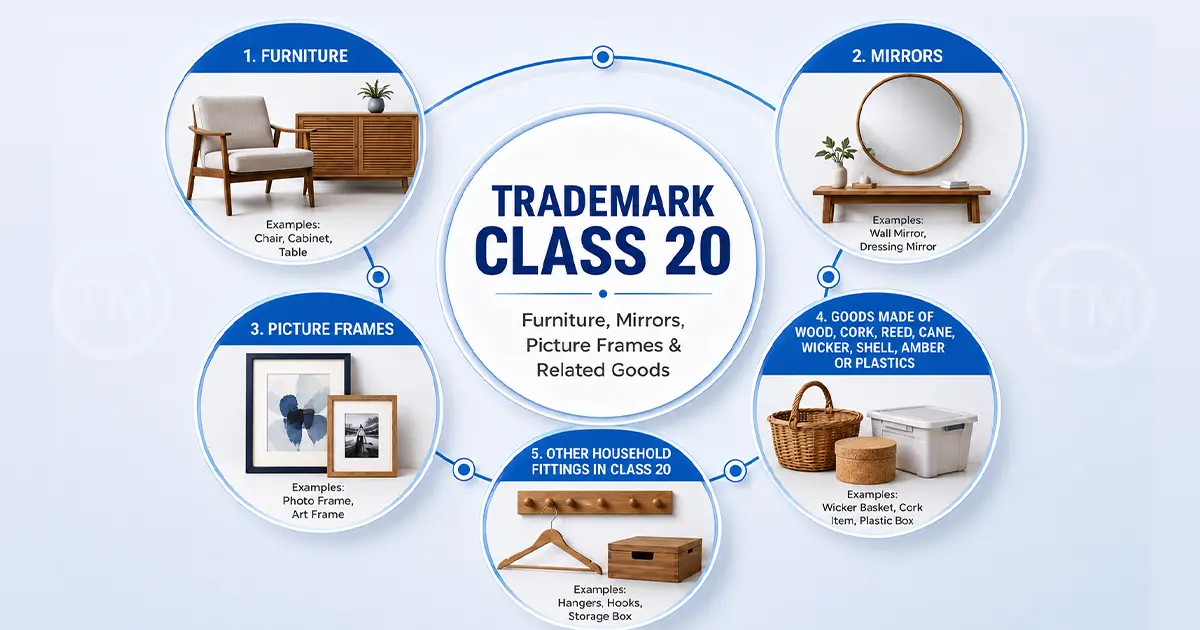
Trademark Class 20 covers furniture, mirrors, picture frames, and non-metal containers. It includes products made from wood, plastic, cane, bamboo, wicker, cork, horn, bone, mother-of-pearl, meerschaum, and yellow amber. It mainly covers home and office furniture, mattresses, and décor brands in India.
Class 20 is one of 45 classes under the Nice Classification (NCL), maintained by WIPO under the Nice Agreement, 1957. India follows this classification under the Trade Marks Act, 1999.
Update: This content follows the Nice Classification 13th Edition (NCL 13-2026), effective from January 1, 2026. The 12th Edition removed ivory from the Class 20 heading. This change remains in the 2026 edition.
Key Takeaways
- Class 20 covers furniture, mirrors, picture frames, and non-metal containers made of wood, plastic, cane, cork, bone, horn, mother-of-pearl, meerschaum, or amber.
- Ivory was removed from the official class heading starting with the 12th Edition (2025) and remains absent in the current 13th Edition.
- Registration protects your brand name and logo, not the design or shape of the product, which needs separate design registration.
- Metal furniture (Class 6), building materials (Class 19), kitchenware (Class 21), lighting (Class 11), and textile furnishings (Class 24) all fall outside Class 20.
- Mirrors split across five classes depending on use: decorative (Class 20), surgical (Class 10), vehicle (Class 12), gun-sighting (Class 13), and optical instruments (Class 9).
- Filing costs ₹4,500 per class for individuals, startups, and MSMEs, and ₹9,000 for companies and partnerships.
- Validity runs 10 years from the date of filing and renews indefinitely in 10-year cycles.
Trademark Class 20: Quick Facts
| Detail | Description |
|---|---|
| Class Number | 20 |
| Type | Goods |
| Covers | Furniture, mirrors, picture frames, mattresses, non-metal containers, and goods of wood, cork, cane, wicker, plastic |
| Governing Law | Trade Marks Act, 1999 |
| Classification Edition | NICE Classification 13th Edition (NCL 13-2026), effective 1 January 2026 |
| Filing Form | Form TM-A |
| Government Fee | ₹4,500 (individual/startup/MSME) or ₹9,000 (company/LLP) per class |
| Validity | 10 years from the date of filing |
| Renewal | Form TM-R, renewable indefinitely every 10 years |
| Filing Mode | Online via the IP India e-filing portal |
Who Should Register Under Trademark Class 20?
Trademark Class 20 applies to you if you fall into one of the following categories:
- Furniture manufacturers protecting brand names for chairs, tables, beds, sofas, and cabinets.
- Home décor brands covering mirrors, shelves, and picture frames.
- Mattress and bedding companies safeguarding mattresses, cushions, and futons.
- Office furniture suppliers protecting desks, workstations, and storage units.
- Interior product sellers dealing in non-metal fixtures and movable interior goods.
- E-commerce furniture sellers securing brand rights before listing on marketplaces.
Goods Covered Under Trademark Class 20
Trademark Class 20 covers furniture and non-metal goods used for furnishing, storage, and interior purposes. The class focuses on the nature and function of the products, ensuring that the brand associated receives legal protection.
Below is the Trademark Class 20 goods list:
| Category | Examples |
|---|---|
| Home and office furniture | Chairs, tables, desks, beds, wardrobes, sofas, armchairs, benches, stools, cabinets, bookcases |
| Storage and fixtures | Shelves, cupboards, drawers, crates, non-metal boxes and containers, non-metal lockers |
| Bedding | Mattresses, pillows, cushions, futons, bed bases, mattress supports |
| Non-metal material goods | Plastic and wooden furniture, cane chairs and baskets, mirrors, picture frames, coat racks, and items of cork, horn, bone, shell, amber, or meerschaum |
| Movable interior accessories | Non-metal hooks, hangers, coat stands, decorative storage, folding screens, room dividers |
| Specialty furniture | Office, school, and garden (non-metal) furniture, baby furniture, portable furniture |
| Partitions and panels | Movable room partitions, folding screens, decorative non-metal panels |
| Household fixtures | Non-metal curtain rods, towel racks, holders, dispensers |
| Display units | Non-metal display boards, showcases, merchandise stands |
| Miscellaneous | Pegs, hangers, trays, racks, and other non-metal storage items |
Goods Not Covered Under Trademark Class 20
Class 20 excludes metal products, building materials, kitchenware, and specialized items. Class 20 excludes these common items:
- Metal furniture and hardware (locks, safes, hinges, handles) belong to Class 6.
- Building materials (pipes, bricks, cement, tiles, wall panels) belong to Class 19.
- Kitchenware and utensils (pans, cutlery, cooking vessels, food storage) belong to Class 21.
- Lighting fixtures (lamps, chandeliers, LED fittings) belong to Class 11.
- Textile furnishings (curtains, upholstery fabric, bed linen) belong to Class 24.
Mirrors can fall under different trademark classes. Decorative wall, bathroom, and dressing-table mirrors belong to Class 20. Surgical and dental mirrors fall under Class 10. Vehicle rearview mirrors are classified under Class 12, gun-sighting mirrors under Class 13, and mirrors built into optical instruments under Class 9.
How to Register a Trademark Under Class 20?
You can register under Class 20 as “proposed to be used” or “already in use,” depending on your brand’s status.
Follow the instructions below for smooth registration:
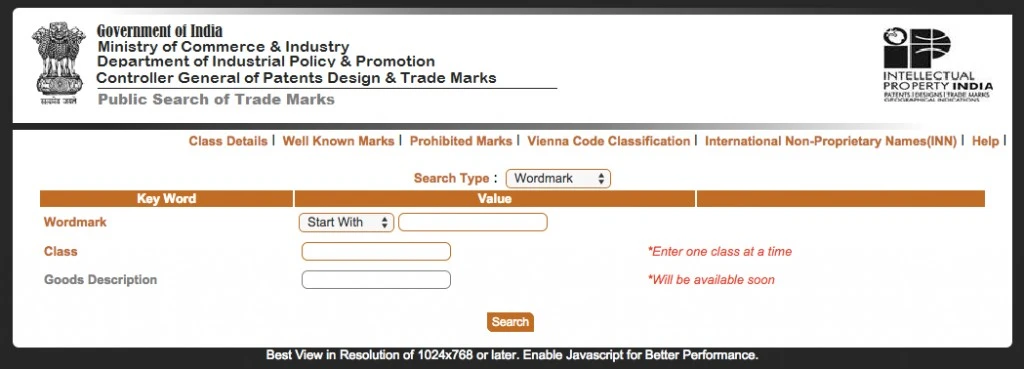
- Search first. Check your brand name on the IP India Trademark Public Search portal. You can also use a professional trademark search. Check related classes like 6, 21, 24, and 35 for possible conflicts.
- Describe your goods clearly. List specific products such as chairs, mattresses, and storage units. Avoid broad terms like “furniture.”
- File Form TM-A. Apply online through the IP India portal or offline at the Registry. Include your brand details, logo, and goods description.
- Complete examination. The Registrar checks the application under Sections 9 and 11 of the Trade Marks Act, 1999. If objected, submit a trademark objection reply within 30 days.
- Complete publication. Accepted marks are published in the Trademark Journal for 4 months. Anyone can file a trademark opposition during this period.
- Get your certificate. Once registered, the trademark is valid for 10 years from the filing date. You can renew it indefinitely.
The cost for trademark registration for furniture businesses in India is around ₹4,500 for individuals or startups and ₹9,000 for companies per class, excluding professional service fees.
When Do You Need Additional Classes With Class 20?
Class 20 covers furniture and non-metal goods, while other classes cover related products.
| Class | Covers | Difference from Class 20 |
|---|---|---|
| Class 6 | Metal furniture, safes, metal cabinets, metal hardware | Metal goods, versus Class 20’s non-metal focus |
| Class 11 | Lighting fixtures, lamps, chandeliers | Electrical/lighting items, not furniture |
| Class 19 | Building materials, bricks, cement, tiles | Construction materials, not movable goods |
| Class 21 | Kitchenware, utensils, food containers | Cooking and serving items, not furniture |
| Class 24 | Textiles, curtains, bed linen | Fabric goods; Class 20 covers non-textile bedding like mattresses |
| Class 27 | Carpets, rugs, mats, wall hangings | Floor and wall coverings, not furniture |
| Class 35 | Retail and online sales services | Service-side registration, paired with Class 20 for e-commerce furniture brands |
Large furniture businesses may need multiple trademark classes. For example, Godrej Interio is understood to cover core furniture under Class 20 and kitchen and home storage under Class 21. Check your full product range before choosing a single class.
