

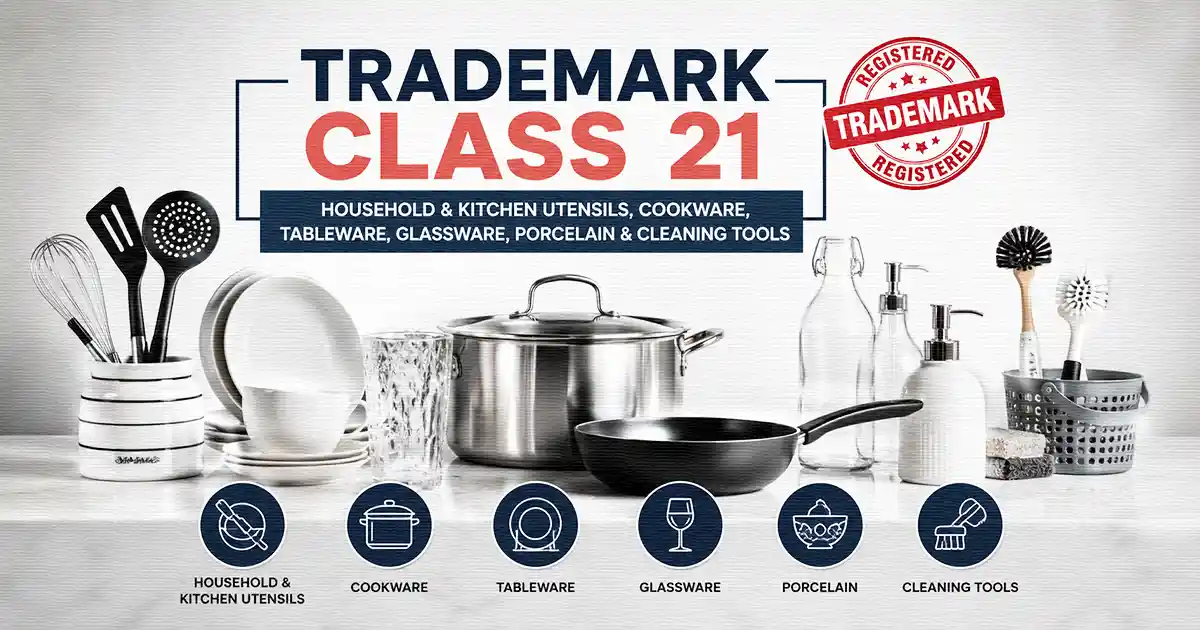
Class 21 is the trademark class for household and kitchen utensils, cleaning articles, combs, brushes, glassware, porcelain, and earthenware in India. It falls under the NICE Classification system, which organizes all trademarks into 45 classes: Classes 1 to 34 cover goods, while Classes 35 to 45 cover services. India adopts this system for all trademark filings under the Trade Marks Act, 1999.
Every business that manufactures, imports, or sells kitchenware, tableware, cleaning tools, or decorative glass and ceramic items must file under this class to secure meaningful brand protection.
Latest Update: This guide reflects the NICE Classification 13th Edition (NCL 13-2026). Under this edition, electric toothbrushes and tongue scrapers moved from Class 10 into Class 21. NCL 12-2025 governs applications filed before 1 January 2026.
Key Takeaways
- Trademark Class 21 is a goods class covering household and kitchen utensils, containers, cleaning articles, combs, brushes, glassware, porcelain, and earthenware.
- Filing fee: ₹4,500 per class for individuals, startups (DPIIT), and MSMEs (Udyam); ₹9,000 per class for companies, LLPs, and partnership firms (online filing via Form TM-A).
- Registration validity is 10 years from the date of application, renewable indefinitely in 10-year blocks using Form TM-R.
- Class 21 does not cover electrical kitchen appliances (Class 7 or 11), cutlery with a cutting edge such as knives (Class 8), building glass (Class 19), or cleaning services (Class 37).
- The one substantive NCL 13-2026 change for Class 21 is that electric toothbrushes and tongue scrapers moved in from Class 10. Popular categories like insulated ware and eco-friendly reusable containers were already Class 21 goods.
Who Should Register Under Trademark Class 21?
Class 21 is the right choice for kitchenware brands, glassware manufacturers, home decor companies, and cleaning product businesses looking to register a trademark. Here’s what registration under Class 21 actually gives you:
- Kitchenware and cookware brands: Non-electric cooking utensils, mixing bowls, kitchen containers, and storage boxes.
- Tableware and glassware manufacturers: Drinking glasses, tumblers, jugs, decanters, and stemware.
- Ceramic and porcelain companies: Crockery, dinner sets, mugs, vases, and decorative earthenware.
- Cleaning product brands: Brushes, mops, sponges, dusters, and other non-electric cleaning tools.
- Home decor and lifestyle brands: Decorative glass items, candle holders, and household ornaments made of glass or porcelain.
- Personal care accessory makers: Combs and hair brushes sold as standalone grooming tools.
- Insulated ware and storage solution companies: Thermoware, lunch boxes, water bottles, and airtight containers.
- Export-oriented artisanal and craft businesses: Handcrafted glass, terracotta, and pottery products sold under a brand name.
What Goods Does Trademark Class 21 Cover?
Class 21 in India protects a wide range of household, kitchen, cleaning, and glassware goods, including the trademark class for glassware, porcelain, and earthenware. Businesses can protect this identity through various types of trademarks, such as word marks, logos, and shape marks.
The table below summarises the key categories and examples:
| Goods Category | Examples |
| Household and Kitchen Utensils | Mixing bowls, ladles, non-electric whisks, rolling pins, strainers, graters |
| Containers for Household or Kitchen Use | Storage containers, lunch boxes, water bottles, thermoware, jars, canisters |
| Combs and Sponges | Hair combs, bath sponges, cleaning sponges |
| Brushes (Except Paintbrushes) | Toothbrushes, hairbrushes, cleaning brushes, bottle brushes |
| Brush-Making Materials | Bristles and other raw materials used to manufacture brushes |
| Articles for Cleaning Purposes | Mops, dusters, squeegees, cleaning cloths, buckets |
| Unworked or Semi-Worked Glass | Raw glass and semi-processed glass, excluding building glass |
| Glassware | Drinking glasses, tumblers, jugs, decanters, glass bowls, glass vases |
| Porcelain and Earthenware | Crockery, dinner sets, mugs, decorative porcelain figurines, terracotta ware |
| Works of Art of Porcelain, Terracotta, or Glass | Decorative ornaments, sculptures, and art pieces made of these materials |
| Cages, Aquaria, and Terraria | Small household cages, indoor aquaria, vivaria, and terraria for pets |
| Toothpicks and Toothbrush Cases | Toothpick holders, toothbrush containers |
| Insulated & Eco-Friendly Household Ware | Thermoware, insulated flasks, eco-friendly reusable containers, and sustainable household products |
Use a trademark class search tool to confirm the correct class before filing. Choosing the right class at the application stage helps you avoid rejections, save refiling costs, and ensure your trademark covers the full scope of products offered.
Registering under the correct trademark class list ensures your products are fully protected and reduces the risk of objections during examination.
Goods Not Covered Under Trademark Class 21
While Class 21 protects a broad range of household, kitchen, and glassware goods, the following are explicitly excluded:
| Goods/Service Type | Correct Class |
| Electric kitchen appliances such as mixers, kettles, and toasters | Class 7 or Class 11 |
| Cutlery with a cutting edge, such as knives, and hand-operated cutting tools | Class 8 |
| Building and construction glass, including window panes | Class 19 |
| Furniture, mirrors, and picture frames | Class 20 |
| Retail sale and distribution services for household goods | Class 35 |
Note: A single kitchenware brand may need to file across multiple classes. For example, a brand selling mixing bowls (Class 21) and electric blenders (Class 7) should register in both classes for full protection.
For example, Prestige files separately under Classes 21, 7, 11, and 35 for cookware, electric appliances, cooking appliances, and retail services.
How to Register Your Trademark in Class 21?
Here is a step-by-step breakdown of the trademark process under Class 21 in India:
1. Trademark Search
Before filing, verify whether a similar mark already exists under Class 21:
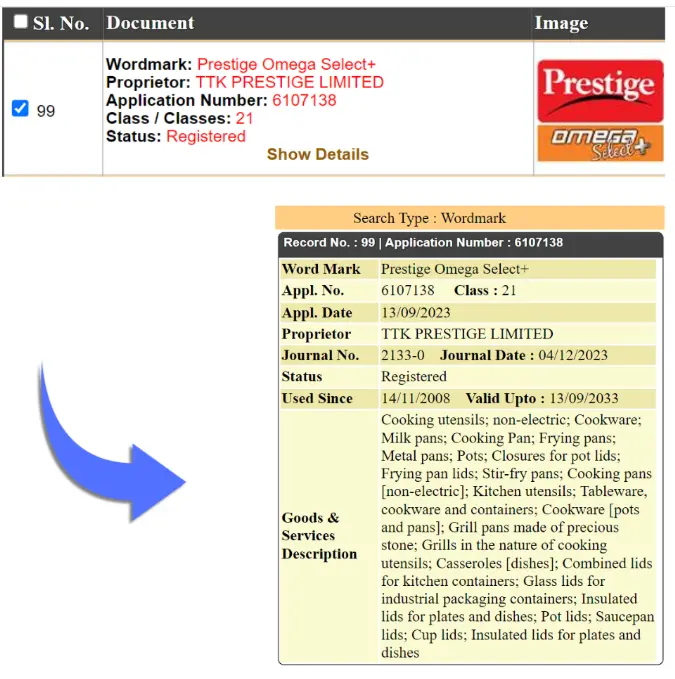
- Visit the IP India Trademark Public Search portal or use the RegisterKaro Trademark Search tool for a deeper analysis across phonetic and device-mark variations.
- Confirm Class 21 fits your products using the trademark class search tool.
- If you plan to expand internationally, also check the WIPO Global Brand Database.
- Enter your brand name or relevant keyword and review identical or similar marks along with their current status.
2. Complete Filing Process
After completing the trademark search, proceed with the formal application and registration stages:
Step 1: Prepare the Application
Gather all applicant details and finalize your trademark logo or wordmark. Draft a precise description of your goods under Class 21. If applicable, note the date of first use in commerce.
Step 2: File Form TM-A
Submit Form TM-A online through the IP India e-filing portal. Ensure Class 21 is correctly selected and pay the prescribed government fee at the time of submission. You may use the ™ symbol immediately upon filing.
Step 3: Examination by the Trademark Office
The Trademark Examiner reviews your application for correct classification, distinctiveness, and potential conflicts with existing registered marks.
Tip: Filing under the correct class with a precise goods/services description helps this stage move without objections. See the Common Mistakes section below for the specific errors to avoid.
Step 4: Reply to the Examination Report
If objections are raised under Section 9 (absolute grounds) or Section 11 (relative grounds) of the Trade Marks Act, 1999, you must file a written reply within 30 days of receiving the Examination Report. If further clarification is required, a hearing notice is issued with a scheduled date.
A well-drafted trademark objection reply backed by legal arguments and supporting evidence significantly improves the chances of acceptance.
Step 5: Publication in the Trademark Journal
Once accepted, the mark is published in the official Trademark Journal. From the date of publication, third parties have 4 months to file a Notice of Opposition under Section 21 of the Trade Marks Act, 1999. If no opposition is received, the mark proceeds to registration
If an opposition is filed, the applicant must respond by submitting counter-statements and supporting evidence, typically with the help of professional trademark opposition defence services.
Trademark Class 21 Registration Fees in India
Registration under trademark Class 21 costs ₹4,500 per class for individuals, startups, and MSMEs filing online, and ₹9,000 per class for companies and other entities. Here’s the complete fee breakdown by applicant type:
| Applicant Type | Fee Per Class (Online) | Fee Per Class (Physical) |
| Individual / Sole Proprietor | ₹4,500 | ₹5,000 |
| Startup (with DPIIT recognition) | ₹4,500 | ₹5,000 |
| Micro or Small Enterprise (with Udyam registration) | ₹4,500 | ₹5,000 |
| Company / LLP / Partnership Firm | ₹9,000 | ₹10,000 |
Fees apply per class at the time of filing Form TM-A. A multi-class application, such as Class 21 + Class 11 + Class 35, attracts the per-class fee multiplied by the number of classes. Professional fees, if engaged, are additional.
Note: Government fees are subject to change. Always verify the latest fee structure for registering a trademark by checking the official IP India website before filing.
Class 21 Trademark Filing Mistakes and How to Avoid Them
Kitchenware, glassware, and household product businesses often encounter delays or weak protection because they make avoidable errors. Here are the most frequent mistakes and how to steer clear of them:
- Vague Product Descriptions: Descriptions like “kitchen items” or “household goods” are too broad and regularly attract examiner objections. Be specific, describe exactly what you sell, such as “non-electric stainless steel mixing bowls” or “handblown glass tumblers.”
- Not Conducting a Trademark Search: Many applicants skip this step and discover conflicts only after filing. Always search the Indian Trademark Registry and WIPO’s global database before submitting your application to avoid costly rejections.
- Misclassifying Goods: Electric kitchen appliances belong to Class 7 or 11, cutting tools with a blade to Class 8, and building glass to Class 19, not Class 21. Use the trademark class search tool to confirm you’re filing your goods in the correct class.
- Mixing Up Trademark and Design Registration: Trademark protects your brand name, logo, and tagline. Design registration protects the unique visual shape or ornamentation of a product, such as a distinctive glass or bowl silhouette. Both are separate and necessary. Registering one does not substitute for the other.
- Incomplete Application Documents: Missing or incorrect documents slow down your application significantly. Check the full list of documents required for trademark registration before submitting.
- Missing Examination Report Deadlines: A missed 30-day deadline can get your application abandoned. Stay on top of your filing status and address any trademark objection promptly.
