

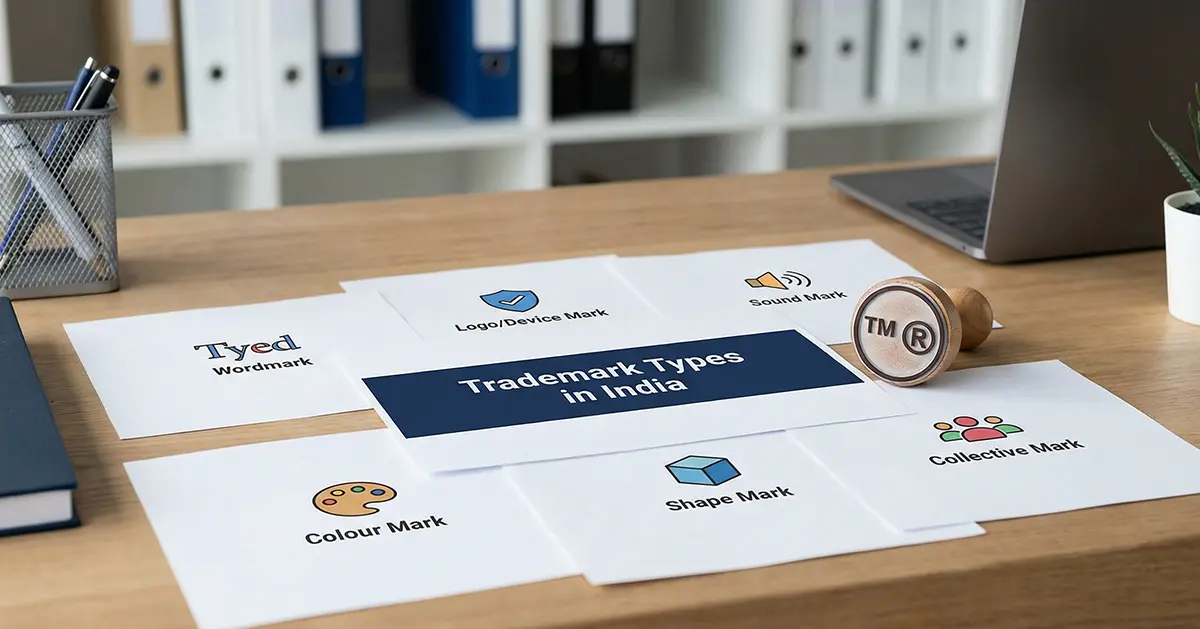
Trademark types in India fall into two categories. Conventional marks include word, device, service, collective, and certification marks. Non-conventional marks include shape, colour, sound, and smell marks. Each protects a different part of your brand identity, and choosing the wrong one during trademark registration can leave part of your brand legally exposed.
Under Indian law, a trademark is a unique sign, symbol, word, or design that identifies your goods or services. Different brand elements need different protection. Nike’s “Just Do It” is a word mark. Netflix’s “ta-dum” intro, registered in India since 2021, is a sound mark. Both require different types of registration.
Key Takeaways
- Trademarks in India include word, logo, service, collective, certification, well-known, and non-conventional marks.
- Each trademark type protects a different part of your brand identity.
- Word marks protect names and slogans, while device marks protect logos.
- Service marks are meant for service-based businesses.
- Collective and certification marks represent groups and quality standards.
- Well-known trademarks receive broader legal protection across classes.
- Sound, shape, colour, and smell can also qualify for trademark protection if legal requirements are met.
- Filing the right trademark type helps secure stronger and broader brand protection.
Different Types and Kinds of Trademarks in India (with Examples)
The Trade Marks Act, 1999, recognizes two broad categories of trademarks:
A. Conventional Trademarks
Conventional trademarks protect the traditional elements that identify a business, such as its name, logo, or services. These are the most commonly registered trademark types in India. The main types of conventional trademarks are:
1. Word Marks
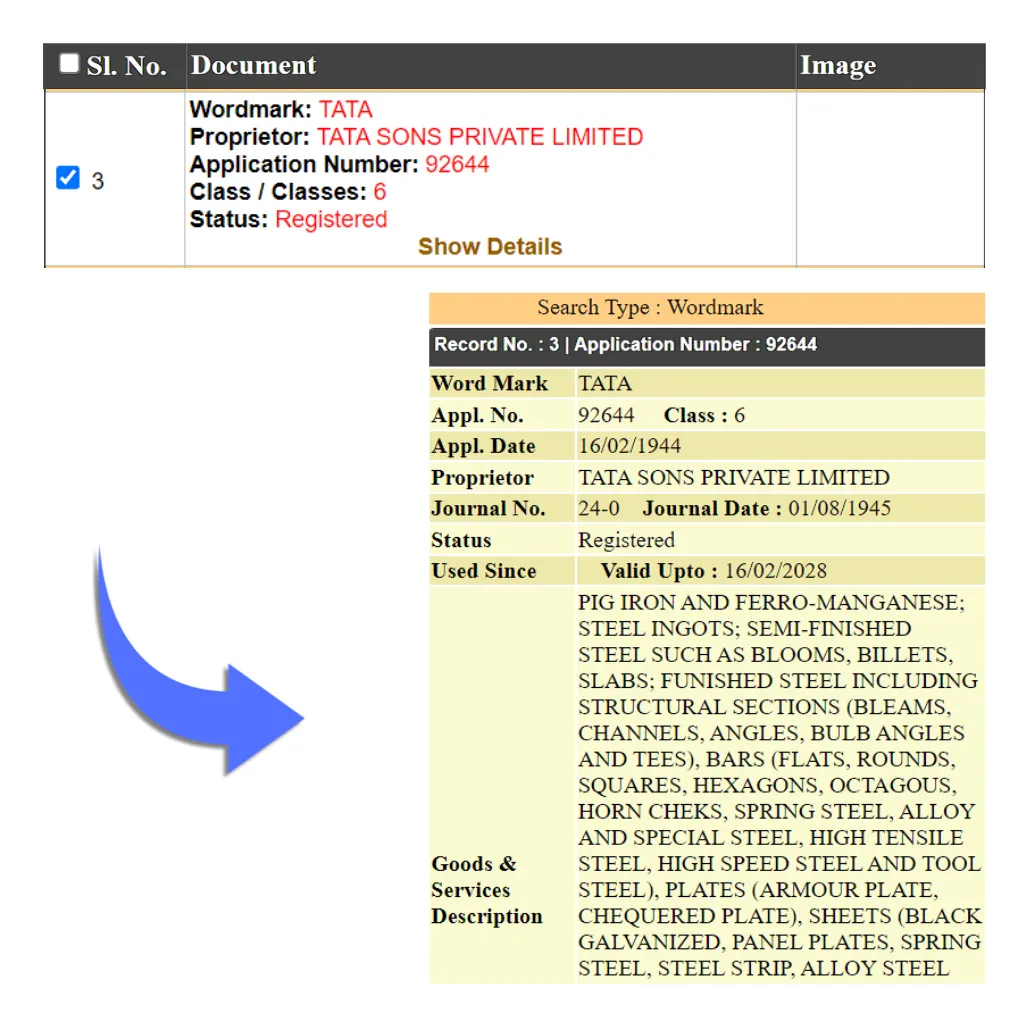
A Word Mark protects the name, tagline, or slogan that identifies your brand. When the words themselves carry recognition and recall, registering them ensures a ‘mark’ under Section 2(m) of the Trade Marks Act includes words, letters, and numerals.
Use this trademark type when you want to:
- Protect your brand name, tagline, or slogan in all fonts and styles.
- Focus on a unique or catchy name that defines your business.
- Rely on words as the primary element of brand recall.
Examples: “Amazon,” “TATA,” and “Google” are registered word marks. These trademarks protect the words themselves, regardless of the font, style, size, or color in which they appear.
2. Device / Logo (Symbol) Marks
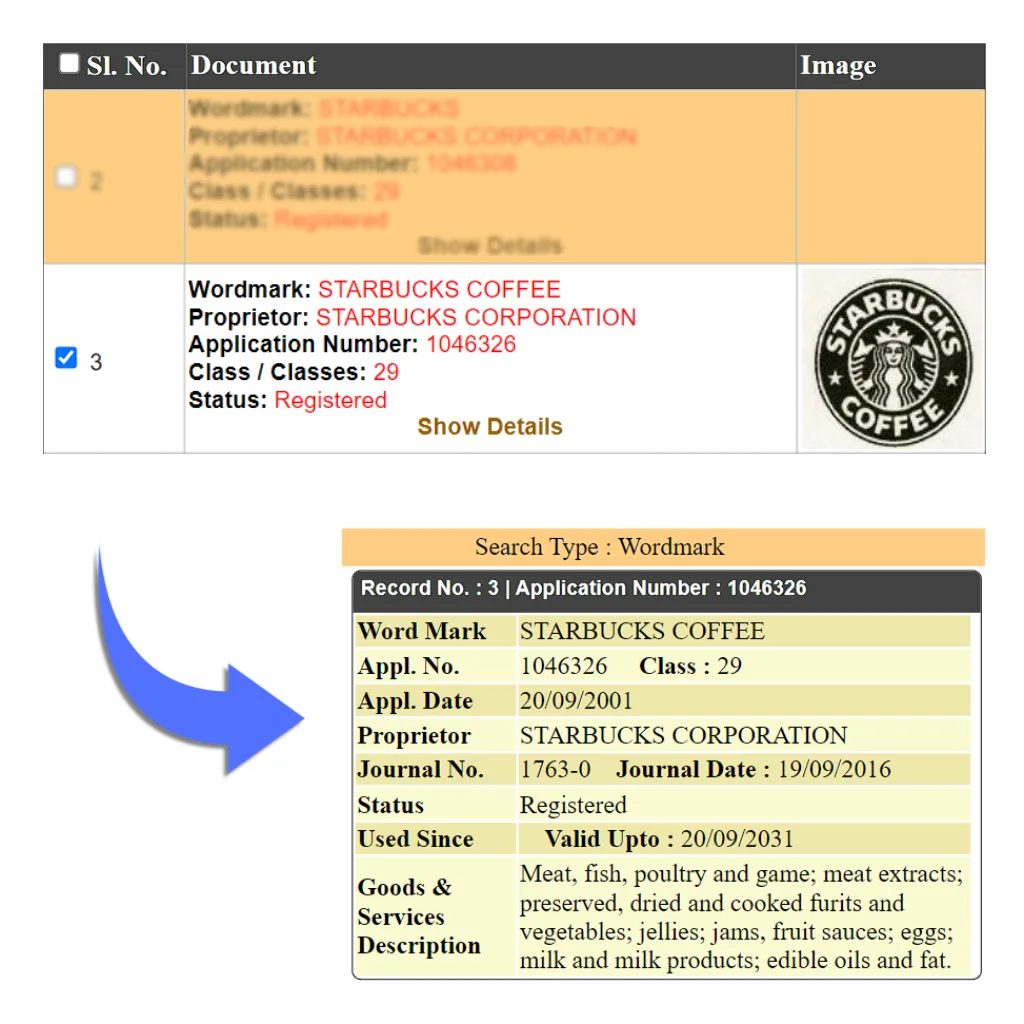
A device mark protects a brand’s logo or visual symbol, helping build recognition and trust. Moreover, you can sue for infringement if someone copies your logo without permission.
Brands utilize this type of trademark to:
- Build brand identity through visuals.
- Apply the logo consistently across products, packaging, and marketing materials.
- Prevent imitation of your brand’s visual signature.
Examples: The bitten apple logo of Apple, the Golden Arches “M” of McDonald’s, the Nike Swoosh, and the Starbucks Siren logo are all registered device marks. These logos identify their brands through distinctive visual symbols.
3. Service Marks
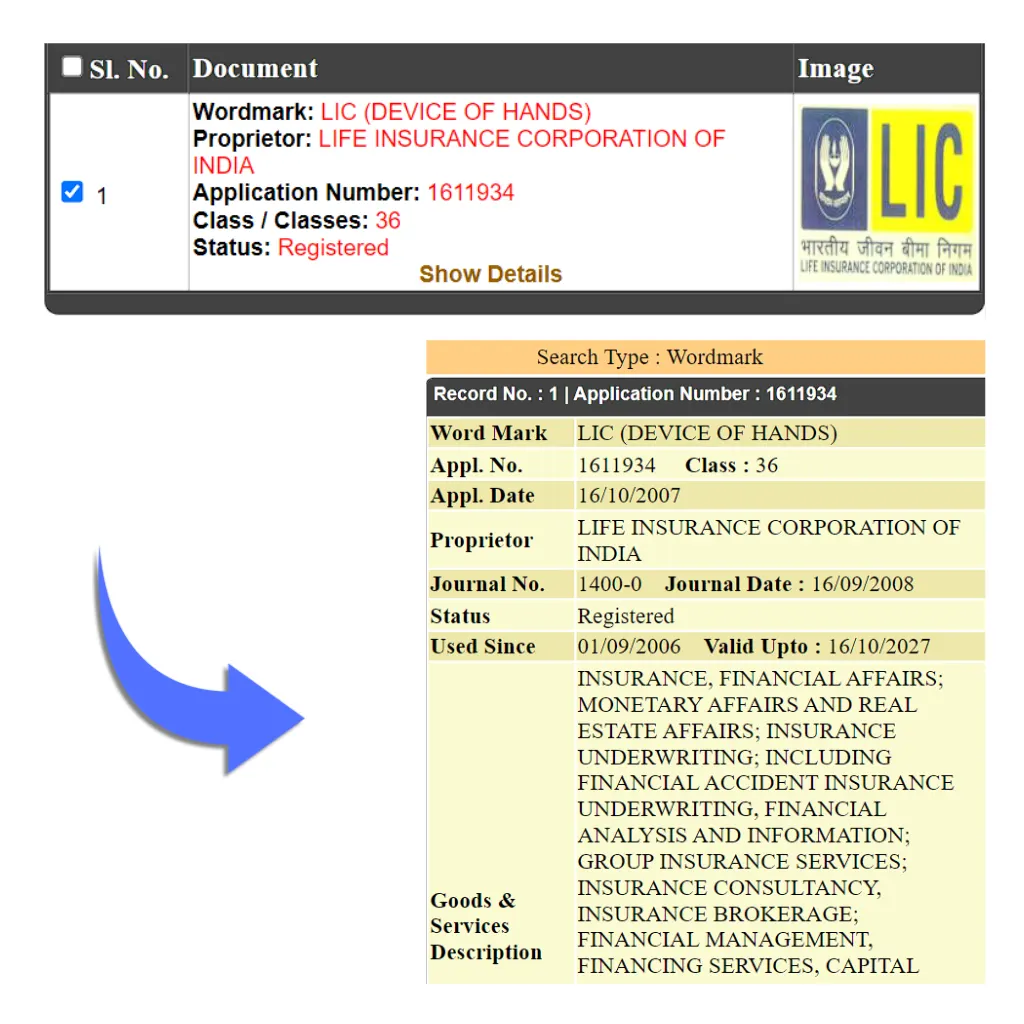
Service marks protect brands that provide services rather than goods. They distinguish one service provider from another and build trust in service-based industries. Service marks can include names, taglines, or slogans specifically linked to the services offered.
Use this trademark type when you want to:
- Distinguish services rather than physical products.
- Build credibility and recognition in service industries.
- Protect your service-based brand identity.
Examples: IRCTC for railway ticketing services, LIC’s “Yogakshemam Vahamyaham” tagline for insurance services, and Akasa Air’s “It’s Your Sky” tagline are registered service marks. They identify and distinguish the services offered by these businesses.
4. Collective Marks
A collective mark represents a group, organization, or association. It signals membership or adherence to certain standards rather than ownership by a single business. Only authorized members (associations, public institutions, Section 8 companies, etc.) can use the mark, protecting the collective identity legally.
Apply this type of trademark to:
- Represent a group with shared goals or standards.
- Provide members with a unified identity that signals credibility.
- Distinguish certified or trained members from others.
Examples: The CA mark used by members of the Institute of Chartered Accountants of India (ICAI) and the FICCI logo used by its members are examples of collective marks.
5. Certification Marks
Certification marks indicate that goods or services meet specific quality, safety, or origin standards. They enhance consumer trust by verifying compliance. The mark cannot be used by unauthorized manufacturers and is governed by Chapter IX (Sections 69–78) of the Trade Marks Act.
Use this type of trademark when you want to:
- Assure customers of compliance with legal or quality standards.
- Build trust and credibility for products or services.
- Protect marks used to certify authenticity, quality, or origin.
Examples: The ISI mark on electrical products, the FSSAI logo on packaged foods, and the Agmark symbol on agricultural products are certification marks that ensure quality and reliability.
6. Well-Known Marks
A well-known mark is a trademark recognized by a substantial section of the public, even outside its original goods or services category. Once a mark crosses this threshold, it receives broader protection than a standard registered trademark, blocking others from using a similar mark even on unrelated products.
Use this status when you want to:
- Protect your brand across categories, not just the ones you currently operate in.
- Block imitators from riding on your reputation in unrelated industries.
- Strengthen enforcement against confusingly similar marks nationwide.
Examples: Tata, Nike, and Amul are recognized as well-known trademarks in India. Their protection extends well beyond their original product categories.
B. Unconventional Marks
Unconventional marks protect distinctive brand features that go beyond names and logos. These include colours, sounds, shapes, and smells, provided they can function as trademarks and meet the legal requirements for registration.
1. Colour Marks
Protect a distinctive colour or colour combination that consumers associate with a particular brand. Under Section 10 of the Trade Marks Act, a trademark may be registered with a limitation to specific colours. If no colour limitation is claimed, the registration generally covers the mark in all colours.
2. Sound Marks
Protect unique sounds that identify the source of goods or services, such as jingles or audio signatures. Under Rule 26(5) of the Trade Marks Rules, the application must include an MP3 file (up to 30 seconds) along with a graphical representation of the sound.
3. Shape Marks
Protect the distinctive three-dimensional shape of a product or its packaging. However, Section 9(3) prohibits registration of shapes that result from the nature of the goods, are necessary to achieve a technical result, or add substantial value to the product.
4. Smell Marks
Protect distinctive, non-functional scents associated with a brand. Although recognised in principle, smell marks are difficult to register in India because Section 2(zb) requires graphical representation, and the Trade Marks Rules do not prescribe a filing procedure for scent marks, unlike colour, shape, and sound marks.
5. Pattern, Position & Motion Marks
- Pattern marks protect a repeating design consumers associate with a brand (e.g., a signature check or monogram pattern).
- Position marks protect the specific placement of a mark on a product (e.g., a coloured tab on a fixed spot).
- Motion marks protect a short moving visual element. Indian law doesn’t expressly define motion marks, but registration is possible if the movement is clearly represented and distinctive.
Choosing the right trademark helps you protect your brand’s identity and stand out in the market. India registers trademarks under 45 different classes based on the type of goods or services you offer. The government e-filing fee is ₹4,500 per class for individuals, startups, and MSMEs, and ₹9,000 per class for companies and LLPs.
Note: Physical filing attracts higher government fees, while professional charges vary depending on your service provider.
Which Trademark Type Should You File First?
The trademark you should file first depends on which part of your brand is most valuable and how it is used in the marketplace. In some cases, filing more than one type of trademark provides broader protection.
The table below shows which trademark type is generally the best choice for different business situations:
| Your Situation | Trademark Type to File |
| Your brand name is your most valuable asset | Word mark |
| Your logo has a unique design and strong recognition | Device mark |
| Both the brand name and logo have independent value | File separate Word and Device mark applications |
| You offer services rather than goods | Word or Device mark in the relevant service classes (35–45) |
| An association allows its members to use the mark | Collective mark with the required regulations |
| A certification body authorizes use based on standards | Certification mark with the required regulations |
| A distinctive colour, sound, shape, or other non-traditional feature identifies your brand | Unconventional mark (subject to closer examination) |
Note: A trademark no longer has to be declared well-known through a court decision or a dispute before the Registrar. Under Rule 124, any person can directly apply to the Registrar by filing Form TM-M, along with a statement of case and supporting evidence. The government fee is ₹1,00,000 (e-filing only, verified as of June 2026). Before making a decision, the Registrar considers the factors listed in Section 11(6)–(9) and may invite public objections for 30 days.
Which Marks Can Be Registered and Which Cannot?
Every trademark falls somewhere on a spectrum of inherent strength, and where it lands largely determines whether it registers at all. Here’s how examiners rank the five levels:
| Strength | What It Is | Example | Registrability |
| Invented / Fanciful | A coined word with no prior meaning | A made-up brand name | Strongest |
| Arbitrary | A real word unrelated to the goods | A common word used on unrelated products | Strong |
| Suggestive | Hints at a quality without describing it directly | A name requiring some imagination to connect to the product | Often registrable |
| Descriptive | Directly describes the goods or a quality | A flavor or ingredient claim on food packaging | Refused, unless acquired distinctiveness is proven |
| Generic | The common name of the product itself | The product category name | Never registrable |
A coined or arbitrary name is harder to challenge and easier to enforce than a descriptive one, at the same filing cost.
