Pvt Ltd Company Registration Online in India
Private limited company registration gives a business a separate legal entity under the Companies Act, 2013. RegisterKaro's CA-led team manages DSC, DIN, name approval, and online SPICe+ filing from ₹1,499 + government fees.
 Company Incorporated in 7–10 Business DaysName Approval & Filing Handled by Qualified CAs & CSPAN, TAN, DIN, DSC, MoA, AoA & Certificate of IncorporationComplete Package from ₹1,499 + Govt. Fees, No Hidden ChargesTrusted by 2 Lakh+ Startups & Entrepreneurs Across India

 What Sets Us ApartWhat Sets Us Apart
Choose the Best Pvt Ltd Company Registration Plan for Your Business
BASIC
₹1,499
+ Govt FeesWhat you'll get
- Company name help
- SPICe+ form in 2–3 working days
- Company PAN + TAN
- MOA + AOA
- PF and ESIC registration
- Incorporation certificate in 7–10 days
- DSC preparation in 3–4 days
- DIN for directors
- Expert assisted process
- INC 20A / Business commencement certificate
- MSME Registration
- Startup India Registration
- Digital signature certificate
- Company DSC
- Trademark Registration
STANDARD
₹6,499
+ Govt FeesWhat you'll get
- Company name help
- SPICe+ form in 2–3 working days
- Company PAN + TAN
- MOA + AOA
- PF and ESIC registration
- Incorporation certificate in 7–10 days
- DSC preparation in 3–4 days
- DIN for directors
- Expert assisted process
- INC 20A / Business commencement certificate
- MSME Registration
- Startup India Registration
- Digital signature certificate
- Company DSC
- Trademark Registration
PREMIUM
₹8,499
+ Govt FeesWhat you'll get
- Company name help
- SPICe+ form in 2–3 working days
- Company PAN + TAN
- MOA + AOA
- PF and ESIC registration
- Incorporation certificate in 7–10 days
- DSC preparation in 3–4 days
- DIN for directors
- Expert assisted process
- INC 20A / Business commencement certificate
- MSME Registration
- Startup India Registration
- Digital signature certificate
- Company DSC
- Trademark Registration
What is Private Limited Company Registration?
Private limited company registration is the process of incorporating a business with the Registrar of Companies (ROC) under the Ministry of Corporate Affairs. The Companies Act, 2013 governs the formation, management, compliance, and closure of a private limited company. Registration gives limited liability protection, a structured ownership model, and a form that investors recognize, which is why Pvt Ltd registration is the default choice for startups and growing businesses in India.
After incorporation of a private limited company, the business becomes a separate legal entity from its founders. They enjoy several benefits, including limited liability, perpetual succession, easier access to funding, and the ability to hold assets and conduct business in their own name. Unlike sole proprietorships and partnerships, shareholders' personal assets remain protected from business liabilities.
The entire process runs online through the SPICe+ form on the MCA V3 portal. A new private limited company registration covers name approval, DSC, DIN, MOA and AOA, PAN and TAN in one application, so no visit to the ROC is needed.
Private Limited Company Registration Requirements in India
A business must meet these Pvt Ltd company requirements before it can register under MCA guidelines:
- Directors: A minimum of 2 directors is required, with a maximum of 15 directors by default. More than 15 directors can be appointed through a special resolution. At least one director must be a resident in India under Section 149(3) of the Companies Act, 2013, having stayed in India for at least 182 days during the previous financial year.
- Shareholders: A minimum of 2 shareholders and a maximum of 200 shareholders are permitted. The same individuals can also serve as directors. Employees holding shares through an Employee Stock Option Scheme are excluded from this limit.
- Registered office: The company must have a registered office (commercial, residential, or virtual office) for receiving official correspondence. Address proof and the property owner's NOC are generally required.
- Company name: The proposed name must comply with MCA naming guidelines and end with "Private Limited."
Note: Foreign nationals, NRIs, and foreign companies are eligible to start a private limited company in India. They can hold up to 100% of the shares under the automatic route in most sectors, provided at least one director is resident in India. Where an overseas parent company is the shareholder, this falls under foreign company registration and carries additional FEMA and RBI compliance.
Minimum Capital Requirement for Pvt Ltd Companies
There is no minimum paid-up capital requirement to register a Private Limited Company in India. The Companies (Amendment) Act, 2015 removed the earlier minimum requirement of ₹1 lakh, so you can incorporate with any amount and increase it later as the business grows.
However, you must declare an authorized capital limit, which determines the maximum value of shares a company can issue. It is commonly set at ₹1 lakh at incorporation and can be increased later through the MCA by paying the applicable fees. The MCA charges no incorporation filing fee where authorized capital is up to ₹15 lakh. Above that, slab-based fees apply on authorized capital, and state stamp duty is payable in every case.
Most founders open a Pvt Ltd company with ₹1 lakh authorized capital and raise it later through Form SH-7 when funding or credit needs it.
Documents Required for Pvt Ltd Company Registration
Here are the key documents and prerequisites businesses need to file for a private limited company in India:
For Directors and Shareholders (Indian Nationals)
- PAN Card (mandatory for all directors and shareholders)
- Aadhaar Card
- Recent passport-sized photographs
- Any one address proof: utility bill (electricity, gas, or telecom, not older than 2 months), bank statement (not older than 2 months), driving licence, or Voter ID
- Email ID and mobile number linked with Aadhaar (required for OTP verification during filing)
- Specimen signature (a signed document in the prescribed format; our team will guide you on this)
For Foreign Directors/Shareholders (Additional Documents)
- Valid passport copy (with visa details, if applicable)
- Address proof from home country (utility bill, bank statement, or driving licence)
- Bank statement from the home country
Note: All foreign documents must be notarized and apostilled. Documents not in English require certified translation. Requirements may vary by country; our team will guide you through the specifics.
For the Registered Office
- Proof of address: Utility bill (not older than 2 months) or property tax receipt
- No Objection Certificate (NOC) from the property owner, if rented or leased.
- Copy of rent or lease agreement (if applicable)
Company-Related Documents & Information
- 3-4 proposed company name options in order of preference
- Description of your business activities (this forms the basis of your MOA's object clause)
- Authorized and paid-up capital details
- Shareholding pattern (who holds how many shares and at what value)
- Draft Memorandum of Association (MOA) and Articles of Association (AOA)
- Resolution Appointing First Directors
Note: The MOA, AOA, and director consent declarations are drafted by our legal team as part of the private limited company registration process. However, different regions might require additional documents for company registration as per MCA and state-based ROC guidelines. Our experts prepare a complete, region-specific document checklist for you and handle the drafting, so nothing is missed while planning your registration.
How to Register a Pvt Ltd Company in India: Step-by-Step Process
The Pvt Ltd company registration process starts with a Class 3 DSC and ends with the Certificate of Incorporation. Here is the private limited company registration process step by step:
Step 1: Get Digital Signature Certificates (DSC)
Obtain a Class 3 Digital Signature Certificate (DSC) for each proposed director and subscriber to the MOA through an MCA-approved Certifying Authority, such as eMudhra.
The DSC is required to digitally sign the incorporation documents filed with the MCA.
Step 2: Reserve Your Unique Company Name
Reserve your company name through SPICe+ Part A on the MCA V3 portal (mca.gov.in) before filing the incorporation application. Submit up to two name options in order of preference.
Your company name must:
- Be unique and not closely similar to an existing company or LLP name.
- Not infringe any registered trademark.
- End with "Private Limited".
- Include a distinctive element and avoid generic or purely descriptive names.
- Match the business activity mentioned in the company's objects clause.
- Avoid misleading, offensive, or restricted words.
Words such as "Bank," "Insurance," "National," "Board," "Stock Exchange," or "Municipal" require prior approval from the relevant regulatory authority.
If MCA rejects the proposed names, you get one additional chance to resubmit without paying the fee again. If it gets rejected after resubmission, you must file a fresh SPICe+ Part A application and pay ₹1,000.
Once approved, MCA reserves the company name for 20 days, within which you must complete the incorporation filing.
Tip: Run a pvt ltd company name check before paying the ₹1,000 reservation fee. Three checks matter: the MCA company and LLP database, the trademark registry for the same class, and domain availability for the brand. The free company name search tool covers the MCA search in seconds. A name rejected at resubmission stage means a fresh SPICe+ Part A application and another ₹1,000.
Step 3: Prepare and Draft Key Documents (MOA & AOA)
Prepare and finalize the documents required for incorporation:
- MOA and AOA: Define the company's objectives, share capital, ownership, and internal rules.
- DIR-2 and INC-9: Obtain the required director consent and declarations.
- Registered office proof: Keep the rent agreement, ownership proof, and recent utility bill ready.
Make sure each document is complete, accurate, digitally signed, and compliant with MCA requirements.
Step 4: File the SPICe+ Incorporation Form
File the SPICe+ Form online through the MCA V3 portal. This single application, together with its linked AGILE-PRO-S form, covers multiple registrations at once:
- Company incorporation and CIN allotment
- PAN and TAN allotment
- DIN for up to 3 directors
- EPFO and ESIC registration
- GST registration (if opted)
- Professional tax and Shops & Establishment registration (in states where applicable)
- A company bank account
Government fees are calculated based on your declared authorized capital.
Note: SPICe+ allots a DIN to a maximum of 3 directors who don't already have one. If your company has more than three new directors, the additional directors must obtain their DIN separately (through Form DIR-3) or be appointed after incorporation.
Step 5: Receive Your Certificate of Incorporation (COI)
After the ROC verifies and approves your application, it issues the Certificate of Incorporation (COI), also known as the Company Registration Certificate. The COI confirms that your company legally exists and includes key details such as its legal name, CIN, date of incorporation, registered office, PAN, and TAN.
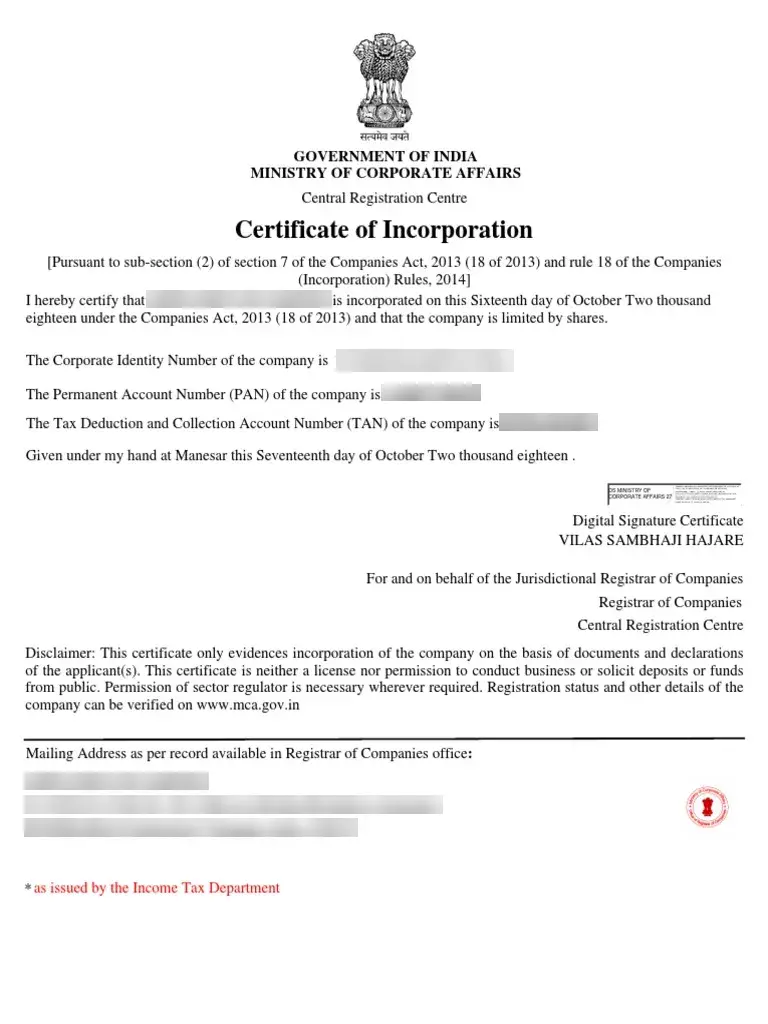
Once you receive the COI, your company is officially incorporated and can proceed with its business operations. You will need the COI for activities such as:
- Opening a company bank account
- Obtaining GST and other applicable tax registrations
- Entering into legal contracts
- Applying for licences and business permits
- Raising funds and onboarding investors
It also establishes the company's legal identity and strengthens its credibility with customers, banks, investors, and government authorities.
Incorporation of a private limited company generally takes 7 to 10 working days when documents are accurate and complete. Timelines vary with government processing and ROC handling, and a resubmission query typically adds 3 to 5 working days.
Note: File Form INC-20A (Declaration of Commencement of Business) within 180 days, confirming subscribers have paid their share capital. Missing it attracts a ₹50,000 penalty on the company and ₹1,000/day on each defaulting officer.
Fees and Penalties of Pvt Ltd Company Registration in India
Pvt Ltd company registration cost in India runs from about ₹8,000 to ₹15,000 in total for authorized capital up to ₹15 lakh. That covers professional fees from ₹1,499, a ₹1,000 name reservation fee, Class 3 DSCs, and state stamp duty. The MCA charges no incorporation filing fee up to ₹15 lakh of authorized capital.
Registration Fees of a Private Limited Company
The fees for registration of a private limited company involve several components, as shown in the table below:
| Fee Category | Item | Cost/Range |
| Government Fees | Name reservation fee | ₹1,000 |
| Incorporation fees (SPICe+) |
| |
| Stamp duty | Varies by state and capital (From ₹135 to ₹15,020 for capital up to ₹1 lakh) | |
| Professional Fees | DSC | ₹2,500 per DSC |
| Professional service charges (MOA, AOA, filing) | ₹1,499 (for Indian clients); Varies for Foreign/NRI clients | |
| PAN & TAN | Issued via SPICe+ (no separate fee; included in incorporation) | |
| Post-Registration Costs | Company seal and stationery | ₹500 to ₹1,500 |
| Bank account opening charges | Varies by bank | |
| GST registration (if applicable) | Government fees: Free + Professional charges (if any) |
Note: Stamp duty charges and government fees for Private Company registration may vary depending on the company’s location and authorized capital.
For a complete breakdown, check our comprehensive guide on Company Registration Fees in India. To price a specific capital amount, use the company incorporation fees calculator.
Penalties for Non-Compliance of a Private Limited Company
Failing to meet statutory and regulatory requirements after registration can result in financial penalties and legal consequences, such as:
| Non-Compliance / Default | Form (if applicable) | Penalty Details |
| Delay in Annual Return | Form MGT-7 | ₹10,000 on the company, plus ₹100 per day of continuing default, up to a maximum of ₹2 lakh. Every officer in default faces the same, capped at ₹50,000 (Section 92(5)). |
| Delay in Financial Statements | Form AOC-4 | ₹10,000 on the company, plus ₹100 per day of continuing default, up to a maximum of ₹2 lakh. The MD/CFO or responsible director faces the same, capped at ₹50,000 (Section 137(3)). |
| Failure to hold a minimum of four board meetings | N/A | ₹25,000 on the officer in default responsible for convening the meeting (Section 173(4)). |
| Non-maintenance of Statutory Registers | N/A | ₹3 lakh on the company and ₹50,000 on every officer in default (Section 88(5)). |
| Failure to Update Company Changes | N/A | ₹1,000 per day of continuing default, up to a maximum of ₹1 lakh, on the company and every officer in default (Section 12(8)). |
| Non-Disclosure of Interest by Directors | N/A | ₹1 lakh penalty on the director; related defaults can also lead to vacation of office under Section 167 (Section 184(4)). |
| Non-Compliance with CSR Requirements | N/A |
|
Managing compliance doesn't have to be stressful. With our experts handling your filings and deadlines, you can avoid costly mistakes and keep your company compliant year-round.
What is a Private Limited Company Registration Number?
A Private Limited Company Registration Number, also known as a Corporate Identity Number (CIN), is a unique 21-character code assigned by the Registrar of Companies (ROC) when a company is incorporated. It appears on the Certificate of Incorporation and identifies the company in its filings and correspondence with the MCA. The CIN is how the MCA identifies a company, and it is also how anyone can look up private limited company registration details on the MCA register.
The CIN contains specific information about the company:
| Part | What It Indicates |
| Listing status (1 letter) | Whether the company is listed (L) or unlisted (U) |
| Industry code (5 digits) | The company's primary business activity |
| State code (2 letters) | The state of the registered office |
| Year of incorporation (4 digits) | The year the company was incorporated |
| Company type (3 letters) | The company type, such as PTC for Private Limited Company |
| Registration number (6 digits) | The unique number assigned by the ROC |
You need the CIN for MCA filings, annual returns, financial statements, and official communication with the ROC or MCA. Companies must also mention their CIN on letterheads, invoices, notices, and other official documents as required under the Companies Act, 2013.
Check any company's CIN, status, and filing history through the registered company details search.
Benefits of Registering a Pvt Ltd Company in 2026
Here is why a Pvt Ltd structure is the preferred choice for startups, growing businesses, and companies in India today:
- Limited liability: Your personal assets are generally protected, as all risk falls only on the capital you have invested in the company. This protection applies because a Private Limited Company is “limited by shares” under Section 2(22) of the Companies Act, 2013.
- Separate legal entity: The company is legally separate from its owners. It can own property, enter contracts, and sue or be sued in its own name, independently of its shareholders.
- Lower corporate tax: Companies with turnover up to ₹400 crore are generally taxed at 25%, while eligible companies can opt for the 22% rate under Section 115BAA. Eligible new manufacturing companies could opt for 15% under Section 115BAB (this concessional rate applies only to companies that commenced manufacturing on or before 31 March 2024). These rates are below the 30% top individual slab, and eligible business expenses such as salaries, rent, and depreciation can also be claimed as deductions.
- Investor-ready structure: VCs and angel investors commonly prefer Pvt Ltd Companies because the share-based structure provides clear ownership, investment, dilution, and exit mechanisms.
- Easy to raise capital: Proper financial records and audited accounts can improve access to bank and NBFC financing compared with many unincorporated businesses.
- 100% FDI allowed: Most sectors permit 100% FDI under the automatic route, making the structure suitable for businesses seeking overseas capital.
- ESOPs to attract talent: A Pvt Ltd Company can offer ESOPs to eligible employees to attract and retain talent while aligning them with long-term growth.
- Higher credibility: A registered company can build greater trust with clients, banks, vendors, and investors. It can also participate in tenders and enterprise contracts that may not be accessible to informal businesses.
- Easy ownership transfer: Ownership is represented through shares, which can be transferred subject to the Companies Act and the Articles of Association. This allows new investors or shareholders to enter without disrupting the company's operations.
- Perpetual succession: The company continues to exist independently of changes in ownership. It can keep operating even if a shareholder leaves, retires, or passes away, providing long-term business continuity and stability.
- Access to government schemes: An eligible company can obtain DPIIT Startup India recognition, which is free and now covers companies up to 10 years old with turnover up to ₹200 crore, raised from ₹100 crore in February 2026. It may also qualify for MSME benefits and startup funding programs such as the Fund of Funds for Startups.
First 30 Days After Private Limited Company Registration: What to Do
Here is what every newly registered Private Limited Company must do within the first 30 days to stay legally compliant:
- Open a current account in the company's name using the COI, CIN, PAN, MOA, AOA, and a board resolution authorizing it.
- Register for GST if your turnover crosses ₹40 lakh (goods) or ₹20 lakh (services), or if you supply inter-state or sell via e-commerce.
- Apply for DPIIT (Startup India) recognition if eligible. Recognition unlocks the Section 80-IAC tax holiday of three consecutive years within the first ten, self-certification on 9 labour and 3 environmental laws, and faster patent examination.
- Apply for Udyam (MSME) registration to access priority sector lending, 25% reservation in government tenders, and protection under the MSMED Act for delayed payments.
- Appoint the first auditor within 30 days of incorporation under Section 139(6) and file Form ADT-1.
Tip: Keep track of all post-incorporation filings and annual due dates with the Compliance Calendar to ensure your company never misses a statutory deadline.
Annual filings begin after this. The private limited company compliance page covers ADT-1, AOC-4, MGT-7, DIR-3 KYC, and ITR-6 with due dates, and the team can bundle the first year with incorporation.
Common Mistakes That Delay Your Pvt Ltd Company Application
Most SPICe+ resubmissions happen due to a few common errors. Avoid these mistakes to prevent delays and rejection:
- Choosing a similar company name: A name that conflicts with an existing company, LLP, or trademark may get rejected. Search the MCA database and trademark registry before submitting your proposed name.
- Drafting an incorrect objects clause: The company's objectives may not match the proposed name or actual business activities, leading to MCA objections. Draft the objects clause carefully and ensure it clearly covers your intended business activities.
- Submitting incorrect address proof: Old utility bills, address mismatches, or missing NOC from the property owner can delay approval. Submit a recent utility bill, valid ownership/rental documents, and owner consent wherever required.
- Providing inconsistent details: Mismatches in director names, DIN, PAN, Aadhaar, DSC, or application details can result in resubmission. Verify all personal and company details across documents before filing.
- Using an invalid DSC: An inactive or incorrect Digital Signature Certificate can prevent successful form submission. Ensure every proposed director has an active Class 3 DSC before filing SPICe+ forms.
- Making capital structure errors: Incorrect authorized capital, paid-up capital, or subscriber shareholding details can lead to corrections. Confirm capital details and share allocation with all subscribers before submission.
- Missing post-incorporation filings: Not filing Form INC-20A within 180 days of incorporation can attract penalties and restrict business operations. Track post-incorporation deadlines and complete mandatory filings on time.
Comparison Between Different Types of Company Registration in India
Choosing the right business structure is essential, as it impacts liability, tax benefits, compliance, and investment opportunities. Below is a quick comparison between key business structures in India:
| Feature | Private Limited Company | Limited Liability Partnership (LLP) | Sole Proprietorship | Partnership Firm | One Person Company (OPC) |
| Legal Status | Separate Legal Entity | Separate Legal Entity | No Separate Legal Entity | No Separate Legal Entity | Separate Legal Entity |
| Liability Protection | Limited to the extent of shares held | Limited to the extent of the contribution | Unlimited liability | Unlimited liability | Limited to the extent of shares held |
| Minimum Members | 2 Directors, 2 Shareholders | 2 Partners | 1 Proprietor | 2 Partners | 1 Director, 1 Shareholder |
| Key Compliance Requirements | High (Annual filings with MCA, financial statements) | Moderate (Annual filings with MCA) | Low (Basic tax filings) | Moderate (Partnership Act, Tax filings) | Moderate (Annual filings with MCA, financial statements) |
| Tax Benefits | Subject to corporate tax rates, eligible for various deductions and exemptions | Tax benefits for business expenses | Limited Deductions | Tax Benefits for Business Expenses | Eligible for various deductions and exemptions |
| Investor Friendly | Highly suitable for investors and venture capital | Limited investor appeal | Not suitable | Not suitable | Limited investor appeal |
| Regulatory Authority | Ministry of Corporate Affairs (MCA) | Ministry of Corporate Affairs (MCA) | No specific authority | Registrar of Firms (RoF) | Ministry of Corporate Affairs (MCA) |
| Ideal for | Startups, SMEs, and companies with growth potential | Professional firms and service providers | Small traders and local businesses | Small to medium-sized businesses with shared ownership | Individual Entrepreneurs seeking to establish a separate legal identity |
Register a Private Limited Company in Your City
Connect with RegisterKaro and let our experts handle the legal hassle while you grow your business.
Frequently Asked Questions (FAQs)
Can a salaried person or someone in a job become a director of a Private Limited Company?
Yes, the Companies Act allows a salaried person to become a director or shareholder of a Private Limited Company. However, the employment contract may restrict outside business activities or directorships, so the employer's policy should be checked.
Can a government or PSU employee register or hold shares in a company?
Government and PSU employees are generally subject to service conduct rules that may restrict directorships or business activities. Prior departmental permission may be required to become a director, while passive shareholding may be permitted under certain rules.
Can I register a company with my family members, such as my spouse?
Yes, two members from your family, such as a husband and wife, can be the directors and shareholders of a Private Limited Company. You can also change the shareholding and board composition later as the business grows.
Can I use a virtual office or co-working space as my registered office?
Yes, you can use a virtual office or co-working space as the registered office, provided the address is genuine and supported by valid address proof, such as a utility bill. The registered office must be capable of receiving official correspondence, and the ROC may physically verify the address.
Can another company or LLP hold shares in my Private Limited Company?
Yes, a company or LLP can hold shares in your Pvt Ltd Company, subject to applicable laws. However, a HUF or partnership firm cannot hold shares in its own name; instead, the Karta or a partner may hold them in an individual capacity, as applicable.
Do I need to deposit the full capital before incorporation?
No, you don't have to deposit the subscribed capital before incorporation. Subscribers bring in their share money after the company is incorporated, and the company then files Form INC-20A (declaration of commencement of business) within 180 days. This filing confirms the paid-up capital is in the company's bank account, and it must be done before the company starts operations or exercises any borrowing powers.
Does a Private Limited Company need a company secretary?
Not every Private Limited Company needs a whole-time company secretary. The requirement generally applies when the company's paid-up share capital reaches ₹10 crore or more. Smaller companies can obtain compliance support from a practising Company Secretary or Chartered Accountant where required.
How long is the approved company name valid?
A name approved through the MCA name reservation process is generally reserved for 20 days for a new company. The incorporation application must be filed within the applicable reservation period, or the name may lapse.
Can NRIs or foreign nationals hold 100% of an Indian company?
Yes, 100% foreign ownership is permitted under the automatic FDI route in many sectors, subject to sector-specific conditions and applicable foreign investment rules. The company must also have at least one director who is resident in India.
How much does Private Limited Company registration cost?
Private Limited Company registration generally costs around ₹8,000–₹15,000, including our professional fees starting from ₹1,499 and applicable government charges. MCA incorporation fees are generally waived for companies with authorized capital up to ₹15 lakh, although state stamp duty and other applicable charges may still apply.
How do I start a private limited company in India?
Start with a Class 3 DSC for each proposed director, reserve a name through SPICe+ Part A, then file SPICe+ Part B with the MOA, AOA and registered office proof. The ROC issues the Certificate of Incorporation with PAN, TAN and DIN, normally within 7 to 10 working days.
How long does pvt ltd company registration take?
Registration normally takes 7 to 10 working days once documents are ready. Name approval takes 1 to 3 days, drafting and filing 2 to 4 days, and ROC approval 3 to 5 days. A resubmission query adds 3 to 5 working days.
How do I check whether a pvt ltd company name is available?
Search the MCA company and LLP database, then check the trademark registry for the same class. The free company name check tool runs the MCA search instantly. Names that clash with an existing company, LLP or registered trademark get rejected at SPICe+ Part A.
Can a private limited company be registered online without visiting an office?
Yes. The whole process runs on the MCA V3 portal through SPICe+. Documents are uploaded and signed with a Class 3 DSC, and the Certificate of Incorporation arrives by email. No visit to the ROC is required.
What is the difference between incorporation and registration of a private company?
They describe the same event. Incorporation is the legal formation of the company under the Companies Act, 2013, and registration is the filing with the Registrar of Companies that completes it. The Certificate of Incorporation evidences both.
Can a single person open a private limited company?
No. A private limited company needs at least two shareholders and two directors. A solo founder can register a One Person Company instead, which requires one member and one nominee, and convert it to a private limited company later.

Reviewed by
Joel DsouzaJoel Dsouza is a Chartered Accountant (CA) and compliance expert with over 7 years of hands-on experience in company registration, tax structuring, GST, ROC filings, and MCA compliance. As a qualified member of the Institute of Chartered Accountants of India (ICAI) and Co-Founder at RegisterKaro, he has personally advised more than 1,000 startups and SMEs across India, helping founders navigate incorporation, regulatory frameworks, and financial planning from Day 1. With deep expertise across all three levels of Finance and Portfolio Management, Joel is committed to promoting financial literacy and simplifying India's startup ecosystem through clear, actionable guidance that entrepreneurs can act on immediately.
Why Choose RegisterKaro for Private Limited Company Registration?
RegisterKaro manages the key steps of Private Limited Company incorporation and provides ongoing support, from the initial name check to post-registration compliance. Here’s what we offer:
- End-to-end incorporation: Name reservation, MOA and AOA drafting, SPICe+ filing, DSC, DIN, PAN, and TAN handled by qualified Chartered Accountants and Company Secretaries.
- 7–10 day turnaround: Fast processing supported by accurate documentation and responses to MCA resubmission queries within 24 hours, helping avoid unnecessary delays.
- Transparent pricing from ₹1,499 plus government fees: The quote separates professional fees, MCA charges, and state stamp duty, so the total is clear before filing starts.
- Dedicated CA or CS: A qualified professional remains assigned from name approval through the Certificate of Incorporation, with support available by call, WhatsApp, and email.
- Optional first-year compliance bundle: AOC-4, MGT-7/MGT-7A, ADT-1, DIR-3 KYC, and ITR-6 filings can be bundled into one plan instead of being billed separately.
- MCA query handling: Dedicated support for responding to clarification requests or resubmission remarks raised by the Registrar of Companies.
- Compliance reminders: Ongoing reminders for important MCA, tax, and annual compliance deadlines to help prevent missed filings and penalties.

What Our Clients Say
View All
Jinal Agghi
 Verified
I am really happy with the services provided by the team, especially Vandana Rawat, for her exceptional support in streamlining my experience of incor... Read more

p bhilawadi
VerifiedOver all experience is good..and appreciate timely meets all the expectations to register the pvt ltd company..happy to suggest people about to take s... Read more

TNQ FRESH FOODS PVT...
VerifiedWe incorporated a Pvt Ltd via RegisterKaro and it was very smooth. Especially Nancy mam . This is a great option for new company registration for sta... Read more

Accomora
VerifiedRegisterKro provided a highly professional and efficient service for my Private Limited Company registration. The entire process was handled smoothly... Read more

siddarth Jb
VerifiedThanks for incorporating my company (Spacegrade OPC Private Ltd). The process was easy and hassle free. Thank you pranjal you made this super simple a... Read more

Gungun Singh
VerifiedI am extremely grateful to Satyapriya Tripathi for his exceptional guidance and support throughout the process through Register Karo. His expertise an... Read more

Dr Vaibhav Nilajkar
VerifiedI'd like to extend my sincere thanks to the @RegisterKaro team for their outstanding support in setting up my company and handling all the necessary r... Read more

Nikhil Chinchankar
VerifiedFive stars for RegisterKaro! I took their Dormancy service and was impressed by how fast and smooth the process was. A special shoutout to Mehul , who... Read more

Krish Chopra 12d
VerifiedI had recently registered my private company and had a very good experience, thanks to Jiya. She helped through the whole process and did a wonderful... Read more

Snehal Tawde
VerifiedPrompt, professional and detailed service by team. Ayush was very helpful and patient; as I was a novice in this area, and he advised me thoroughly, t... Read more
Private Limited Company Registration Across India
Related Blogs
View All
Fees for Registration of a Private Limited Company in India

Difference Between Partnership and Company (Firm vs Pvt Ltd)
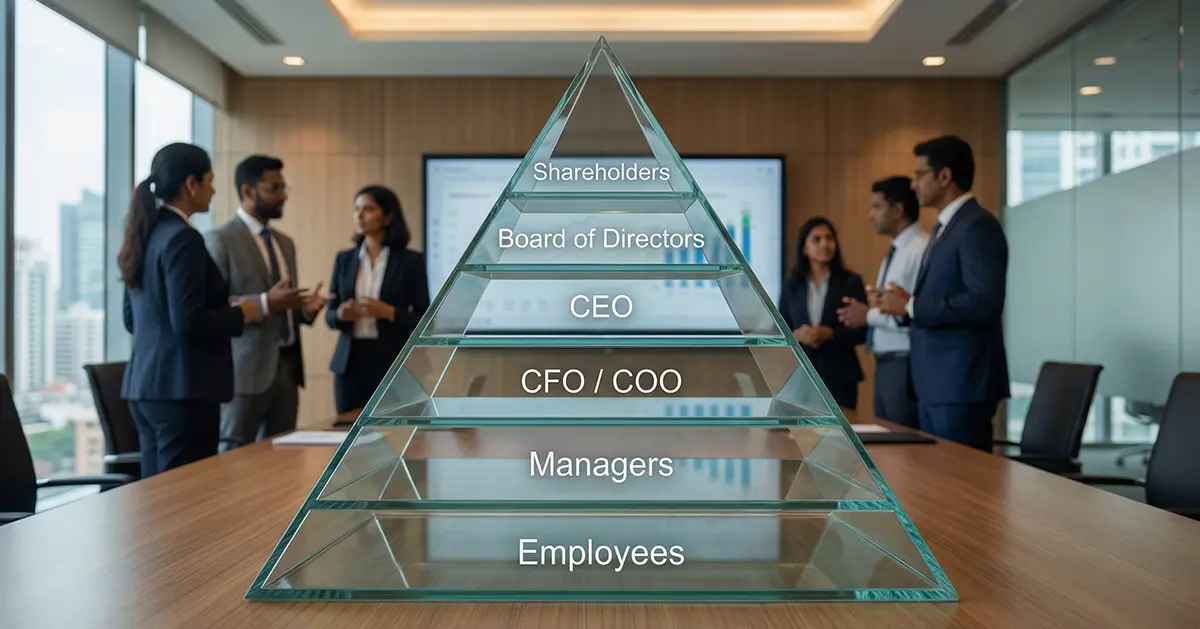
Designation Hierarchy in a Private Limited Company: Roles

How to Convert LLP to Private Limited Company in India

How to Open a Company Bank Account in India?

Top 10 Private Limited Companies in India
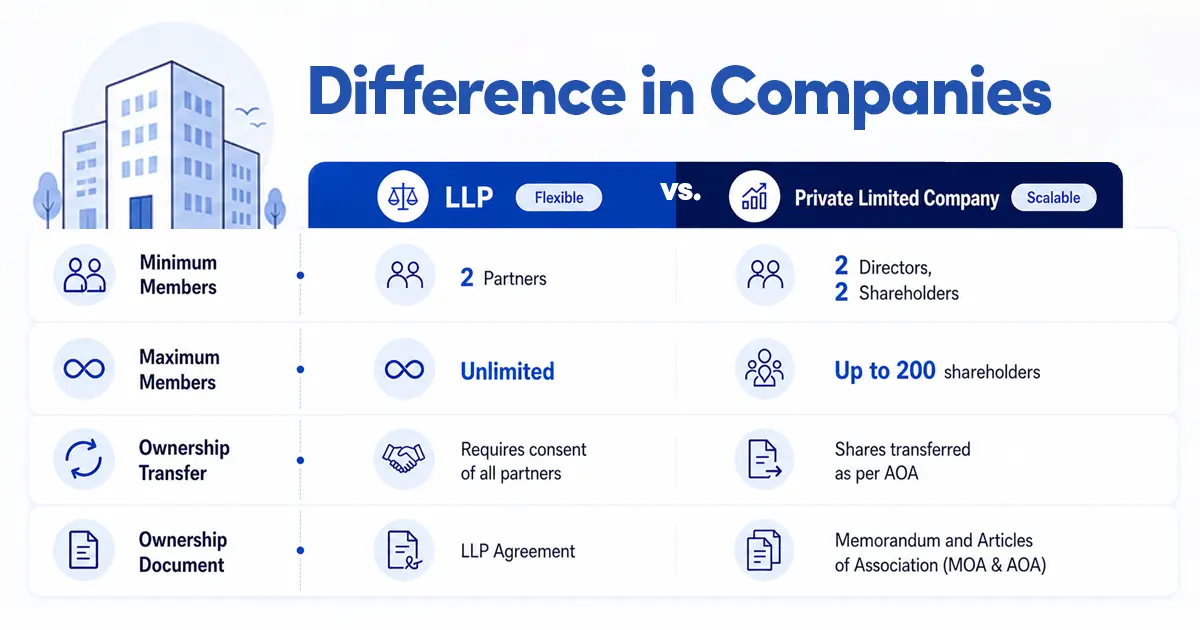
Difference Between Private Limited Company and LLP in India (2026)

Maximum & Minimum Number of Members in a Private Company

How to Run Multiple Businesses Under One Company in India?

Audit Requirements of a Private Limited Company: Types & Importance