

Foreign Director Appointment in an Indian Company: Procedure 2026
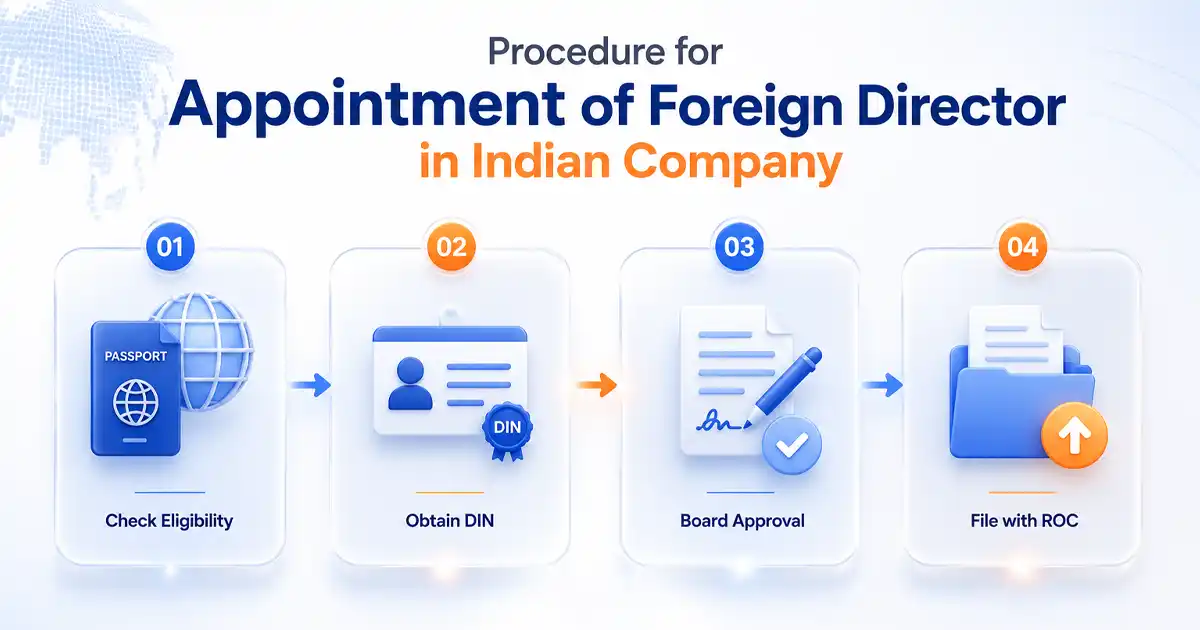
The procedure for the appointing a foreign director in an Indian company involves obtaining a DSC and a DIN, passing a board resolution, and filing Form DIR-12 with the ROC within 30 days. One condition always applies, though: every company with foreign directors must have at least one resident director who stayed in India for at least 182 days during the financial year.
Indian companies can appoint foreign nationals to their board as directors, and the law fully permits it. A foreign national can hold almost any director role, from Managing Director to Independent or Nominee Director.
The Companies Act, 2013, the Companies (Appointment and Qualification of Directors) Rules, 2014, and FEMA, 1999, govern this process, and none of them bars a foreign national from joining an Indian board. Foreign directors must also comply with FEMA regulations and Indian tax laws on the remuneration they receive once appointed.
In this guide, we’ll cover eligibility, documents required, the step-by-step procedure, the key forms (DIR-2, DIR-8, DIR-12), and the FEMA and tax compliance involved.
Key Takeaways
- Indian companies can appoint foreign nationals as directors; the Companies Act, 2013, does not bar it.
- Every company must have at least one resident director who stays in India for 182 days during the financial year.
- A foreign national must obtain a DSC and a DIN (Form DIR-3) before appointment.
- The company files Form DIR-12 within 30 days of appointment, along with Form DIR-2, Form DIR-8, and the board resolution.
- To appoint a foreign national as Managing or Whole-Time Director, the person must be a resident (12 months) under Schedule V, or the company needs Central Government approval.
- A national of a land-bordering country needs security clearance from the Ministry of Home Affairs (2022 Rules).
- Foreign directors must follow FEMA and tax rules under the Income Tax Act, 2025, including TDS and DIR-3 KYC.
Which Positions Can a Foreign National Hold in an Indian Company?
Under Section 2(34) of the Companies Act, 2013, a director is simply an individual appointed to a company’s Board. The Act does not prohibit foreign nationals from holding these directorship positions. Accordingly, a foreign national can be appointed to various roles in the board of an Indian company, including:
- Executive roles: Managing Director (MD) and Whole-Time Director (WTD).
- Non-executive roles: Independent Director, Nominee Director, Additional Director, Alternate Director, Small Shareholder Director, and Woman Director (where applicable).
One important exception applies to the executive roles. To appoint a foreign national as Managing Director or Whole-Time Director without Central Government approval, Schedule V requires the person to be a resident of India, that is, someone who has stayed in the nation continuously for at least 12 months before the appointment. Otherwise, the company needs prior Central Government approval in Form MR-2. However, this condition does not apply to companies in Special Economic Zones (SEZs).
Note: If a director’s stay exceeds 182 days, they may also be considered a tax resident of India under the Income Tax Act, depending on the duration and conditions of stay.
How Many Foreign Directors Can a Company Have?
There’s no specific cap required on the number of foreign directors, but few conditions applies:
- At least one director must be resident in India under Section 149(3).
- Minimum requirements for directors are 2 in a Private Limited Company, 3 for a Public Company and 1 for an OPC.
- The maximum number of directors can be 15, which is extendable by special resolution (Section 149(1)). So a board can be almost entirely foreign, as long as one resident director is in place.
Difference Between Resident Director and Foreign Director
A resident director is defined by physical stay in India, whereas a foreign director is defined by nationality.
The table below breaks down how the two differ:
| Basis | Resident Director | Foreign Director |
| Defined by | Physical stay in India | Nationality (a non-Indian citizen) |
| Requirement | Stayed in India for at least 182 days during the financial year (Section 149(3)) | A foreign national appointed as a director |
| Mandatory | Yes, every company must have at least one | No, a company may choose to appoint one |
| Nationality | Indian citizen or foreign national | Always non-Indian |
Key Advantages of Appointing Foreign Directors in Indian Companies
Bringing a foreign national onto the board offers several practical advantages for Indian companies, such as:
- Stronger internal policies: A foreign director introduces global best practices and can refine the company’s existing procedures.
- Global expansion: Their experience helps the company develop its operations and expand into new foreign jurisdictions.
- Wider client base: As operations grow and the company gains cross-cultural reach, its clientele expands.
- Operational strength: A foreign national’s expertise helps develop and strengthen the company’s core operations.
- Enhanced credibility: Diverse, global leadership boosts investor confidence and supports access to foreign investment.
- Knowledge transfer: A foreign director brings advanced technology, management practices, and a global perspective to the boardroom.
Eligibility Criteria for Foreign Directors in Indian Companies
The following are the eligibility criteria for the appointment of Foreign Directors in Indian Companies:
- The individual must have a valid passport;
- Every proposed director, including a foreign national, must obtain a Director Identification Number (DIN) before appointment.
- An ordinary director must be a major (18+); an MD or WTD must be at least 21 and not above 70 as per Section 196.
- The individual must not be disqualified under Section 164 (for example, an undischarged insolvent or convicted with a sentence of six months or more).
- The board must have at least one director who stayed in India for 182 days during the financial year.
- A foreign national in an executive role must hold a valid Employment Visa.
- A national of a land-bordering country must obtain MHA security clearance before appointment (2022 Rules).
- In case the Foreign National has experience in any skill that is the Company’s core operation, then he or she can be appointed as an Independent Director.
Documentation Required to Appoint Foreign Directors in Indian Companies
The documents a foreign director must submit, and how they are attested, depend on where the person is located:
Core Documents and Forms
Every foreign director must submit a standard set of documents and forms, regardless of location:
- Valid passport (identity proof).
- Recent address proof, not older than one year.
- Passport-size photograph.
- Class 3 Digital Signature Certificate (DSC).
- Form DIR-3 (DIN application).
- Form DIR-2 (consent, submitted to the company).
- Form DIR-8 (non-disqualification declaration).
- Form MBP-1 (disclosure of interest).
If the Foreign National is a Resident of India
A foreign national already living in India can have the documents attested locally:
- Valid residential permit or visa as proof of stay.
- Passport and address proof, self-attested and notarized before an Indian notary.
- Recent passport-size photograph.
If the Foreign National is in Their Home Country
The attestation method depends on whether the country signed the Hague Convention:
- Hague signatory: notarized locally, then apostilled.
- Non-signatory: notarized, then attested by the Indian Embassy or Consulate.
If the Foreign National Resides in a Third Country
If the person lives in a country other than their home country or India, the local Indian mission attests the documents:
- Passport.
- Visa.
- Application form with a photograph.
Documents for an Employment or Business Visa
A foreign national taking up a role in India must also arrange the right visa, which requires supporting documents:
- Proof of the company’s financial standing and an experience certificate.
- A valid travel document and a re-entry permit.
- Business activity documents, including business registration certificates.
A non-executive / non-resident foreign director attending board meetings (or joining virtually) generally does not need an Indian employment visa. A business visa suffices for such visits. An employment visa is needed only if the foreign national is taking up an executive role and working in India (e.g., a resident MD/WTD).
Conditions for a Business Visa
A Business Visa carries specific conditions that the foreign national must meet:
- Must not visit India for money lending, petty trade, or full-time employment.
- Must be a person of assured financial standing.
- Must comply with all requirements, such as paying tax liabilities.
Note: A PAN is not needed for the DIN, but a foreign director must obtain one if their financial transactions in India exceed ₹2,50,000 in a financial year.
Procedure for the Appointment of Foreign Directors in Indian Companies
After confirming eligibility and arranging the attested documents, the company carries out the appointment through these steps:
- Check the Articles of Association (AOA): Confirm that the AOA authorizes the board to appoint a foreign national as a director. If it does not, the company must alter the AOA first.
- Obtain DSC and DIN: The proposed director obtains a Class 3 DSC and then applies for a DIN in Form DIR-3 with attested documents, which must be notarized and apostilled for Hague Convention countries or consularized for non-Hague countries. A national of a land-bordering country must also attach a security clearance from the Ministry of Home Affairs.
- Collect consent and declarations: The company obtains the proposed director’s consent in Form DIR-2, a non-disqualification declaration in Form DIR-8, and a disclosure of interest in Form MBP-1.
- Pass a Board Resolution: The company convenes a board meeting under Section 173 of the Companies Act, 2013, and passes a resolution approving the appointment. If a Nomination and Remuneration Committee is required under Section 178, it first recommends the appointment before the board passes the resolution.
- File Form DIR-12 with the ROC: The company files Form DIR-12 within 30 days of the appointment under Section 170(2), attaching the board resolution, DIR-2, DIR-8, and the letter of appointment. A CA, CS, or CMA must certify the form, except for OPCs and small companies.
- Update statutory registers: The company records the appointment in its Register of Directors and Key Managerial Personnel.
- File additional forms for executive roles: For a Managing Director, the company also files Form MGT-14 within 30 days, and a public company files Form MR-1 within 60 days. (MGT-14 is not required for the appointment of a Whole-Time Director, and MR-1 does not apply to private companies.)
Note: Shareholders should confirm an additional director’s appointment at the next general meeting. The process usually takes one to two weeks once documents are ready. Importantly, the company must file DIR-12 within 30 days, since late filing attracts escalating fees (up to 12 times the normal fee) plus possible penalties.
Compliance for Foreign Directors in Indian Companies
After the appointment, the foreign director and the company must meet ongoing tax, foreign-exchange, and corporate requirements:
Income Tax Compliance
- A foreign director’s income earned in India is taxable under the Income Tax Act, 2025, which replaced the Income Tax Act, 1961, from 1 April 2026. The rates and treatment remain unchanged.
- The company must deduct TDS on the remuneration it pays to a non-resident director. A Double Taxation Avoidance Agreement (DTAA) between India and the director’s home country can reduce this rate.
- A foreign director must obtain a PAN if their financial transactions in India exceed ₹2,50,000 in a financial year.
FEMA Compliance
- A foreign director can receive remuneration, commission, and sitting fees like an Indian director, subject to FEMA, 1999.
- They may hold a foreign currency account outside India and receive their remuneration there.
- The company must route any remittance abroad through an authorized dealer bank by filing Form 15CA. Additionally, it must obtain Form 15CB (a CA’s certificate) once the taxable remittance crosses ₹5 lakh in a financial year.
Ongoing Corporate Compliance
- Every foreign director who holds a DIN must file DIR-3 KYC to keep it active. Under the 2026 rules, this filing is due once every three years, by 30 June.
Appointing a foreign director involves precise forms, attestation, and compliance. Get expert help with the appointment of a foreign director or the incorporation of a Company with foreign directors.
