

Conversion of Partnership Firm into Private Limited Company (2026)
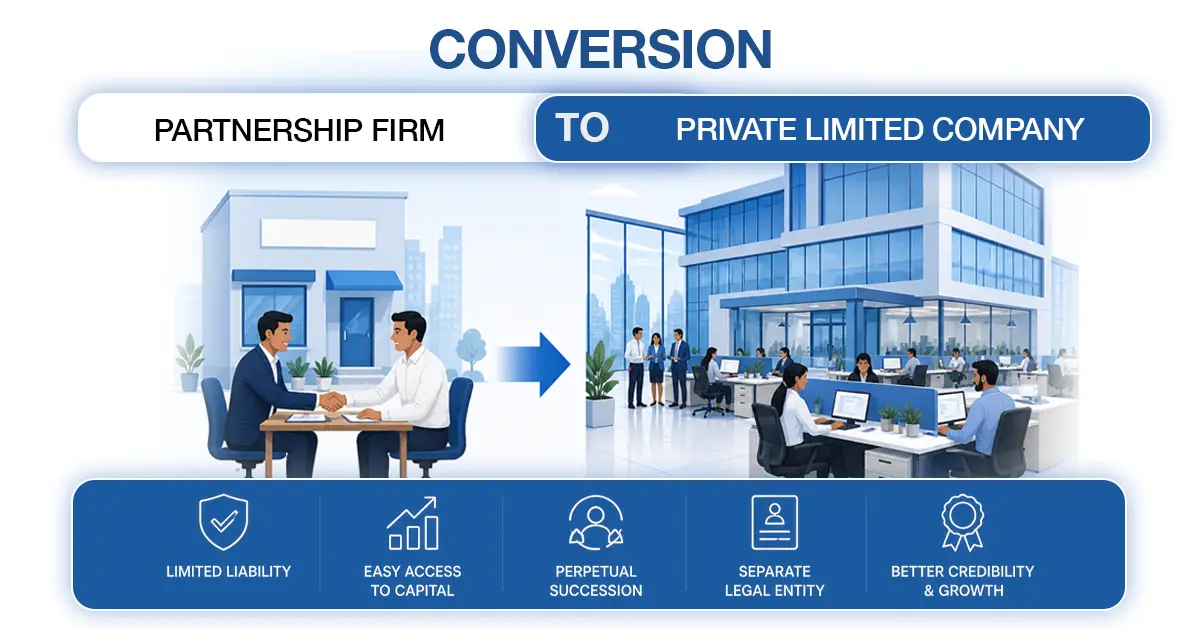
The conversion of a partnership firm into a Private Limited Company is regulated by Section 366 of the Companies Act, 2013, read with the Companies (Authorized to Register) Rules, 2014. A partnership firm with at least two partners can convert to a Private Limited Company. This has become popular among Indian businesses seeking limited liability, better funding access, and credibility.
Converting to a Private Limited Company gives the business a distinct legal identity and protects the personal assets of the partners. The company structure boosts credibility with clients, banks, and investors. It also enables professional management and supports long-term growth.
Key Takeaways
- A partnership firm converts into a Private Limited Company under Section 366 of the Companies Act, 2013, by filing Form URC-1 after publishing the mandatory Form URC-2 newspaper notice with a 21-day objection period.
- The conversion can be tax-neutral under Section 47(xiii) if the firm transfers all assets and liabilities, partners become shareholders in proportion to their capital contribution, receive only shares, and retain 50% voting power for five years.
- The conversion usually takes 20–30 working days and costs around ₹15,000–₹36,000+, depending on capital, state charges, and professional support.
- The new company receives a fresh PAN and TAN, obtains a new GST registration, can transfer eligible ITC through Form GST ITC-02, and gains limited liability, perpetual succession, and better funding opportunities.
Eligibility and Documents for Conversion of a Partnership Firm into a Private Limited Company
Before converting under Section 366 of the Companies Act, 2013, the partnership firm must meet the required conditions:
| Requirement | What’s required |
| Partner consent | Written consent from all partners approving the conversion |
| Partnership deed | Latest registered deed showing partner details and contribution ratio |
| Financial records | CA-certified statement of assets and liabilities and latest ITR |
| Firm registration | Certificate of Registration of the partnership firm |
| Directors | Minimum two directors with valid DIN and Class 3 DSC |
| Capital structure | Proposed authorized capital and shareholding pattern based on partner contributions |
| Tax compliance | No pending GST, income tax, or statutory dues |
| Creditor approval | NOC from all secured creditors |
| Public notice | Newspaper advertisement through Form URC-2 |
| Dissolution undertaking | Affidavit confirming dissolution of the firm after conversion |
| Registered office proof | Recent utility bill, ownership proof or rent agreement, and landlord NOC if applicable |
| KYC documents | PAN, identity and address proof, photographs, and passport copy for foreign nationals/NRI directors |
| Incorporation documents | MOA, AOA, INC-9, DIR-2, Form URC-1, and supporting attachments |
| Sector-specific approvals | Fresh or updated licences such as FSSAI, IEC, or Shops & Establishment registration, if applicable |
All documents must be self-attested, scanned in PDF format, and digitally signed before filing. Foreign documents require apostille or notarization as applicable.
How to Convert a Partnership Firm into a Company? Step-by-Step Guide
Here is the step-by-step procedure for the conversion of a partnership firm into a Private Limited Company:
Step 1: Obtain Partner Consent and and Director Credentials
All partners must provide written consent for the conversion. The proposed directors must also obtain a Class 3 DSC and a valid Director Identification Number (DIN) to complete MCA filings.
Step 2: Reserve Company Name (SPICe+ Part A)
File the proposed company name through the SPICe+ Part A on the MCA portal. The name must end with “Private Limited” and comply with naming guidelines under the Companies Act, 2013.
Step 3: Publish Newspaper Advertisement (Form URC-2)
Publish a notice in Form URC-2 in two newspapers, one English daily and one vernacular paper, inviting objections to the conversion. A 21-day window is mandatory before proceeding.
Step 4: Draft MOA and AOA
- Prepare the Memorandum of Association (MOA) defining the company’s objectives.
- Draft the Articles of Association (AOA) outlining governance rules, management structure, and operational framework.
Step 5: File URC-1 and SPICe+ Application and Receive COI
Submit Form URC-1 and SPICe+ application for Private Limited Company Registration with the RoC, attaching:
- Partner consent and a list of partners with shareholding patterns
- NOC from all secured creditors
- CA-certified statement of assets and liabilities
- Copy of newspaper advertisement (Form URC-2)
- Registered partnership deed and the latest ITR of the firm
- MOA, AOA, identity, and address proofs of director
After the RoC verifies both the Form URC-1 and the SPICe+ application, it issues the Certificate of Incorporation (COI), legally establishing the Private Limited Company.
Step 6: Transfer Assets, Liabilities, and Allocate Shares
While assets and liabilities of the partnership firm transfer automatically to the company, contracts may require novation or consent from counterparties.
You must also issue shares to partners in the same ratio as their capital accounts on the conversion date. This is required for tax-neutral conversion under Section 47(xiii).
Step 7: Update Registrations and Licenses
- Open new bank accounts or update existing ones in the company’s name.
- Update GST Registration, PAN, and other licenses.
- Notify vendors, clients, and government authorities about the change.
The full conversion of a partnership firm to a company process usually takes 20–30 working days, depending on document readiness and approvals.
How Much Does Conversion of a Partnership Firm into a Private Limited Company Cost?
The total partnership-to-Private Limited Company conversion cost typically ranges between ₹15,000 and ₹36,000 for a standard setup. Here’s a detailed breakdown:
| Fee component | Typical amount | Details |
| DSC (minimum two directors) | ₹5,000 (₹2,500 per director) | Class 3 DSC required for proposed directors to sign MCA forms |
| Government filing fees | Nil up to ₹15 lakh capital; slab-based above | RoC incorporation charges depend on authorised capital |
| Stamp duty on conversion | ₹1,000–₹5,000 | Applies to MOA and AOA; varies by state |
| Form URC-1 filing fee | ₹200–₹600 | RoC fee based on authorised capital |
| Professional fees | ₹1,999 | Covers CA/CS or service provider assistance for filings and documentation |
| Document preparation | ₹2,000–₹5,000 | Includes drafting MOA, AOA, consent letters, and supporting documents |
| Newspaper advertisement (Form URC-2) | ₹3,000–₹8,000 | Publication in one English and one regional newspaper |
| Post-incorporation compliance | ₹2,000–₹10,000 | Includes updating bank accounts, GST, licences, and statutory records |
| Total indicative cost | ₹15,000–₹36,000+ | Varies based on authorised capital, state charges, and professional support |
Tax Implications of Partnership to Pvt Ltd Company Conversion
Key tax implications during conversion are:
- Capital gains: Section 47(xiii) allows tax-neutral conversion if all assets and liabilities transfer, partners receive only shares, become shareholders, and retain 50% voting power for five years. Breaching these conditions withdraws the exemption under Section 47A(3).
- Loss carry-forward: Under Section 72A(6), the company can carry forward and set off unabsorbed depreciation indefinitely, while it can carry forward and set off business losses for up to 8 years.
- Stamp duty: No stamp duty applies on asset transfer, but it applies on MOA, AOA, and related documents.
- Tax rate: Companies may opt for 22% tax under Section 115BAA, while firms are taxed at higher effective rates.
- PAN/TAN: The company gets a new PAN and TAN via SPICe+. The firm’s PAN becomes inactive after conversion.
- GST: The transfer is treated as a going concern, so no GST applies. The firm can transfer unused input tax credit to the company using Form GST ITC-02.
