Producer Company Registration for Farmers & Agri
Register your Producer Company online starting from ₹25,000. RegisterKaro handles the entire ROC-compliant process for farmers and agri-producers, from your documentation to your final Certificate of Incorporation.
 ROC-Compliant Producer Company RegistrationEnd-to-End Documentation, e-MoA & e-AoA Filing by ExpertsPAN, TAN & Certificate of Incorporation IssuanceDedicated Support for Farmer & Producer EligibilityTransparent Pricing, No Hidden Charges

 What Sets Us ApartWhat Sets Us Apart
What is a Producer Company in India?
A Producer Company is a hybrid business entity registered under the Companies Act, 2013, formed by farmers and primary producers. Under Section 378C(5), a Producer Company is treated as a private limited company, but without any limit on the number of members.
The concept of a Producer Company was introduced in 2002 based on the recommendations of the Y.K. Alagh Committee. It was designed to give agricultural producers a legal structure that combines the mutual-benefit principles of a cooperative with the governance framework and capital-raising opportunities of a company. The structure was originally introduced under Part IXA of the Companies Act, 1956, and was later incorporated into Chapter XXI-A of the Companies Act, 2013, which governs Producer Companies today.
A Producer Company combines the member-owned and democratic principles of a cooperative society with the professional management and limited liability of a private limited company. It enables members to collectively manage activities such as production, harvesting, processing, marketing, and export of their produce, helping improve their income and overall economic well-being.
Producer Company Governing Laws - Companies Act, 2013
Producer Companies are governed by Chapter XXI-A (Sections 378A–378ZU) of the Companies Act, 2013, inserted by the Companies (Amendment) Act, 2020, and effective from 11 February 2021. These provisions carry forward the framework that earlier sat under Part IXA of the Companies Act, 1956, now consolidated under the 2013 Act.
- Formation: Producer companies can be formed by 10 or more individuals, 2 or more producer institutions, or a combination of both.
- Objects: Their primary objective is to advance the interests of their members, who are involved in producing primary agricultural produce.
- Activities: Producer companies are authorized to engage in various activities such as the production, harvesting, processing, marketing, and export of primary produce. They may also offer technical and other support services to their members.
- Membership: Membership centers on active producers. Under Section 378A, an "active member" is defined as one who meets the quantum and period of patronage set out in the company's own Articles of Association. This means each Producer Company defines its own specific threshold for active membership, rather than the Act imposing one fixed fraction.
- Management: They are managed by a board of directors elected by the members, ensuring a democratic governance structure.
- Limited Liability: Members' liability is limited to the amount unpaid on the shares they hold.
- Conversion: Existing cooperative societies have the option to convert into producer companies.
How is a Producer Company Different from a Cooperative Society?
A Producer Company and a Cooperative Society are both people-centric organizations that work for collective upliftment in India. However, they differ significantly in their legal structure, operational framework, and governance.
Here's a comparison between a Producer Company and a Cooperative Society in India:
| Feature | Producer Company | Cooperative Society |
| Governing Law | Companies Act, 2013 | State Cooperative Societies Act or Multi-State Cooperative Societies Act, 2002 |
| Registration Authority | Registrar of Companies (RoC) | Registrar of Cooperative Societies |
| Primary Focus | Business-oriented collective activities for producers | Mutual welfare and economic interests of members |
| Membership | Primary producers or Producer Institutions | Individuals or other cooperatives, subject to applicable law |
| Minimum Members | 10 individual producers or 2 Producer Institutions | Generally 10 individuals, but varies by state |
| Voting Rights | Generally one member, one vote | One member, one vote |
| Management | Board of Directors | Elected managing committee or board |
| Area of Operation | Can generally operate across India | Depends on the applicable cooperative law |
| Capital & Funding | Can access institutional finance and other funding options | Primarily member contributions, loans, and applicable funding schemes |
| Profit Distribution | Can distribute surplus based on members' participation or patronage | Surplus is generally allocated according to cooperative rules |
| Compliance | Higher compliance with regular RoC filings | Compliance depends on the applicable cooperative law |
Note: A Producer Company distributes surplus through patronage bonus based on member participation. It may also pay a limited dividend on share capital after allocating funds to statutory reserves like the General Reserve.
Benefits of Producer Company Registration for Indian Farmers
Registering a Producer Company helps farmers deal with everyday challenges and strengthens their position in unpredictable markets. The key benefits are:
- Enhanced Bargaining Power: By pooling their produce and resources through a Producer Company, farmers can collectively negotiate better prices for their inputs (like seeds, fertilizers, and machinery). They can also achieve higher prices for their output by directly accessing larger markets.
- Access to Larger Markets and Supply Chain Optimization: Producer Companies enable farmers to sell directly to wholesalers, retailers, processors, exporters, and bypass layers of intermediaries. This cuts wastage and transaction costs, putting a larger share of the consumer price in the farmer's hands. It also helps them meet the volume and quality requirements of large buyers.
- Improved Access to Finance and Credit: Producer Companies generally have better access to loans, grants, and subsidies than individual farmers due to their higher credibility and collective structure. They can benefit from bank financing, priority sector lending, and government support through NABARD's Producer Organisation Development Fund (PODF). They may also receive assistance from SFAC and NAFED. Additionally, they may receive assistance under the ₹6,865 crore Central Sector Scheme for the Formation and Promotion of 10,000 FPOs.
- Professional Management and Governance: A Producer Company operates under the Companies Act and is managed by a democratically elected Board. As a result, it benefits from a structured and professional framework that ensures transparent accounting, statutory compliance, and better decision-making for sustainable growth.
- Economies of Scale and Cost Efficiency: By purchasing inputs in bulk, Producer Companies can reduce the cost of seeds, fertilizers, and other resources. They can also lower transportation, packaging, and marketing expenses by working collectively. The savings can fund shared infrastructure, warehouses, cold storage, and processing units that no individual farmer could afford alone.
- Value Addition and Diversification: A Producer Company enables members to grade, process, package, and brand their produce. As a result, they can sell finished or semi-processed goods at higher prices and diversify their income streams.
- Limited Liability Protection: As a separate legal entity, a Producer Company provides limited liability to its members. This means that the personal assets of the farmers are protected from the company's debts or losses, mitigating financial risk.
- Access to Technology and Training: Producer Companies can provide members with modern farming techniques, improved seeds, and new technology. In addition, they can run training programs on agriculture, business management, and market dynamics to improve productivity.
- Government Support and Incentives: Eligible Producer Companies may benefit from various government schemes, subsidies, credit support, and agricultural development programmes. However, the 100% profit deduction under Section 80PA was available only for assessment years beginning before April 1, 2025, so it should not be listed as a current tax benefit for 2026.
- Perpetual Succession: Like other companies, a Producer Company has perpetual succession, meaning its existence is not affected by the death, retirement, or insolvency of its members. This ensures long-term stability and continuity of operations.
Objectives of the Farmer-Producer Company
The primary goal of a Producer Company is to bring farmers together to collectively operate their businesses as registered entities. It also empowers existing cooperative societies to transform into companies if they choose to do so.
Under Section 378B of the Companies Act, 2013, a Producer Company may carry out one or more of the following objects:
- Production and trade: Cultivating, harvesting, collecting, sorting, storing, selling, marketing, and exporting the primary produce of its members, or importing goods and services for their benefit. These tasks can be carried out by the company directly or through a third party.
- Processing: Activities such as preserving, drying, distilling, brewing, canning, packaging, and other methods of processing agricultural products.
- Supplying equipment: Manufacturing, selling, or distributing machinery, equipment, or materials primarily to its members.
- Education: Educating members and others about collaboration and mutual support through training and awareness.
- Support services: Delivering expert consultations, training, technical assistance, and research to benefit the members.
- Power and resources: Generating and supplying electricity, improving land and water usage, and facilitating communication related to agricultural activities.
- Insurance: Providing insurance coverage for farmers and their agricultural produce under relevant insurance schemes.
- Teamwork and cooperation: Encouraging collaboration, joint effort, and mutual assistance among members.
- Welfare: Offering welfare facilities and benefits to members as approved by the board of the company.
- Related activities: Undertaking additional activities that align with the above objectives or promote cooperation and mutual benefit among members.
- Finance: Providing funds or credit support for purchasing, marketing, processing, or selling produce, or any other related business activity mentioned above.
Structure of Producer Company in India
A Producer Company has a unique hybrid governance structure. It combines the democratic, member-centric principles of a cooperative with the professional management and legal discipline of a private limited company.
Board of Directors (BoD)
- Managed by a Board elected by the members in the General Meeting.
- Minimum 5 directors, maximum 15.
- Independent directors are not mandatory (unlike listed public companies).
- Directors hold office for a term of not less than one year and not exceeding five years, as specified in the Articles, and are eligible for re-appointment.
- The Board sets the strategic direction, policy, and oversight of operations.
Chief Executive Officer (CEO)
- Under Section 378W, every Producer Company must appoint a full-time CEO, who cannot be a member of the company.
- The CEO handles day-to-day management and reports to the Board, ensuring professional, expert-led operations.
General Meeting of Members
- Ultimate authority rests with the members through the Annual General Meeting and Extraordinary General Meetings.
- Members decide key matters, electing directors, approving financial statements, amending the AoA, and making major strategic moves by resolution.
- The "one member, one vote" principle applies regardless of shareholding. The exception is when all members are Producer Institutions, where voting can instead be based on patronage.
Internal Control & Audit
- Must maintain proper books of account and undergo annual statutory audits, like any company under the Act.
Statutory Compliance
- Must file annual returns, financial statements, and other documents with the RoC, providing a transparent, credible regulatory framework.
Eligibility for Farmer Producer Company Registration
Only primary producers can form a Producer Company. This requirement ensures that the company operates for the benefit of genuine farmers and producers involved in production-related activities.
Who Can Be a Member?
- Individuals: Any person engaged in "primary produce", covering agriculture, horticulture, animal husbandry, floriculture, pisciculture, viticulture, forestry and forest products, and related processing activities like drying, curing, and pickling.
- Producer institutions: Existing bodies formed by primary producers (such as farmer cooperatives or associations).
- Minimum members: 10 or more individual producers, or 2 or more producer institutions, or a combination of both.
- No maximum limit: There is no upper cap on the number of members a Producer Company can have.
- Active membership: Membership centers on active producers, defined as "active Members" under the Articles based on the quantum and period of their patronage (participation in the company's business). This is set out in Section 378A rather than a fixed statutory percentage.
- General Reserve: Under Section 378ZF of the Companies Act, 2013, a Producer Company must maintain a general reserve every year.
Who Can Be a Director?
- Directors must be individuals and are generally elected by the members from among themselves so that management represents the producers' interests.
- A Producer Company must have a minimum of 5 directors and a maximum of 15.
How Much Capital is Needed?
- Authorized Capital Requirement: The Companies Act, 2013, does not prescribe any minimum paid-up capital for a Producer Company. However, it requires every company to declare an authorized capital in its MoA.
- Authorized capital: ₹5,00,000 is commonly recommended as a baseline for growth.
- Paid-up capital: ₹1,00,000 is typically suggested for initial incorporation.
- Type of capital: A Producer Company can issue only equity shares (no preference shares), but may issue debentures. Members contribute capital by subscribing to shares, usually priced affordably to encourage broad participation.
Different Models of Producer Companies in India
Producer Companies aren't formally classified by law, but in practice, they're grouped by the sector their members operate in:
- Agricultural Producer Company: Formed by farmers and growers in crop cultivation, dairy, or poultry, to raise members' income and improve farming practices.
- Horticultural Producer Company: Brings together growers of fruits, vegetables, and flowers to improve product quality and open better marketing channels.
- Sericulture Producer Company: Formed by silk farmers, reelers, and weavers to improve silk quality, market access, and fair prices.
- Handloom Producer Company: Set up by handloom weavers and fabric producers to strengthen their economic position and expand sales.
- Forest Producer Company: Focuses on sustainable use of non-timber forest produce (medicinal plants, honey, lac, tendu leaves) and forest conservation.
- Livestock Producer Company: Formed by those in animal husbandry, dairy, poultry, goat, and sheep rearing, covering production, processing, and marketing of milk, meat, eggs, and wool.
- Service-Oriented Producer Company: Rather than dealing in a single produce type, these provide services to producer-members such as input supply, technical and advisory support, collective marketing and storage, credit and insurance, and value-added processing.
Documents Required for Producer Company Registration
You'll need different documents from every proposed director and member, plus proof for the registered office.
From Each Director and Member (Individuals)
| Document | Notes |
| Identity proof | PAN card (mandatory), Aadhaar card. Since membership and directorship are restricted to Indian primary producers, a foreign passport doesn't apply here. An exception may apply if a specific director is appointed on behalf of a qualifying producer institution with its own distinct documentation. |
| Address proof | Voter ID/driving licence/utility bill/bank statement, not older than 2 months |
| Photograph | Recent passport-sized photo |
| Digital Signature Certificate (DSC) | Required for all proposed directors and subscriber-members who sign the e-forms |
| Director Identification Number (DIN) | Required for each proposed director (can be applied for within the SPICe+ form) |
| Consent to act as director (DIR-2) | Signed declaration from each proposed director |
| Declaration of non-disqualification (DIR-8) | Confirms the director isn't disqualified under the Companies Act |
| Producer Declaration | Each member must declare that they are a primary producer engaged in eligible activities under the Companies Act |
For the Registered Office
| Document | When it's needed |
| Ownership proof (sale/property deed) + latest utility bill (≤2 months) | If the premises are owned by a director or a relative |
| No Objection Certificate (NOC) | If the premises are rented or owned by someone else |
| Utility Bill | Electricity, water, or gas bill of the premises for address verification |
| Rent agreement/lease deed | If the premises are rented |
Producer declaration ("Farmer Certificate")
There's no separate "Farmer Certificate"; instead, each member submits a declaration confirming they are a producer as defined under the Companies Act, 2013. To support the declaration, members may also provide:
- Land records (Khasra/Khatauni)
- Lease agreements for cultivated or farmed land
- Proof of agricultural income
How Farmers Can Register a Producer Company in India? Step-by-Step Process
Registering a Producer Company is a streamlined, fully digital process governed by the Companies Act, 2013, similar to the process followed for Pvt Ltd company registration in India. It involves several key steps:
Step 1. Apply for a DSC
All proposed directors and subscribers to the MoA must obtain a Digital Signature Certificate (DSC), as all incorporation forms are filed and signed electronically. At present, a Class 3 DSC is accepted for company registration purposes.
The process is fully online and is usually completed within 24 hours. It involves three levels of verification: document verification, video verification, and mobile number verification.
Step 2. Submit Application for Name Reservation
File Part A of SPICe+ (or the RUN service) to reserve the name, clearly stating the business activity code and the company's objective. The name must be unique, comply with the Emblems and Names (Prevention of Improper Use) Act, 1950, and must end with the words "Producer Company Limited."
Step 3. Submit e-MoA (INC-33) and e-AoA (INC-34)
File the electronic MoA, which sets out the company's objects and scope, and the AoA, which lays down its internal rules and management framework.
Step 4. Receive PAN, TAN & Incorporation Certificate
Once the MCA verifies and approves the documents, your PAN, TAN, and Certificate of Incorporation (COI) are issued. You can then open a current bank account in the company's name.
Within 30 days of incorporation, deposit the subscribed capital and appoint the first auditor. File Form ADT-1 with the ROC. Issue share certificates within 2 months, as required under Section 56(4). Hold the first AGM within 90 days under Section 378ZA.
Fees to Apply for Producer Company Registration
The total cost of registering a Producer Company in India generally ranges from ₹25,000 to ₹30,000. This may include government fees, Digital Signature Certificates (DSCs), and professional charges.
| Cost Component | Estimated Cost |
| Digital Signature Certificates (DSCs) | ₹2,000–₹5,000 |
| Government Fees | ₹6,000–₹8,000 |
| Professional Charges | ₹15,000–₹17,000 |
| Total Estimated Cost | ₹25,000–₹30,000 |
Note: Government fees vary by state due to differing stamp duty rates, so your actual cost may differ from this estimate depending on where you register.
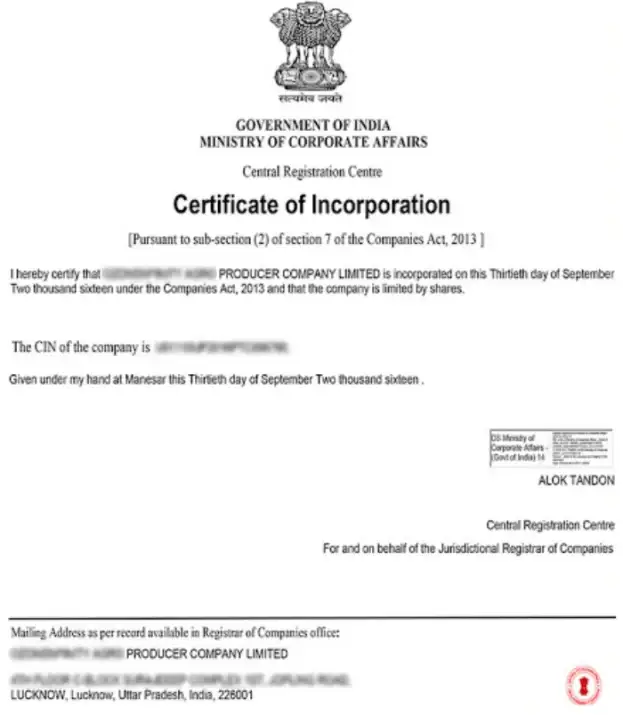
Producer Company Registration Certificate
The Certificate of Incorporation (COI) issued by the RoC (MCA) confirms the successful registration of a Producer Company in India.
How to Download the Producer Company Registration Certificate?
Once your Producer Company is incorporated, the MCA emails the digitally signed Certificate of Incorporation. You usually do not need to download it separately.
If you lose the original or need a certified copy, you can request one through the MCA V3 portal's Get Certified Copies service under Document Related Services.
Here's a general step-by-step process:
- Visit the Official MCA Portal: Go to the official website of the Ministry of Corporate Affairs at mca.gov.in.
- Log in to Your Account: You need to have registered user credentials on the MCA portal. Log in using your user ID and password.
- Navigate to 'MCA Services' → 'Document Related Services': On the current V3 portal, look for the "MCA Services" tab, then select "Document Related Services."
- Select 'Get Certified Copies' or 'View Public Documents': Depending on the MCA portal's current interface, you might find an option like "Get Certified Copies" or "View Public Documents" under the "MCA Services" menu.
- Search for Your Company: Enter your Company Identification Number (CIN) or the name of your Producer Company in the search box.
- Select the Incorporation Certificate: From the list of documents related to your company, find and select the "Certificate of Incorporation" or "Company Incorporation Certificate."
- Pay the Fee (If Applicable): Requesting a certified copy carries a fee starting from ₹100, per Section 399(1)(b) of the Companies Act, 2013. Complete the payment when prompted.
- Download and Save: Once the document is accessible, click the download button to save the certificate to your device.
How to Check the Status of a Producer Company Registration Certificate?
You can check the registration status of your Producer Company (or any other company registered in India) on the MCA portal. Here's how:
- Visit the Official MCA Portal: Go to mca.gov.in.
- Go to 'MCA Services': On the homepage, find and click on the "MCA Services" tab.
- Select 'View Company/LLP Master Data': From the dropdown menu, choose this option.
- Enter Company CIN or Name:
- If you have the CIN: Enter the 21-digit Corporate Identification Number (CIN) of your Producer Company.
- If you don't have the CIN: You can search by entering the company's name. You might need to use the search icon next to the "Company/LLP Name" field to find the CIN first.
- Complete the Captcha: Enter the displayed captcha code for verification.
- Click 'Submit': The system will display the company's master data, including its registration status, date of incorporation, registered address, and director details.
Post-Registration Compliance for Producer Company
After registration, a Producer Company must open a bank account and maintain statutory records. Additionally, it must conduct meetings and file annual returns and financial statements with the RoC.
What to Do Immediately After Getting Your Certificate
After receiving the Certificate of Incorporation for your Producer Company from the RoC, the following immediate steps are essential:
- Open a current bank account in the name of the Producer Company for all financial transactions.
- Deposit the subscribed capital into the company's bank account.
- Issue share certificates to all members for their subscribed shares within 2 months of incorporation, as required under Section 56(4).
- Apply for required registrations such as GST, Professional Tax (if applicable), and other sector-specific licenses.
- Appoint the first auditors within 30 days of incorporation, and file Form ADT-1 with the ROC to formally record the appointment, mandatory since a July 2025 amendment extended this filing requirement to first auditor appointments.
- Maintain statutory registers at the registered office as per the Companies Act.
- Ensure nominee details are updated for members as per legal requirements.
- Transfer the prescribed portion of profits to the General Reserve as required.
- A common seal may also be adopted, if required.
Annual Compliances for Producer Companies
Annual compliances for a Producer Company include the following:
- Filing Form MGT-7 (Annual Return) with details of members, directors, and shareholding.
- Form AOC-4 must be filed with audited financial statements, including the balance sheet and profit & loss account.
- Income Tax Return (ITR) must be filed annually, and a tax audit under Section 44AB is required if turnover exceeds the prescribed limits.
- GST annual return (GSTR-9/9C) must be filed if the company is registered under GST.
- A Director's Report must be prepared with details of performance and disclosures.
- At least four board meetings must be held in a financial year, with a maximum gap of 120 days between meetings, as required under Section 378V(1).
- Financial statements must be audited annually by a qualified Chartered Accountant.
Record Maintenance for a Producer Company
- Maintain proper books of accounts, including ledgers, cash books, invoices, receipts, bank statements, and vouchers for financial accuracy and audits.
- Keep statutory registers such as the register of members, directors, and KMP, charges, and minutes of meetings at the registered office.
- Record all resolutions passed in board and general meetings.
- Maintain operational records related to production, procurement, sales, inventory, quality control, and member transactions.
- Keep employee records, including contracts, payroll, attendance, and statutory deductions if applicable.
- Store copies of all filings made with RoC, MCA, Income Tax, GST, and other regulatory authorities.
Connect with RegisterKaro and let our experts handle the legal hassle while you grow your business.
Frequently Asked Questions (FAQs)
What is the main purpose of a Producer Company?
A Producer Company empowers primary producers, farmers, fishers, and artisans to organize as a formal company. Members pool resources to handle production, processing, marketing, selling, and export collectively, raising their incomes and strengthening their livelihoods.
How many people are needed to start a Producer Company?
You need at least 10 individual producers, or 2 or more producer institutions, or a combination of both. The company must also appoint a minimum of 5 directors. There's no upper membership limit.
Can a Producer Company do business with non-members?
A Producer Company must deal primarily with produce from its active members. It can transact with non-members in limited ways, sourcing inputs or selling surplus, but its core business stays focused on members.
Is income from a Producer Company tax-free?
No, a Producer Company's income isn't automatically tax-free; it pays corporate tax like any other company under the Income Tax Act, 2025. However, agricultural income generally remains exempt under applicable provisions.
How are profits distributed in a Producer Company?
A Producer Company distributes surplus mainly through a patronage bonus, based on each member's business volume with the company, rather than shareholding alone. Members may also receive a limited dividend after statutory reserve allocations.
What is the role of NABARD in helping Producer Companies?
NABARD supports Producer Companies through the Producer Organisation Development Fund (PODF), offering credit, grants, and technical guidance. This helps producer companies build infrastructure, access larger markets, and strengthen their operations.
How long does it take to register a Producer Company in India?
Registration usually takes 14 to 21 working days. The timeline depends on document submission speed, MCA name approval, and current processing times. The entire process runs online through the SPICe+ form.
Can a cooperative society be converted into a Producer Company?
Yes, an existing cooperative society engaged in primary production can convert into a Producer Company under the Companies Act, 2013. This lets it keep its member-focused character while gaining corporate governance advantages.
What statutory registers does a Producer Company need to maintain?
A Producer Company maintains several registers at its registered office, including the Register of Members, Register of Directors and Key Managerial Personnel, Register of Charges, and Minutes Books for meetings, kept up to date at all times.
Can a Producer Company have more than 50 members?
Yes, a Producer Company can have far more than 50 members. The law sets a minimum of 10 individuals or 2 producer institutions, with no maximum cap on total membership.
How much does it cost to register a Producer Company?
Registration typically costs around ₹25,000–₹30,000, including government fees, Digital Signature Certificates, and professional charges. The actual cost may vary based on the number of members, state stamp duty, and DSCs required.
What is the minimum capital required to register a Producer Company?
The Companies Act, 2013, doesn't mandate a strict minimum paid-up capital. Members commonly set ₹5,00,000 as authorized capital and ₹1,00,000 as paid-up capital, though you can adjust these based on your group's needs.
What is the difference between an FPO and a Producer Company?
A Farmer Producer Organization (FPO) is an umbrella term for any farmer-owned body, cooperative, society, or company. A Producer Company is one specific legal form of an FPO, registered under the Companies Act.
Can a Producer Company issue shares to the public or list on a stock exchange?
No, a Producer Company cannot invite public subscription for shares or debentures, and it cannot list on a stock exchange. Shares stay within producer-members and remain non-tradable, protecting against outside takeovers.
Does a Producer Company need to appoint a CEO?
Yes, under Section 378W, every Producer Company must appoint a full-time Chief Executive. The CEO cannot be a member and is responsible for the company's day-to-day management, reporting to the Board.
Is GST mandatory for a Producer Company?
GST registration becomes mandatory once turnover crosses the prescribed threshold, or immediately if selling through an e-commerce platform. It's also required for interstate supply or specific taxable activities regardless of turnover.
Can a Producer Company export agricultural products?
Yes, a Producer Company can export agricultural and allied products after meeting export regulations, including obtaining an Import Export Code (IEC) and complying with customs, quality, and documentation requirements for international trade.
Can NRIs become members of a Producer Company?
Only Indian primary producers and producer institutions can become members. NRIs cannot directly join unless they qualify as a recognized producer institution operating within India, keeping membership focused on active domestic producers.
Can a Producer Company receive government grants?
Yes, a Producer Company can receive grants, subsidies, and financial assistance under schemes run by NABARD, state governments, and central agencies, supporting infrastructure development, capacity building, and improved market access for members.
What is the minimum share value in a Producer Company?
The Companies Act doesn't set a fixed minimum share value. The company decides the face value of shares in its Articles of Association, allowing flexibility in structuring ownership and capital participation among members.

Reviewed by
Joel DsouzaJoel Dsouza is a Chartered Accountant (CA) and compliance expert with over 7 years of hands-on experience in company registration, tax structuring, GST, ROC filings, and MCA compliance. As a qualified member of the Institute of Chartered Accountants of India (ICAI) and Co-Founder at RegisterKaro, he has personally advised more than 1,000 startups and SMEs across India, helping founders navigate incorporation, regulatory frameworks, and financial planning from Day 1. With deep expertise across all three levels of Finance and Portfolio Management, Joel is committed to promoting financial literacy and simplifying India's startup ecosystem through clear, actionable guidance that entrepreneurs can act on immediately.
Why Choose RegisterKaro for Producer Company Registration?
A Producer Company involves more than standard incorporation, with specific membership, voting, reserve, and compliance requirements. Here's how RegisterKaro handles that complexity for you:
- Guidance grounded in current law: We track regulatory changes, like the 2025 rule making ADT-1 mandatory for first auditors, so you're never caught off guard.
- Fully digital, start to finish: DSC, name reservation, e-MoA, e-AoA, all handled online with minimal paperwork.
- One team, start to certificate: We prepare and file everything ourselves, no coordinating between multiple people.
- Support beyond incorporation: Annual filings, board compliance, auditor appointments, and statutory registers. We stay with you well past day one.

What Our Clients Say
View All
Rishabh Bajpai
 Verified
Overall, my experience with the incorporation process was good and well-managed. The team was supportive and responsive throughout the process & kept... Read more

Sanoj kumar padhi
VerifiedIt's a very Nice Place For Further requirement Of Company and Firm registration, I am Too Much Satisfied For the all Services and Support, Thank You R... Read more

Velvvora Global
VerifiedWe had a great experience with RegisterKaro. The entire registration process was smooth, well-organized, and completed efficiently. Their team maintai... Read more

Nethran DS
VerifiedIt's a very good experience with Register Karo on crossing the hurdle of registering my company i.r.o all documental procedures and follow up. Thank u... Read more

Tusshar Kant
VerifiedI contacted Registerkaro to register my company. They appointed Mr. Vishal Anand for help and he was my point of contact. I am extremely happy with t... Read more

Vineet Garg
Verified“I’ve had a good experience working with RegisterKaro for my agribusiness registration and compliance. They assisted with company incorporation smooth... Read more

Utsav Patel17
VerifiedCompany's advisors have really good knowledge about legal operations and they goes out of the way for successful incorporation of business. Really ap... Read more

Sameer Kulkarni
VerifiedThe support given by Register Karo in completing the formalities for company formation has been great. Ms. Shruti has been cooperative and supportive... Read more

Sannidhya M Sah
VerifiedI had a great experience with RegisterKaro while incorporating my company. They offered a good price for their services, and I was particularly impres... Read more

seespvtltd
VerifiedI used RegisterKaro for everything needed to set up my company, and their team gave me full support. Amazingly, they(specially startup team) got the r... Read more