Company Registration Online in India
Register your company online with RegisterKaro, an expert MCA registration service provider built for startups, SMEs, and new businesses. Get transparent fees with no visit required, trusted by 2 Lakh+ founders across India.
 Certificate of Incorporation, PAN, TAN & DIN in 7–15 working daysFree company name search & reservation (up to 2 options)Expertly drafted MoA & AoA + GST registration via AGILE-PRO-SBank-account-ready document kitEnd-to-end post-incorporation compliance support

 What Sets Us ApartWhat Sets Us Apart
Choose the Best Company Registration Plans According to Your Business Structure
Private Limited Company (Pvt Ltd)
- Easy Investor Onboarding
- High Growth Potential
What's Included
- Expert assistance
- Company name help
- SPICe+ form in 3-4 working days
- Company PAN + TAN
- MOA + AOA
- PF & ESIC
- DSC preparation in 3-4 days
- Incorporation certificate in 7-10 days
- DIN for directors
- Business commencement certificate
Limited Liability Partnership (LLP)
- Lower Compliance Requirements
- Flexible Management
- Limited Liability Protection
What's Included
- Expert assistance
- Company name filed and approved
- DSC preparation
- FiLLiP form in 2-3 working days
- Incorporation certificate
- LLP PAN + TAN
- DPIN for designated partners
- DSC
One Person Company (OPC)
- Limited Liability Protection
- Full Ownership
- Legal Recognition
What's Included
- Company name help
- DSC preparation in 3-4 days
- SPICe+ form in 3-4 working days
- Incorporation certificate in 7-10 days
- Company PAN + TAN
- DIN for directors
- MOA + AOA
- DSC
- Business commencement certificate
- PF & ESIC
What is Company Registration in India?
Company registration is the process of legally incorporating a business under the Companies Act, 2013. Once registered, your company becomes a separate legal entity, distinct from its owners. This means it can own assets, sign contracts, open bank accounts, and raise funds in its own name, and your personal assets stay protected if the business runs into debt.
According to the MCA, more than 31 lakh companies have been registered in India, of which over 20 lakh are active and doing business as of August 2026.
Under the Companies Act, 2013, registering a company brings primary advantages that unregistered individuals or businesses don’t usually get:
- Owning property and assets in the company's own name
- Suing and being sued in the company's name
- Transferring ownership smoothly through share transfer, without disrupting operations
- Issuing equity shares to raise capital from investors
- Granting ESOPs to attract and retain employees
- Raising debt through debentures and convertible instruments
- Receiving Foreign Direct Investment under the automatic route
Different Options for Company Registration in India
India recognizes several business structures where each have their own unique registration procedure, compliance requirements, and tax treatment. These include:
1. Private Limited Company
A Private Limited Company, governed by the Companies Act, 2013, is a separate legal entity that offers limited liability to its shareholders.
Best For: Startups and growing businesses planning to raise external funding.
2. Limited Liability Partnership (LLP)
A Limited Liability Partnership structure gives partners limited liability with more flexible management and compliance than a company.
Best For: Professionals, consultants, and service businesses with two or more owners.
3. One Person Company (OPC)
OPC registration gives a single founder limited liability and a separate legal identity with just one member and one nominee (Section 2(62), Companies Act, 2013)
Best For: Solo founders and professionals who want a corporate structure without bringing in partners.
4. Public Limited Company
A Public Limited Company can raise capital from the public and list its shares on a stock exchange, subject to applicable legal and regulatory requirements.
Best For: Larger businesses that plan to access public capital markets.
5. Sole Proprietorship
A sole proprietorship is the simplest business structure in India, which offers the single owner complete control with minimal paperwork.
Best For: Freelancers, traders, small retailers, and local businesses.
6. Partnership Firm
A partnership firm is a business owned and operated by two or more partners who share profits and responsibilities under the Indian Partnership Act, 1932.
Best For: Small businesses with two or more owners wanting a simple, low-cost setup.
7. Section 8 Company
A Section 8 Company is a not-for-profit organization formed for objectives such as charity, education, social welfare, or environmental protection under the Companies Act, 2013.
Best For: NGOs, charitable organizations, and social initiatives seeking a formal corporate structure.
8. Nidhi Company
A Nidhi Company, registered under Section 406 of the Companies Act, 2013, is a mutual benefit organization established to promote savings among its members. It is registered under Section 406 of the Companies Act, 2013.
Best For: Mutual-benefit groups focused on member savings and lending.
9. Producer Company
Registered by farmers, agriculturalists, and producer groups, a Farmer Producer Company pools resources, strengthens bargaining power, and supports collective processing and marketing.
Best For: Farmers, agricultural producers, and other producer collectives.
10. Startup India
Not a separate company structure, the Startup India initiative brings a DPIIT recognition layered on top of your Pvt Ltd, LLP, or OPC, unlocking tax holidays, faster IP filing, and self-certification benefits.
Best For: Eligible startups seeking benefits such as tax incentives, easier compliance, and support for intellectual property.
How to Choose the Right Business Structure in India?
Choosing a business structure is less about picking the most popular option and more about matching the structure to your business goals, risk, funding plans, and growth stage. Consider these factors together before deciding:
- Number of owners: A single founder can choose an OPC for limited liability or a proprietorship for simpler operations. Two or more owners seeking limited liability can consider an LLP or Private Limited Company, while a partnership firm suits those who prefer a simpler structure.
- Personal risk: If business debts or legal claims could put your personal assets at risk, an OPC, LLP, or Private Limited Company provides limited liability protection. A proprietorship or partnership may work when the business carries relatively low risk, and you want fewer compliance obligations.
- Tax treatment: A proprietorship or partnership is taxed based on the applicable tax rules, with individual rates applying to proprietorship income (up to 30% plus surcharge). A Private Limited Company or OPC can opt for a 22% tax rate under Section 115BAA, subject to conditions, while an LLP is generally taxed at 30%. Compare the overall tax impact before choosing based on rates alone.
- Funding plans: If you plan to raise equity from angel investors or VCs, a Private Limited Company is generally the best fit because it can issue shares. An LLP can raise capital through partner contributions, but proprietorships cannot issue equity.
- Compliance capacity: A Private Limited Company generally involves the most ongoing compliance, including ROC filings, audits, Board meetings, and an AGM. An LLP has fewer formalities, while a proprietorship typically has simpler tax and business compliance.
- International operations: A Private Limited Company is usually better suited to businesses planning exports, FDI, or overseas expansion. LLPs can also undertake international activities and receive FDI, but the applicable conditions and procedures can be more restrictive.
Eligibility Criteria for Company Registration in India
Founders must meet these conditions set by the Ministry of Corporate Affairs (MCA) before filing:
| Requirement | What's Needed | Applies To |
| Minimum Directors & Shareholders |
| All company types (varies by structure) |
| Resident Director | At least one director resident in India and must have stayed 182+ days in the financial year (Section 149(3), Companies Act, 2013); for an OPC, the threshold is 120 days (post-2021 amendment) | All companies |
| Registered Office | A valid address in India (residential or commercial), with a recent utility bill and the owner's NOC | All companies |
| DIN & DSC | A Director Identification Number (DIN) and Digital Signature Certificate (DSC) for every director (DIN allotted via SPICe+ for up to 3 directors) | All directors |
| Minimum Age | Directors must be 18 or older and legally competent to contract | All directors |
| Foreign Nationals | Eligible as directors or shareholders; passport and address proof must be notarized and apostilled | Foreign directors/shareholders |
| Valid KYC | PAN, Aadhaar, and address proof dated within 60 days | All Indian applicants |
| Unique Name | A name not identical or deceptively similar to an existing company or registered trademark | All companies |
| Lawful Object | A legal business activity; restricted activities (banking, insurance, stock broking) need a license | All companies |
| No Minimum Capital | No minimum paid-up capital | All companies |
Before you finalize a name, run it through a free company name search to confirm availability with the MCA and the trademark registry at the same time. It's the single most effective way to avoid a Form Part A rejection.
Documents Required for Company Registration in India
Document requirements for business registration vary by structure. Below are the primary documents for the top 5 company registration structures in India:
1. Private Limited Company (Pvt Ltd)
- PAN and Aadhaar of directors and shareholders
- Address proof of directors and registered office
- Passport-sized photographs of all directors and shareholders
- e-MoA (INC-33) and e-AoA (INC-34)
- DSC and DIN of all directors
For a complete breakdown, check out the Private Limited Company document list.
2. One Person Company (OPC)
- PAN and Aadhaar of the sole owner
- PAN, Aadhaar, and consent of the nominee in Form INC-3
- Address proof of the owner and registered office
- Passport-sized photograph of the owner
- MoA & AoA
- DSC and DIN of the owner
3. Limited Liability Partnership (LLP)
- PAN and Aadhaar of partners
- Address proof of partners and registered office
- Passport-sized photographs of partners
- LLP Agreement signed by all partners
- DSC and DIN for designated partners
4. Partnership Firm
- PAN and Aadhaar of all partners
- Partnership deed signed by all partners
- Address proof of partners and registered office
- Passport-sized photographs of partners
- Utility bill or rent agreement as proof of office
5. Sole Proprietorship Firm
- PAN and Aadhaar of the proprietor
- Proof of business address (rent agreement or utility bill)
- Bank account proof
- Passport-sized photograph of the proprietor
- Business license or GST registration (if applicable)
How to Register a Company Online in India?
The process of company incorporation starts with choosing your company structure and ends with ROC approval and the Certificate of Incorporation. Here is the step-by-step process:
Step 1: Choose the Right Business Structure
Select the company type based on your ownership, funding plans, liability, and compliance needs. Your choice determines the incorporation forms, fees, and compliance requirements.
Estimated Timeline: 1 working day (planning)
Step 2: Apply for Digital Signature Certificate (DSC)
Get a Class 3 DSC for every proposed director to digitally sign the incorporation forms.
- Apply through a licensed provider such as eMudhra, Sify, or Ncode.
- Submit PAN, address proof, and a photograph.
Estimated Timeline: 1-2 working days
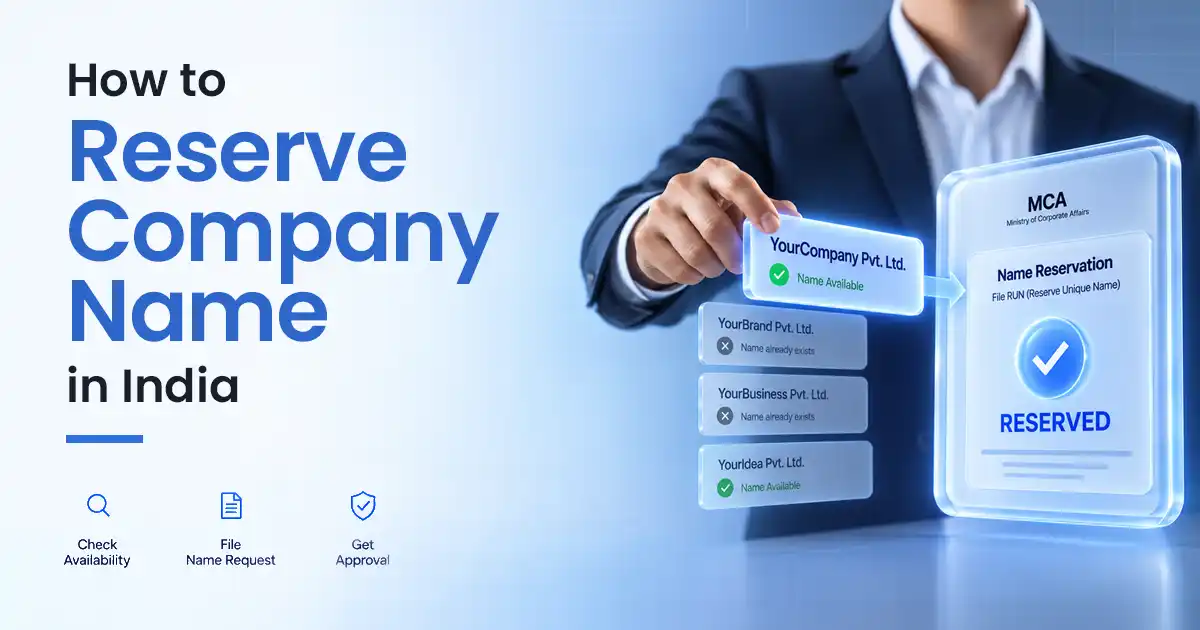
Step 3: Reserve Your Company Name
Propose up to two names through SPICe+ Part A. The MCA checks them against existing companies, trademarks, and prohibited words. An approved name remains reserved for 20 days.
Note: You generally do not need to apply for DIN separately. SPICe+ can allot DIN to up to three proposed directors. For LLPs, designated partners receive DIN through FiLLiP. A standalone DIR-3 is generally used when appointing a fourth director or in other eligible cases.
Estimated Timeline: 1–3 working days
Step 4: Draft Incorporation Documents (MoA & AoA)
These define your company’s legal framework:
- MoA: States business objectives and operational scope.
- AoA: Governs internal procedures, director roles, and voting rights.
For a Private Limited Company and OPC, file these electronically as INC-33 and INC-34.
Estimated Timeline: 1–2 working days
Step 5: Complete Consents and Declarations
Provide the declarations and consents required from the proposed directors and subscribers:
- INC-9: Declaration from the subscribers and first directors confirming that they meet the legal requirements for incorporation.
- DIR-2: Written consent from each proposed director to act as a director of the company.
Submit these documents with the incorporation application as required.
Estimated Timeline: Same day
Step 6: File SPICe+ Part B + AGILE-PRO-S
Complete the SPICe+ application with the company's incorporation details and upload the required documents:
- Company details: Enter the proposed business activity, authorised capital, registered office, and other incorporation details.
- Director and shareholder details: Provide the required personal and ownership information.
- Attachments: Upload the MoA, AoA, KYC documents, registered office proof, INC-9, DIR-2, and other applicable documents.
- Submission: Sign the forms digitally and submit the completed application to the MCA for processing.
Estimated Timeline: 1–2 working days
Step 7: Pay Statutory Fees and Stamp Duty
Pay the applicable government fees and state stamp duty when submitting the incorporation forms:
- Government fees: Depend on the company type and authorized capital and are nil up to ₹15 lakh of authorized capital, subject to applicable rules.
- Stamp duty: Varies by state. Punjab (starting from ₹10025), Karnataka (starting from ₹10020), and Madhya Pradesh (starting from ₹7550) are among the states with higher applicable charges.
Estimated Timeline: Same day
Step 8: Receive your Certificate of Incorporation
Once the ROC approves the application, the company receives its Certificate of Incorporation (COI) along with its CIN, PAN, and TAN digitally.
What is a Company Registration Certificate?
A Company Registration Certificate, officially the Certificate of Incorporation (COI), is the government-issued document that proves your company legally exists under the Companies Act, 2013. The Registrar of Companies issues it digitally through the MCA21 portal.
It is your company's legal proof of existence. Without it, you cannot open a current account, sign contracts in the company's name, apply for statutory registrations, or raise investment. The CoI contains:
- Company Name: As approved during SPICe+ filing.
- CIN: The Corporate Identification Number is a 21-character alphanumeric code assigned by the ROC that encodes your company's listing status, industry (NIC code), state, year of registration, ownership type, and a 6-digit registration number.
- Date of Incorporation: The company's legal formation date.
- PAN and TAN: If applied through SPICe+, which they usually are.
- Company Type: Private Limited, LLP, OPC, etc.
- Registered Office Address: The company's legal address
Estimated Timeline: 3–7 working days
Note: Registration costs vary depending on company type, authorized capital, and state of registration.
Company Registration Fees in India
Total business registration cost depends on three variables: the company type, the authorized capital, and the state of registration (which sets stamp duty). The table below breaks down each cost component across the three most common structures.
| Cost Component | Private Limited Company | LLP | One Person Company (OPC) |
| Name Reservation | ₹1,000 (SPICe+ Part A) | ₹200 (RUN-LLP) | ₹1,000 (SPICe+ Part A) |
| Digital Signature Certificate (DSC) | ₹2,500 per director | ₹2,500 per partner | ₹2,500 per director |
| Government Filing Fee (MCA) | Nil up to ₹15 lakh authorized capital | ₹500–₹5,000 (by contribution slab) | Nil up to ₹15 lakh authorized capital |
| Stamp Duty on MoA & AoA | ₹135–₹15,020 (varies by state) | 0.1%–1% of contribution (varies by state) | ₹135–₹15,020 (varies by state) |
| MoA & AoA / LLP Agreement Drafting | Usually included in professional fees | Usually included in professional fees | Usually included in professional fees |
| Professional Fees | ₹1,499 | ₹1,499 | ₹1,499 |
| Post-Incorporation Registrations (PAN, TAN, GST, EPFO, ESIC, bank) | Included via AGILE-PRO-S | Included / nominal | Included via AGILE-PRO-S |
| Typical All-In Estimate | ₹8,000–₹15,000 | ₹6,000–₹35,000 | ₹5,000–₹17,500 |
Note: PAN and TAN are issued as part of the SPICe+ process at no separate cost, and DIN is allotted free with incorporation.
For a state-by-state cost breakdown, read our detailed post on company registration fees in India.
How Long is a Company Registration Certificate Valid in India?
A company's Certificate of Incorporation does not expire. Once incorporated, the company continues to exist as a separate legal entity even when its directors, shareholders, or ownership change. It ceases to exist only when it is legally wound up, struck off, or merged with another company.
However, maintaining active status requires ongoing compliance. Key obligations include:
| Aspect | Requirement | Consequence of Default |
| Commencement of Business | File INC-20A within 180 days of incorporation | ROC can initiate strike-off under Section 248; borrowing restrictions may apply |
| Annual ROC Filings | File AOC-4 and MGT-7/MGT-7A every year | ₹100/day per form, with no upper limit |
| Statutory Compliances | Complete Board meetings, AGM, statutory audit, statutory registers, and DIR-3 KYC | Penalties and potential loss of good standing |
| Director Disqualification | Failure to file financial statements or annual returns for 3 consecutive years | Directors can face disqualification under Section 164(2) for 5 years |
| Strike-Off Risk | Company does not carry on business for 2 consecutive financial years | ROC may initiate strike-off under Section 248 |
Advantages of Company Incorporation in India
Business registration creates a separate legal identity, protects personal assets, and gives your venture more options for funding and expansion. Key advantages include:
- Separate Legal Identity: The company becomes a distinct legal person under the Companies Act, 2013. It can own property, enter contracts, and sue or be sued in its own name.
- Limited Liability: Shareholders are generally liable only up to their unpaid share capital, protecting their personal assets from business debts and claims.
- Perpetual Succession: The company continues to exist even when directors or shareholders change, or an owner dies.
- Lower Tax Rates: Domestic companies generally pay tax at 25–30%, with concessional rates of 15–22% available to eligible companies under Sections 115BAA and 115BAB.
- Access to Government Schemes: Incorporated businesses can seek Startup India, MSME/Udyam, and DPIIT recognition, which may provide access to tax benefits and government support.
- Easier Fundraising: Companies can issue equity shares, preference shares, and debentures to investors, banks, and NBFCs and can receive FDI under applicable routes.
- Increased Credibility: A valid CIN and Certificate of Incorporation strengthen your credibility with customers, lenders, investors, and business partners and can support participation in larger contracts and tenders.
- Easy Ownership Transfer: Shares can be transferred or sold without affecting the company's continuity, making ownership changes and succession easier.
- Brand and IP Protection: A company can protect its brand name, logo, and other intellectual property through trademark and copyright registration.
- Global Market Access: A company can expand internationally, establish overseas subsidiaries, and export using an IEC.
Connect with RegisterKaro and let our experts handle the legal hassle while you grow your business.
Frequently Asked Questions (FAQs)
How long does it take to register a company in India?
Company registration typically takes 7 to 15 working days once your documents are ready. The timeline depends on DSC issuance, MCA name approval, and ROC processing. Delays usually come from name rejections or incomplete director KYC, both of which a professional filing helps you avoid.
What is the minimum capital required to register a company in India?
There is no minimum paid-up capital requirement. You can start a Private Limited Company or OPC with any amount of capital. MCA filing fees are nil up to ₹15 lakh of authorized capital, so you only pay stamp duty and professional charges at the lower end.
Can a single person register a company in India?
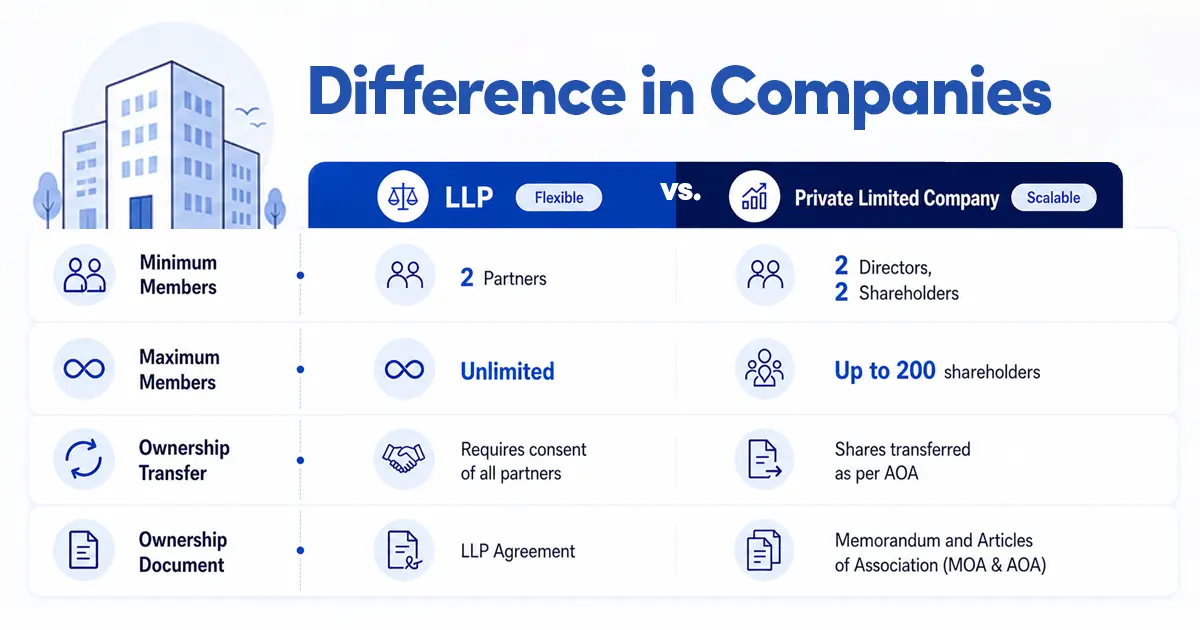
Yes, a single person can register a One Person Company (OPC), which needs one director and one nominee. To register a Private Limited Company, you need a minimum of two directors and two shareholders, though the same two people can hold both roles.
Can foreign nationals or NRIs register a company in India?
Yes, foreign nationals and NRIs can be directors and shareholders in an Indian Private Limited Company, subject to FDI rules. The company must still have at least one director who is a resident of India (stayed at least 182 days during the financial year).
Is GST registration included in company incorporation?
GST registration is optional at incorporation and can be applied for through the AGILE-PRO-S form alongside SPICe+. You are legally required to register for GST only once your turnover crosses the threshold or you undertake activities that mandate it.
Is DIN charged separately during registration?
No, DIN is allotted free of cost through the SPICe+ form for up to three directors at the time of incorporation. A separate DIR-3 application is needed only when appointing a fourth director or in other eligible cases.
What are the compliances after company registration?
After incorporation, you must file INC-20A (commencement of business) within 180 days, appoint an auditor via ADT-1 within 30 days, and file annual returns (AOC-4 and MGT-7/MGT-7A). Directors must also complete DIR-3 KYC. Missing these attracts penalties and, over time, strike-off risk.

Reviewed by
Joel DsouzaJoel Dsouza is a Chartered Accountant (CA) and compliance expert with over 7 years of hands-on experience in company registration, tax structuring, GST, ROC filings, and MCA compliance. As a qualified member of the Institute of Chartered Accountants of India (ICAI) and Co-Founder at RegisterKaro, he has personally advised more than 1,000 startups and SMEs across India, helping founders navigate incorporation, regulatory frameworks, and financial planning from Day 1. With deep expertise across all three levels of Finance and Portfolio Management, Joel is committed to promoting financial literacy and simplifying India's startup ecosystem through clear, actionable guidance that entrepreneurs can act on immediately.
Why Choose RegisterKaro for Company Registration in India?
RegisterKaro handles your company registration from name approval to the Certificate of Incorporation, giving you expert support throughout the process. Here's what you get:
- CA-Led Filing: CA and CS professionals handle your SPICe+ and AGILE-PRO-S filings, helping ensure accurate submissions and reduce MCA queries.
- Transparent, All-Inclusive Pricing: Know your total cost upfront, including government fees, professional charges, and the services covered.
- End-to-End Support: We handle document collection, MoA and AoA preparation, name reservation, and ROC filing, so you don't have to manage the paperwork yourself.
- Fast Turnaround: Most incorporations are completed within 7 to 15 working days, with your Certificate of Incorporation, PAN, TAN, and DIN provided digitally.
- Post-Incorporation Support: Get assistance with INC-20A, auditor appointment, GST, and annual ROC compliance after incorporation.
- Dedicated Expert Support: A dedicated professional guides you through the process, keeps you updated, and helps resolve queries at each stage.

What Our Clients Say
View All
CAREER FORUM
 Verified
Have great experiance with Registerkaro for company registration and compliance related services. The entire process was very fast. A special thanks t... Read more

Mohit Malik
VerifiedI had a very positive experience with the GST compliance and registration services. The entire process was smooth, quick, and clearly explained. The t... Read more

Allan Frank Stephen
VerifiedI had an excellent experience with RegisterKaro, thanks to Anu Scaria. Anu guided me very well through the MCA incorporation process and provided dail... Read more

Abdul Basith
VerifiedI contacted Registerkaro to create an LLP and they had assigned me Mr. Priyabrata. He had done an excellent job and completed the work very much soone... Read more

manju devi
VerifiedIt was my first time where i used registerkaro services. I had a very great experience. The staff was very supportive and experienced. Special thanks... Read more

Karan Ahuja
VerifiedExcellent service from RegisterKaro! The team was knowledgeable, supportive, and made the whole process very easy. Everything was handled professional... Read more

Nikhil Kumar
VerifiedI’m extremely pleased with the efficient and professional service provided by Saharsh Baranwal and his team during the incorporation of my company. Th... Read more

Malar Mannan
VerifiedVery good Experience to do business with RegisterKaro. They working with us (IMSOFAI) from company registration to annual compliance and their staffs... Read more

Shashank Mishra
VerifiedHad a seamless experience incorporating my company through RegisterKaro. The entire process was smooth, well-coordinated, and handled with great profe... Read more

Shivani Nagwanshi
VerifiedI really appreciate register karo because I am new in company incorporation process I don't know the procedure but register karo help me a lot and mak... Read more
Related Blogs
View All
Form MGT-14: Meaning, Resolutions, Due Date & Fees

How to Start a Finance Company in India: 2026 Registration Guide

How to Register a Media Company in India: Process & Licenses

How to Register a Software Company in India?

Wholly Owned Subsidiary: Meaning, Examples & Incorporation Process
Company Name Reservation in India: Rules, Process & Fees
Difference Between Private Limited Company and LLP in India (2026)

Minimum and Maximum Number of Directors in a Public Company

Maximum & Minimum Number of Members in a Private Company
How to Run Multiple Businesses Under One Company in India?