Startup India Registration (DPIIT Recognition)
Register your business under the Startup India scheme (DPIIT Recognition) with ease. Unlock tax exemptions, funding access, and compliance benefits with expert help from RegisterKaro.
 DIPP/DPIIT Recognition SupportFunding & Tax Incentives AssistanceFast Loan Application ProcessingComplete Compliance GuidanceTrusted by 20,000+ Startups

 What Sets Us ApartWhat Sets Us Apart
What is Startup India Registration (DPIIT Recognition)?
Startup India Registration, officially known as DPIIT Recognition, is a government initiative that gives your business the official status of a startup in India. It was launched under the Startup India Scheme by the Department for Promotion of Industry and Internal Trade (DPIIT).
By registering your business under this scheme, you can unlock benefits like:
- Tax exemptions
- Funding opportunities
- Fast-track patent filing
- Simplified compliance
- Access to government tenders and investor networks.
It also offers founders exclusive perks designed to boost innovation and help their business grow. Without this, many startups miss out on crucial benefits and networking opportunities that can accelerate their success.
Types of Startups Eligible for Registration in India
The Startup India Registration process applies to various types of new businesses across industries. Here’s a breakdown of common startup types that can apply for DPIIT recognition:

1. Technology Startups
Focused on creating innovative tech solutions like software, apps, and digital tools. These startups receive government support for tech-driven innovation.
Example: AI-based apps or automation tools.
2. Service-Based Startups
Offer unique services that transform traditional industries. These startups improve customer experiences in sectors like education, healthcare, and finance.
Example: Online tutoring or home cleaning services.
3. Manufacturing Startups
Specialize in creating physical products with innovative designs or processes. They enjoy tax benefits and easy patent filing.
Example: Electric vehicles or eco-friendly packaging.
4. Agri-Tech Startups
Leverage technology to improve farming, food production, and supply chain management. These startups make agriculture more sustainable.
Example: Smart irrigation or precision farming tools.
5. Social Impact Startups
Address social issues such as education, healthcare, and environmental sustainability. These businesses aim to create positive change.
Example: Affordable housing or rural education platforms.
6. E-commerce Startups
Sell products or services online, often catering to niche markets. These startups thrive on the growing demand for digital shopping.
Example: Sustainable fashion or local grocery delivery services.
Objectives of Startup India Registration
The government launched this scheme to:
- Promote entrepreneurship and innovation across India
- Build a simple and supportive ecosystem for new businesses
- Provide tax benefits and funding support to startups
- Simplify legal and regulatory compliance
- Connect entrepreneurs with investors, mentors, and industry experts
These objectives are designed to make India a global startup hub by encouraging risk-taking, creativity, and long-term growth.
Laws & Legal Framework Governing Startup India Registration
The Startup India initiative is backed by a strong regulatory foundation to ensure proper implementation.
Key Regulations:
- Startup India Action Plan, 2016: Introduced the official recognition and benefits for startups.
- DPIIT Notification G.S.R. 127(E), 2019: Lays down eligibility criteria and registration procedures.
- Provisions from the Income Tax Act: Offers tax exemptions to eligible startups.
Government Initiatives
To strengthen the startup ecosystem, India has launched several programs, including:
- Fund of Funds for Startups (FFS): Provides financial support to startups through venture capital firms
- Startup India Seed Fund Scheme: Funding for early-stage startups
- Credit Guarantee Scheme for Startups: Collateral-free loans to new businesses.
Authorities Responsible for Startup India Registration
The Startup India ecosystem is managed and implemented by multiple government bodies:
- Department for Promotion of Industry and Internal Trade (DPIIT)
- Startup India Hub for facilitation and support
- Inter-Ministerial Board for tax exemption approval
- Ministry of Commerce and Industry for policy implementation.
These legal frameworks and initiatives help ensure that startups get the support they need to thrive.
Characteristics of Startup India Registration
The Startup India Registration (DPIIT recognition) program has several unique features that make it one of India’s most impactful business initiatives.
Nationwide Recognition
- Your startup recognition is valid across all Indian states and union territories.
- No matter where you operate from — Delhi, Mumbai, Bengaluru, or Jaipur — your recognition remains valid.
- This ensures a unified support system and easy access to benefits across India.
Exclusive Opportunities
- Tax exemptions for eligible startups
- Simplified compliance processes to save time
- Fast-tracked patent applications for quicker protection of your innovations
- Access to government funding schemes to support your growth
- Opportunities for networking with investors and mentors.
Scope of Duration
- Recognition is valid for 10 years from your date of incorporation.
- Startups can enjoy tax holidays for up to three consecutive years.
- The recognition remains valid as long as your startup meets the eligibility criteria — turnover below ₹100 crore and under 10 years old.
Flexibility and Portability
- Your Startup India recognition stays with your business, even if you relocate or expand to another city.
- The certificate remains valid even if founders or directors change.
- You can update details anytime through the Startup India portal without losing recognition.
Benefits of Startup India Registration
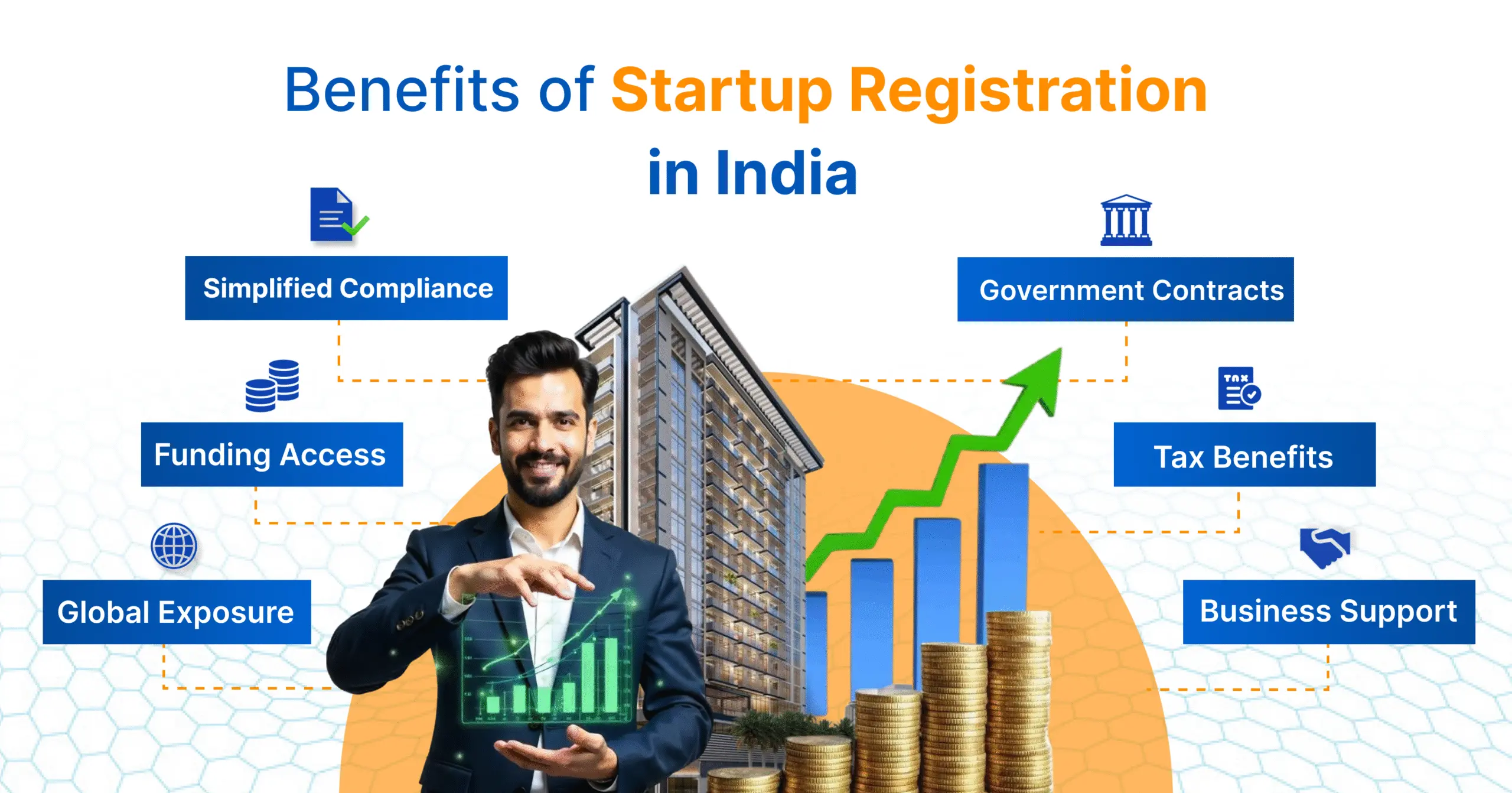
Startup India Registration offers a range of exclusive benefits designed to help your startup grow, scale, and succeed through government support:
a. Funding Access
Get access to government funding schemes, venture capital, and angel investor networks that prioritize DPIIT-recognized startups.
b. Tax Benefits
Enjoy income tax exemptions for three consecutive years, tax exemptions on capital gains, and reduced compliance burden under various tax regulations.
c. Simplified Compliance
Self-certify your startup under 9 labor and 3 environmental laws, and get faster approval for patents and trademarks with reduced fees.
d. Business Support
Access mentorship programs, networking opportunities, and learning resources through the Startup India Hub and partner organizations.
e. Government Contracts
DPIIT-recognized startups get priority in government tenders — no prior experience or turnover limit required.
f. Global Exposure
Participate in government-sponsored international startup events, market access programs, and cross-border networking opportunities.
Eligibility for Startup India Registration
To qualify for Startup India Registration eligibility, your business must:
1. Eligible Business Structures
To qualify, your startup must be registered as a Private Limited Company, a Limited Liability Partnership (LLP), or a Registered Partnership Firm. These formal business structures ensure legal recognition and compliance with Indian corporate laws.
2. Age of the Business
The startup should be less than 10 years old from the date of its incorporation or registration. This criterion ensures that the benefits are extended to emerging businesses in their formative years.
3. Annual Turnover Limit
The startup's annual turnover should not exceed ₹100 crore in any financial year since its inception. This limit helps focus support on startups that are in their growth phase and need assistance to scale.
4. Innovation and Scalability
The entity must be working towards innovation, development, or improvement of products, services, or processes. Alternatively, it should have a scalable business model with high potential for employment generation or wealth creation.
5. Original Entity Formation
The startup should not be formed by splitting up or reconstructing an existing business. This ensures that the benefits are directed towards genuinely new ventures rather than restructured entities.
Documents Required for Startup India Registration
Before you apply for Startup India Registration, make sure you have all your documents ready. Having a complete set helps avoid application delays and ensures faster DPIIT approval.
Basic Documents (Mandatory for All Startups)
- Certificate of Company Incorporation or Registration - Issued by the Registrar of Companies or Registrar of Firms. It proves your business is legally registered.
- PAN Card of the Entity - Used for tax identification. The PAN must belong to the company/LLP/partnership, not the founder personally.
- Business Details - Include your registered address, date of incorporation, business nature, and main activities.
- Director/Partner/Promoter information - List the names, DIN or LLPIN (if applicable), and identification details of all key members.
- Brief Description of Innovation / Unique Idea - A 200–400 word summary explaining how your startup is innovative, problem-solving, or scalable.
- Proof of Concept / Business Plan - Attach one of the following:
- Website or product screenshots
- Pitch deck or presentation
- Video demo or prototype images
- Revenue or user traction (if available)
Conditional Documents (Depending on Startup Type)
- Letter of Recommendation (if applicable) - From a recognized incubator, industry association, or government body validating your startup’s innovation.
- Funding Proof (if funded) - Investment confirmation from SEBI-registered investors, angel networks, or venture capital firms.
- Patent / Trademark Filings (if any) - If your startup is IP-based, submit patent application details or registration certificates.
- Income Tax Returns (if already operational) - If your startup has filed returns, attach the latest ones to establish credibility.
Self-Declaration Conditions (Mandatory for All)
When applying for DPIIT recognition, you’ll need to submit a self-declaration form confirming that:
- Your startup is working toward innovation, improvement, or scalable business models
- It should state that the business is not formed by splitting or reconstructing an existing company
- The annual turnover has not exceeded ₹100 crore in any financial year
- The declaration is signed by an authorized director/partner
Documents for Special Circumstances
| Startup Type | Additional Documents Required |
|---|---|
| Funded Startups | Proof of funding (Term Sheet, Investment Agreement, or Certificate from SEBI-registered fund) |
| Patent-Based Startups | Copy of Patent Filing or Grant Certificate |
| For Tax Exemption Requests | Application to Inter-Ministerial Board (IMB) + Required Forms |
| Incubator-Endorsed Startups | Recommendation Letter from DPIIT-recognized Incubator or Accelerator |
Pro Tips for a Smooth Startup India Application
- Combine all documents into a single, organized folder before applying.
- Ensure your innovation write-up is original, specific, and not copied from online samples.
- Keep file sizes below 5 MB each (as per Startup India portal limits).
- Use PDF format for official documents for faster upload.
- Review your entries twice before final submission — even small mismatches (like PAN or company name) can delay approval.
Common Mistakes to Avoid
- Submitting incomplete innovation descriptions (vague “we provide solutions” statements)
- Forgetting to attach proof of concept (portal rejects without this)
- Mismatched entity name in the incorporation certificate and the PAN card
- Uploading personal PAN instead of company PAN
How to Register Under the Startup India Scheme?
Getting Startup India (DPIIT) recognition is simple when you follow the right steps. Here’s a clear, step-by-step guide to help you complete the process quickly and correctly.
Step 1: Initial Preparation
- Go to the official Startup India website
- Create your user account using a valid email ID and mobile number.
- Complete OTP verification for both email and phone.
- Before starting, gather all the required documents — the incorporation certificate, PAN, business details, and innovation write-up.
Pro Tip: Keep all your files in PDF format (under 5 MB) to avoid upload issues.
Step 2: Prepare Your Documents
- Prepare digital copies of your incorporation certificate and other business details.
- Write a short and clear description of your innovation and business model - what problem you solve and how your idea is unique.
- Keep director/partner identification proofs (Aadhaar + PAN) ready.
- Make sure every document is clear, scanned, and readable.
Tip: Review your “innovation write-up” carefully — vague or copied text often leads to delays.
Step 3: Fill and Submit the Application
- Log in to your Startup India account.
- Click on “Apply for DPIIT Recognition.”
- Fill out the form with accurate company details — incorporation date, turnover, industry type, etc.
- Upload all supporting documents in the specified format.
- Submit your self-declaration confirming your startup’s eligibility.
- Review everything before final submission.
Common Mistake: Uploading the personal PAN instead of the company PAN. Double-check this field before submitting.
Step 4: DPIIT Review & Verification
- The Department for Promotion of Industry and Internal Trade (DPIIT) reviews your application.
- The review usually takes 7–15 working days, though it can extend to 2–4 weeks if clarifications are needed.
- You’ll be notified by email, or you can track your application on the Startup India dashboard.
Tip: Respond quickly to any clarification requests from DPIIT to speed up approval.
Step 5: Receive Your Recognition Certificate
- Once approved, you’ll receive your Startup India Recognition Certificate from DPIIT.
- Download and securely store your certificate and recognition number — you’ll need it for tax exemptions, funding, and tender benefits.
- Your startup is now officially recognized under the Government of India’s Startup India Scheme.
Step 6 – Post-Recognition Support (Optional but Important)
- Apply for tax exemptions under Section 80-IAC and Section 56(2)(viib).
- Register for intellectual-property benefits (patent/trademark rebate).
- Explore funding options through Startup India Seed Fund or Fund of Funds for Startups (FFS).
Simplify the Process with RegisterKaro
Need Expert Help with Startup India Registration? Don’t worry about forms, rules, or paperwork — our experts handle it all for you! Whether you need help checking eligibility, preparing documents, or applying for DPIIT recognition, we’re here to guide you.
Startup India Registration Fees
One of the biggest advantages of Startup India Registration is that the registration process itself is completely free of cost. Startups do not need to pay any government fees to apply on the Startup India portal.
-
Company Incorporation Fees – To be eligible for Startup India benefits, you must first register your business as an LLP, Private Limited Company, or Partnership Firm. Incorporation with the MCA (Ministry of Corporate Affairs) for different business structures varies depending on multiple factors:
-
Private Limited Company Registration in India: ₹7,000 to ₹20,000
-
Limited Liability Partnership: ₹6,000 and ₹15,000
-
Partnership Firm: ₹3,000 to ₹10,000
-
-
Professional Charges – Many startups hire consultants or legal experts to handle documentation and compliance. Their service fees may vary.
-
Patent, Trademark, or IPR Costs – Startups often apply for intellectual property protection, which involves separate official fees.
Impact of Not Registering for Startup India
While Startup India Registration is optional, not registering could result in:
- Missing out on valuable tax benefits and exemptions
- Limited access to government funding programs
- Reduced credibility with investors and partners
- Difficulty accessing simplified compliance procedures
- May lose Startup India recognition if it fails to meet eligibility criteria.
Revocation of Startup India Registration
Your Startup India Registration can be cancelled for the following reasons:
- Eligibility Violations: Exceeding the ₹100 crore turnover limit or operating beyond 10 years.
- False Declarations: Providing inaccurate or misleading information in your application.
- Non-Innovative Business: Simply copying existing models without innovation.
- Regulatory Non-Compliance: Violating tax laws or other statutory requirements.
Startup India Registration Certificate
The Startup India Certificate, issued by the Department for Promotion of Industry and Internal Trade (DPIIT), officially recognizes your business as a startup.
This recognition unlocks various benefits, including tax exemptions, easier compliance, and access to funding schemes.
Startup India recognition is a good start, and many founders also choose to complete company registration online to officially set up their business.
Last Updated: October 2025
Connect with RegisterKaro and let our experts handle the legal hassle while you grow your business.
Frequently Asked Questions (FAQs)
What is Startup India registration?
Startup India registration, also known as DPIIT recognition, is a government initiative that supports new and innovative businesses in India. Once registered, startups get benefits like tax exemptions, funding support, and easy compliance under the Startup India Scheme.
What is DPIIT, and why is it crucial for startups?
DPIIT recognition helps startups get official government support. It gives access to tax exemptions, funding opportunities, faster patent filing, and relaxation in government tenders. This recognition also increases your startup’s credibility and trust with investors and customers.
How do I register my startup under the Startup India scheme?
You can register your startup online through the Startup India portal. Just create an account, fill in your business details, upload documents like your Incorporation Certificate and write-up, and apply for DPIIT recognition. If everything is correct, you’ll get your recognition certificate in 7–15 days.
Who can apply for Startup India registration?
Any Private Limited Company, LLP, or Partnership firm that is less than 10 years old and has an annual turnover under ₹100 crore can apply. The business must be working on innovation, improvement, or a scalable business model to qualify.
What documents are required for Startup India registration?
You’ll need:
- Certificate of Incorporation / Registration
- PAN card of the business
- Aadhaar & PAN of the founder
- A short write-up about your business innovation
- Website or pitch deck link
- Authorization letter
Keep these ready before applying to avoid delays.
How long does it take to receive a DPIIT certificate?
If your documents and application are correct, it usually takes around 7 to 15 working days to get approved by DPIIT. Sometimes, it may take longer if additional details or clarifications are needed.
Is DIPP registered, and is Startup India registration the same?
DIPP (now DPIIT) recognition is a part of the Startup India registration process, essential for availing specific benefits.
How to check the Startup India company registration status?
Log in to the Startup India portal, navigate to your dashboard, and check the status under the 'Recognition' tab.
Can a sole proprietorship apply for DPIIT recognition?
No, a sole proprietorship is not eligible for Startup India registration. Only Private Limited Companies, LLPs, or registered Partnerships can apply. You can, however, convert your proprietorship into a company or LLP before applying.
What is the ₹20 lakh grant for startups in India?
Under the Startup India Seed Fund Scheme, eligible startups can receive up to ₹20 lakhs for proof of concept, prototype development, or product trials.
Who is eligible for a Startup India certificate?
Startups incorporated as Private Limited Companies, LLPs, or Registered Partnerships within the last 10 years, with turnover under ₹100 crore, and working towards innovation or improvement of products/services.
What kind of business structure should I choose for my startup?
Opt for a Private Limited Company, LLP, or Registered Partnership to be eligible for Startup India benefits.
For how long is a company recognized as a startup?
An entity is considered a startup up to 10 years from the date of its incorporation.
Can an existing company apply for Startup India registration?
Yes, an existing company can apply if it’s less than 10 years old, has a turnover below ₹100 crore, and focuses on innovation or technology improvement. Even if you are already operational, you can still apply for DPIIT recognition.
Can I do the Startup India registration online?
Yes, the entire registration process is online via the Startup India portal and the NSWS portal.
How much does Startup India registration cost?
There is no government fee for Startup India registration — it’s completely free of cost. However, startups usually hire professionals like RegisterKaro to handle the process and write-up, which may cost a small service fee starting from ₹1,999.
Is Startup India registration mandatory for startups?
No, it’s not mandatory. However, registering gives your startup official government recognition and unlocks valuable benefits like tax exemptions, funding access, and credibility with investors. So, even though it’s optional, it’s highly recommended.
Which authority grants Startup India Registration?
The Department for Promotion of Industry and Internal Trade (DPIIT) issues the Startup India Registration certificate.
How long does the Startup India Registration process take?
The process usually takes 2-4 weeks from application to certificate issuance, depending on the completeness of the submitted documents and the workload of the certifying body.
What happens if my startup doesn't get registered?
Without registration, your business can not access tax benefits, simplified compliance, government funding schemes, and other startup incentives.
Can I update my Startup India Registration details after approval?
Yes, you can update your profile and business information through your Startup India dashboard whenever changes occur.
What are the key benefits of Startup India Registration?
Benefits include tax exemptions, simplified compliance, patent fast-tracking, funding access, and networking opportunities with investors.
Do I need to renew my Startup India Registration certificate?
No, the registration remains valid for up to 10 years from your business incorporation date, as long as you maintain eligibility.
Can my Startup India Registration be transferred to another business?
No, the registration is specific to your business entity and cannot be transferred or assigned to another company.
Can foreign-owned startups apply for DPIIT recognition?
Only startups registered and operating in India can apply. Foreign-owned startups can qualify if they have a registered office in India and meet the eligibility criteria under the Startup India scheme.
Can I apply for other government schemes with my Startup India Registration?
Yes, once registered, you can apply for various government schemes like the Startup India Seed Fund Scheme, Fund of Funds for Startups (FFS), and more.
Does Startup India Registration help with intellectual property rights?
Yes, it provides fast-tracking of patent applications and access to legal assistance for intellectual property-related matters.
How do I write the “innovation write-up” for Startup India?
Write about:
- The problem your startup solves
- Your solution and what makes it unique
- Technology or process innovation
- Scalability and growth potential
Keep it clear, specific, and under 300–400 words. Avoid generic language like “we are helping people”; instead, show real innovation and results.

Reviewed by
Joel DsouzaJoel Dsouza is a Chartered Accountant (CA) and compliance expert with over 7 years of hands-on experience in company registration, tax structuring, GST, ROC filings, and MCA compliance. As a qualified member of the Institute of Chartered Accountants of India (ICAI) and Co-Founder at RegisterKaro, he has personally advised more than 1,000 startups and SMEs across India, helping founders navigate incorporation, regulatory frameworks, and financial planning from Day 1. With deep expertise across all three levels of Finance and Portfolio Management, Joel is committed to promoting financial literacy and simplifying India's startup ecosystem through clear, actionable guidance that entrepreneurs can act on immediately.
Why Choose RegisterKaro for Startup India Registration?
Here's how we facilitate your Startup India Registration at RegisterKaro:
- Expert Guidance: Access specialized knowledge from professionals experienced in startup recognition.
- Complete Management: We handle the entire process from document preparation to certificate delivery.
- Affordable Service: Cost-effective packages with transparent pricing structures.
- Quick Processing: Strategic application handling for faster approval outcomes.
- Continuous Support: Ongoing assistance with compliance and updates.

What Our Clients Say
View All
Krishna Chaitanya G
 Verified
I got in touch with register karo for my wife's pvt Ltd registration and the experience has been seamless. You need to upload all the requested docume... Read more

Meenakshi Bazzad
VerifiedI've had an excellent experience with RegisterKaro service. Purnima Sharma support was invaluable, especially with our Startup India registration. I h... Read more

Karingula Pranay
VerifiedIf you’re looking for reliable Startup India registration support, RegisterKaro is a great choice. Ms. Ayushi managed my case efficiently, answered al... Read more

gyan swaroop
VerifiedHello everyone! This is Cdr. Gyan (Retd) from Shubhagya Sales and Services. I am delighted to share my experience with the team at Register Karo. A sp... Read more

Sarathkumar Mani
VerifiedRegisterkaro assisted me in obtaining the Startup India registration, and the entire process was smooth and swift. I’d like to extend my appreciation... Read more

Technodroid
VerifiedI got my company incorporated through RegisterKaro, and the overall experience was very good. The process was smooth, professional, and hassle-free. T... Read more

AYUSH KUMAR
VerifiedWe chose RegisterKaro to handle our company’s compliance requirements, and it has been a great experience. The team is professional, responsive, and a... Read more

mahima dixit
VerifiedThe company really great I had really wonderful experience with it , I will prefer everyone to try it. Experienced team with great knowledge thanks Me... Read more

NS Enterprise
VerifiedA very smooth experience with RegisterKaro during the registration of our company. I was so impressed by how helpful and patient the team was. Everyth... Read more

Nimish keshri
VerifiedMohit kumar has done my company i corporation he completed the process very smoothly even with rejection from run application he did his job very well... Read more
Startup India Registration Across India
Related Blogs
View All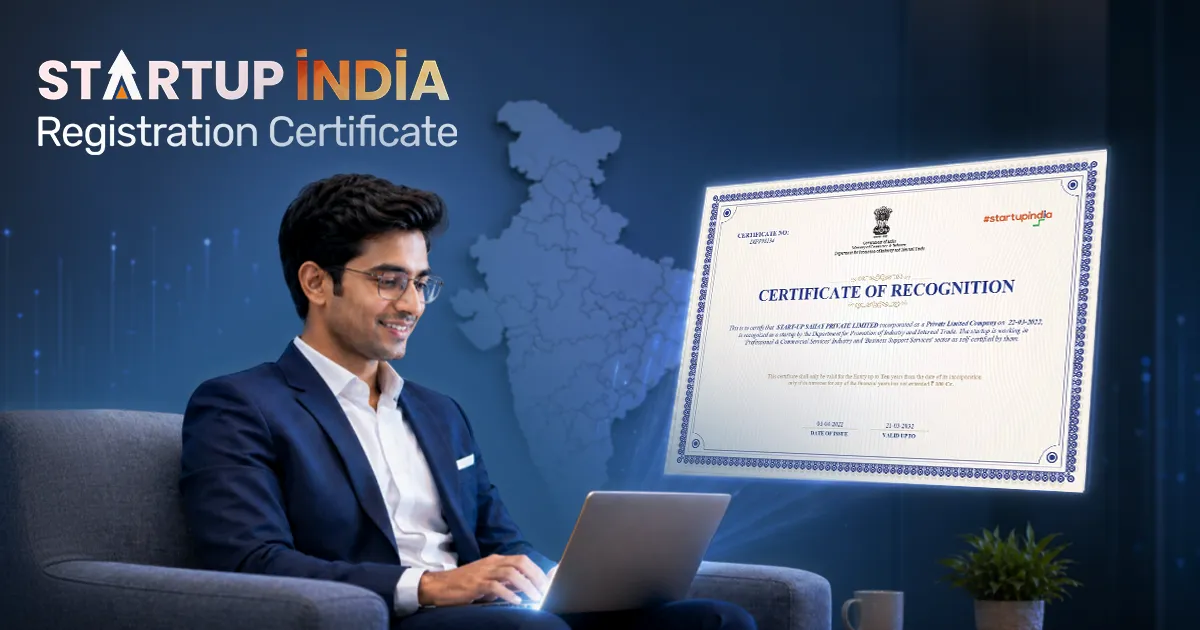
Startup India Certificate: How to Download (2026)

Startup India Registration Fees in 2026: Complete Cost & Charges Breakdown
Difference Between Seed Funding and Angel Funding for Indian Startups
Difference Between Seed Funding and Series A Funding in India

Types of Funding for Startups in India 2026: 11 Options Guide

Government Schemes For Women Entrepreneurs in India: Funding Options

How to Invest in Startups in India? 2026 Complete Guide

Kerala Startup Incubators List with their Contact Information

What are the Documents Required for Startup India Registration?

How to Start a Security Service Business in India