

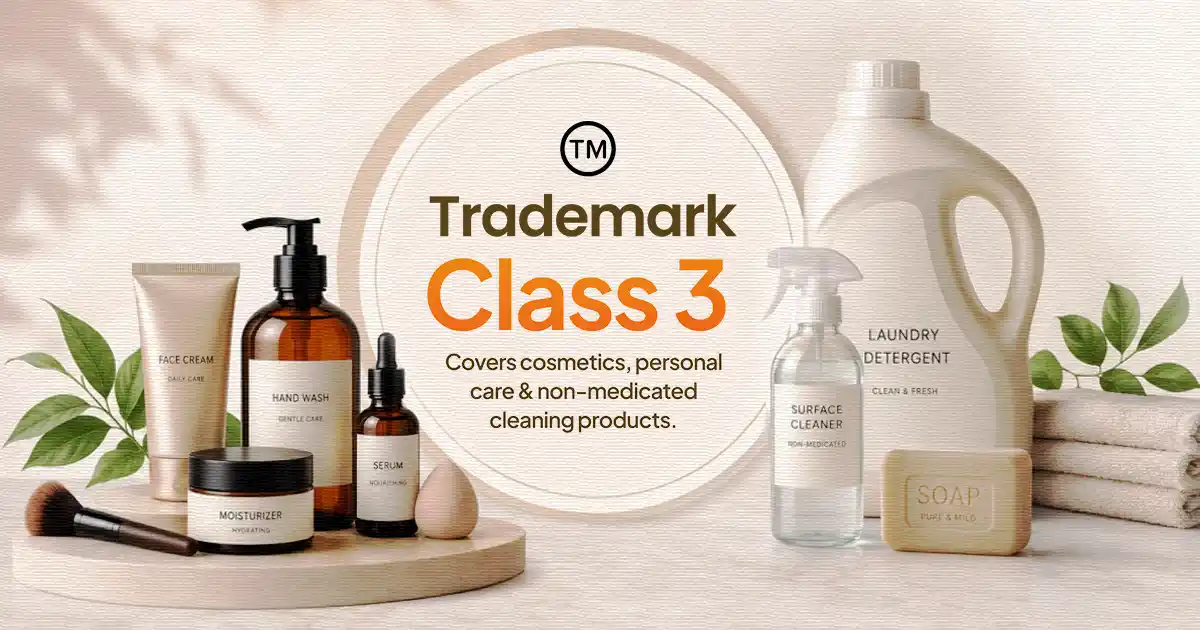
Class 3 is the trademark class for cosmetics, toiletries, perfumery, and cleaning preparations in India. It covers skincare, makeup, hair care, soaps, and household cleaning agents, spanning conventional, herbal, organic, and Ayurveda-inspired formulations. If you manufacture, market, or distribute beauty, personal care, or cleaning products, Class 3 is where you secure full legal rights to your name and logo.
According to IBEF, India’s beauty and personal care market is valued at over ₹2.4 lakh crore and is projected to grow at around 10–11% annually. The country also runs one of the fastest-growing beauty e-commerce markets in the world. That scale, combined with how strictly courts treat phonetic similarity in this category, makes trademark protection under Class 3 especially important. The Lakme Ltd. v. Subhash Trading (Delhi HC, 1996) case is a great example. A name too close to an existing cosmetics brand can also lead to an injunction, as “LikeMe” found out when it was restrained for sounding too similar to “Lakme.”
Latest Update: This guide reflects the NICE Classification 13th Edition (NCL 13-2026), effective 1 January 2026. Under this edition, essential oils are no longer classified as a single group. Oils for fragrance and cosmetic use stay in Class 3, while oils for medicinal or aromatherapy use now fall under Class 5.
Key Takeaways
- Trademark Class 3 covers cosmetics, perfumery, soaps, cleaning preparations, essential oils, hair care, and dentifrices.
- Filing fee is ₹4,500 per class for individuals, startups, and small enterprises; ₹9,000 for all other applicants.
- DPIIT-recognized startups and Udyam-registered MSMEs get a 50% fee concession by submitting a valid certificate at filing.
- Registration is valid for 10 years from the date of application, not the certificate-issue date, and renews indefinitely in 10-year blocks.
- Class 3 applications typically take 12–18 months, longer than most classes, since the crowded beauty sector draws frequent objections and opposition.
- Third parties get a 4-month window to oppose a published mark before final registration.
- A Class 3 Digital Signature Certificate (DSC) is required to file the application online.
Trademark Class 3: Quick Facts
| Detail | Description |
|---|---|
| Class Number | 3 |
| Type | Goods |
| Covers | Non-medicated cosmetics, toiletries, soaps, perfumes, haircare, oral care, cleaning preparations |
| Excludes | Medicated cosmetics (Class 5), cosmetic ingredients (Class 1), electric beauty devices (Class 11), cosmetic tools (Class 8/21) |
| Governing Law | Trade Marks Act, 1999 |
| Classification System | NICE Classification (13th Edition, NCL 13-2026, effective 1 Jan 2026) |
| Filing Form | Form TM-A |
| Government Fee | ₹4,500 (individual / startup / MSME) or ₹9,000 (company / LLP) per class |
| Validity | 10 years from the date of filing |
| Renewal | Form TM-R, renewable indefinitely every 10 years |
| Filing Mode | Online via the IP India e-filing portal |
Who Should File Under Trademark Class 3?
You should register your trademark under Class 3 if you manufacture, sell, or distribute:
- Cosmetics and makeup products
- Perfumes, essential oils, or aromatic products
- Skincare and haircare products
- Soaps, deodorants, bath products, and other toiletries
- Toothpastes, mouthwashes, denture care, or other oral hygiene products
- Household cleaners, polishes, and laundry products
- Pet care, grooming, or cosmetic products
Goods Included in Trademark Class 3 (A List)
Trademark Class 3 includes essential personal care, beauty, and cleaning products used in everyday grooming and household maintenance. Below is a list of the products covered:
| Product Category | Description | Examples |
| Cosmetics & Makeup | Non-medicated products used to enhance or alter physical appearance. | Lipsticks, foundations, eyeliners, makeup removers |
| Skincare Preparations | Non-medicated products for cleansing, moisturising, or skin protection. | Body lotions, face creams, sunscreens, and talcum powder |
| Hair Care Preparations | Non-medicated products used to clean, style, or colour hair. | Shampoos, conditioners, hair dyes, and non-medicated hair lotions |
| Perfumery & Essential Oils | Fragranced products applied to the body, plus deodorants for humans and animals. | Perfumes, body deodorants, pet deodorants, essential oils |
| Non-Medicated Dentifrices | Everyday oral cleaning products that make no therapeutic claim. | Toothpaste, mouthwash, teeth-whitening strips |
| Soaps & Bath Preparations | Non-medicated cleansing products for the body. | Toilet soaps, bath salts, shower gels, bubble bath |
| Nail & Eyelash Care | Products and accessories for grooming nails and lashes. | Nail polish, nail polish remover, false eyelashes, false nails |
| Bleaching & Laundry Preparations | Substances used to whiten or clean fabric. | Fabric bleach, stain removers, laundry detergents |
| Cleaning, Polishing & Abrasive Preparations | Non-medicated agents used to clean, polish, or scour surfaces. | Floor cleaners, metal polish, sandpaper, dishwashing liquid |
| Room Fragrancing & Sanitary Toiletries | Non-medicated products that freshen spaces or serve everyday hygiene use. | Air fresheners, incense, scented wet wipes |
Knowing the specifics of trademark Class 3 helps avoid trademark objections and ensures proper classification for your products.
Conducting a trademark class search is vital to ensure that your brand is unique and free from trademark infringement, securing your market position in India.
Items Not Covered Under Trademark Class 3
While Class 3 covers a broad range of beauty, personal care, and cleaning products, certain related items fall outside its scope. These exclusions include:
- Ingredients for Cosmetic Manufacturing: Bulk vitamins, preservatives, and antioxidants used to make cosmetics do not fall in this class (Class 1).
- Medicated Cosmetics & Toiletries: Medicated shampoos, medicated soaps, medicated lotions, and medicated dentifrices are excluded (Class 5).
- Cosmetic & Cleaning Instruments: Makeup brushes and cleaning cloths, pads, and rags fall under Class 21; emery boards, emery files, and sharpening stones are covered under Class 8.
- Industrial Degreasers & Chimney Cleaners: Degreasing preparations used in manufacturing and chemical chimney cleaners are placed under Class 1.
- Non-Personal Deodorants: Deodorants other than for human beings or animals, such as those for fabrics, rooms, or industrial use, fall under Class 5.
- Beauty & Grooming Services: Salon, spa, and hygienic beauty-care services for humans or animals are covered under Class 44, not Class 3.
Hindustan Unilever registers Lakme and Cinthol finished cosmetic and soap products under Class 3. Makeup brushes and applicators sold with these brands fall under Class 21 because cosmetic tools and instruments are classified separately.
Forest Essentials follows the same logic with its Ayurveda-inspired range. It registers its face oils, body lotions, and soaps under Class 3, since they carry no medicinal claim, and would only need to file under Class 5 if it launched a product with a stated therapeutic use.
If you are confused about which class best suits your product, check the trademark classes list before registering.
How to Register a Trademark in Class 3 in India?
Registering a trademark protects your reputation and prevents confusion. Here’s the step-by-step process to register under Class 3 in India:
1. Conduct a trademark search: Run a trademark search to check whether your brand name conflicts with existing word or device marks. If you find a conflict, reconsider the name or consult a trademark attorney.
2. Prepare and file the application: File Form TM-A under Class 3 with the Indian Trade Marks Registry. Submit applicant details, your logo or wordmark, proof of use (if applicable), the Class 3 goods description, and a Class 3 Digital Signature Certificate (DSC). File online through the IP India Trademark E-Filing Portal. Fees vary by applicant type and number of classes.
3. Examination: The examiner checks your application under the Trade Marks Act, 1999, including distinctiveness under Section 9 and similarity under Section 11. If objections arise, respond within 30 days to keep the application active.
4. Publication and opposition period: Once accepted, the mark is published in the Trademark Journal. Third parties have 4 months to oppose it. If no opposition is filed, it moves toward registration.
5. Final registration and protection: If no opposition is filed, the Registry registers your trademark, granting exclusive rights and allowing you to use the ® symbol. You can download the trademark registration certificate from the IP India website.
Registration is valid for 10 years from the application date under Section 25 of the Trade Marks Act, 1999. You can renew it indefinitely in 10-year periods using Form TM-R.
Registration fee for Class 3:
- ₹4,500 for Individual/Startup/Small Enterprise
- ₹9,000 for all other cases
Note: DPIIT-recognized startups and Udyam-registered MSMEs get a 50% fee concession. Pay ₹4,500 instead of ₹9,000 per class.
Class 3 applications typically take 12–18 months due to frequent objections and opposition in the crowded beauty sector.
Common Mistakes When Filing Under Class 3
Here are the most common mistakes and how to avoid them:
- Filing Under the Wrong Class: Raw cosmetic ingredients belong to Class 1, medicated skincare and soaps to Class 5, cosmetic tools and brushes to Class 8/21, and salon services to Class 44. Verify with the trademark class search tool before filing.
- Using Descriptive or Generic Brand Names: Examiners frequently object to words like “Glow,” “Pure,” “Fresh,” or “Radiance”. Choose a distinctive and unique brand name instead.
- Using Vague Product Descriptions: Broad terms like “cosmetics” or “cleaning products” trigger objections. Use precise terms such as “non-medicated facial serums” or “herbal shampoo for dry hair.”
- Confusing Similar-Sounding Brand Names: Beauty and personal care names face heightened scrutiny for phonetic similarity, since consumers often shop by sound and shelf recall rather than spelling. In Lakme Ltd. v. Subhash Trading (Delhi HC), the court restrained “LikeMe” for cosmetics based on phonetic closeness to “Lakme,” despite the different spelling. Choose a clearly distinguishable name, not just visually but phonetically.
- Skipping a Comprehensive Trademark Search: Search the Indian Trademark Registry and WIPO’s global database to identify identical or phonetically similar marks in Class 3.
- Submitting Incomplete Documentation: Missing applicant proofs, an unclear logo file, or an incomplete power of attorney can stall your application at the examination stage. Review the complete list of documents required to register a trademark before submission.
- Missing the Examination Report Deadline: Failing to reply within 30 days can result in abandonment. Respond to any trademark objection on time.
- Ignoring Multi-Class Filing: Filing only under Class 3 may leave cosmetic tools (Class 8/21), retail/e-commerce sale of cosmetics (Class 35), or salon services (Class 44) unprotected. File under all relevant classes from the outset.
