


The Government of India has constituted the 8th Central Pay Commission (CPC). The commission will review and revise the salaries, pensions, and service conditions of the government employees and pensioners. The government notified its Terms of Reference (ToR) on 3rd November 2025. They have confirmed that pension revision is part of the notified Terms of Reference, meaning the commission will also review pensions.
The government has made some changes to the 7th Pay Commission framework. The changes include:
- It will cover approximately 50.14 lakh employees and 69 lakh pensioners.
- It mandates the revision of pay scales, allowances, pensions, and service conditions.
There are still some uncertainties surrounding its implementation, including the date of the 8th Pay Commission’s implementation. The things which are still unclear are:
- The exact percentage increase in basic pay is not yet announced.
- House Rent Allowance (HRA), Travel Allowance (TA), medical reimbursement, and other allowances are not finalized yet.
- The exact cost and budget allocation (funding) remain uncertain.
Latest Update:
21 Jan, 2026: The panel and other legal experts in the field predict multiple possible fitment factor values for the 8th Pay Commissions such as 2.15, 2.57, and 2.86. Pensioners and government employees are eagerly waiting for the update which will determine revised salaries and pensions.
19 Dec, 2025: Minister of State for Finance, Pankaj Chaudhary, informed Lok Sabha in a written reply about the constitution of the 8th CPC. The Government has confirmed that the 7th Pay Commission’s tenure will officially conclude on 31 December 2025 and that the 8th Central Pay Commission has not yet begun its formal recommendations and is projected to be implemented from January 1, 2026. No official announcement has been made on this so far.
What is the Government’s Stance on the 8th Pay Commission?
The government confirmed that the 8th CPC will include pension revision for retirees. This means the pensioners will also benefit from the changes recommended under the new structure. It also clarified that it is not considering any proposal to merge DA/DR with basic pay or pension.
What Might Change Under the 8th CPC?
As per the provisions of the 8th CPC, central government employees could see their base salary go up substantially. This provision will also revise pensions. The commission may additionally revise allowances like House Rent Allowance (HRA) and Travel Allowance (TA) to reflect inflation, rising living costs, and the updated salary structure.
8th CPC Fitment Factor Hike: When Will it Come Into Effect?
Up until now, many experts and the media have speculated that the 8th CPC will adopt a fitment factor in the range of roughly 1.83-2.86 (some even cite 2.28-2.86). This suggests that the total salary may rise by an estimated 25–35% (or more) after adjustments to revised pay, allowances, and inflation.
A fitment factor multiplies an employee’s current basic pay by the new basic pay under a new Pay Commission. Let’s understand this with an example:
If your current basic pay is Rs. 30,000
Fitment factor decided is 2.72 (hypothetical)
Your New basic pay will be = 30,000 × 2.72 = Rs. 81,600
The resolution suggests the 8th Central Pay Commission will submit its recommendations within 18 months of its publication. The commission may also submit interim reports if required. The government will decide the implementation timeline, budget, and rollout after examining the 8th Pay Commission’s guidelines. That’s when the 8th Pay Commission salary hikes will kick in for parties affected.
In short, salaries may be effective from January 1, 2026, but actual payment of increases may only happen after the report is submitted and approved (likely 2027–28).
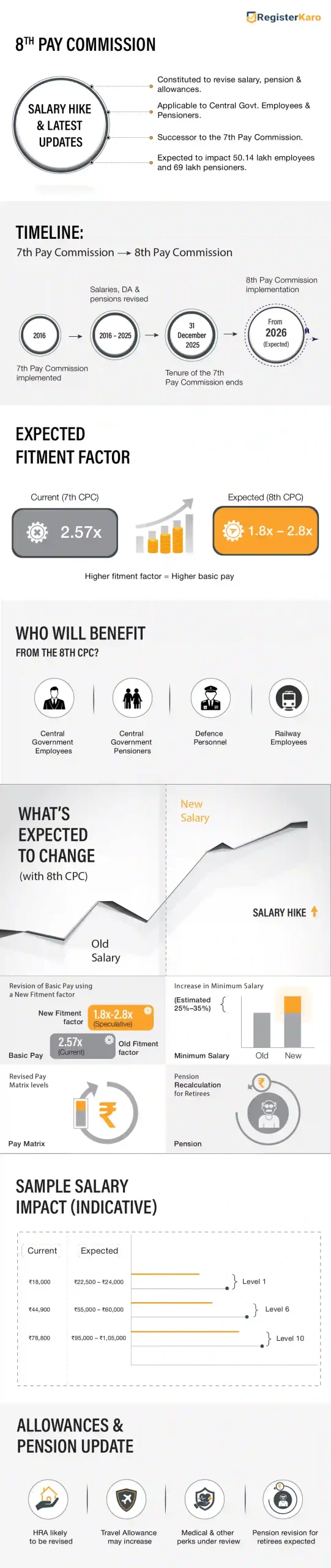
Comparison Table As Per 8th Pay Commission Employees’ Salary Slab
The 8th Central Pay Commission provisions will lead to a salary hike for the government sector salaried employees. The following table shows a potential hike in salaries for different levels of government employees.
| Category | 7th CPC Basic Pay | 8TH CPC Basic Pay |
| Level 1 | Rs. 18,000 | Rs. 22,500 – Rs. 24,000 |
| Level 6 | Rs. 44,900 | Rs. 55,000 – Rs. 60,000 |
| Level 10 | Rs. 78,800 | Rs. 95,000 – Rs. 105,000 |
Note: This is an expected hike based on the speculations of the media and experts. The original amount may vary based on the government provisions and fitment factor.
Who Will Benefit From the 8th Pay Commission Latest News?
The 8th Pay Commission will affect a wide range of beneficiaries across the government sector. The group listed below will directly benefit from the 8th CPC provisions:
- Regular Central Government Employees: A higher fitment factor and revised pay matrix under the 8th CPC could significantly raise their basic pay, improving their overall salary.
- Retired Employees: The new guidelines also consider revising pensions and retirement allowances, which will directly impact retired employees.
- Newly Recruited: For recruits, the 8th CPC could mean a higher entry-level basic pay right from the start, along with improved allowances.
- Public Sector Units (PSUs): There might be a spillover effect on these sectors. PSUs and state governments may have to revise pay scales to maintain parity.
8th CPC Timeline: Key Events & Next Steps
Look at the timeline frame of the 8th Central Pay Commission to stay updated on key events so far and what to expect in the near future.
- October-November 2025: The Cabinet approves the Terms of Reference (ToR) for the 8th CPC.
- November 2025: The government formally constituted the 8th CPC.
- November 2025- April/May 2026: Commission works, consults stakeholders, and decides on fitment factor, allowances, pensions, etc.
- 2026 (Expected): Possible roll-out of revised pay, allowances, and pensions, depending on government approval and budget allocation
- 2027 (Expected): The report submission for 8th CPC is expected around mid-2027.
Conclusion
The 8th Central Pay Commission will significantly change the government payroll structure. The speculations point toward a positive rise for both employees and pensioners. Although the government has not yet announced major details such as the revised pay matrix and allowance structure, current trends indicate favorable adjustments.
The government will implement the changes immediately after the commission completes its work and approves the recommendations.
