

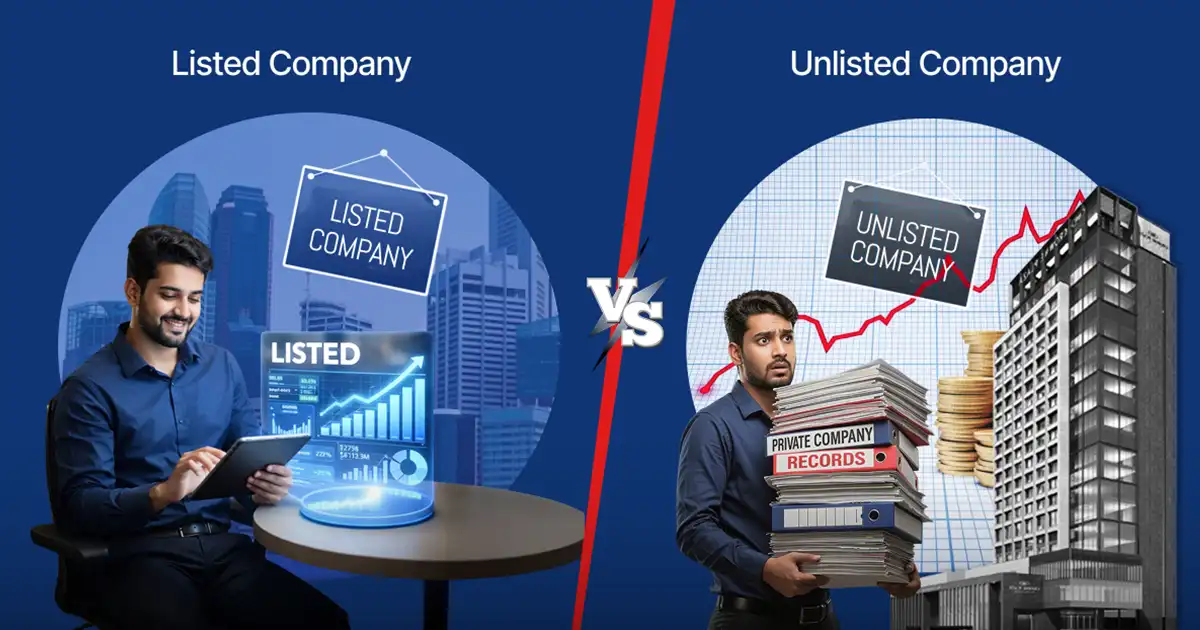
The key difference between a listed and an unlisted company is whether its securities trade on a recognized stock exchange. A listed company offers securities for public trading on exchanges such as the NSE or BSE, while an unlisted company does not. This status shapes the company’s fundraising options, investor access, disclosure obligations, governance, and compliance requirements.
The distinction matters to promoters, shareholders, and investors because it affects how the company approaches capital raising, manages its ownership structure, communicates financial information, and meets regulatory obligations. Understanding these factors helps businesses assess the implications of listing before pursuing an IPO or continuing as an unlisted company.
Key Takeaways
- Listed companies have securities traded on recognized stock exchanges such as the NSE or BSE, while unlisted companies do not.
- Listed companies follow the Companies Act, 2013 and applicable SEBI regulations, including LODR requirements. Meanwhile, unlisted companies follow the Companies Act and other applicable laws.
- An unlisted company can be a private company, unlisted public company, startup, or pre-IPO company.
- While listed companies face extensive periodic disclosure and corporate-governance requirements, unlisted companies generally have fewer public disclosure obligations.
- Tax treatment differs based on whether the shares are listed or unlisted, including different holding periods for determining long-term capital gains.
What is a Listed Company? Meaning and Features
A listed company refers to a business whose shares are traded on recognized stock exchanges like the National Stock Exchange or the Bombay Stock Exchange in India. Under Section 2(52) of the Companies Act 2013, a company becomes listed when any of its securities are listed on a recognized stock exchange.
Key Features of Listed Companies:
- Investors freely trade shares on the NSE or BSE.
- Ownership is distributed across retail investors, institutional funds, Foreign Portfolio Investors (FPIs), and High Net Worth Individuals (HNIs).
- Valuation is determined daily by market forces: supply, demand, and investor sentiment.
- Mandatory quarterly and annual financial disclosures under SEBI LODR (Listing Obligations and Disclosure Requirements) Regulations, 2015.
- Independent directors, audit committees, and nomination committees are mandatory under SEBI governance norms.
- Subject to SEBI’s insider trading regulations and corporate governance codes.
Well-known examples of listed companies include Reliance Industries and Tata Consultancy Services (TCS), which actively trade shares on these exchanges.
What is an Unlisted Company? Key Features
An unlisted company operates without trading its shares on any recognized stock exchange in India. Governed primarily by the Companies Act 2013, it may function as a private limited or public limited company. Ownership changes through private share transfer agreements and board resolutions, not through open market transactions.
Key Features of Unlisted Companies:
- Shares are held by promoters, private equity funds, venture capital investors, or individual investors through private deals.
- Ownership transfer requires a formal share transfer agreement and board resolution.
- Buyers and sellers determine valuation through mutual negotiation based on financial performance and future growth potential.
- Only annual audited financial statements need to be filed with the Registrar of Companies (ROC).
- No mandatory quarterly disclosures, no public shareholding pattern requirements.
- Greater management control and strategic flexibility for promoters.
Popular unlisted companies in India are Zepto, Razorpay, and Zerodha
Key Difference Between Listed and Unlisted Companies in India
The table below covers every key difference between a listed company and an unlisted company:
| Basis | Listed Company | Unlisted Company |
| Definition | Shares traded on NSE or BSE | Shares not traded on any stock exchange |
| Legal Provision | Section 2(52), Companies Act, 2013 | Companies Act, 2013; SEBI does not apply |
| Ownership | Public shareholders, FPIs, retail investors, HNIs | Promoters, PE funds, VC investors, private individuals |
| Minimum Members | At least 7 (public company) | At least 2 (private company) |
| Minimum Public Shareholding | Must maintain at least 25% public shareholding | No such requirement |
| Regulation | SEBI LODR, ICDR, and Insider Trading (PIT) Regulations | Companies Act, 2013 and Income Tax laws only |
| Corporate Governance | Independent directors, audit committee, and a woman director mandatory under SEBI LODR | Minimal; largely voluntary unless Companies Act thresholds are met |
| Share Transfer | Freely bought and sold on the stock exchange | Private agreement + board resolution required |
| Liquidity | High; shares can be sold on any trading day | Low; finding a buyer takes time and effort |
| Valuation | Market-driven, changes daily | Negotiation-based; periodic valuation by professionals |
| Transparency | High and SEBI-enforced; strong investor protection | Limited; disclosures mainly to the ROC |
| Disclosure | Quarterly + annual disclosures mandatory | Annual audited statements filed with the ROC only |
| Capital Raising | IPO, FPO, QIP, Rights Issue, GDR | Private equity (PE), Venture Capital (VC), private placement |
| Compliance Cost | High; listing fees, SEBI filings, exchange filings | Low; ROC filings under the Companies Act only |
| LTCG Holding Period | 12 months for long-term classification | 24 months for long-term classification |
| LTCG Tax Rate | 12.5% (gains above ₹1.25 lakh exempt) | 12.5% (no exemption limit) |
| STCG Tax Rate | 20% (Section 111A) | Applicable income tax slab rates |
| Change of Status | Can be delisted with SEBI approval | Can apply for an IPO and list on NSE/BSE |
Similarities Between Listed and Unlisted Companies
Despite their different market status, listed and unlisted companies share a common corporate and legal foundation. They:
- Operate under the Companies Act, 2013 and remain registered with the ROC.
- Have a separate legal identity, perpetual succession, and limited liability.
- Use share-based ownership, with shareholder rights governed by applicable law.
- Maintain statutory records, prepare financial statements, undergo statutory audits, and meet applicable ROC filing requirements.
- Pay corporate income tax on taxable profits under applicable tax laws.
- Can raise capital and issue shares, subject to applicable legal requirements.
Taxation Criteria: Listed vs Unlisted Shares in India (2026)
The tax treatment of profits from selling shares is one area where the difference between listed and unlisted companies has a direct financial impact on investors. Budget 2024 introduced a uniform LTCG tax rate of 12.5%, but the holding period and exemptions differ:
| Tax Parameter | Listed Shares | Unlisted Shares |
| Long-Term Holding Period | More than 12 months | More than 24 months |
| LTCG Tax Rate | 12.5% (gains above ₹1.25 lakh exempt) | 12.5% (no ₹1.25 lakh exemption) |
| STCG Tax Rate | 20% (Section 111A) | Applicable income tax slab rates |
| Indexation Benefit | Not available (removed from July 23, 2024) | Not available (removed from July 23, 2024) |
| STT Applicability | Yes: Securities Transaction Tax paid on trade | No: STT does not apply |
These tax rules remain unchanged for FY 2026-27. An investor selling listed shares after 12 months pays 12.5% LTCG tax on gains above ₹1.25 lakh. An investor selling unlisted shares must hold them for at least 24 months to qualify for the 12.5% LTCG rate, and no ₹1.25 lakh exemption applies.
Listed vs Unlisted Company: Which is Better?
The right choice between a listed and an unlisted company depends entirely on the company’s stage, long-term goals, and the investor’s risk appetite.
Choose to remain unlisted if:
- The business is at an early stage and needs operational flexibility.
- Promoters want to retain full decision-making control without public scrutiny.
- The compliance cost of listing is disproportionate to the capital required.
- The company raises sufficient capital through PE or VC funding.
Choose to list if:
- The company needs large-scale capital that PE or VC cannot provide efficiently.
- The promoters want to provide an exit route for early investors.
- Brand credibility and public visibility are important to the business.
- The company has a stable earnings track record and meets SEBI’s eligibility criteria.
