

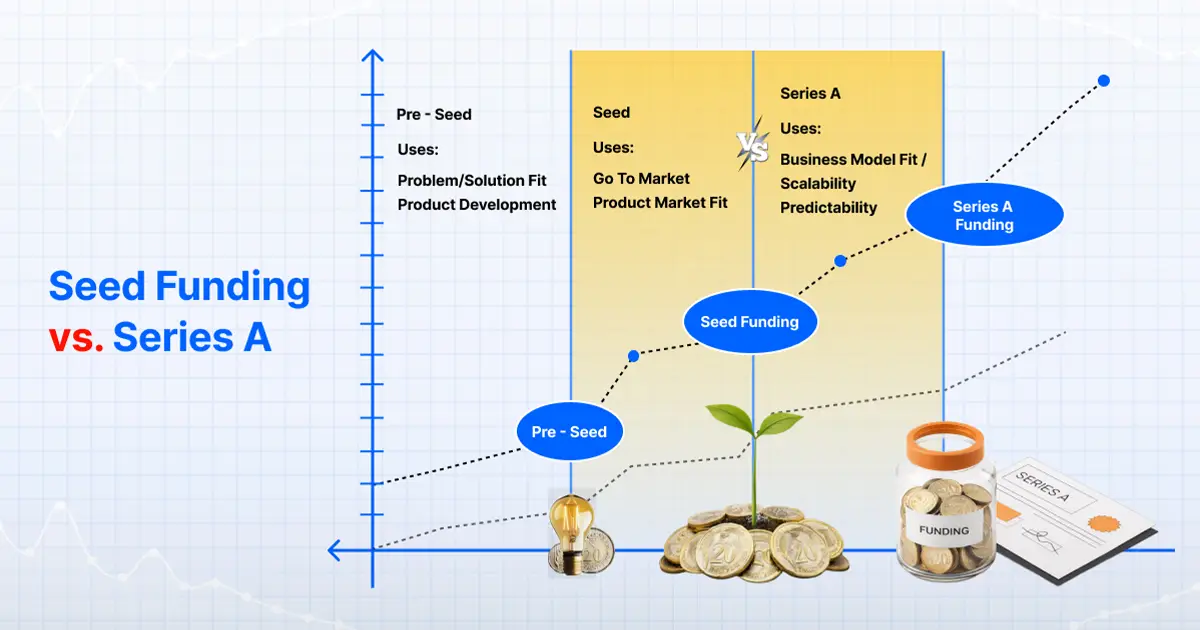
Every startup begins with an idea, but there comes a point when financial growth becomes the real priority. This is where understanding the difference between Seed and Series A funding becomes important. Seed funding helps you turn your idea into a product and get your first users. Meanwhile, Series A funding gives you the resources to expand, hire a team, and grow your market presence.
To make this leap, founders need to move from just building an idea to running the business professionally, setting up proper financial and legal systems.
Knowing different funding stages is more important than ever. India has over 2.12 lakh startups recognized by the DPIIT, which shows how fast the ecosystem now grows. With so many businesses competing for attention, investors back startups that clearly understand where they stand. Raising the right amount of funding at the right time helps you avoid giving away too much ownership and keeps your growth on track.
This article explains the key differences between Seed Funding and Series A Funding. It also covers investor expectations and practical insights to help Indian startups grow with confidence.
What is Seed Funding? Key Purposes
Seed funding refers to the round of initial capital a startup raises to turn an idea into a functioning business. It is the first official funding stage where founders focus on building a product, testing the market, and laying the foundation for future growth.
Seed funding in India typically ranges from ₹50 lakh to ₹5 crore. Apart from private investors, startups can also access government-supported programs like the Startup India Seed Fund Scheme (SISFS). This scheme funds early-stage capital to help founders turn ideas into viable products or services.
Pre‑seed funding is usually under ₹50 lakh. It helps startups with ideation and early product development. Many successful Indian startups today, including Zomato (2008), Ola (2010), and Razorpay (2014), started with seed funding.
Tip: To apply for the SISFS scheme, DPIIT recognition is mandatory, which you can get with Startup India Registration.
Who Invests in the Seed Stage of Funding for Startups?
At this stage, funding typically comes from investors willing to take higher risks:
- Angel investors: Individuals who invest their own money in early-stage startups. They usually support founders based on the idea, vision, and team potential rather than existing revenue.
- Friends and family: Founders often raise initial capital from people they are familiar with. This funding is based on trust and helps get started quickly without formal processes.
- Early-stage venture capital firms: Some VC firms specialize in seed-stage startups. They look for high-growth potential even if the business is not yet fully proven.
What is Series A Funding?
Series A funding is the first major round of institutional investment for a startup. By this stage, the startup has demonstrated that its idea works in the market and gained initial traction. It has a working product or service, early users, and some measurable revenue or engagement. Series A investors also examine burn rate, Monthly Recurring Revenue (MRR), and gross margin to ensure the startup can scale profitably.
In India, Series A funding typically ranges from ₹5 crore to ₹25 crore. Globally, it can go up to ₹50–₹100 crore, depending on the startup’s traction, market potential, and team strength. This funding helps startups scale operations, expand their team, and enter new markets over the next 12–18 months.
Many successful Indian startups, such as Swiggy (2015), UrbanClap/Urban Company (2015), and CRED (2019), used Series A funding to expand their business after initial validation.
Who Invests in Series A Funding for Startups?
At this stage, funding typically comes from institutional investors who expect measurable growth and a clear business plan:
- Venture Capital (VC) firms: These firms provide larger funding than seed investors. They look for strong traction, a solid growth strategy, and often guide startups through mentorship, networks, and business advice.
- Corporate Venture Arms: Large corporations sometimes invest in startups aligned with their business interests. They provide capital, access to customers, industry expertise, and strategic partnerships.
- Angel Networks (Late-stage Angels): While mostly angels invest at the seed stage, some experienced ones join Series A rounds. They bring mentorship, industry connections, and credibility to the startup.
- Seed-focused Venture Funds (participating in Series A): Some funds that usually invest in seed rounds may also invest in Series A if the startup continues to show strong performance. This helps maintain continuity and investor confidence.
- Family Offices: Wealthy families sometimes invest in promising startups at Series A to diversify their portfolio. They often provide patient capital with fewer short-term pressures.
Series A funding helps a validated startup shift from being simply a proven idea to a scalable business. It allows founders to attract institutional investors, expand their operations, and prepare for future funding rounds like Series B.
Key Differences Between Seed and Series A Funding
The table below explains the Seed vs. Series A difference in detail:
| Factor | Seed Funding | Series A Funding |
| Startup stage | Idea or early product stage, often with an MVP or prototype | Growth stage, with product-market fit and early traction |
| Main purpose | Build the product, test the market, and gain first users | Scale operations, expand the team, and enter new markets |
| Typical funding size (India) | ₹50 lakh to ₹5 crore | ₹5 crore to ₹25 crore |
| Main investors | Angel investors, friends and family, early-stage VCs | Institutional VCs, corporate venture arms, family offices |
| Risk level | Very high, since the model is unproven | Moderate, since the product is validated but scaling remains |
| Metrics investors check | Idea, founding team, and market potential | Revenue growth, traction, CAC, LTV, and retention |
| Valuation basis | Idea, team, and future potential | Traction, revenue, and market opportunity |
| Typical equity dilution | 10 to 20% | 15 to 25% |
| Governance and compliance | Informal structure and flexible processes | Formal board, stricter legal and reporting duties |
| Investor role | Advice, mentorship, and introductions | Active guidance, network access, and scaling support |
| Typical time to next round | 12 to 18 months to reach Series A | 18 to 24 months to reach Series B |
When Do Startups Move from Seed to Series A? What are the Milestones Required?
Startups usually move from seed to Series A funding after achieving certain key milestones, rather than after a fixed period. Investors want to see measurable progress that proves the startup can scale successfully. Typically, this happens within 12–18 months, depending on growth and market conditions.
The main milestones that indicate a startup’s readiness for Series A include:
- Product-Market Fit: The startup’s product or service effectively meets customer needs. Demand has been validated as per customer insights, and early users are actively engaging.
- Revenue Traction: The business generates initial revenue streams, demonstrating its ability to earn sustainable income.
- Scalable Business Model: The startup has a repeatable process for acquiring customers, generating revenue, and expanding operations efficiently.
- Team Readiness: The core team has the skills and bandwidth to manage growth, hire strategically, and execute scaling plans.
- Strong Metrics: Investors look for clear numbers like user growth, retention rates, CAC, and LTV.
Achieving these milestones demonstrates to investors that the startup is ready for the next growth stage. Founders who focus on these areas are more likely to secure Series A funding, negotiate better terms, and attract the right investors. It is advisable to get MSME registration for a smooth transition and legal compliance.
Legal and Compliance Requirements for Startups Raising Seed and Series A Funding in India
To raise funds successfully, founders should understand key legal steps and obligations:
- Company Registration Before Raising Funds: Startups must complete company registration to legally accept external funding. Most Series A investors prefer founders to opt for private limited company registration because it offers limited liability, a clear governance framework, and greater investor confidence.
- Shareholding & Equity Dilution: Funding rounds involve issuing equity, causing ownership dilution for founders. Proper shareholding planning helps founders retain control while offering attractive terms to investors.
- ROC Filings & Compliance: Startups must submit annual filings to the Registrar of Companies (ROC), including financial statements, board resolutions, and shareholding changes. Timely filings build investor trust and keep the company in good legal standing.
- ESOP Structuring: Offering Employee Stock Option Plans (ESOPs) attracts and retains talent. ESOPs are taxable as perquisites under Section 17(2) of the Income Tax Act at the time of exercise, so proper structuring is essential for compliance.
- Due Diligence for Series A: Investors thoroughly review documents, finances, intellectual property, contracts, and regulatory compliance during due diligence. Preparing in advance significantly increases the chances of securing funding and facilitates a faster, more seamless funding process.
Conclusion
Seed and Series A funding serve two different stages of the same journey. Seed funding enables founders to validate the idea, build the product, and gain the first users, whereas Series A funding enables them to scale a proven model into a larger business. The right choice depends on your traction, your metrics, and how ready your business is to grow.
Before you approach investors, complete your company registration, keep your compliance in order, and prepare clear numbers on revenue and growth. Founders who understand these stages raise the right amount at the right time and protect their ownership as they grow.
