

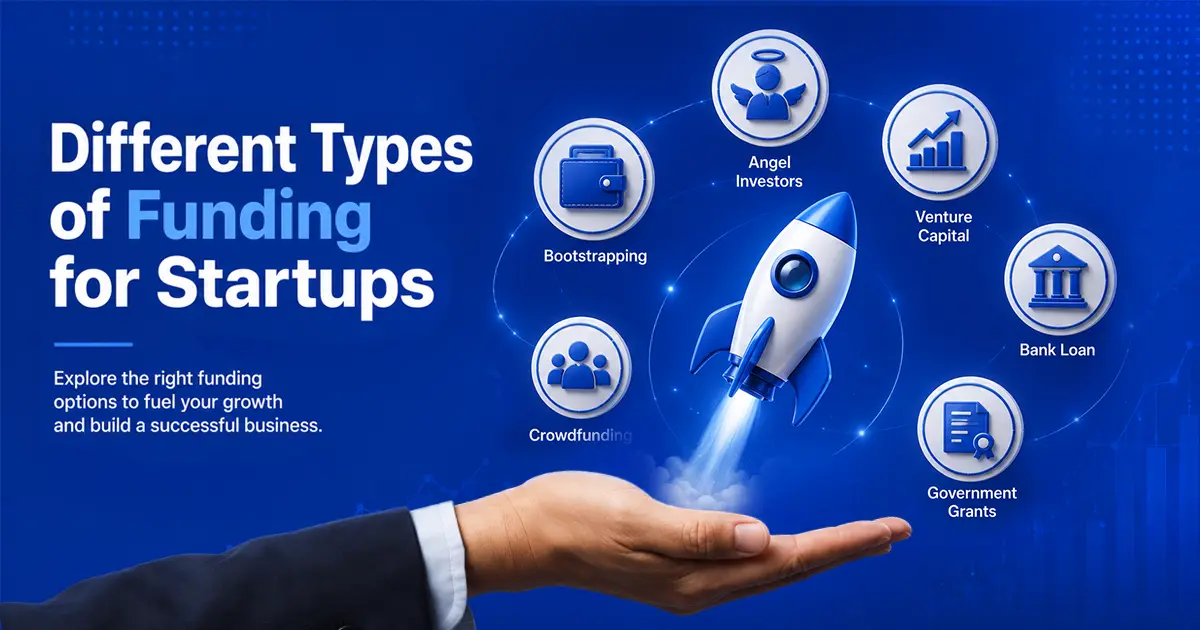
The main types of funding for startups in India in 2026 are bootstrapping (self-funding), friends & family, angel investors, venture capital (VC), venture debt, crowdfunding, incubators & accelerators, corporate funding, government grants and schemes (including the Startup India Seed Fund Scheme and Fund of Funds for Startups), IPO, and other sources like bank loans and family offices. Each option differs in equity dilution, capital amount, repayment obligation, investor involvement, and stage-fit.
India is now the third-largest startup ecosystem globally, with over 1.59 lakh DPIIT-recognized startups as of 2026. The funding landscape has also changed materially in the last two years. Most importantly, the Finance (No. 2) Act, 2024, abolished Section 56(2)(viib), the angel tax, with effect from Assessment Year 2025-26. This change removed one of the biggest historical friction points in Indian startup fundraising.
This guide covers all 11 funding options available to Indian founders in 2026 and explains when each one applies. It sets out the cost of each option in equity, interest, or compliance terms and describes how DPIIT recognition gives access to specific government schemes.
Key Takeaways
- India has 11 major startup funding options in 2026, from bootstrapping and angel investors to venture capital, government schemes, venture debt, and IPOs.
- The right funding depends on your startup stage, capital needs, growth plans, and ownership goals.
- Angel tax has been abolished from Assessment Year 2025-26, removing a major hurdle for startup fundraising.
- DPIIT recognition can provide eligible startups with tax benefits, funding access, and compliance-related benefits.
- Funding typically progresses from pre-seed and seed rounds to Series A, B, C and beyond, depending on business growth.
- Founders should compare equity dilution, interest costs, repayment obligations, and investor involvement before choosing a funding source.
- A strong pitch deck, financial model, and due diligence preparation can make the fundraising process smoother.
11 Types of Funding in Startups
Funding stages for startups vary, and each source of funding has its own advantages, drawbacks, and ideal use cases.
Below are the main funding options available to startups in India:
1. Bootstrapping (Self-Funding)
Bootstrapping refers to using personal savings or resources to fund a startup. Founders maintain complete control over operations, decision-making, and the direction of the business. They usually choose this method when they want to avoid external funding during the early stages.
- Pros: Full ownership and control, encourages discipline and resourcefulness.
- Cons: High personal financial risk, slower growth due to limited capital, and a lack of resources for scaling.
- When it’s suitable: Ideal during the idea stage or when testing product-market fit with minimal capital.
- Examples: Zoho, Wingify, and Zerodha relied heavily on bootstrapping in their early days.
2. Friends & Family Funding
Friends and family funding is one of the quickest ways for early-stage startups to obtain capital. Entrepreneurs often raise small amounts from personal contacts. Even informal funding should include written agreements to avoid misunderstandings.
- Pros: Fast, flexible, and often comes with a supportive environment.
- Cons: Limited amounts of capital, risk of damaging personal relationships if the business struggles.
- When it’s suitable: Best suited for early-stage startups needing small amounts to develop prototypes, validate concepts, or fund initial operations.
- Examples: Many Indian founders start with contributions from parents, siblings, or close friends.
3. Angel Investors
Angel investors are high-net-worth individuals who invest their personal funds into early-stage startups in exchange for equity. These investors also offer valuable mentorship, advice, and business connections. Angel investors typically come in when the startup has passed the idea stage and requires funds for product development or early-market testing.
- Pros: Provides capital along with strategic mentorship and networking opportunities.
- Cons: Requires giving up equity, and investors may want involvement in decision-making and operations.
- When it’s suitable: When a startup is past the validation phase and needs funding to develop its product or test the market.
- Examples: Indian Angel Network, Lead Angels, and Chennai Angels have supported startups like Ola and Byju’s in their early stages.
Angel tax abolished: The Finance (No. 2) Act, 2024 abolished the angel tax under Section 56(2)(viib), effective Assessment Year 2025-26. Any investment received on or after 1 April 2024 now escapes angel tax, whether the investor is resident or non-resident. This reform removed one of the biggest historical challenges in Indian startup fundraising. Investments received before that date still fall under the old provisions and may face scrutiny.
4. Venture Capital (VC)
Venture capitalists invest large amounts in high-growth startups. In return, they usually receive equity ownership. VCs often invest in multiple rounds, offering capital to fuel rapid scaling, hiring, and market expansion. They also bring expertise, strategic guidance, and industry connections.
- Pros: Access to large funding, business guidance, strategic advice, and credibility.
- Cons: Substantial equity dilution, high expectations for growth, and involvement in board-level decisions.
- When it’s suitable: When a startup has a proven product and market fit, and needs large capital to scale quickly or enter new markets.
- Examples: Peak XV Partners (formerly Sequoia India) and Accel Partners have invested in Indian startups like Freshworks, Razorpay, and Zerodha.
VCs generally invest in later stages compared to angel investors and tend to have more structured expectations for growth. Read more to know the difference between angel investors and venture capitalists before choosing one of them.
Startup Funding Rounds: Pre-Seed, Seed, Series A to D Explained
Equity funding for startups happens in sequential funding rounds; each round corresponds to a maturity stage and unlocks a different scale of capital. Understanding these rounds helps founders plan their dilution, valuation milestones, and investor mix.
| Funding Round | Typical Stage | Typical Cheque Size (India) | Typical Investor Type | Typical Equity Dilution |
|---|---|---|---|---|
| Pre-Seed | Idea / earliest team formation | ₹25 lakh – ₹2 crore | Founders, family, angel networks, accelerators | 5–10% |
| Seed Round | MVP built, initial product-market fit | ₹2 crore – ₹15 crore | Angels, micro-VCs, seed funds, family offices | 10–20% |
| Series A | Early traction, repeatable revenue | ₹15 crore – ₹50 crore | Institutional VCs | 15–25% |
| Series B | Scaling proven model | ₹50 crore – ₹200 crore | VCs, growth funds | 10–20% |
| Series C | Market expansion, possible acquisitions | ₹200 crore – ₹500+ crore | Growth-stage VCs, PE funds, strategic investors | 10–15% |
| Series D and beyond | Pre-IPO or late-stage growth | ₹500+ crore | Late-stage PE, sovereign wealth funds, strategic corporates | 5–15% |
| Bridge / Down Rounds | Between major rounds | Variable | Existing investors, venture debt providers | Variable |
Each round typically raises the company’s valuation, but down rounds (where valuation falls below the prior round) can happen if the company underperforms. Founders should aim to retain at least 51-60% combined equity by Series A and not dilute below 30% by Series C to maintain meaningful upside and control.
5. Venture Debt
Venture debt is a loan provided to startups that already have venture capital backing. It is typically used as a bridge between equity rounds or to extend the startup’s runway without giving up more equity. Startups repay venture debt over time with interest, making it a hybrid form of financing.
- Pros: Non-dilutive capital allows startups to extend their runway between funding rounds.
- Cons: The obligation to repay with interest can be risky if the startup’s revenue growth doesn’t meet expectations.
- When it’s suitable: Ideal when startups need time to grow before raising another round of equity funding or to finance specific projects.
- Examples: Startups like Razorpay and Ola have utilized venture debt alongside VC funding to fuel their growth.
6. Crowdfunding
Crowdfunding is a method where startups raise small amounts of money from a large number of individuals, typically via online platforms. It can also serve as a tool for market validation by gauging consumer interest and creating an initial customer base before launching a product.
- Pros: Provides market validation, builds a loyal customer base, and generates publicity.
- Cons: Time-consuming, limited capital per contributor, and potential for campaign fatigue.
- When it’s suitable: Great for launching products or services with a strong consumer appeal, or when startups need early adopters to validate their concept.
- Examples: Platforms like Ketto and Milaap facilitate crowdfunding campaigns for Indian startups.
7. Incubators & Accelerators
Incubators and accelerators are organizations that offer startups structured programs that provide mentorship, office space, and sometimes seed funding. These programs help startups refine their business models, develop their products, and gain access to networks of investors and advisors.
- Pros: Structured mentorship, networking opportunities, and sometimes initial funding.
- Cons: Programs are competitive, and startups may need to give up equity in exchange for participation.
- When it’s suitable: Best for startups that need guidance, mentorship, and resources to refine their business model and go to market.
- Examples: T-Hub, Atal Innovation Mission, and CIIE (IIM Ahmedabad).
8. Corporate Funding / Strategic Partnerships
Corporations may invest through venture arms or strategic partnerships. In return, they may seek equity or product collaboration rights. This type of funding is advantageous for startups that can benefit from market access, industry expertise, and additional resources.
- Pros: Strategic market access, technical expertise, and co-development opportunities.
- Cons: Potential conflicts in goals, complicated agreements, and loss of some independence.
- When it’s suitable: When a startup wants to leverage a corporate partner’s resources, networks, or market reach for growth or co-development.
- Examples: Reliance Strategic Business Ventures and Tata Capital Strategic Investments are active in India.
9. Government Grants & Schemes
Government-backed grants, loans, and schemes provide funding without requiring equity in return. Governments usually design these schemes for innovative and socially impactful startups.
- Pros: Non-dilutive, reduces financial risk, and adds credibility.
- Cons: Strict eligibility criteria, bureaucratic processes, and significant paperwork.
- When it’s suitable: Ideal for early-stage startups or those working on innovative or socially impactful ventures that meet government criteria.
Examples:
- Startup India Seed Fund Scheme (SISFS) provides up to ₹20 lakh grant for proof-of-concept/prototype, or up to ₹50 lakh via convertible debentures/debt for commercialization, delivered through ~300 DPIIT-approved incubators (₹945 crore total outlay).
- Fund of Funds for Startups (FFS) is a ₹10,000 crore corpus managed by SIDBI that invests in SEBI-registered AIFs, which then fund startups.
- SIDBI Direct Loans provides collateral-free debt up to ₹50 lakh for eligible DPIIT/Udyam-registered startups.
Note: Funding schemes, tax benefits, and compliance requirements may change based on government notifications and SEBI or DPIIT regulations.
10. IPO (Initial Public Offering)
An IPO allows startups to raise capital by offering shares to the public, transforming the business into a publicly traded company. It offers large-scale capital but comes with high regulatory and market expectations.
- Pros: Large-scale capital, liquidity for early investors, increased brand visibility, and credibility.
- Cons: Complex regulatory requirements, exposure to public scrutiny, and loss of some control.
- When it’s suitable: Best suited for mature startups with stable revenues looking to expand, provide liquidity to investors, or gain significant market exposure.
- Examples: Zomato, Paytm, and Nykaa have successfully gone public.
11. Other Sources
Other funding sources include bank loans, NBFC loans, family offices, and corporate venture funds. These options are sometimes less conventional but can provide necessary capital or strategic support for startups in need.
- Pros: Flexible, strategic, or specialized funding options available.
- Cons: Loans come with repayment obligations, and strategic investors may want a say in operations.
- When it’s suitable: When startups need debt financing, specialized investment, or strategic partnerships outside traditional venture funding.
- Examples: MSME loan scheme, family offices, and corporate venture funds like Reliance Ventures.
Tip: Financial experts recommend that founders avoid raising excessive equity too early, as dilution can reduce long-term ownership and investor attractiveness.
Tax Benefits for DPIIT-Recognized Startups in 2026
DPIIT-recognized startups in India receive tax benefits that improve their cash position and investor appeal. From 1 April 2026, the Income Tax Act, 2025, governs and renumbers several of these provisions. The key benefits appear below:
1. Income Tax Holiday under Section 80-IAC
An eligible startup can claim a 100% profit deduction for any three consecutive years within its first ten years. The Income Tax Act, 2025, retains this benefit and renumbers it as Section 140. To qualify, the startup must meet the following conditions:
- Incorporation as a Private Limited Company or LLP between 1 April 2016 and 31 March 2030.
- DPIIT recognition under Startup India.
- Annual turnover not exceeding ₹100 crore in the year of claim.
- Innovation or a scalable model with potential to generate employment.
The startup must apply separately for the certificate through the Inter-Ministerial Board (IMB).
2. Angel Tax Abolition under Section 56(2)(viib)
The Finance (No. 2) Act, 2024, abolished the angel tax with effect from Assessment Year 2025-26. A startup can now raise capital at a premium valuation from any investor, whether resident or non-resident. The old law no longer taxes the premium over fair market value, and the Income Tax Act, 2025, does not revive it.
3. Capital Gains Exemption under Section 54GB (Old Act Only)
Under the Income Tax Act, 1961, an individual who sold residential property and reinvested the proceeds in an eligible startup could claim a capital gains exemption, subject to a 5-year lock-in on the shares. The Income Tax Act, 2025 does not carry this forward, so the exemption no longer applies to fresh claims from FY 2026-27.
4. Carry-Forward of Losses under Section 79
A company normally loses the right to carry forward losses when its shareholding changes by more than 49%. The law relaxes this rule for DPIIT-recognized startups, allowing carry-forward even after fundraising shifts the shareholding. The Income Tax Act, 2025, retains this relaxation for eligible startups.
5. Self-Certification Under Labour Laws
A DPIIT-recognized startup can self-certify its compliance for the first five (5) years after incorporation, which lowers its early compliance burden. This cover now applies across the four Labour Codes, which took effect on 21 November 2025, together with three environmental laws. Self-certification lets founders focus on building the business during the crucial early years.
Startup Funding Stages & Corresponding Funding Types
Startups raise funding in stages based on business maturity and growth goals. Here’s a simple table to help founders understand which funding option typically fits each phase of growth:
| Startup Stage | Business Situation | Suitable Funding Types | Best For |
|---|---|---|---|
| Ideation Stage | The business idea is being developed; little or no revenue | Bootstrapping, Friends & Family Funding, Startup India Seed Fund Scheme (SISFS), Grants | Testing business ideas and building initial prototypes |
| Validation / MVP Stage | MVP or prototype is ready; early customer validation begins | Angel Investors, Incubators, Accelerators, Crowdfunding, Seed Funding | Product validation and early market entry |
| Early Traction Stage | Startup gains users, revenue, or market traction | Seed VC Funding, Venture Capital, Series A Funding | Team expansion, customer acquisition, and scaling operations |
| Growth Stage | Revenue growth becomes consistent; business expands across markets | Series B & Series C Funding, Growth Equity, Venture Debt | Scaling aggressively, entering new markets, hiring leadership |
| Expansion / Late Stage | Established startup with strong market presence | Private Equity Funding, Strategic Investors, Venture Debt | Large-scale expansion, acquisitions, operational growth |
| Pre-IPO / Mature Stage | Business prepares for public listing or major exit | Initial Public Offering (IPO), Institutional Investment | Public fundraising and long-term capital access |
Each funding stage aligns with key business milestones, from idea validation to expansion.
How to Choose the Right Startup Funding Option?
The right funding option depends on the startup’s stage, its capital needs, and how much control the founder wants to keep. The guidance below maps each option to the stage it suits best:
- Bootstrapping and grants work best in the early stages when founders want to retain ownership and validate ideas.
- Angel investors and seed funding become relevant once the startup shows product-market fit and early traction.
- Venture capital funding is generally suitable for startups targeting rapid growth and scalable business models.
- Venture debt and private equity are more common for mature startups with stable revenues and expansion plans.
- IPO funding is typically reserved for large startups with strong financial performance and long-term scalability.
Why Startups Need Funding?
When it comes to startup funding options in India, founders need to evaluate their business needs and growth stage. Each type of funding has its pros and cons, so it’s essential to align the right type of investment with the stage your startup is at. Here are some things to consider:
- Fueling Growth: Funding provides the resources to expand operations, increase production, and reach more customers.
- Product Development: It enables startups to develop, refine, and launch new products or services to meet market needs.
- Hiring Talent: With adequate funds, startups can attract and retain skilled professionals to build a strong team.
- Marketing and Brand Building: Funding helps execute marketing strategies that boost brand awareness and customer acquisition.
- Managing Cash Flow: It ensures there’s enough working capital to cover operational expenses and avoid cash flow issues.
- Seizing Opportunities: Having capital allows startups to act on new market opportunities, investments, or strategic partnerships.
- Building Long-Term Stability: Funding creates a foundation for sustainable growth, positioning startups for future success.
Funding isn’t just about meeting immediate needs; it’s about laying the groundwork for long-term growth and competitiveness in the market.
Startup Fundraising Process in India
Raising startup funds in India requires preparation, documentation, and investor readiness:
- Start by creating a compelling pitch deck and financial model, ensuring you meet legal and compliance requirements.
- Be ready for due diligence by organizing key documents, and when investors show interest, negotiate term sheets that align with your growth goals.
This structured approach will help you raise capital efficiently while protecting your equity. Choosing the right funding source can determine how quickly your startup scales. Founders should evaluate dilution, repayment obligations, investor expectations, and long-term growth plans before raising capital.
