

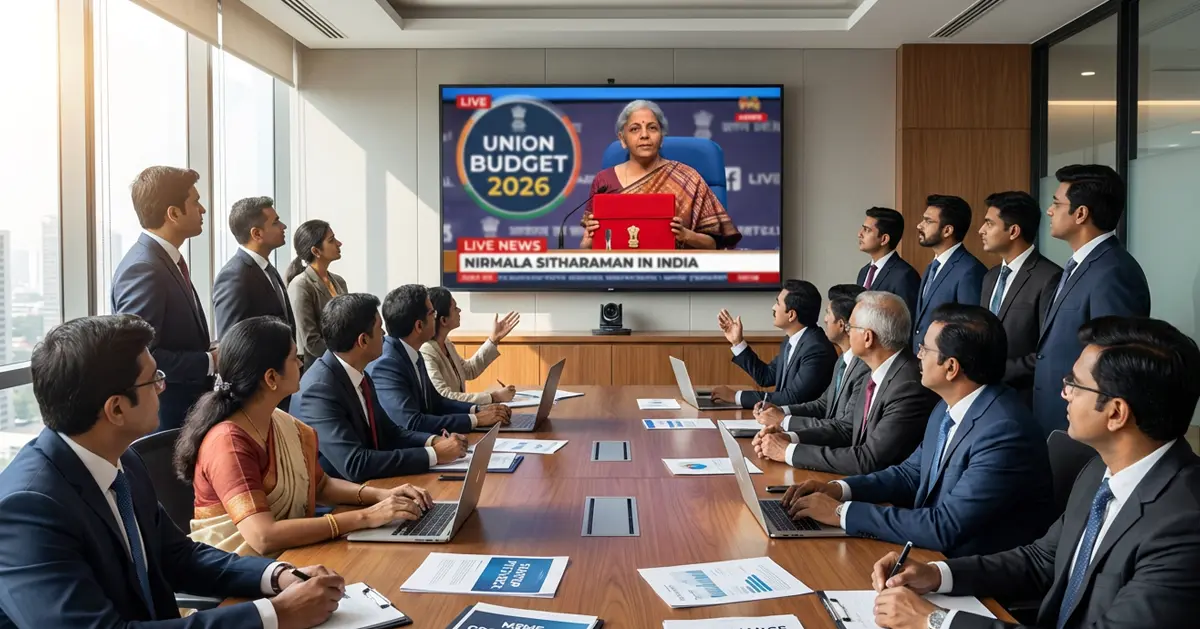
The Income Tax Union Budget 2026 is scheduled to be presented by Finance Minister Nirmala Sitharaman on 1 February 2026. It is expected to bring income tax relief, startup incentives, and easier compliance. The budget may also enhance MSME credit access and facilitate cross‑border investments. Businesses and investors are preparing strategies in anticipation of the announcements.
The Union Budget is India’s main platform used to set tax policies, drive growth, and guide investments. It defines tax rates, exemptions, and compliance rules for individuals and businesses every year. The event also informs the citizens about the total collected tax revenue of the nation. In 2025–26, India collected ₹18.38 trillion in direct taxes from April to January, showing strong revenue growth.
This blog explains how the Union Budget 2026 impacts startups, MSMEs, and company compliance. It highlights tax changes, investment opportunities, and actionable planning tips.
Key Takeaways
- The Union Budget 2026 supports startups, MSMEs, and technology-driven businesses through targeted funding and policy reforms.
- The ₹10,000 crore SME Growth Fund can help high-potential MSMEs access growth capital and scale their operations.
- Startups in IT and technology can benefit from the 15.5% safe harbour margin and the higher ₹2,000 crore threshold for IT services.
- India Semiconductor Mission 2.0 creates new opportunities for deep-tech, semiconductor, and advanced manufacturing startups.
- The new Income Tax Act, effective from 1 April 2026, requires businesses to review their tax processes and compliance systems.
- Businesses should keep their DPIIT, GST, and Udyam registrations updated to access relevant benefits and government schemes.
- Companies should track detailed scheme guidelines and sector allocations to identify funding, investment, and expansion opportunities.
What is the Union Budget in India? Latest Update & Announcements
The Union Budget is India’s annual financial statement. In it, the Finance Minister sets out the government’s expected revenue and expenditure for the coming financial year under Article 112 of the Constitution. Each Budget covers a few core areas:
- Tax changes for individuals, businesses, and startups.
- Government spending on infrastructure, social welfare, and development programs.
- Reforms to improve the ease of doing business and governance.
- Policy priorities across sectors such as health, education, defense, and technology.
- Socio-economic goals that promote employment, innovation, and inclusive growth.
The Budget shapes everything from tax rates and incentives to capital allocation for infrastructure and growth. It remains a central event for policymakers, businesses, investors, and taxpayers alike.
Union Budget 2026: Key Highlights at a Glance
The Budget 2026 combined steady tax reform with targeted funding for enterprise and manufacturing. The main announcements were:
- The new Income Tax Act takes effect from 1 April 2026, replacing the 1961 Act.
- A dedicated ₹10,000 crore SME Growth Fund to scale high-potential enterprises.
- India Semiconductor Mission 2.0 with a provision of ₹1,000 crore for FY 2026-27.
- A single “Information Technology Services” category with a common safe harbour margin of 15.5%.
- The highest-ever railway capital outlay of ₹2,93,030 crore, with seven new high-speed rail corridors.
- A raised defense budget of ₹7,85,000 crore.
The sections below explain what these measures mean for startups, MSMEs, and company compliance.
What the Union Budget 2026 Announced for Startups?
The Budget 2026 supported startups mainly through funding, the IT services safe harbour reform, and the move to the new tax law. The key measures were:
- New safe harbour framework for IT services: The Budget clubbed IT, ITeS, knowledge process outsourcing, and contract software R&D into a single “Information Technology Services” category, with a common safe harbour margin of 15.5%. It also raised the safe harbour threshold sharply from ₹300 crore to ₹2,000 crore. This gives software and services startups far greater tax certainty on cross-border transactions.
- India Semiconductor Mission 2.0: The government provided ₹1,000 crore for FY 2026-27 to produce semiconductor equipment and materials, design full-stack Indian intellectual property, and strengthen supply chains, with a focus on industry-led research and training centers. Deep-tech and hardware startups stand to benefit from this push.
- Transition to the new Income Tax Act: The new Act applies from 1 April 2026 and changes several provisions that startups rely on, so founders should review their filings and structures with an accountant.
- DPIIT recognition remains the gateway: To access most startup-specific benefits and government funding routes, a startup still needs DPIIT recognition through (Startup India registration), so founders should confirm their registration is current.
What the Union Budget 2026 Announced for MSMEs?
The Budget 2026 targeted MSME growth capital, resilience, and modernization. The main announcements were:
- SME Growth Fund of ₹10,000 crore: The government introduced a dedicated fund to provide equity and growth capital, aimed at scaling promising enterprises into larger, competitive firms and creating future champions.
- Rare-earth corridors in Odisha and Kerala: These corridors will support EV and clean-energy manufacturing, opening supply-chain opportunities for MSMEs in these sectors.
- Manufacturing and cluster support: The Budget continued its focus on strengthening manufacturing supply chains and industrial infrastructure, which lowers entry and operating costs for smaller enterprises.
- Ease of formalization: MSMEs should keep their Udyam registration current to access credit-linked schemes and government programs.
These measures aim to improve access to growth capital and lower operating costs for small businesses in FY 2026-27.
What the Union Budget 2026 Announced for Compliance and Taxation?
The Budget 2026 continued the push toward simpler, more certain tax rules, anchored by the new tax law. The key points were:
- New Income Tax Act from 1 April 2026: The Act replaces the Income-tax Act, 1961 with renumbered provisions and clearer rules, which the government expects will reduce disputes and litigation. Companies should update their statutory compliance checklist in India and prepare their filings for the transition.
- Greater tax certainty for IT services: The single IT Services category and the common 15.5% safe harbour margin, together with the higher ₹2,000 crore threshold, reduce transfer-pricing disputes for technology companies.
- Continued digital compliance: The Budget maintained the direction toward integrated digital reporting across tax and corporate law portals, which lowers the compliance burden over time.
Companies should prepare for the new Income Tax Act now, review their GST and Udyam registrations, and speak with their accountant about the revised timelines.
Sector Allocations in the Union Budget 2026
The Budget 2026 raised spending across several major sectors. The key allocations were:
- Railways: ₹2,93,030 crore, the highest ever, up 10.3%, with seven new high-speed rail corridors including Mumbai–Pune and Delhi–Varanasi, and a new East–West Dedicated Freight Corridor from Dankuni to Surat.
- Defense: ₹7,85,000 crore, up 15%, prioritizing deep-tech research and advanced platforms.
- Agriculture: ₹1.63 lakh crore, including the launch of “Bharat-Vistaar,” an AI-based advisory platform for farmers.
- Health: ₹1,06,530 crore, including a ₹10,000 crore “Biopharma Shakti” scheme for biologics manufacturing and customs duty exemptions on 17 cancer drugs.
- Education: ₹1.39 lakh crore.
These allocations point to sustained government spending on infrastructure, manufacturing, and technology, which supports demand across the wider economy.
What Businesses Should Do Now?
The Budget confirms several changes that take effect in FY 2026-27, so businesses should act early. A few practical steps help:
- Review your registrations, and make sure your DPIIT recognition, GST registration, and Udyam registration are current and accurate.
- Prepare for the new Income Tax Act, since the law changes on 1 April 2026, and confirm with your accountant what it means for your filings and private limited company compliance.
- Track the detailed scheme guidelines as departments notify them, since fund criteria and application windows follow the Budget, and compare them with other types of funding for startups in India.
- Protect your intellectual property through timely trademark and patent filings if you operate in a competitive sector.
Conclusion
The Union Budget 2026 combined steady tax reform with targeted funding for startups, MSMEs, and manufacturing, set against the shift to the new Income Tax Act from 1 April 2026. The ₹10,000 crore SME Growth Fund, the reformed IT services safe harbour, and India Semiconductor Mission 2.0 point to a clear focus on enterprise growth and deep-tech capability. Businesses that review their registrations, prepare for the new tax law, and track scheme details as they are notified will be best placed to benefit in FY 2026-27.
