Trust Registration Online in India
Register your Trust online in India with expert support, complete documentation, and end-to-end compliance assistance for charitable or private trusts.
 NGO Darpan ID & FCRA Registration SupportTrust Deed Drafting & DocumentationGovernment-Issued Trust Registration CertificateEnd-to-End Legal & Compliance Assistance from ExpertsTrusted by 5,000+ Registered Trusts Across India

 What Sets Us ApartWhat Sets Us Apart
What is Trust Registration?
A trust is a legal arrangement where one person transfers property (the "settlor") to another person to hold and manage (the "trustee") for the benefit of a third person or group (the "beneficiary") or a specific purpose.
Trust Registration is the formal process of legally establishing a trust under various trust registration acts. This registration provides legal recognition, enables tax benefits, and ensures the trust operates as intended.
Types of Trusts Available for Registration in India
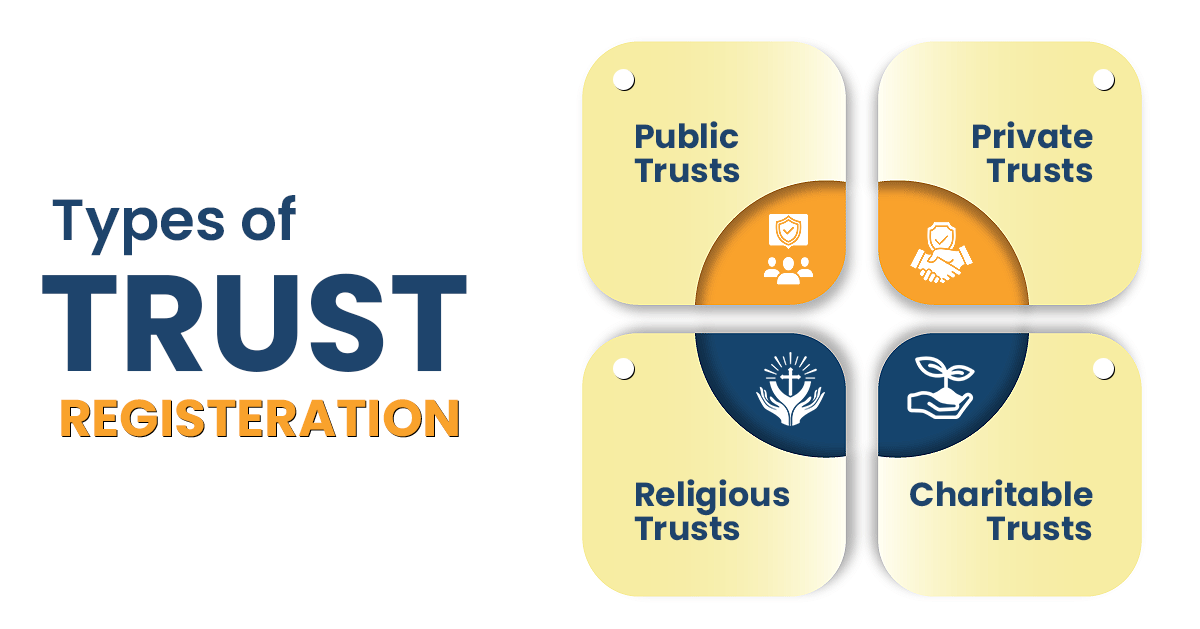
- Public Trusts: Established for public benefit purposes like education, healthcare, and poverty alleviation.
- Private Trusts: Created for specific beneficiaries, often family members.
- Religious Trusts: Focused on religious activities and the maintenance of places of worship.
- Charitable Trusts: Dedicated to charitable causes like relief for the poor, education, and medical relief.
Objectives of a Trust
The main objective of Trust Registration in India is to give legal validity and operational structure to the intentions of the settlor. It helps in:
- Legally binding the trustees to the trust's objectives.
- Protecting the assets held within the trust.
- Ensuring the benefits reach the intended beneficiaries.
- Enabling the trust to receive donations and exemptions during ITR filing.
- Providing a framework for the administration and management of the trust.
- Allowing the trust to sue or be sued in its capacity.
- Facilitating GST registration for the trust if it undertakes taxable activities.
For settlers and beneficiaries, registration ensures the trust’s objectives are legally enforceable.
Laws Governing Trust Registration in India
To register your trust, you must understand the laws that define its formation and operation. These statutes and authorities ensure your trust gains legal validity and access to benefits.
Legal Framework
Trust registration in India is primarily governed by:
- The Indian Trusts Act, 1882 - Provides the foundational legal framework for private trusts.
- The Bombay Public Trusts Act, 1950 (applicable in Maharashtra and Gujarat).
- State-specific Trust Acts in various states for public trusts.
- The Registration Act, 1908 - Governing the registration of trust deeds.
- The Income Tax Act, 1961 - For tax implications and exemptions.
Regulatory Authorities for Trust Registration in India
To maintain legal validity and access government benefits, trusts must interact with the following authorities:
- Registrar/Sub-Registrar Office (under the Registration Act, 1908): Responsible for registering the trust deed, confirming the trust’s legal existence.
- Charity Commissioner (in applicable states): Oversees registration, financial audits, and handles complaints for public charitable trusts.
- Income Tax Department: Grants the 12A and 80G registration, which are necessary for tax exemptions and donor benefits.
Characteristics of Trust Registration
A trust registration has specific characteristics such as:
- Legal Recognition: Your trust gains a valid legal identity, empowering it to enforce its deed and protect beneficiaries.
- Asset Ownership: The trust can hold, buy, sell, or lease property in its name, ensuring a clear title and smooth transfers.
- Tax Exemptions: Registered charitable trusts qualify for income-tax relief under Sections 11 and 12, reducing your tax burden.
- Enhanced Credibility: Formal registration builds donor and regulator confidence, boosting your ability to raise funds and secure grants.
Benefits of Trust Registration in India
Securing Trust Registration offers many advantages:
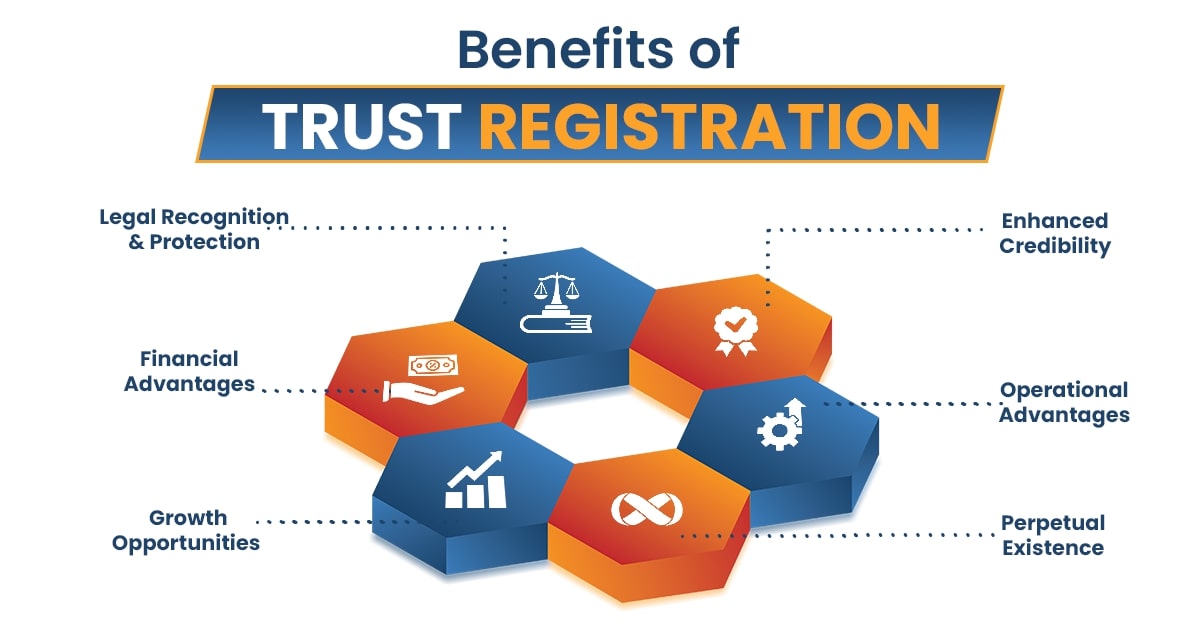
Legal Recognition & Protection
- Establish Legal Identity: Your trust gains formal status under Indian law, creating a distinct legal entity.
- Secure Asset Protection: Registration shields trust property from unauthorized claims and disputes.
Enhanced Transparency & Credibility
- Build Stakeholder Trust: Registered status demonstrates your commitment to transparency and accountability.
- Increase Public Confidence: Official recognition strengthens your reputation among beneficiaries and partners.
Financial Advantages
- Access Tax Benefits: Registered trusts qualify for specific tax exemptions under applicable sections of the Income Tax Act.
- Attract More Donations: Formal status encourages donors who prefer contributing to recognized entities.
Operational Advantages
- Start a Business: If your trust undertakes commercial activities, register under the MSME Act to secure priority lending, lower interest rates, and simplified compliance.
- Acquire Property: The trust can purchase, hold, and transfer assets legally in its name.
Growth Opportunities
- Secure Grant Funding: Many funding agencies require registration as a prerequisite for grant applications.
- Form Partnerships: Registration facilitates collaboration with government bodies and other organizations.
Perpetual Existence
- Ensure Continuity: Your trust continues to function regardless of changes in trustees or beneficiaries.
- Create Lasting Impact: Registration helps institutionalize your mission beyond individual involvement.
Eligibility Criteria for Trust Registration
To establish a valid trust in India, you must fulfill these essential requirements:
-
Trustees
-
- There must be at least 2 trustees to register a trust.
- Trustees can be individuals or entities.
-
Trust Property
-
- The trust must have some property or assets to be managed for the benefit of beneficiaries.
-
Legal Purpose
-
- The trust’s objectives must be lawful and charitable or religious (in case of charitable trusts) or private and legal (in case of private trusts).
- It should not be formed for any illegal or immoral purposes.
-
Written Trust Deed
-
- A trust deed must be created, specifying the terms, objectives, trustees, and beneficiaries.
- This deed is required for registration.
-
Voluntary Act
-
- The trust must be created by a voluntary act of the settlor (the person creating the trust).
-
Registration Jurisdiction
-
- The trust must be registered under the Indian Trusts Act, 1882, or relevant state-specific Trust Acts.
- Registration is done at the local Registrar’s office having jurisdiction over the trust’s place of operation.
Key Documents Required for Trust Registration
A list of documents you need to have for trust registration:
- Original signed trust deed on the prescribed stamp paper
- Identity proof of settlor and trustees (Aadhaar, PAN, Voter ID, Passport, or Driving License)
- Address proof of settlor and trustees (Aadhaar, recent utility bill, or bank statement)
- PAN card application for the trust (to be obtained post-registration)
- Passport-size photographs of the settlor and trustees
- Registered office address proof (property title deed or lease agreement/NOC)
- Details of trust assets (list of movable and immovable properties)
- Digital Signature Certificates (DSC) for authorized signatories.
Step-by-Step Process to Register a Trust
Here's a general outline of how to make a trust in India and get it registered:
- Draft the Trust Deed: This is the most crucial step. The Trust Deed should clearly state:
- Name and address of the Settlor.
- Name(s) and address(es) of the Trustee(s).
- Name(s) of the Beneficiary(ies) or the charitable object if it's a public trust.
- Name of the Trust.
- Address of the Trust.
- The trust property (movable or immovable).
- The objectives of the trust.
- Rules and regulations for managing the trust, appointing/removing trustees, etc.
- Duration of the trust (if not perpetual).
- Procure Stamp Paper: The Trust Deed must be executed on non-judicial stamp paper of appropriate value, which varies by state.
- Signatures and Witnesses: The Settlor and Trustees must sign the Trust Deed in the presence of at least two independent witnesses.
- Obtain DSC (Digital Signature Certificate): For certain online filings related to trusts, especially for post-registration compliance like income tax.
- Approach the Sub-Registrar: Immovable property must be registered with the trust deed. Whereas for movable property, registration is optional, but recommended for legal validity.
- Submit Documents: Along with the Trust Deed, submit KYC documents of the Settlor and Trustees.
- Pay Registration Fees: Pay the applicable registration fees to the Sub-Registrar.
- Obtain Registered Deed: Once the Sub-Registrar is satisfied, the Trust Deed will be registered.
- Download Copy: Log in to your state-specified trust portal, select your trust, and click “Download Trust Registration Certificate.
Need help with your Trust Registration? ☎️ Contact RegisterKaro Today! We simplify the process for you and provide you smooth experience.
Fees & Penalties of Trust Registration
Here, the fees involved in the registration process and the risks of not registering your trust are discussed.
Trust Registration Fees
- Registration Fees: Cost around Rs. 2000/- for urban & Rs. 1000/- for rural areas.
- Stamp duty: Costs between Rs. 500/- to Rs. 1,000/-, depending on the state and the value of assets.
Penalties for Non-Registration
- Unregistered trusts cannot legally own property, transfer assets, or hold bank accounts in the trust's name.
- They cannot file cases in court as a legal entity, limiting their ability to enforce rights.
- Unregistered trusts lose eligibility for tax benefits, which are only available to registered entities.
- Trustees may face personal liability for any financial or legal matters related to the trust’s operations.
Compliance Requirements for Registered Trusts
Following these essential requirements keeps your trust legally valid and operational.
First Steps After Registration
- Use funds only for deed-stated objectives.
- Open and operate dedicated bank accounts in the trust’s name.
- Set up double-entry accounting to record all receipts and payments.
Pro Tip: If your annual receipts exceed ₹10 lakh, schedule an audit under the Income-Tax Act Section 44AB.
Ongoing Compliance Responsibilities
- File ITR-5 each year before the deadline (usually 30 November).
- Submit Form 10B along with audited accounts if you hold 12A/80G approvals.
- Hold trustee meetings regularly and record clear minutes to document decisions.
- Update trustee appointments or resignations by executing a supplementary deed and re-registering it.
- Review every expense to ensure it aligns with your trust’s stated objectives.
Essential Record-Keeping Practices
- Keep property deeds, agreements, and lease papers.
- Log each beneficiary distribution with date and amount.
- Store vouchers, invoices, bank statements, and grant documents for eight years.
Grounds of Cancellation for Trust Registration
Violations below can cancel registration:
-
Administrative Non-Compliance
- Missing annual ITR-5 or Form 10B filing.
- Failing to audit (when required) or maintain proper books.
- Skipping or inadequately documenting trustee meetings.
-
Financial Misappropriation
- Diverting corpus or income for personal use.
- Spending outside the trust’s declared charitable or private purposes.
-
Operational Violations
- Halting the activities you promised in your deed.
- Amending objectives without the trustee's and beneficiary's consent or proper registration.
-
Legal Infractions
- Registering with false or forged documents.
- Engaging in prohibited or unlawful acts.
- Ignoring court orders or directives from the Charity Commissioner or Income-Tax authorities.
Trust Registration Certificate
A Trust Registration Certificate is an official document issued by the Registrar of Trusts upon the successful registration of a trust. This certificate is issued under:
- The Indian Trusts Act, 1882 - for private trusts
- The relevant State Public Trust Act - for public trusts.
The certificate is official proof that the trust is legally formed, recognized by the government, and allowed to carry out its charitable, religious, or private activities.
Why Do You Need It?
The Trust Registration Certificate is crucial for several reasons:
- Legal Recognition: It proves the trust’s existence and structure, protecting its operations under the law.
- Bank Account Opening: Required to open a bank account in the name of the trust.
- Tax Benefits & 12A/80G Registration: A valid certificate is needed to apply for income tax exemptions.
- Fundraising & Donations: Establishes credibility and is often mandatory for receiving grants or donations.
- Compliance: Ensures the trust is registered under government norms, preventing legal issues in the future.
How to Download the Trust Registration Certificate?
Once the trust is registered, the registration certificate can be collected either:
- Physically: From the office of the Sub-Registrar/Charity Commissioner, where the trust was registered.
- Online (if available in your state):
- Visit the official website of the Charity Commissioner or Registrar of Trusts (e.g., charity.maharashtra.gov.in for Maharashtra).
- Log in using your registration details.
- Navigate to “Registered Trusts” or “Trust Search.”
- Enter your trust’s name or registration number.
- Download and print the certificate in PDF format.
If you registered your trust through RegisterKaro, we will directly provide you with a digital and physical copy of the registration certificate, along with guidance on future compliance steps.
Connect with RegisterKaro and let our experts handle the legal hassle while you grow your business.
Frequently Asked Questions (FAQs)
What is Trust Registration?
Trust registration legally records a trust’s creation under the Indian Trusts Act or state charity laws. It grants the trust juridical status and enforces its deed’s terms.
How to register a trust online in India?
You draft a trust deed and upload it on your state’s charity/trust registration portal or www.mca.gov.in (if applicable). You pay the prescribed fee, submit digital signatures, and download the registration certificate.
What is the Purpose of Trust Registration?
Registration legitimizes the trust, protects beneficiaries’ interests, and enables the trust to own property. It also qualifies charitable trusts for tax exemptions and donor benefits.
Is it mandatory to obtain a PAN card for a registered trust?
Yes. Trusts must obtain a PAN to file income-tax returns, claim exemptions, and conduct financial transactions in India.
How many types of trust registrations are there?
Broadly, two: private trusts (private beneficiaries) and public trusts (charitable or religious). Each state may further classify trusts under specialized statutes.
Which type of trust is best?
Choose a private trust for family succession planning and asset management. Opt for a public charitable trust to secure tax benefits and fund social or religious activities.
What are the documents required for trust registration?
Basic Documents you need to register a trust in India are:
- Signed trust deed,
- Settlor and trustee identity proofs,
- Address proofs,
- Requisite legal affidavits
- Details of the trust asset
- Digital Signatures
- NOC from local authorities.
Is it necessary to have a physical office address for trust registration?
Yes. Authorities require a verifiable physical address to serve notices and maintain records, even if you operate virtually.
Can a trust be converted into a private limited company?
No. You cannot directly convert a trust into a private limited company; you must dissolve the trust and transfer assets to a newly incorporated company.
How to get an 80G registration for a trust?
First, register your charitable trust under Sections 12A/12AA of the Income-Tax Act. Then file Form 10G with your audited accounts and trust deed to claim 80G approval.
How long does trust registration take in India?
Authorities typically issue the registration certificate within 15–30 days after receiving complete documents and fees.
Can foreigners be trustees in an Indian trust?
Yes. Non-resident or foreign nationals may serve as trustees once they submit valid identity and address proofs and meet any additional local clearances.
How many members are required for trust registration?
You must appoint at least two trustees in the trust deed; there is no statutory upper limit on the number of trustees.
Can a trust be registered online?
Several states let you start registration on their e-governance portals, but most still require you to submit the signed deed and annexures in person at the sub-registrar’s office.
Is trust registration different in different states?
Yes. Each state enacts its own Trusts Act or charitable-trust rules, leading to variations in procedure, fees, and stamp-duty charges.
How much does trust registration cost?
Registration fees range from roughly ₹3,000 to ₹10,000, depending on the state and stamp duty; you may also incur notary or professional drafting charges.
Can a trust own property?
Absolutely. Once registered, a trust can hold, purchase, sell, or lease immovable assets in its name.
How do I modify a trust deed after registration?
Prepare a supplementary deed detailing the changes, have all trustees sign it, and then register that deed with the same sub-registrar where you filed the original.
Can a trust be converted into an NGO?
A registered trust already qualifies as an NGO; to form a society or Section 8 company, you must wind up the trust and register a new entity under the relevant Act.
What are the tax benefits of registered trusts?
Registered charitable trusts enjoy income-tax exemptions under Sections 11 and 12 and can obtain 80G certificates, so donors can claim deductions.

Reviewed by
Joel DsouzaJoel Dsouza is a Chartered Accountant (CA) and compliance expert with over 7 years of hands-on experience in company registration, tax structuring, GST, ROC filings, and MCA compliance. As a qualified member of the Institute of Chartered Accountants of India (ICAI) and Co-Founder at RegisterKaro, he has personally advised more than 1,000 startups and SMEs across India, helping founders navigate incorporation, regulatory frameworks, and financial planning from Day 1. With deep expertise across all three levels of Finance and Portfolio Management, Joel is committed to promoting financial literacy and simplifying India's startup ecosystem through clear, actionable guidance that entrepreneurs can act on immediately.
Why Choose RegisterKaro for Trust Registration Online?
RegisterKaro offers a seamless trust registration experience backed by legal expertise, transparent pricing, and strong post-registration support—all under one roof.
- End-to-End Service Delivery: From drafting trust deeds to completing all legal filings, we handle the entire process for you.
- Experienced Legal Experts: To provide tailored legal solutions for charitable, religious, and private trusts.
- Transparent Process and Pricing: With clear communication and no hidden charges
- Post-Registration Compliance Support: Our experts help you stay compliant with audits, returns, and legal updates throughout the year.
- High Success Rate: With a 98% success rate, our registration strategies are tried, tested, and trusted by NGOs and entrepreneurs across India.
What Our Clients Say
View All
Vanshika Agrawal
 Verified
A special thanks to Amarsh Kesarwani for his exceptional guidance, constant encouragement, and unwavering support. His leadership and dedication made... Read more

AMBEDKAR BRIJENDRA K...
VerifiedFrom the inicial consultation to the final trade mark process it was completaly smooth and the spoc person to has drafted thr trade mark registation t... Read more

Gaurav Gammer
VerifiedThe Ragister Karo website is user-friendly and easy to navigate. The registration process is simple and straightforward, making it convenient for user... Read more

RS ENGINEERING CORP
Verifiedregisterkaro is the good in LLP and company registration. Kavya Agarwal helps us a lot to get the registration on time. Thanks to the registerkaro tea... Read more

akash sharma
VerifiedExcellent experience with RegisterKaro! Their team is highly professional, responsive, and always ensures that compliances are completed on time. A sp... Read more

Prateek Jagadish
VerifiedThey have great services they are handling my companies (syntellite innovations private limited) compliance and gst , i have no problem so far recomme... Read more

Venu Lakshman
VerifiedI’m a startup based in Bangalore, and for the past six months, we’ve been working with Muskan from RegisterKaro for our GST filing and bookkeeping nee... Read more

ankit agrawal
VerifiedWhat impressed me most was Archana's understanding of compliance and financial matters. She didn't just complete the work,she explained every step and... Read more

Indu Kumari
VerifiedI am happy with my VO experience. my work got completed on time with the help of Mr. Adarsh Jaiswal. He was very supportive, responsive and always rea... Read more

Prateek premanand
VerifiedI had a smooth and hassle-free experience with RegisterKaro. The team was professional, responsive, and guided me through every step of the registrati... Read more
Related Blogs
View All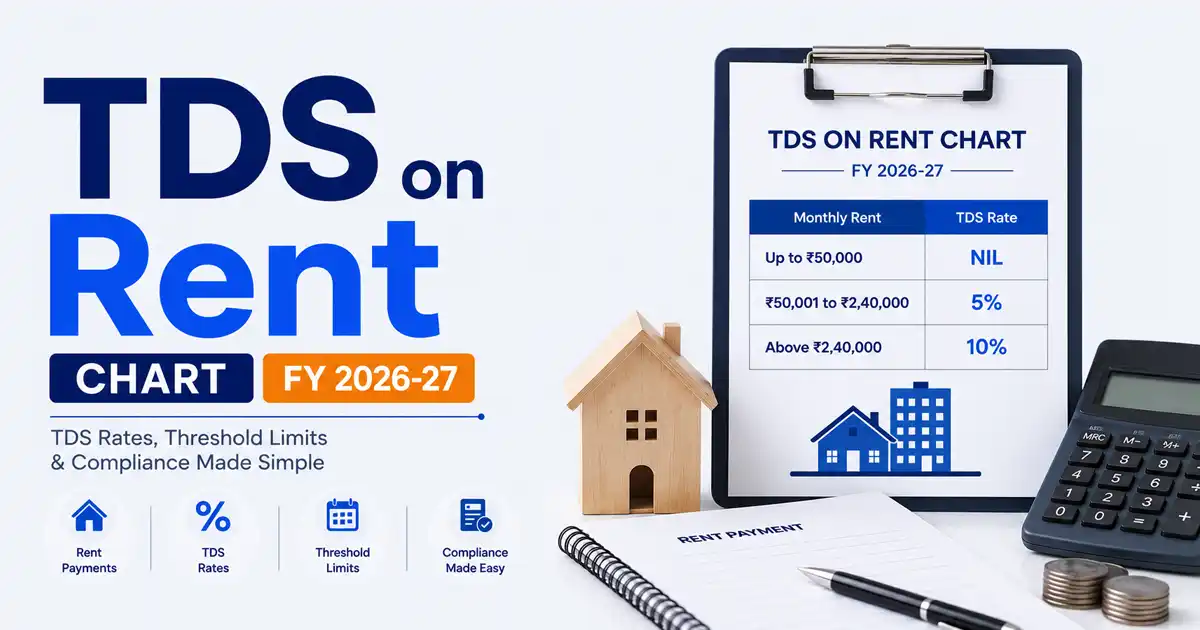
TDS on Rent Chart FY 2026 27 – Rates, Limits, Sections and Complete Guide
GST on Bikes in India: New Rates by Engine Capacity
GST for Electrical Items in India: Rates & HSN Codes

GST on Cars in India 2026: New Rates, Slabs & Impact

GST on Car Insurance in India: Rate, ITC, and Latest Rules
GST on Vehicle Insurance in India: Rate, ITC & Rules
How to Check IEC Code Application Status Online on DGFT Portal

Difference Between Brand and Trademark in India
How to File Trademark Form TM-M: Purpose, Fees & Process
Design Registration Fees in India: 2026 Cost Breakdown