

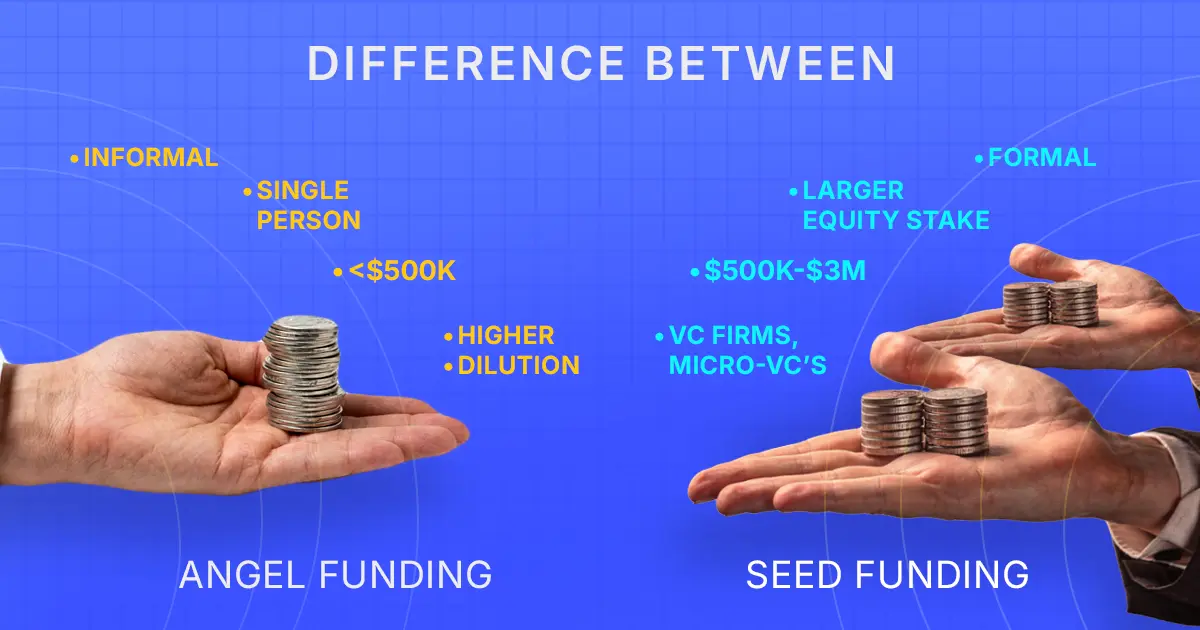
Startups raise capital at different growth stages to build, validate, and scale their business models effectively. Angel funding supports idea validation through early capital, while seed funding supports structured growth with measurable traction and expansion. Understanding the difference between seed funding and angel funding helps founders match each choice to their stage.
This distinction matters in practice, since many founders confuse angel and seed rounds. That confusion leads to poor fundraising decisions and mismatched expectations with investors during the early phases.
OYO Rooms shows how the two work in sequence. The company first secured seed funding of around ₹5 lakh from Venture Nursery to build its early business model and operations. Later, Ritesh Agarwal (CEO of OYO Rooms) attracted angel investors who supported expansion with additional capital, mentorship, and strategic industry connections.
Angel and seed funding often appear similar, but differences in investment timing, risk level, and involvement clearly define their roles.
Key Takeaways
- Angel funding suits startups at the idea or pre-revenue stage, while seed funding suits startups with an MVP or early traction.
- Angel investors use personal funds and often provide mentorship, expertise, and industry connections.
- Seed funding involves larger, structured investments from VCs, angel syndicates, accelerators, and similar sources.
- Key differences between these two include startup stage, investment size, investor type, due diligence, governance, and equity dilution.
- Both funding options involve high risk and equity dilution and can support different stages of a startup’s journey.
- Founders should choose funding based on their business stage, capital needs, traction, and growth plans.
- A strong pitch deck, financial projections, traction, and clear use of funds can improve fundraising prospects.
- Startups must maintain proper legal, valuation, tax, and FEMA compliance when raising funds.
What is Angel Funding in India?
Angel funding refers to early-stage investment provided by investors who use their personal wealth to fund startups. They support startups at a very early stage, often before they launch a product or generate any revenue. In India, angel funding typically ranges from ₹10 lakh to ₹5 crore, depending on the investor and startup potential.
Angel investors are usually successful entrepreneurs, senior professionals, or high-net-worth individuals who invest based on confidence in the founder or the idea. They contribute not only money but also guidance, experience, and industry connections.
As of early 2026, India has over 110,000 active angel investors. This makes India one of the largest angel investing ecosystems in the world, driven by strong startup growth and increasing investor participation.
Key Features of Angel Funding for Startups
Angel funding has specific characteristics that make it suitable for early-stage startups:
- Angel investors use personal funds, which helps startups access faster funding with fewer formal approval processes.
- Startups usually receive funding at the idea stage or pre-revenue stage.
- Investors choose where to invest by relying on the founder’s expertise and business potential.
- Investors provide mentorship, advice, and industry connections, which help startups grow faster and make better decisions.
- Investors rely on trust and vision, which helps startups secure funding even without a detailed financial history.
- Angel investors take equity in return for their investment.
Active Angel Networks in India
India has a strong network of angel investors, including:
- Indian Angel Network has built a strong ecosystem with more than 2,600 co-investing investors. It also reports a growing portfolio with multiple successful exits and unicorn-level outcomes.
- LetsVenture supports structured syndicate investments. It also helps startups manage digital cap tables and fundraising in an organized way.
- AngelList India connects early-stage startups with individual angel investors. It also connects startups with small institutional funds for flexible investment opportunities.
- Mumbai Angels, Lead Angels, and Inflection Point Ventures (IPV) actively invest across sectors. These platforms also support early-stage innovation in India.
These platforms directly strengthen the angel and seed funding ecosystem. They do this by enabling faster capital access and wider investor participation.
What is Seed Funding in India?
Seed funding is the first formal institutional round that a startup engages in after validating its idea. At this stage, the founding team builds a Minimum Viable Product (MVP), gains early users, or shows initial signs of product-market fit before approaching investors.
Before this stage, some startups raise pre-seed funding to develop ideas, conduct research, and build initial prototypes with limited resources. Seed funding rounds are larger than typical angel rounds and often involve venture capital firms, angel syndicates, startup accelerators, or government-backed programs. In India, seed funding generally ranges between ₹50 lakh and ₹5 crore, depending on the startup’s traction and potential.
Key Features of Seed Funding for Startups
Seed funding plays a key role in startup growth with specific characteristics:
- Seed investors fund startups only after they show traction through an MVP, users, or early revenue.
- Startups raise higher capital in seed rounds compared to angel funding to support scaling and team expansion.
- Seed funding follows a structured process with due diligence, valuation discussions, and formal agreements.
- Investors typically take 10% to 20% equity, depending on valuation and funding size.
Did You Know: Indian startup funding rises to nearly $4 billion (approx. ₹37,200 crore) in Q1 2026.
Seed Funding Sources in India
Beyond angel networks, Indian founders can access seed capital through:
- Venture capital firms such as Blume Ventures, Stellaris Venture Partners, and Prime Venture Partners invest in seed-stage startups. These startups usually show early traction and strong growth potential.
- Global accelerators like Y Combinator and Sequoia Surge support Indian startups. They provide both seed capital and structured mentorship programs.
- The government supports early-stage innovation through the Startup India Seed Fund Scheme. This scheme provides up to ₹20 lakh as grants and up to ₹50 lakh as convertible debentures. It supports DPIIT-recognized startups through approved incubators.
This scheme plays an important role in early-stage funding access. It also strengthens the broader seed funding vs. angel ecosystem in India.
Difference Between Seed Funding and Angel Funding: Side-by-Side Comparison
The table below clearly compares angel investment vs. seed funding across key investment factors:
| Basis | Angel Funding | Seed Funding |
| Investor Type | Individual investors use personal wealth | Venture capital firms, syndicates, and accelerators invest institutional capital |
| Startup Stage | Startups raise funds at the idea stage or pre-revenue stage without traction | Startups raise funds after early traction, such as MVP, users, or initial revenue |
| Typical Amount | ₹10 lakh to ₹5 crore in flexible investments | ₹50 lakh to ₹5 crore or more in structured rounds |
| Equity Dilution | Founders give early equity at lower valuations. | Investors take 10%–20% equity based on valuation |
| Decision Speed | Investors decide quickly within 2 to 6 weeks | Investors take 2 to 6 months due to the formal evaluation |
| Governance | Investors keep involvement informal with limited control | Investors require structured governance and formal agreements |
| Due Diligence | Investors rely on trust and basic evaluation | Investors conduct detailed financial and legal checks |
| Primary Goal | Investors focus on idea validation and early team building | Investors focus on scaling operations and preparing for Series A |
| Common Instruments | Investors use equity, iSAFE, or convertible notes | Investors prefer priced equity rounds and structured investment instruments |
This comparison between seed and angel funding shows that startup maturity, funding needs, and growth readiness drive overall funding decisions.
What Angel and Seed Funding Have in Common?
Although angel and seed funding differ in many ways, they still share some common features that every founder should understand. Both:
- Support startups at an early stage, where businesses often lack stable revenue and operate on strong ideas and potential.
- Involve equity dilution, where founders give up a portion of ownership in exchange for capital to build and grow the business.
- Carry a high level of risk, as many early-stage startups fail before reaching stable growth or Series A funding.
- Often work together in a startup journey, where angel investors may also participate in seed rounds after initial validation.
Advantages and Limitations of Angel Funding and Seed Funding
The following sections present a comparison of the advantages and limitations of angel funding and seed funding across key business factors.
Advantages and Limitations of Angel Funding
The table below explains the key advantages and limitations of angel funding across important startup growth factors:
| Basis | Advantages | Limitations |
| Access to Capital | Founders secure funding even before building an MVP | Investors provide limited capital and may require multiple investors |
| Funding Process | Investors complete funding quickly with fewer formal requirements | Founders face high competition and low approval rates |
| Investor Involvement | Investors support founders with mentorship and industry networks | Founders may receive limited structured guidance for scaling |
| Equity & Ownership | Founders raise capital early to validate ideas | Early funding reduces founder ownership at lower valuations |
| Business Stage Fit | Founders validate ideas and build early-stage startups | Funding does not support long-term scaling needs alone |
Advantages and Limitations of Seed Funding
The table below explains the key advantages and limitations of seed funding across important startup growth factors:
| Basis | Advantages | Limitations |
| Access to Capital | Founders access growth capital to build teams and launch products | Founders must demonstrate traction to qualify for funding |
| Funding Process | Investors provide structured funding for scaling | Investors take longer due to detailed due diligence and legal checks |
| Investor Involvement | Investors strengthen credibility with expertise and backing | Investors demand governance rights, board roles, and reporting |
| Equity & Ownership | Founders use funds to scale operations and grow valuation | Founders give up more equity in structured funding rounds |
| Business Stage Fit | Founders scale operations and prepare for future funding rounds | Funding suits only startups with validated ideas and readiness to grow |
Where to Find Angel and Seed Investors?
Founders can explore multiple channels to connect with both angel and seed investors across India’s startup ecosystem:
- Use angel networks and investment platforms to connect with individual investors and early-stage funding opportunities.
- Approach venture capital firms and seed funds that actively invest in startups with early traction and growth potential.
- Join startup accelerators and incubators that provide funding, mentorship, and direct investor access.
- Attend startup events, pitch competitions, and networking meetups to build relationships with active investors.
- Use professional platforms like LinkedIn to reach investors and build meaningful connections.
How to Pitch to Angel and Seed Investors?
Founders must present a clear, structured, and compelling pitch to attract investor interest and build confidence:
- Explain the problem, solution, and unique value proposition in a simple and easy-to-understand manner.
- Present market size, target audience, and growth potential to show long-term scalability.
- Highlight traction such as MVP, early users, or revenue to demonstrate progress and validation.
- Introduce the founding team and explain their expertise, vision, and execution capability.
- Clearly define funding requirements and explain how the startup will use the capital.
Outreach Process for Fundraising Via Seed and Angel Investors
Founders should follow a structured outreach process to improve response rates and build strong investor relationships:
- Prepare a pitch deck, financial projections, and a short introduction email before contacting investors.
- Identify relevant investors based on startup stage, sector, and investment preferences.
- Send personalized outreach messages instead of generic emails to increase engagement and response.
- Schedule meetings to present the pitch and answer investor questions with clarity and confidence.
- Follow up consistently and share updates to maintain investor interest and build trust over time.
This structured approach helps founders connect with the right investors, pitch effectively, and manage fundraising with clarity and confidence.
Legal and Regulatory Considerations of Seed and Angel Funding
Indian startups must follow clear legal and regulatory rules while raising early-stage funding. These rules ensure compliance, protect investors, and support smooth future fundraising.
a. Angel Tax: Fully Abolished (Effective April 1, 2025)
The government completely removed angel tax under Section 56(2)(viib) of the Income Tax Act through the Finance Act 2024. This change became effective on April 1, 2025.
Earlier, this provision taxed investments exceeding Fair Market Value at a rate of 30.9%. Now, startups do not pay angel tax on any investments received on or after this date.
This removal applies to all investors, regardless of valuation, funding stage, or investment structure. The government introduced this reform to simplify fundraising and encourage early-stage startup investments in India.
b. DPIIT Startup Recognition
Startups no longer need DPIIT recognition to avoid angel tax, as the tax has been removed. However, getting DPIIT recognition still provides strong benefits for early-stage companies.
Startups gain access to Section 80-IAC tax exemption, which offers a 100% profit tax holiday for three consecutive years. This benefit remains valid until April 2030.
Recognized startups also access the Startup India Registration, fast-track intellectual property protection, and the Startup India Investor Connect platform for verified investor matching. These benefits strengthen early-stage fundraising and improve credibility during angel and seed funding rounds.
c. Share Valuation and FEMA Compliance
Startups must follow FEMA regulations for all equity investments from foreign investors or NRIs. They must ensure proper valuation through a SEBI-registered merchant banker or a Chartered Accountant before issuing shares.
Startups must complete all required filings within prescribed timelines, as failure to comply with FEMA rules can lead to penalties.
Common Mistakes Indian Startups Make Around Early Funding
Startups end up losing funding opportunities due to certain mistakes that are avoidable during early-stage fundraising. Understanding these mistakes helps founders improve their chances of securing the right investors at the right time:
- Raising funds too early: Founders approach investors before building an MVP or traction, which leads to rejection. They should focus on product development and validation first.
- Choosing the wrong investor: Founders prioritize funding over fit, which reduces long-term value. They should choose investors with relevant expertise and industry alignment.
- Ignoring legal compliance: Founders skip proper documentation and filings, which creates issues in future funding rounds. They should maintain proper records and complete all required compliances.
- Over-diluting early equity: Founders sometimes give away 25% to 30% equity at an early stage, which reduces control and weakens future negotiations. They should plan dilution carefully and raise only the required capital.
These mistakes directly impact how investors evaluate startups and often reduce funding success during both angel and seed stages.
