

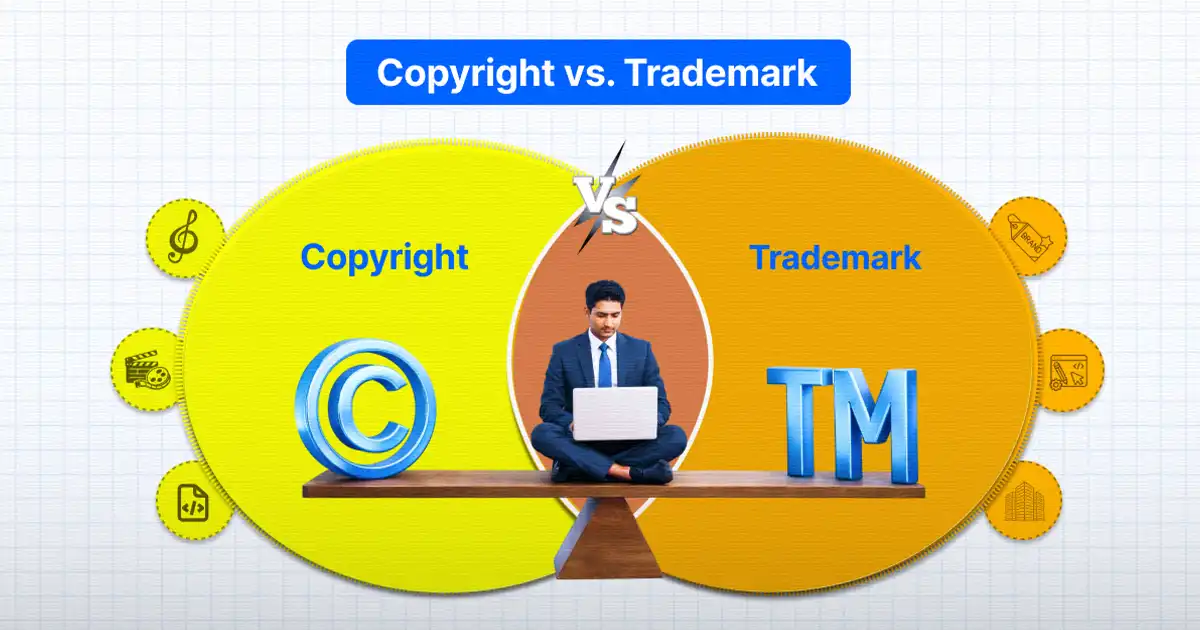
Creators, entrepreneurs, and business owners often confuse copyright and trademark. Both copyrights and trademarks are examples of Intellectual Property Rights (IPR), but they guard very different aspects of your valuable work. Copyright protects original creative works like books, songs, films, and software code from unauthorized reproduction and copying. A trademark protects brand identifiers like logos, names, and slogans that help customers identify your business products easily.
This guide explains the key difference between trademark and copyright in India. It includes clear examples, registration details, and updated government fees. It is based on the latest provisions under the Copyright Act, 1957, and the Trademarks Act, 1999.
What Does a Copyright Mean in India?
Copyright grants creators exclusive legal rights over their original literary, dramatic, musical, and artistic works under Indian law. The Copyright Act 1957 governs Copyright Registration in India and protects the specific expression of an idea, not the idea itself. The law grants automatic protection as soon as you create your work in tangible form, while preventing copyright infringement. Although, registration is not mandatory but it provides prima facie evidence of ownership in court. That’s why creators should register despite protection being automatic.
For example, when an author writes a novel, copyright protects the specific words, characters, and plot structure used. The general theme of friendship, however, remains free for any other writer to use creatively.
Copyright protects books, paintings, films, songs, software code, website content, photographs, and original architectural designs in India. The validity lasts for the author’s lifetime +60 years after their death under the current Indian law.
What is Trademark in India?
Section 2(1)(zb) of the Trade Marks Act, 1999 defines a trademark as a mark capable of graphical representation that distinguishes the goods or services. The Trademarks Act 1999 governs trademark law in India and protects brand identity across various commercial categories. Trademarks Registration helps customers distinguish your products from competitors and build trust in your brand over time.
Think about the Tata logo, the Amul girl mascot, or the iconic McDonald’s golden arches that you recognize instantly. These marks immediately tell you which company stands behind the product.
Unlike copyright, trademark protection requires active registration with the Trademark Registry for strong legal enforcement rights in India. A registered trademark remains valid for 10 years, and owners can renew it indefinitely by paying the prescribed government fees.
Copyright vs Trademark Differences: Key Comparison
The table below highlights the main trademark and copyright differences across important legal and practical dimensions in India:
| Basis | Copyright | Trademark |
| Governing Law | Copyright Act, 1957 | Trade Marks Act, 1999 |
| What it Protects | Original creative expression (books, music, art, code) | Brand identity (names, logos, slogans, symbols) |
| How Protection Starts | Automatically on creation; no registration needed | Only after registration (or prior use in India) |
| Registration Body | Copyright Office under DPIIT | Controller General of Patents, Designs, and Trademarks |
| Duration | Creator’s lifetime + 60 years | 10 years, renewable indefinitely |
| Government Fee | Starting from ₹ 500 for literary/artistic works | Starting from ₹4,500 per class for individuals and small enterprises, and ₹9,000 for others |
| Symbol Used | © (used even without registration) | ™ (unregistered), ® (registered only) |
| Renewal Required | No: protection lasts automatically | Yes: every 10 years |
| Purpose | Protect creative work from copying | Protect brand identity from imitation |
This comparison clearly shows how trademarks and copyrights act differently despite both falling under the umbrella of intellectual property law.
Legal Framework of Trademark and Copyright Act in India
The trademark and copyright act framework in India operates through two separate legislations with distinct enforcement mechanisms & remedies. The Copyright Act, 1957, has seen amendments in 1983, 1994, 1999, 2012, and 2014 to match technological changes globally. The Trademarks Act, 1999, replaced the older Trade and Merchandise Marks Act, 1958, to align with India’s TRIPS obligations.
Both laws provide civil and criminal remedies against infringement, including injunctions, damages, and imprisonment for serious commercial violations. Courts handle copyright and trademark disputes differently based on the specific rights and evidence involved in each filed case.
Copyright and Trademark Symbols: ™, ®, and ©
Founders often get confused about the three IP symbols, and using the wrong one can create legal risk. Here is what each symbol means under Indian law:
- © (Copyright symbol): Any creator can use the © symbol on their work as soon as it is created, even before registration. It signals that the work is protected by copyright. There is no legal requirement to display it, but using it discourages copying and signals ownership.
- ™ (Trademark symbol): A business can use this symbol for a mark that it uses as a trademark but has not yet registered. Using the ™ symbol does not give the same rights as a registered trademark. It simply indicates that the business treats the mark as its trademark.
- ® (Registered Trademark symbol): Only a business with a valid, registered trademark can legally use this symbol in India. Using ® without proper registration is illegal and attracts penalties under Section 107 of the Trademarks Act, 1999, in India. Once trademark registration is complete and the certificate is issued, the ® symbol can be used.
By using these symbols correctly, you clearly communicate your legal rights to third parties.
Can One Work Have Both Copyright and Trademark Protection?
Many business assets receive both copyright and trademark protection simultaneously, even when both registrations serve different legal purposes. A logo is the clearest example.
Consider a startup that designs a logo with original graphic artwork. The artistic expression of that logo: the specific illustration, color combination, and creative design, is automatically protected by copyright from the moment the designer creates it. However, copyright protection does not stop a competitor from creating a similar-looking logo or using the same business name.
Trademark registration protects the logo as a commercial brand identifier and prevents competitors from using confusingly similar marks in the same industry.
For example, A.R. Rahman’s film score for Roja receives automatic copyright protection as an original musical work. But if Rahman’s name or signature were to be used as a brand on merchandise, trademark registration would be required to protect that commercial identity. Copyright protects the music; a trademark would protect the brand.
Section 45 of the Copyright Act creates a specific legal bridge between the two. If someone applies for registration of an artistic logo, the Copyright Office may require proof that no conflicting trademark exists. This proof usually comes in the form of a Trademark Search Certificate. This prevents a person from registering a copyright on a logo that closely resembles an existing trademark.
How Much Do Registering a Copyright and Trademark Cost?
The government fee for copyright registration usually starts at ₹500 per work for literary, dramatic, musical, or artistic works. This category covers blog articles, website content, books, photographs, designs, and similar creative works.
For other categories, the current government fees include:
- ₹5,000 per work for cinematograph films
- ₹2,000 per work for sound recordings
- ₹200 to ₹1,000 for change in particulars
- ₹500 per copy for certified extracts and copies
On the other hand, the government fee for trademark registration starts at ₹4,500 per class for individuals, startups, and small enterprises, including MSMEs. For companies, LLPs, partnership firms, and other business entities, the government fee starts at ₹9,000 per class.
Understanding the difference between copyright and trademark is essential for every creator, entrepreneur, and business owner operating in today’s market. Copyright safeguards your original creative expressions, while trademark defends your brand identity from confusion and dilution caused by competitors. Both protections work together to build a strong intellectual property portfolio for your creative and commercial ventures in India.
