


Every year, millions of Indian taxpayers wait anxiously to know their ITR processing time and refund status. The Central Processing Centre processed over 8 crore Income Tax Returns for AY 2025-26, yet nearly 63 lakh returns remained under processing at the time of reporting. These numbers prove that delays can happen even when systems work at a large scale.
Many taxpayers often ask how much time it takes to process an ITR after filing. The answer depends on verification, accuracy, and workload at the department.
ITR processing begins only after you successfully complete e-verification on the portal (incometax.gov.in). The Income Tax Act allows authorities to issue intimation within 9 months from the financial year end. However, most returns get processed much earlier if taxpayers file correctly and verify promptly. In this blog, you will understand ITR return processing time, refund timelines, and reasons behind delays in simple language.
What is the ITR Processing Time in the New Portal?
ITR processing time means the time the Income Tax Department of India takes to check and complete your filed tax return.
The IT department:
- Verifies income details
- Cross-checks TDS and tax payments
- Reviews deductions claimed
- Matches data with AIS and Form 26AS
The CPC electronically processes returns using automated systems. After verification, it issues an intimation under Section 143(1) of the Income Tax Act.
Processing begins only after e-verification. Filing alone does not start the processing clock.
How to Complete E-Verification for Your ITR?
You can verify your ITR using any of these methods:
- Aadhaar OTP (the fastest and most commonly used method).
- Net banking login (available through most major banks on the portal).
- Bank account EVC (Electronic Verification Code generated via your bank).
- Demat account EVC (generated through your broker’s portal).
- Physical ITR-V (send the signed acknowledgement by post to CPC Bengaluru).
Note: The physical ITR-V route is the slowest option. It can delay your processing start by several weeks. Always opt for online e-verification to save time. Once you verify successfully, the ITR processing time after e-verification officially begins.
Standard ITR Processing Timelines in India
Most income tax returns are processed within 15 to 45 days from the date of e-verification. Here is a general pattern based on return complexity:
| ITR Form | Income Type | Typical Processing Time |
| ITR-1 Form | Salaried, simple income | 15–25 days |
| ITR-2 Form | Capital gains, multiple properties | 25–45 days |
| ITR-3 / ITR-4 Form | Business income | 45 days or more |
b. Legal Deadline for ITR Processing
Under Section 143(1) of the Income Tax Act, the department must process your ITR within 9 months. This period starts from the end of the financial year you filed your return.
This is the maximum time to process an ITR allowed by law:
| Financial Year (FY) | Assessment Year (AY) | Processing Deadline |
| 2024-25 | 2025-26 | 31 December 2026 |
| 2025-26 | 2026-27 | 31 December 2027 |
| 2026-27 | 2027-28 | 31 December 2028 |
Here, taxpayers can expect the ITR processing time for AY 2027-28 to follow this statutory timeline. The department begins processing immediately after e-verification and must complete it within the legal 9-month window.
c. ITR Refund Processing Time After E-Verification
Once the CPC confirms a refund in the Section 143(1) intimation, the amount reaches your bank account within 4 to 5 weeks in most cases. However, three conditions must be met for the refund to land successfully:
- Your bank account must be linked to your PAN.
- The account must be pre-validated on the e-filing portal.
- It must be set as the default account for refund credit.
If you fail to meet any of these conditions, the refund bounces back to the department, and you need to re-initiate the process.
What is the Process for Income Tax Return (ITR) Filing?
The ITR return processing time follows a clear sequence of steps. Knowing each step helps you identify exactly where your return stands and whether there is a problem.
Step 1: Filing and Submission
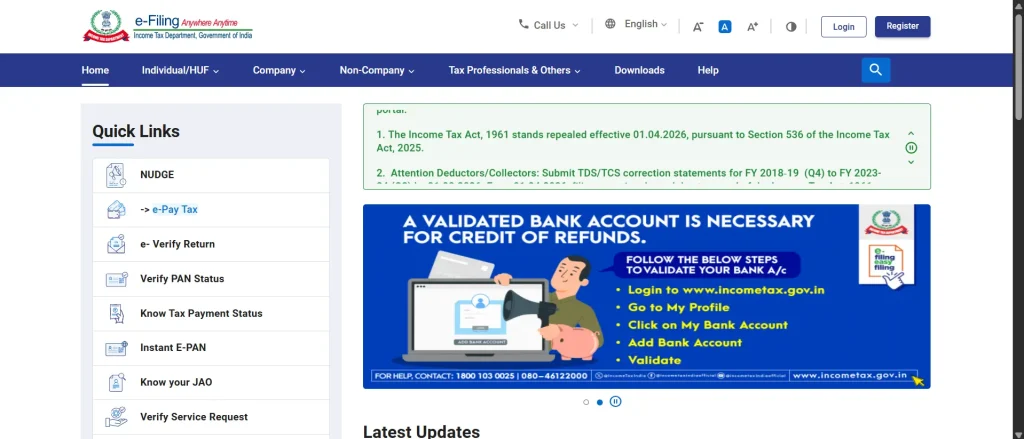
You log in to the Income Tax e-filing portal (eportal.incometax.gov.in) and select the correct ITR form for your income type. After filling in all details, you submit the return.
The portal accepts the submission and generates an acknowledgement number called ITR-V. This step only marks the filing as submitted; it does not start the processing clock yet.
Step 2: E-Verification (Mandatory)
After submission, you must complete e-verification within 30 days. The moment you verify, the ITR processing time after e-verification officially starts.
Skipping or delaying this step is the single biggest mistake taxpayers make. An unverified return is treated as not filed, and you lose all your refund claims automatically.
Step 3: CPC Processing Workflow
Once your verified return reaches CPC, the system runs a series of automated checks:
- It matches your declared income with Form 26AS (TDS records) and AIS data.
- It verifies deductions claimed under Sections 80C, 80D, 24(b), and others.
- It cross-checks the figures against your employer’s TDS return filings.
- It looks for discrepancies in interest income, dividends, and other passive income.
If everything matches cleanly, the return moves forward. If the system finds a mismatch, it either auto-adjusts the figures or puts the return in a manual review queue.
Step 4: Section 143(1) Intimation
After CPC finishes processing, it sends you an intimation under Section 143(1) to your registered email and mobile number. This intimation carries one of three outcomes:
- Return accepted as filed (no changes, no demand, no refund).
- Refund confirmed (the excess tax you paid will be credited to your bank).
- Demand raised (you owe additional tax that you must pay within 30 days).
This is not a scrutiny notice. It is simply the CPC communicating the result of its automated processing. Read it carefully and respond if there is a demand.
Factors Affecting ITR Return Processing Time in India
Several factors determine how much time it takes for ITR processing to complete. Understanding these factors will help you file accurate income tax returns and reduce the chances of unnecessary processing delays.
a. Accuracy of Data in Your Return
This is the most common cause of delays. If your declared income does not match what AIS or Form 26AS shows, the CPC flags your return.
Common mismatch areas include:
- TDS figures not matching employer records.
- Interest income from savings accounts or FDs was not declared fully.
- Foreign income or assets not reported correctly.
- Deductions claimed that Form 16 does not reflect.
Always download your AIS and Form 26AS from the portal before filing. Reconcile every figure before you submit.
b. Type of ITR Form You Filed
Return complexity has a direct impact on ITR processing time. A salaried taxpayer filing ITR-1 with standard deductions gets processed much faster than a business owner filing ITR-3 with profit and loss accounts. The more data the CPC needs to verify, the longer it takes.
c. Peak Filing Season Traffic
Every year, crores of taxpayers file their returns during the last 10–15 days before the due date. This sudden surge creates a heavy backlog at the Central Processing Centre (CPC) and slows down the income tax portal significantly.
Returns filed in June or early July usually get processed faster because the system handles fewer submissions during that period. Late filings increase the workload on the department, which often results in longer ITR processing times for many taxpayers.
d. Manual Review and Scrutiny Selection
Some returns get picked for manual review based on CBDT risk parameters. Common triggers include:
- Very large refund claims relative to declared income.
- Cash deposits that do not match income levels.
- Unusual or very high deduction claims.
- High-value transactions flagged in AIS but not reported.
If the system selects your return for manual review, the time taken to process the ITR can stretch to several months. There is no way to speed this up; you simply have to wait and respond promptly to any notices.
How to Track Your ITR Processing Status?
You can track your ITR return through:
Method 1: Income Tax e-Filing Portal
The e-filing portal provides the most accurate and updated information. Follow these steps:
- Log in to eportal.incometax.gov.in using your PAN and password.
- Click on ‘e-File’ in the top menu.
- Select ‘Income Tax Returns’ and click ‘View Filed Returns.’
- The portal displays the current processing status for each assessment year.
The status will show Successfully e-Verified, Under Processing, Processed — Refund Determined, or Processed — Demand Raised. This method gives the most reliable update on ITR processing time in the new portal.
Method 2: NSDL or TIN Portal for Refund Status
Visit tinpan.proteantech.in and navigate to the refund tracking section. Enter your PAN and Assessment Year. The portal shows whether your refund has been dispatched, failed, or is still pending. This method specifically tracks ITR refund processing time after the Section 143(1) intimation.
Method 3: CPC Helpline and Grievance Portal
If the portal status is unclear or outdated, use these options:
- Call the CPC toll-free helpline at 1800-103-0025 for direct assistance.
- Submit a grievance on the e-filing portal under the ‘Grievances’ section.
Always note your grievance registration number after submission. The department typically responds within 30 days, giving you clear updates on your ITR processing status.
Common Issues That Delay ITR Processing
Many taxpayers notice “Under Processing” status even after 45 days. This situation raises doubts about how much time it takes to get the ITR processed.
Common reasons include:
- Pending e-verification or delayed physical ITR-V receipt.
- Incorrect bank account details or failed validation.
- Mismatch between AIS data and declared income.
- Filing a revised return, which increases the overall ITR processing time.
Fraudsters also send fake refund messages requesting sensitive information from taxpayers. Remember, the Income Tax Department never sends refund confirmation via WhatsApp or asks for bank details through SMS or email links. Always track your refund only on official government portals. Never share your PAN, OTP, or bank details with anyone claiming to be from the IT Department.
What to Do if ITR Processing or Refund is Delayed?
If your return has been under processing for more than 45 days, follow these steps:
Step 1: Check for Notices or Defect Messages
Log in to the portal and go to the Pending Actions” section. The CPC may have sent a defect notice under Section 139(9) asking you to fix errors in your return. It may also have sent a demand notice you missed.
Resolve any pending action before raising a grievance, because the CPC holds processing until you respond to such notices.
Step 2: Raise a Grievance on the Portal
If you see no pending notices and your return remains under processing beyond 45 days, raise a grievance on the portal immediately. Follow these steps carefully to ensure proper submission and faster resolution:
- Log in to the e-filing portal and click on “Grievances” in the top menu.
- Select “Submit Grievance” and choose the relevant grievance category correctly.
- Enter your acknowledgement number, Assessment Year, and total days elapsed clearly.
- Submit the grievance request and note the registration number for tracking purposes.
The CPC usually responds within 30 days after reviewing your grievance details. If you find the response unsatisfactory, escalate the matter to the appropriate authority promptly.
Step 3: Contact CPC or Assessing Officer
If you receive an unsatisfactory response to your grievance, call the CPC helpline at 1800-103-0025 immediately. If the issue remains unresolved, send a written complaint to your jurisdictional Assessing Officer. You can find your Assessing Officer’s details on the e-filing portal under the “My Profile” section.
Escalate the matter to the AO level only when CPC communication has clearly failed, or the refund amount is significantly high.
What are Your Rights When CPC Misses the Legal Deadline?
If the CPC fails to issue the Section 143(1) intimation within the 9-month statutory deadline, the law considers your return as accepted. You also have additional rights:
- You can approach the Assessing Officer to release your refund.
- You can claim interest under Section 244A at 0.5% per month on the delayed refund.
- This interest applies from the date the refund became due until the date it is actually paid.
Note: This interest amount is taxable in the year you receive it.
These are statutory rights given to you under the Income Tax Act. Do not hesitate to use them if the department crosses the legal deadline.
Conclusion
ITR processing time remains a major concern for Indian taxpayers every year. Most returns are processed within weeks, yet delays may occur due to errors. Understanding how much time it takes to process ITR helps you manage expectations confidently.
Always verify returns quickly, report income accurately, and validate bank details properly. These steps reduce ITR refund processing time and prevent unnecessary complications. When you understand ITR processing time clearly, you reduce anxiety and handle tax matters confidently.
RegisterKaro ensures seamless tax filing and compliance. Our expert team handles accurate ITR preparation, swift e-verification, and proper bank validation, so your refund reaches you faster. With RegisterKaro, you get complete legal compliance, zero delays, and peace of mind. Contact us today!
