


Every business generates financial data, from salary payments and vendor invoices to expenses and tax filings. Without proper organization, this data can quickly become difficult to manage. This is where the types of bookkeeping play an important role in converting raw financial transactions into structured and accurate financial records.
The types of bookkeeping services a business should use depend on several factors, including:
- The size of the company
- The volume of transactions
- The level of financial visibility and control required by the owner
Different bookkeeping systems, such as single-entry and double-entry bookkeeping, help businesses maintain accurate records and ensure compliance with accounting standards. Choosing the right system is essential for effective financial management and decision-making.
This guide explains the types of bookkeeping, how each system works, and which method is best suited for your business. Whether you run a sole proprietorship, a startup, or a growing company, selecting the right bookkeeping system early can help you avoid errors and costly financial corrections later.
What is Bookkeeping and Why Does it Matter?
Bookkeeping is the process of recording, organizing, and maintaining every financial transaction a business makes. It forms the foundation of all accounting and financial reporting. Without accurate bookkeeping, a business cannot prepare tax returns correctly, track profitability, raise funding, or stay compliant with regulatory requirements like GST registration and TDS filing.
Bookkeeping records typically include sales receipts, purchase invoices, bank statements, expense vouchers, payroll records, and credit or debit notes. Businesses also prefer getting outsourced bookkeeping services to get professional assistance for financial management at hefty costs.
The different types of bookkeeping systems determine how these records are maintained and how much detail they capture.
Types of Bookkeeping Systems in India
At the most fundamental level, bookkeeping systems fall into two categories: single-entry bookkeeping and double-entry bookkeeping.
1. Single-Entry Bookkeeping
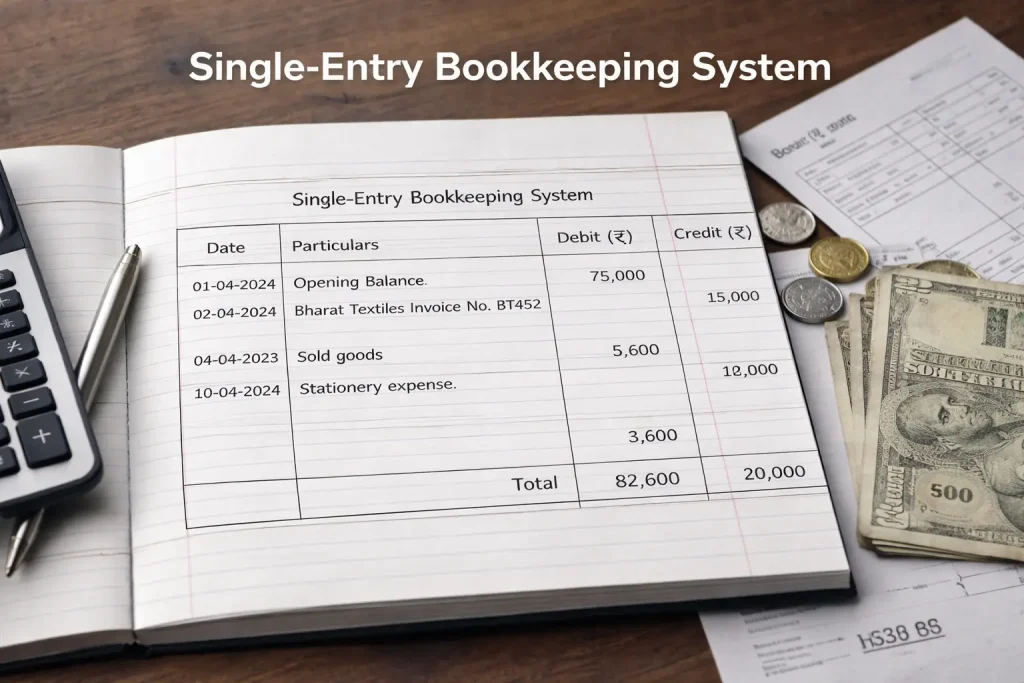
Single-entry bookkeeping records each financial transaction as one entry in a simple register, typically a cash book or income-expense ledger. Each transaction appears once, either as an income or an expense. There are no debit and credit splits, no balance sheet entries, and no tracking of assets or liabilities.
This system resembles a personal bank passbook in its simplicity. A freelancer records ₹50,000 received from a client as income. A retailer records ₹12,000 paid to a supplier as an expense. The records stay flat and readable without requiring any accounting knowledge.
Single-entry bookkeeping works best for:
- Sole proprietors and freelancers with low transaction volumes
- Small retailers, traders, and home-based businesses
- Startups in their early months, before financial complexity grows
- Businesses that deal primarily in cash and do not extend credit
Advantages of a Single-Entry Bookkeeping System:
- Simple to maintain — no accounting background required
- Lower cost since no specialised bookkeeper is necessary
- Fast to set up and easy to update daily
Limitations of a Single-Entry Bookkeeping System:
- Cannot produce a balance sheet or profit and loss statement independently
- Offers no way to detect errors or internal fraud
- Fails to track accounts payable, accounts receivable, or asset values
- Unsuitable for businesses that deal with credit transactions, loans, or inventory
2. Double-Entry Bookkeeping System
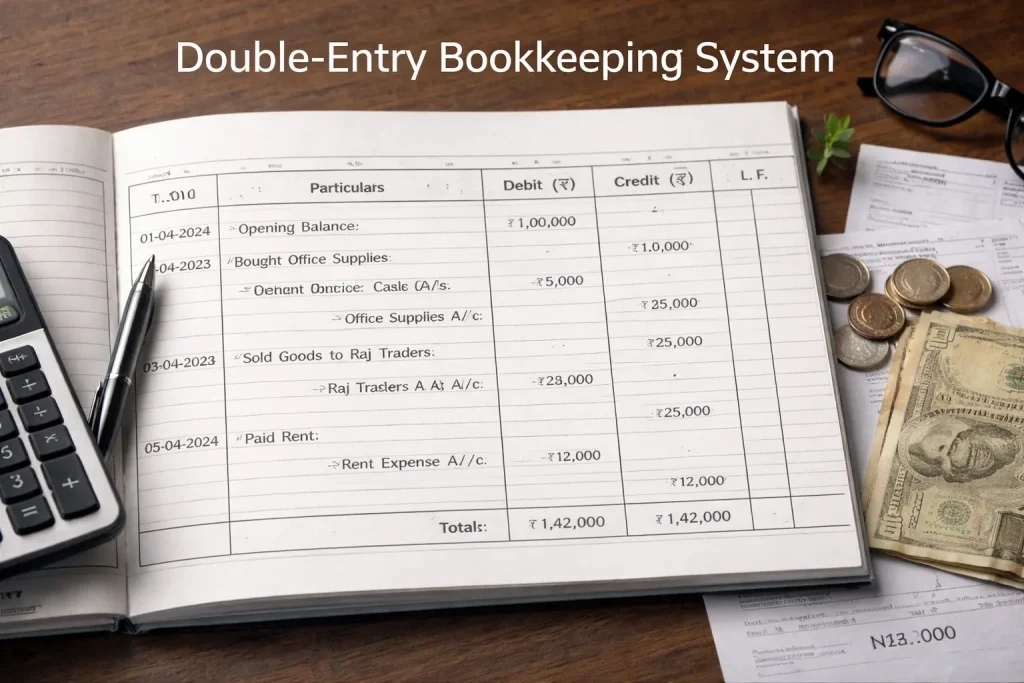
Double-entry bookkeeping records every transaction across two accounts — one debit and one credit. This system follows the fundamental accounting equation:
Assets = Liabilities + Equity.
Every rupee that comes into the business is matched by a rupee that goes out or is allocated elsewhere, keeping the records balanced.
Example:
When a business receives ₹1,00,000 from a client, double-entry bookkeeping records this as a debit in the bank account and a credit in the accounts receivable account. When the same business pays ₹20,000 in rent, it debits the rent expense account and credits the bank account. In short, every transaction tells a complete financial story.
Double-entry bookkeeping works best for:
- Private limited companies, LLPs, and Partnership firms
- Businesses that maintain inventory, fixed assets, or loans
- Companies that extend credit to customers or purchase on credit
- Any business that needs audited financial statements or seeks funding
- GST-registered businesses managing input tax credit
Advantages of the double-entry bookkeeping system:
- Produces complete financial statements, including balance sheet, P&L, and cash flow
- Enables the detection of errors through trial balance preparation
- Supports fraud detection since both sides of every transaction are traceable
- Gives investors, banks, and auditors the financial clarity they demand
- Mandatory under the Companies Act, 2013, for registered companies in India
Limitations of the double-entry bookkeeping system:
- Requires trained bookkeepers or accounting software
- More time-consuming than single-entry for very small businesses
- Higher cost of maintenance without the right tools or partner
Understanding both types of bookkeeping systems helps a business owner make an informed decision about which approach serves their operations.
Different Types of Bookkeeping Methods in India
Beyond the core systems, different methods of bookkeeping services define how businesses actually manage their records in practice. Each approach mentioned below suits a different stage of business growth:
1. Manual Bookkeeping
Manual bookkeeping involves recording transactions in physical ledger books, journals, and registers by hand. Accountants and bookkeepers traditionally followed this method before software became accessible. Today, very small businesses or those in areas with limited digital access still rely on manual records.
Manual bookkeeping demands extreme attention to detail. A single calculation mistake can affect all later entries and distort the business’s financial position for the entire quarter. The audit and reconciliation process for manual books is time-intensive and prone to human error.
2. Computerized Bookkeeping
Computerized bookkeeping uses accounting software to record, organize, and report on financial transactions. Software like Tally, QuickBooks, Zoho Books, and similar platforms automate the calculation, categorization, and reporting work that manual bookkeeping requires.
The advantages of computerized bookkeeping are significant. Computerized systems generate financial reports in seconds, flag discrepancies automatically, and integrate with GST portals for direct GST return filing.
Most registered businesses in India today use computerized bookkeeping as their primary system, either in-house or through an outsourced partner like RegisterKaro.
3. Outsourced Bookkeeping
Outsourced bookkeeping hands all financial record-keeping responsibilities to a professional third-party service. Businesses share their financial data with the service provider, who maintains accurate records, prepares periodic reports, and ensures regulatory compliance.
This approach suits businesses that want accurate books without building an internal accounting team, which can be much more expensive. Startups, MSMEs, and growing companies especially benefit from outsourcing because it converts a fixed cost (a salaried accountant) into a variable one, while still accessing professional expertise.
You can also get additional services, such as Accounting and Bookkeeping services, combined with RegisterKaro. Fill the form now to avail of the ongoing offer.
4. Virtual Bookkeeping
Virtual bookkeeping is a subset of outsourced bookkeeping where everything happens online. The bookkeeper works remotely, accessing financial data through cloud accounting platforms, and delivers reports digitally. Virtual bookkeeping eliminates geographic restrictions — a business in Nagpur can work with a bookkeeper in Delhi or Bengaluru without any friction.
Post-pandemic, virtual bookkeeping has become the standard for tech-forward businesses. Cloud platforms ensure real-time data availability, automated bank reconciliation, and instant access to reports for business owners and their CAs simultaneously.
How to Choose the Right Type of Bookkeeping Service/Method for Your Business?
The choice among these types of bookkeeping systems comes down to three factors: the size and complexity of the business, the regulatory requirements applicable to the entity, and the financial visibility the owner needs for decision-making.
- Sole proprietors and freelancers with simple cash transactions: Single-entry manual or computerized bookkeeping.
- Registered companies: Double-entry computerized bookkeeping is mandatory for Pvt Ltd Company Registration, LLP, and OPC under the Companies Act 2013.
- GST-registered businesses: Double-entry with integrated GST reporting capabilities.
- Businesses seeking funding or bank loans: Double-entry with outsourced or professional bookkeeping for auditable accounts.
- Startups scaling quickly: Virtual outsourced bookkeeping to reduce overhead while maintaining accuracy.
Why Accurate Bookkeeping Matters for Indian Businesses?
In India, the regulatory environment makes bookkeeping a legal obligation, not just a financial best practice. GST returns require detailed transaction-level data. TDS filings depend on accurate payroll and vendor payment records. Income tax assessments scrutinize income and expense claims closely. Inaccurate or missing books lead to penalties, notices, and disputes with tax authorities.
Beyond compliance, good bookkeeping drives better business decisions. An owner who knows their cash position, receivables, and expenses in real time makes faster and more confident decisions than one who waits for month-end summaries from a scattered pile of receipts.
How RegisterKaro Helps You Set Up and Maintain Bookkeeping
Choosing the right bookkeeping system is only the first step. Executing it correctly day after day and then month after month requires either dedicated in-house talent or a reliable professional partner.
RegisterKaro offers end-to-end accounting and bookkeeping services for businesses at every stage. Whether you are a solo founder who needs clean books for your first GST filing or a growing company that needs monthly MIS reports, reconciliation support, and audit-ready financial statements, RegisterKaro’s team of 500+ MCA-certified experts handles it all.
Our bookkeeping services include:
- Selection of the right bookkeeping system based on your business structure and transaction volume.
- Set up and configuration of accounting software suited to your business
- Monthly recording, categorization, and reconciliation of all transactions
- GST-compliant accounts maintenance with input tax credit tracking
- TDS computation and payroll bookkeeping
- Monthly and quarterly P&L statements, balance sheets, and cash flow reports
- Year-end financial statement preparation for tax filing and audit
We serve over 2,500 businesses every month across India — from first-time founders registering their company to established SMEs managing complex multi-entity accounts. Contact RegisterKaro now to get your customized quotation.
Start your bookkeeping journey with RegisterKaro today and build the financial foundation your business deserves.
