NBFC Compliances in India
Ensure seamless NBFC compliance with RegisterKaro. Stay ahead of RBI norms, avoid penalties, and maintain business continuity with expert-managed filings, digital processes, and end-to-end regulatory support.
Running an NBFC? Don’t let complex RBI regulations slow you down. Our experts ensure accurate filings, timely submissions, and complete legal compliance.
 100% RBI-Compliant Filings & ReportingIncludes NBS-7, NBS-9, DNBS Returns, SAC & MoreAvoid Penalties, License Suspension & Operational DisruptionFully Digital Process with Expert-Led SupportTrusted by 5,000+ NBFCs, Fintechs & Lending Startups

 What Sets Us ApartWhat Sets Us Apart
What is an NBFC?
A Non-Banking Financial Company (NBFC) is a financial entity providing diverse banking-like services without possessing a conventional banking license. These companies operate under the Companies Act, participating in activities such as lending, investing in securities, and asset financing. In essence, NBFCs function as financial intermediaries, delivering credit and other financial solutions outside the traditional banking system.
Purpose of NBFCs
The core purpose of Non-Banking Financial Companies (NBFCs) is to expand financial access and offer specialized services beyond traditional banks. They aim to:
- Boost financial inclusion, reaching underserved individuals and small businesses.
- Provide niche lending for areas like retail, infrastructure, and microfinance.
- Offer flexible, tailored financial solutions that meet diverse customer needs.
- Contribute to economic growth by funding key sectors.
- Drive innovation and competition within the financial landscape.
How an NBFC is Different from a Bank
While both Non-Banking Financial Companies (NBFCs) and Banks are crucial financial intermediaries, they operate under different regulations and have distinct functions. Here's a tabular comparison:
| Feature | Bank | Non-Banking Financial Company (NBFC) |
| Primary Regulation | Banking Regulation Act, 1949; RBI Act, 1934 (RBI) | Companies Act, 2013/1956; RBI (framework differs from banks) |
| Banking License | Requires a full banking license from the RBI | Does not hold a banking license |
| Deposit Acceptance | Can accept demand deposits (savings, current accounts) | Cannot accept demand deposits (only time deposits like FDs under specific conditions) |
| Payment & Settlement | Part of the payment and settlement system; can issue cheques, demand drafts | Not part of the payment and settlement system; cannot issue cheques drawn on itself |
| Credit Creation | Can create credit (through fractional reserve banking) | Cannot create credit like banks |
| Deposit Insurance | Deposits are insured by DICGC (up to ₹5 lakh per depositor) | Deposits are generally not insured by DICGC |
| CRR/SLR Maintenance | Mandatorily maintains Cash Reserve Ratio (CRR) and Statutory Liquidity Ratio (SLR) with the RBI | Not required to maintain CRR and SLR |
| Forex Transactions | Generally allowed to deal in foreign exchange | Limited to certain NBFCs with specific RBI approval |
| Scope of Services | Wide range: deposits, loans, credit/debit cards, wealth management, forex, etc. | Primarily lending, investment, asset financing, and specialized financial products |
| Flexibility & Speed | Stricter norms, often longer processing times | Generally, more flexible, quicker approvals, less paperwork |
| Target Audience | Broad customer base, including individuals, businesses, and institutions | Often caters to underserved segments, MSMEs, niche markets |
| Loan Interest Rates | Generally lower due to regulated funding costs | Can be slightly higher due to higher risk profile and funding costs |
What are the various types of NBFCs in India?
Outlined below are several categories of NBFCs operating in India, along with their roles in shaping the nation’s financial ecosystem:
1. Asset Finance Companies (AFCs)
Asset Finance Companies focus on providing finance for tangible assets such as machinery, vehicles, equipment, and more. They serve individuals, SMEs, and corporate clients by offering tailored financial solutions for purchasing essential assets. Through leasing and loan options, AFCs support business expansion and promote economic development.
2. Loan Companies
Loan Companies play a key role in the consumer finance market by offering personal loans, housing loans, education loans, and more. They also extend financial support to businesses in the form of trade finance, working capital loans, and project-specific funding. These companies help bridge the gap left by traditional banks, meeting unique financial requirements.
3. Infrastructure Finance Companies (IFCs)
IFCs are dedicated to financing infrastructure-related projects, thereby aiding national development. They primarily support sectors like transportation, telecommunications, power, and roads. By providing long-term and project-based financing, IFCs contribute to infrastructure creation and boost economic growth and quality of life.
4. Microfinance Institutions (MFIs)
MFIs play a pivotal role in financial inclusion by offering small loans, or microloans, to low-income individuals and self-help groups (SHGs). By funding micro-entrepreneurs and underprivileged communities, MFIs help them establish or grow small-scale businesses, reduce poverty, and support sustainable livelihoods.
5. Investment Companies
These NBFCs specialize in acquiring and managing financial instruments such as stocks, bonds, mutual funds, and securities. They cater to both retail and institutional investors, promoting investments across diverse asset classes. By leveraging financial market expertise, investment companies help in capital formation and foster responsible investment behavior.
6. Systemically Important Core Investment Companies (CICs–SI)
CICs–SI are a specific category of investment companies that significantly influence the financial sector. These NBFCs invest at least 90% of their total assets in the form of equity shares, debt, or other financial assets of group companies. Due to their potential impact on financial system stability, the RBI closely monitors and regulates CICs–SI to ensure systemic safety.
Why NBFC Compliance is Non-Negotiable
For any Non-Banking Financial Company (NBFC), strict adherence to compliance is not just a regulatory hurdle; it's the foundation of its stability, reputation, and long-term survival.
If an NBFC doesn’t follow the rules, it can face heavy fines, limits on its operations, or even lose its license, putting the entire business at risk.
- Maintaining Financial Stability: Adherence to regulatory guidelines, especially RBI directives, ensures NBFCs operate within a framework that fosters systemic financial stability.
- Protecting Stakeholders: Conforming to regulations like KYC and AML norms protects both depositors and borrowers from financial risks.
- Avoiding Penalties and Restrictions: Non-compliance can lead to significant penalties, including fines and limitations on business activities.
- Maintaining Trust and Reputation: Compliance demonstrates a commitment to ethical practices, building confidence with clients and the broader financial community.
- Ensuring Business Continuity: Compliance secures the ongoing operation of the NBFC, preventing license cancellation and business disruption.
- Facilitating Growth and Innovation: While compliance is vital, NBFCs must also prioritize innovation and customer-centric strategies to remain competitive and expand.
Complete NBFC Compliance Checklist
A comprehensive NBFC compliance checklist ensures you cover all critical areas, from initial registration and capital adequacy to ongoing regulatory filings and risk management.
1. Registration and Licensing
- NBFC Registration: Ensure your NBFC is registered with the Reserve Bank of India (RBI) and possesses a valid Certificate of Registration (CoR).
- Minimum Net Owned Fund (NOF): Verify that your NBFC consistently maintains the required NOF.
- Capital Adequacy: Confirm that your capital adequacy ratio consistently meets RBI standards.
2. Regulatory Frameworks and Reporting
- RBI Regulations: Adhere to all pertinent RBI guidelines, including those related to prudential norms, fair practices, and risk management.
- Annual Returns: File all mandated annual returns (like NBS-7) with the RBI punctually.
- Audited Financial Statements: Ensure the timely submission of audited balance sheets and profit & loss accounts.
- GST Compliance: File GST returns (GSTR-9, 9C) by the stipulated due date.
- FEMA & FDI Compliance: Ensure compliance with the Foreign Exchange Management Act (FEMA) guidelines and accurately report foreign investments to the RBI.
- Fair Practices Code: Implement and strictly adhere to the RBI's Fair Practices Code.
- Grievance Redressal: Establish an effective mechanism for grievance redressal and customer protection.
- Statutory Auditor's Certificate: Ensure the submission of the Statutory Auditor's Certificate (SAC).
3. Risk Management and Internal Controls
- Risk Management: Establish robust risk management policies and procedures.
- Internal Controls: Implement effective internal control systems to ensure compliance and operational efficiency.
- Cybersecurity: Protect customer data and information from cyber threats.
- Asset Quality: Continuously monitor and maintain the quality of assets.
RBI Reporting: The XBRL Portal
The RBI XBRL Portal is the primary platform for Non-Banking Financial Companies (NBFCs) in India to submit their various regulatory returns to the Reserve Bank of India (RBI). XBRL (eXtensible Business Reporting Language) is a global standard for the electronic communication of business and financial data. Its adoption by the RBI is a significant step towards standardizing, streamlining, and enhancing the accuracy and transparency of financial reporting in the non-banking financial sector.
What is XBRL?
XBRL is essentially a language that uses unique electronic "tags" to identify and categorize every piece of financial information.
Unlike traditional reporting methods, where data is presented in static documents, XBRL allows for machine-readable data, enabling automated processing, analysis, and validation.
Why did the RBI mandate XBRL for NBFCs?
The RBI mandated XBRL reporting for NBFCs (starting from FY 2019-2020 for most categories) for several key reasons:
- Enhanced Data Accuracy and Reliability: XBRL's structured format and built-in validation rules minimize manual errors and inconsistencies, leading to higher data quality.
- Improved Efficiency and Automation: It automates the data submission and analysis process, reducing the time and resources required for both NBFCs (in preparing and filing) and the RBI (in processing and analyzing).
- Greater Transparency and Comparability: Standardized tagging allows for easier comparison of financial data across different NBFCs, providing better insights for regulators, analysts, and other stakeholders.
- Real-time Monitoring: The system facilitates quicker data submission and processing, enabling the RBI to monitor the financial health of regulated entities more closely and identify potential risks early.
- Global Alignment: Adopting XBRL aligns Indian financial reporting practices with international best practices for electronic data transmission.
- Streamlined Data Management: It simplifies the tracking and management of vast amounts of financial data, providing an overview.
The Fair Practices Code (FPC)
The Fair Practices Code is a set of rules by the RBI that banks and NBFCs follow to treat borrowers fairly and transparently.
Key Objectives of the FPC
- Transparency: The FPC mandates clear and upfront communication regarding loan terms, fees, interest rates, and other associated charges.
- Fairness: It prohibits discriminatory practices and ensures borrowers are treated equitably, irrespective of their background or circumstances.
- Customer Protection: It provides a mechanism for borrowers to address grievances and seek redressal for any unfair practices encountered.
- Ethical Practices: The FPC encourages ethical and responsible lending practices, cultivating trust and confidence within the financial system.
Specific Aspects Covered by the FPC
- Loan Application and Processing: Encompasses clear application forms, timely acknowledgment of applications, and a defined timeline for processing.
- Loan Disbursal: Ensures proper assessment of credit needs, due diligence on borrowers' creditworthiness, and transparent sanction letters.
- Loan Repayment: Mandates clear communication on interest rates, repayment schedules, and procedures for foreclosure or prepayment.
- Recovery Practices: Prohibits coercive and abusive recovery methods, ensuring respectful and courteous behavior from recovery agents.
- Grievance Redressal: Establishes a mechanism for borrowers to raise complaints and seek resolution for any issues they face.
- Disclosure: Requires full and transparent disclosure of all loan-related information, including fees, charges, interest rates, and repayment terms.
- Digital Lending: In the context of digital lending, the FPC also includes provisions for transparency in agent relationships, clear communication of the lender's name, and proper oversight of digital lending platforms.
NBFC Compliance Calendar
Below is a general illustrative NBFC compliance calendar for the Financial Year 2025-26 (Assessment Year 2026-27).
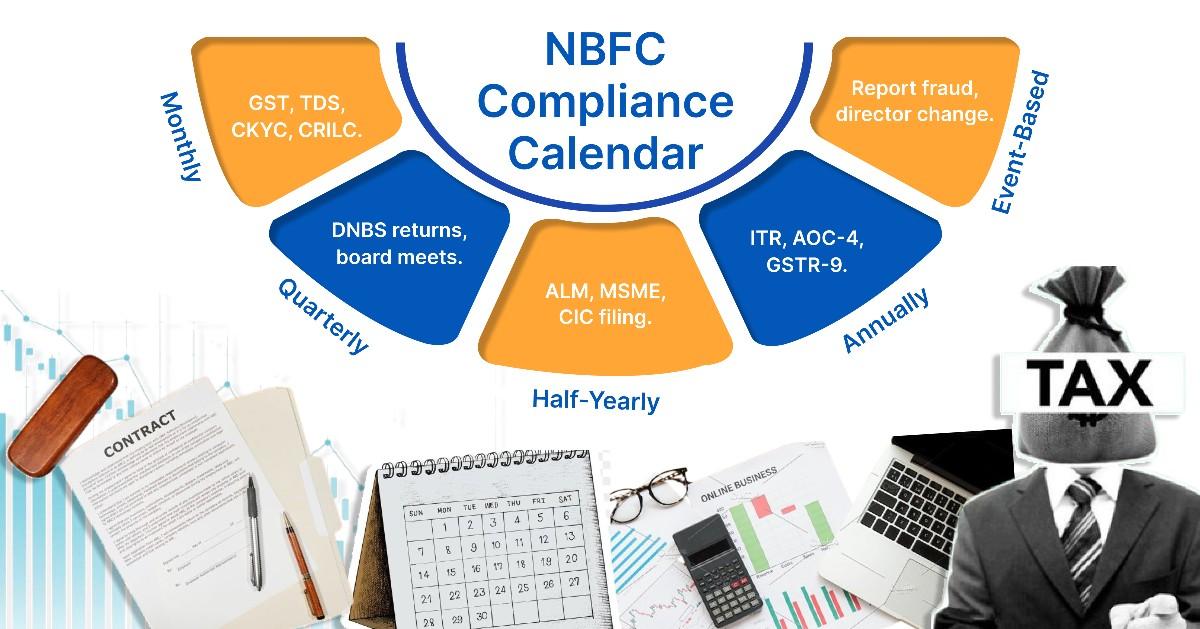
Monthly Compliances
These are recurring compliances that must be fulfilled every month to ensure timely tax payments, regulatory reporting, and liquidity oversight.
| Compliance | Due Date | Governing Act |
| TDS/TCS Payment & Filing | 7th of the subsequent month | Income Tax Act, 1961 |
| GST Returns (GSTR-1) | 11th of the subsequent month | CGST Act, 2017 |
| GST Returns (GSTR-3B) | 20th of the subsequent month | CGST Act, 2017 |
| CKYC Uploads | Within 3 days of account opening | PML Rules, 2005 |
| CRILC Reporting (DNBS08) | 15th of the subsequent month | RBI Supervisory Returns |
| Liquidity Risk Monitoring (e.g., DNBS-04B) | 10th of the subsequent month | RBI Supervisory Returns / Scale-Based Regulation |
| Reporting of Pledged Securities (Annex X) | As per the RBI directive | RBI |
Quarterly Compliances
These are filings and reviews that take place every quarter, focusing on financial health, governance, and advanced tax planning.
| Compliance | Due Dates | Governing Act |
| DNBS-01 (Financial Details) | 21st July, Oct, Jan, April | RBI Supervisory Returns |
| DNBS-02 (Financial Parameters) | 21st July, Oct, Jan, April | RBI Supervisory Returns |
| DNBS-03 (Prudential Norms) | 21st July, Oct, Jan, April | RBI Supervisory Returns |
| DNBS-04A (Short Term Dynamic Liquidity) | 21st July, Oct, Jan, April | RBI Supervisory Returns |
| DNBS-13 (Overseas Investment) | 21st July, Oct, Jan, April | RBI Supervisory Returns |
| Quarterly Board Meetings | 4 times a year, max 120-day gap | Companies Act, 2013 |
| Advance Tax Installments | 15th June, 15th Sep, 15th Dec, 15th Mar | Income Tax Act, 1961 |
Half-Yearly Compliances
These obligations must be completed twice a year and mainly cover MSME payments, liquidity positions, and housing finance details.
| Compliance | Due Date | Governing Act |
| MSME-1 Return (Dues to MSMEs) | 31st Oct (Apr-Sep), 30th Apr (Oct-Mar) | Companies Act, 2013 |
| ALM-II (Structural Liquidity) | 12th May, 12th Nov | RBI Directions |
| Schedule-II Return (HFCs) | 12th May, 12th Nov | RBI HFC Circular |
| CIC Half-Yearly Compliance Report | 15th May, 15th Nov | CIC Regulation Act, 2005 |
Annual Compliances
These are year-end regulatory filings and board-level reviews that ensure transparency, accountability, and legal compliance across financial and corporate areas.
| Compliance | Due Date | Governing Act |
| AOC-4, MGT-7 (Financial Statements) | Within 30/60 days of AGM (by 30 Sep) | Companies Act, 2013 |
| DNBS-10 (Statutory Auditor’s Certificate) | Within 5 days of Board approval or by 31st Dec | RBI Directions |
| Income Tax Return Filing (Audit cases) | 31st October | Income Tax Act, 1961 |
| Income Tax Return Filing (Non-audit cases) | 31st July | Income Tax Act, 1961 |
| GST Annual Returns (GSTR-9/9C) | 31st December | CGST Act, 2017 |
| Board Resolution (Not Accepting Public Deposits) | 30th April | RBI NBFC Deposit Directions, 2016 |
| Director KYC (DIR-3 KYC) | 30th September | Companies Act, 2013 |
| Fair Practices Code Review & Disclosure | Annually (Board Review) | RBI Fair Practices Code |
| Grievance Redressal Mechanism Review | Annually, ongoing reporting | RBI Guidelines |
| FIU-IND Statement on STRs/CTRs | As prescribed by FIU-IND | PMLA, 2002 |
| FEMA/FDI Reporting (e.g., FLA Return) | As per the FEMA calendar | FEMA, 1999 |
Event-Based Compliances
These compliances are triggered by specific events like fraud detection, change in management, or creation of a charge, and require immediate attention and reporting.
| Compliance | Timeline | Governing Act |
| Fraud Reporting (FMR-1 to FMR-4) | Within 7–14 days of detection | RBI Fraud Risk Management Directions |
| Change in Directors/KMPs | DIR-12 within 30 days; RBI intimation | Companies Act, 2013; RBI Guidelines |
| CERSAI Filing | Within 30 days of creation/modification | SARFAESI Act, 2002; CERSAI Rules |
| Breach of Prudential Norms | Immediate intimation & corrective plan | RBI Master Directions |
| Acceptance/Repayment of Public Deposits | Ongoing reporting | RBI NBFC Deposit Directions, 2016 |
RBI's Prudential Norms for NBFCs
The Reserve Bank of India's (RBI) prudential norms for Non-Banking Financial Companies (NBFCs) are regulations crafted to ensure the financial stability and sound operation of these institutions.
1. Asset Classification
NBFCs are mandated to categorize their assets (primarily loans) into distinct classes based on their performance, specifically as standard, substandard, doubtful, and loss assets. This classification aids in assessing the inherent risk associated with each asset and guides the NBFC in making appropriate provisions.
2. Provisioning Requirements
NBFCs are required to set aside funds as provisions for non-performing assets (NPAs), the amount being determined by their classification. The RBI dictates the specific percentage of provisions that must be allocated for each asset category, thereby ensuring NBFCs possess adequate resources to cover potential losses from defaulted loans.
3. Income Recognition
Income recognition defines how NBFCs account for their earnings, such as interest and fees. RBI guidelines strictly mandate that income should be recognized only when it is realized, meaning upon actual receipt, not prior.
This practice maintains transparency and prevents NBFCs from inflating their profits by prematurely recognizing income.
4. Capital Adequacy
The RBI establishes minimum capital requirements for NBFCs to ensure they possess sufficient capital to absorb potential losses and sustain operations. This involves maintaining a minimum Capital to Risk-weighted Assets Ratio (CRAR), which serves as an indicator of the NBFC's financial strength.
Different categories of NBFCs (e.g., deposit-taking, non-deposit-taking, systemically important) may be subject to varying CRAR requirements.
5. Scale-Based Regulations
The RBI has introduced a scale-based regulatory framework for NBFCs, which involves categorizing them into distinct layers based on their size, operational activities, and inherent risk profile.
This framework facilitates differentiated regulations tailored to the specific characteristics of each NBFC category.
Other Laws an NBFC Must Comply With
Beyond RBI regulations, NBFCs must adhere to broader legal frameworks for legal operation and financial integrity.
1. Companies Act, 2013
Governs corporate structure and compliance:
- Incorporation & Registration: Formal company registration.
- Annual Filings: Timely submission of financial statements (AOC-4) and annual returns (MGT-7/7A) to MCA.
- Board & General Meetings: Adherence to rules for conducting meetings.
- Director Compliances: Proper appointment and changes of directors, including "Fit and Proper" criteria.
- Statutory Registers: Maintaining accurate company records.
2. Tax Compliance
Ensures adherence to tax laws:
- Income Tax Act, 1961:
-
- Advance Tax: Paying tax installments throughout the year.
-
- ITR Filing: Annual corporate income tax return submission.
-
- TDS/TCS: Compliance with tax deduction/collection at source provisions and timely filing of returns.
- Goods and Services Tax (GST) Act, 2017:
- GST Registration: Obtaining registration if the turnover exceeds the limits.
- GST Returns & Payment: Timely filing of monthly/quarterly and annual GST returns (GSTR-1, GSTR-3B, GSTR-9/9C) and tax payments.
3. Foreign Investment
Regulates foreign capital for NBFCs:
- FEMA Regulations: Adherence to RBI's Foreign Exchange Management Act guidelines for foreign investment.
- Reporting to RBI: Timely submission of forms like FC-GPR (FDI received), ODI (overseas investment), and the annual FLA Return.
- Valuation Norms: Compliance with RBI/FEMA guidelines for share valuation.
Connect with RegisterKaro and let our experts handle the legal hassle while you grow your business.
Frequently Asked Questions (FAQs)
What is the minimum Net Owned Fund (NOF) required for an NBFC?
−As per RBI guidelines, an NBFC must have a minimum Net Owned Fund of ₹10 crore (for most categories) to be eligible for registration. However, this threshold may vary depending on the type of NBFC.
What is the difference between a deposit-taking and a non-deposit-taking NBFC?
+What is the penalty for not filing NBFC returns on time?
+What is the purpose of the NBS-7 and NBS-9 returns?
+Can all NBFCs accept deposits from the public?
+What is a Statutory Auditor Certificate (SAC)?
+How does the RBI's XBRL system work for filing returns?
+What does the "principal business" or "50-50 test" mean for a company?
+Can an NBFC accept deposits from NRIs?
+What are the main compliances under the Companies Act for an NBFC?
+What is the Fair Practices Code (FPC)?
+Which NBFCs are exempt from RBI registration?
+
Reviewed by
Joel DsouzaJoel Dsouza is a Chartered Accountant (CA) and compliance expert with over 7 years of hands-on experience in company registration, tax structuring, GST, ROC filings, and MCA compliance. As a qualified member of the Institute of Chartered Accountants of India (ICAI) and Co-Founder at RegisterKaro, he has personally advised more than 1,000 startups and SMEs across India, helping founders navigate incorporation, regulatory frameworks, and financial planning from Day 1. With deep expertise across all three levels of Finance and Portfolio Management, Joel is committed to promoting financial literacy and simplifying India's startup ecosystem through clear, actionable guidance that entrepreneurs can act on immediately.
Why Choose RegisterKaro for the NBFC Compliance Service?
Partnering with an experienced firm for NBFC compliance is crucial in today's complex regulatory environment. Here's why RegisterKaro stands out as an ideal choice for your NBFC's compliance needs:
- Expert Team with Deep Regulatory Knowledge: Our team of CAs, CSs, and legal experts offers an in-depth understanding of RBI regulations, the Companies Act, tax laws, and FEMA.
- End-to-End Service Under One Roof: We provide comprehensive services from NBFC registration and ongoing RBI filings to corporate secretarial and tax compliances.
- Proactive and Timely Filings: We ensure all filings are completed well before deadlines, using automated reminders and dedicated compliance managers to avoid penalties.
- Stay Ahead of Regulatory Changes: We continuously monitor regulatory updates and proactively help your NBFC adapt to new guidelines, ensuring ongoing compliance.

What Our Clients Say
View All
Jit
 Verified
Register Karo is the best platform to register your company, @kajal chowhan helped me a lot, to make the process smoothly. Thank you team registerkaro

Guru
Verifiedprofessional work, good team work by the team allocated to us, on time delivery for incorporation of my company, Ankit followed a good workflow throug... Read more

yayati
VerifiedI reached out to registerkro for company windup. Would like to give shout out to Astha gupta who was extremly helpful throughout the process. Kudos to... Read more

Vijay Azad
VerifiedHi It was pleasure to contact you@alka for company registration .Happy with the dedication and support during process and working beyond timeline...

aravind raj
VerifiedWe did startup registeration with their team, it was point to point approach and they were clear in those procedures and their followup is too good...

vinay kumar
VerifiedYour staff Ankita Matta is a polite person the way of handling the issues was good. I hope in future register karo team handle the issues in a same wa... Read more

Riya Singh
VerifiedRegister karo demonstrated professionalism and expertise in navigating complex legal and regulatory issues related to our industry. Special thanks Ank... Read more

ganesh patil
VerifiedHad a great experience with Register Karo. The LLP registration process was handled smoothly and everything was explained clearly. Highly recommended!

Amit Kumar
VerifiedMs Vandana Sharma has done awesome work for me from Registerkaro . She worked late night with me . I appreciate her for these type of effort . Thanks... Read more

Pritam R
VerifiedPleasant experience to deal with them especially the compliance team. Thanks everyone, separately to ANSHU. Hope they will co-operate in future if nee... Read more
Related Blogs
View All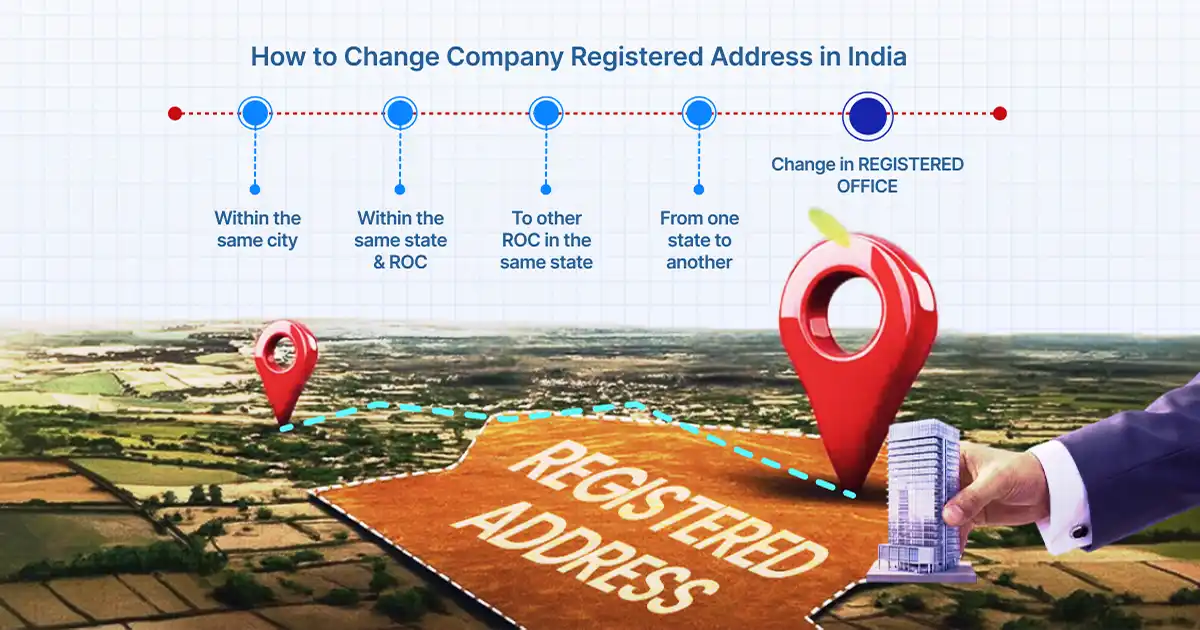
How to Change Company Registered Address in India: Complete Process

How to Check Company PAN Number Online in India

Penalty for Late Filing ROC Annual Returns: Fees & Consequences
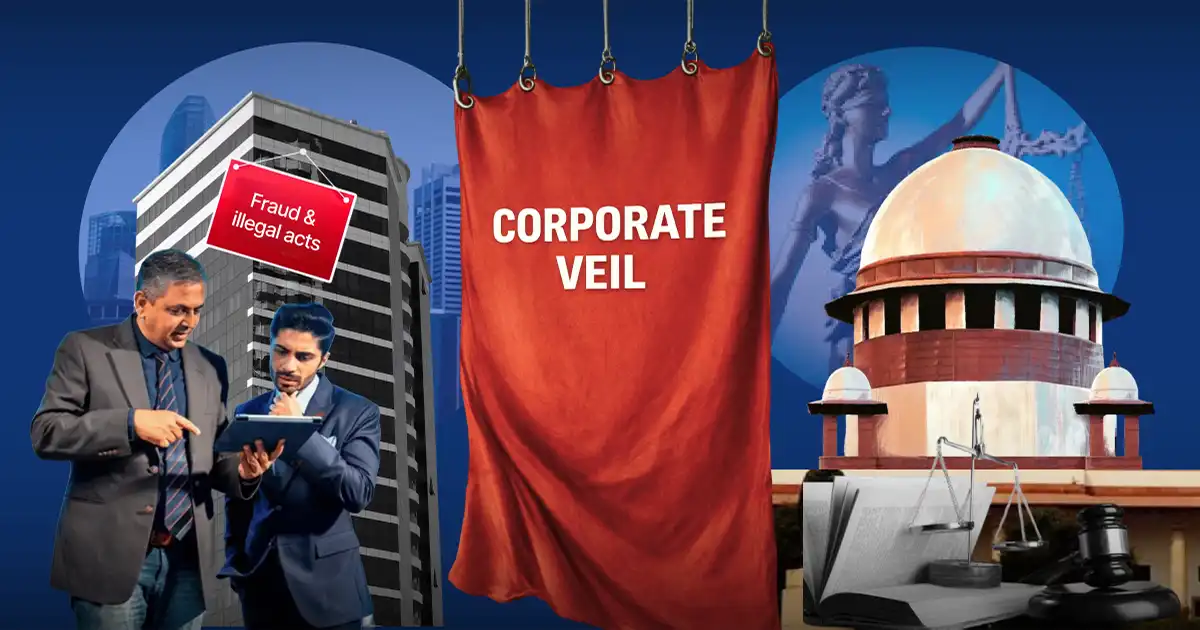
Lifting of Corporate Veil in India: Meaning, Cases & Examples

Can LLP Buy Property in India? Rules, Process & Tax Guide

Removal of a Company Secretary Under the Companies Act, 2013

Difference Between Strike Off and Winding Up of a Company in India

LLP Strike Off in India: Form 24, Documents & Procedure (2026)

Companies Compliance Facilitation Scheme, 2026: 90% Relief on ROC Compliance

Can One GST Number Be Used for Multiple Businesses?
Featured In