LLP Registration Online in India
Register LLP online in India from ₹1,499 + govt fees. RegisterKaro manages new LLP registration, covering name approval, MCA filing, LLP agreement, PAN, TAN, DSC, and DIN, with CA/CS-verified accuracy.
 Fast LLP Incorporation in 10–15 DaysName Approval, MCA Filing & Incorporation CertificateDSC, DIN, PAN & TAN RegistrationLLP Agreement Drafting & Compliance SupportTrusted by 2 Lakh+ Startups & Entrepreneurs

 What Sets Us ApartWhat Sets Us Apart
Choose the Best LLP Registration Package for Your Business
Basic
Standard
Premium
What is LLP Registration in India?
Once registered, an LLP becomes a separate legal entity, distinct from its partners. This means it can own assets, take on loans, and enter contracts in its own name, while each partner's liability stays limited to their agreed contribution. On successful incorporation, the MCA issues a Certificate of Incorporation with a unique LLP Identification Number (LLPIN) that serves as proof of the LLP's legal existence.
In India, LLPs are popular among professional firms, service businesses, consultancies, and startups seeking formal structure and limited liability with fewer compliance requirements. As partners can define their roles, contributions, and profit-sharing through the LLP Agreement, the structure offers a level of internal flexibility that companies following stricter statutory rules (Pvt Ltd) cannot match.
LLP formation requires at least two designated partners, a registered office in India, and an LLP agreement filed with the MCA. The sections below explain how to register an LLP in India, the documents, fees, and post-incorporation compliance.
Requirements to Register an LLP in India
Before LLP formation, the business must meet these requirements under the Limited Liability Partnership Act, 2008:
- Minimum partners - At least two partners are required to form an LLP (individuals or bodies corporate).
- Designated Partners - A minimum of two designated partners who are individuals, with at least one being a resident of India. At least one of them must have stayed in India for at least 120 days during the financial year.
- Age requirement - All partners and designated partners must be at least 18 years of age.
- No maximum limit - There is no maximum limit on the number of partners in an LLP.
- DSC and DIN - All designated partners must possess a valid Digital Signature Certificate (DSC) and Director Identification Number (DIN).
- Prohibited sectors - LLPs cannot be registered for non-profit activities or in sectors prohibited by the government.
Documents Checklist for LLP Registration Online
Before starting online LLP registration in India, keep these documents ready to avoid rejections and processing delays. The required documents are as follows:
1. For Partners and Designated Partners
- PAN card (mandatory for Indian partners)
- Aadhaar, passport, or voter ID as identity proof
- Address proof such as a recent utility bill, bank statement, or rental agreement
- Recent passport-size photographs
- A valid Digital Signature Certificate (DSC) for each designated partner
- Proof that at least one designated partner is resident in India
2. For Registered Office
- Recent utility bill for the premises
- No Objection Certificate from the owner (or ownership documents, if owned by a partner)
- Rent or lease agreement, if the premises are rented
3. Business and Financial Documents
- LLP Agreement detailing partnership terms, profit-sharing ratio, and management structure
- Statement of each partner's capital contribution, with bank statements showing the capital infusion
- Business plan or project report, for certain regulated activities
- Professional certifications, for professional LLPs such as CA or CS firms.
4. For Foreign Partners or Investment
- 100% FDI in an LLP is allowed under the automatic route in sectors where 100% FDI is permitted under the automatic route, and no FDI-linked performance conditions apply.
- Passport and address proof, apostilled or notarized as applicable
- Foreign investment (FDI) approval, where required
Note: Certain regulated business activities may require additional pre-approvals or sector-specific licenses before or after incorporation. For example, a food business needs an FSSAI license, financial or lending activities need RBI approval (such as an NBFC registration), and insurance needs IRDAI approval.
For a full checklist, read our complete guide on the documents required for LLP registration in India.
Download LLP Incorporation Sample Documents & Forms
| Documents | File (PDF) |
| NOC for Business Address | Download |
| Certificate of Incorporation | Download |
| LLP Form - FiLLiP | Download |
| LLP Agreement | Download |
| Consent to act as designated partner (Form 9) | Download |
| Reserve Unique Name for LLP (RUN) | Download |
| Subscriber Sheet | Download |
How to Register an LLP in India?
LLP incorporation online involves five steps on the MCA portal, from getting a DSC for partners to filing the LLP agreement:
Step 1: Obtain a Digital Signature Certificate (DSC)
Get a Class 3 DSC for each designated partner so they can digitally sign all documents on the MCA portal (mca.gov.in). Apply through a licensed Certifying Authority such as eMudhra, Sify, or NSDL.
Note: DPIN is now merged with DIN and is no longer issued for LLPs.
Step 2: Reserve LLP Name
Every LLP must have a unique name before incorporation, approved by the MCA. Name reservation is done through the RUN-LLP form. You can file up to two name options in order of your preference. The names must comply with MCA guidelines and not match existing LLPs, companies, or trademarks.
You can check your LLP name availability for your LLP to avoid any conflict and a possible re-filing.
Under Section 15 of the LLP Act, the name must end with "Limited Liability Partnership" or "LLP". An approved RUN-LLP name stays reserved for 3 months.
Note: If the MCA rejects your name application, you can resubmit once within 15 days without an additional fee. A second rejection requires a fresh RUN-LLP application with the ₹200 fee.
Step 3: File the FiLLiP Form and Other Incorporation Documents
Submit Form FiLLiP (Form for Incorporation of Limited Liability Partnership) along with necessary documents, including the Subscriber Sheet and consent of a Designated Partners (Form 9). The Subscriber Sheet is signed by the first partners to confirm their agreement to form the LLP.
The subscriber sheet also shows the initial ownership structure of the firm.
Step 4: Receive Certificate of Incorporation
Once the Registrar approves your filing, the MCA issues the Certificate of Incorporation (COI), which officially confirms your LLP's registration. It includes the LLPIN, registered office address, and partner details and establishes the LLP as a separate legal entity.
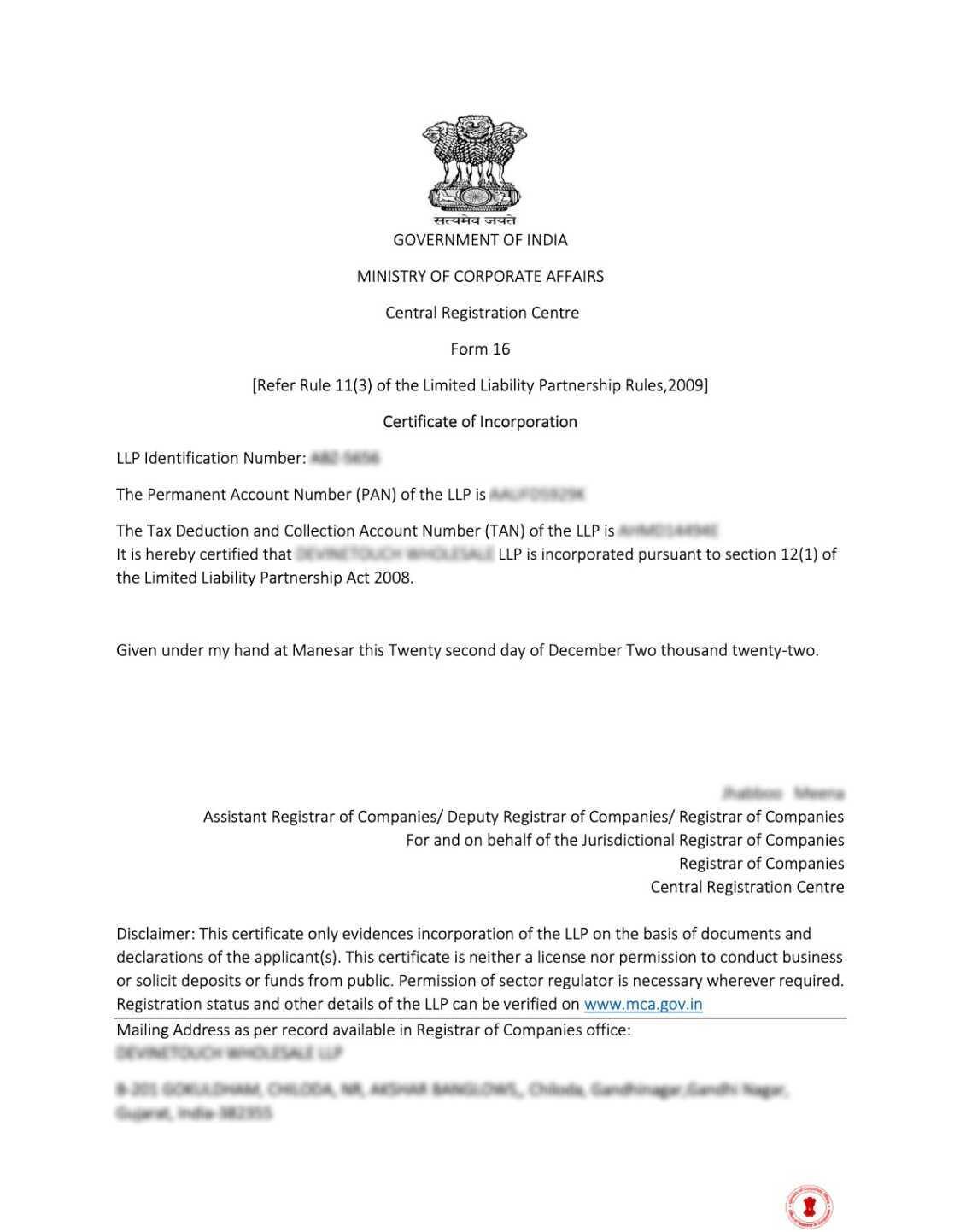
With the COI, your LLP can:
- Open a current bank account in its own name
- Enter into contracts and agreements
- Apply for required registrations and licences
- Start conducting business across India
Keep the COI securely stored, as you will need it for various legal, financial, and compliance purposes. You can access the document online through the MCA portal after approval.
This completes LLP incorporation, and the LLP's PAN and TAN are allotted along with the certificate.
Step 5: Submit LLP Agreement
The LLP Agreement is a legal document that governs the internal functioning of the LLP. Draft a detailed LLP Agreement and file it through Form 3 on the MCA portal within 30 days of incorporation. The agreement should outline:
- The partners' rights and duties
- The profit-sharing ratio
- Capital contribution and other key operating terms
It ensures clarity among partners and serves as a reference for resolving disputes.
What is an LLP Registration Number (LLPIN)?
After your LLP is incorporated, the MCA assigns a unique LLP Identification Number (LLPIN). The LLPIN is a 7-character alphanumeric identification number, such as AAB-1234, and appears on the firm’s Certificate of Incorporation.
LLPIN serves as an identifier for Limited Liability Partnership firms in India and is often used for MCA filings, official verification, and regulatory requirements. You can also use it to identify and verify an existing LLP’s registration details on the MCA portal. LLPs in India often use their LLPIN when filing forms with the MCA and can also provide it when dealing with banks, tax authorities, and other government departments.
How Much Time Does It Take to Register an LLP?
LLP registration online on the MCA portal (MCA21) usually takes around 10 to 15 working days. The exact timeline depends on how quickly you submit documents, how soon the name is approved, and how efficiently the government processes the application.
LLP Incorporation Timeline Breakdown
- Apply for DSC: 1–2 days
- Name reservation via RUN-LLP: 1–3 days
- Filing incorporation forms (FiLLiP) with the MCA: 3–5 days
- Certificate of Incorporation issued: 2–5 days
Note: These timelines are indicative and may exceed 15 days if the proposed name is rejected, documents contain errors or mismatches, or the MCA takes longer to process the application.
Fees of LLP Registration in India
The cost of LLP registration usually starts from ₹6,000 and rises with the capital contribution, the number of DSCs, and state stamp duty.
| Fee Component | Approximate Amount |
| Name reservation (RUN-LLP) | ₹200 |
| Incorporation fee |
|
| DSC (per partner) | ₹2,500 |
| DIN application (if the LLP has more than 2 partners) | ₹500 |
| LLP Agreement drafting | ₹3,000–₹10,000 |
| Stamp duty on LLP Agreement | 0.1%–1% of contribution, depending on state |
| Professional fees | ₹1,499 (Our Charge) |
Note: These LLP registration fees are indicative and can vary with your state, capital contribution, and the service provider you choose. For an exact figure based on your specific details, use the LLP incorporation fees calculator or speak to an expert before you file, so there are no surprises later.
Post-Incorporation Compliance Requirements for an LLP
After registering the LLP, complete annual and event-based filings under the LLP Act, 2008, and applicable tax laws to keep it compliant and avoid penalties:
Annual Compliance
Every financial year, an LLP must complete these key filings:
- Form 11 (Annual Return): Due 30 May 2027 (within 60 days of the financial year-end).
- Form 8 (Statement of Account & Solvency): Due 30 October 2027. Professional certification applies when the LLP crosses the prescribed turnover or contribution threshold.
- DIR-3 KYC: Every designated partner holding a DIN must file their KYC every three years on 30 June of the applicable financial year. The deadline to file DIR-3 KYC is now triennial instead of annual.
- Income Tax Return (ITR-5): Due 31 July 2027 if no audit applies, or 31 October 2027 if an audit applies.
- Tax Audit: Required when the LLP crosses the turnover threshold under Section 44AB; the audit report is due by 30 September 2027.
- GST Returns: LLPs registered under GST file GSTR-1 and GSTR-3B monthly or quarterly, with the annual GSTR-9 due by 31 December 2027.
Tip: To keep track of these dates and avoid missing a deadline, use our compliance calendar.
TDS on Payments to Partners (Section 393(3), earlier Section 194T)
LLPs must deduct 10% TDS under Section 393(3) of the Income-tax Act, 2025 (Section 194T of the 1961 Act until 31 March 2026) on payments such as partner remuneration, interest, commission, or bonus when the aggregate amount paid or credited to a partner exceeds ₹20,000 in a tax year.
Tip: Account for this requirement when structuring partner payments and managing your LLP compliance obligations.
Event-Based Compliance
Certain changes also require filings with the MCA:
- Change in partners: File Form 4 within 30 days.
- Change in LLP Agreement: File Form 3 within 30 days of incorporation.
- Change in registered office: File Form 15.
- Closure: File Form 24 to strike off an eligible LLP.
Missing MCA filing deadlines can result in ₹100 per day per form, with no maximum cap for Forms 8 and 11. Continued non-compliance can also affect the LLP's ability to obtain loans, enter contracts, and maintain good standing with the ROC.
Key Benefits of LLP Formation for Your Business
Combining the liability protection of an entity with the flexibility of a partnership, an LLP offers major benefits:
- Limited liability protection: Each partner's liability is generally limited to their agreed contribution, protecting personal assets from the LLP's business liabilities.
- Separate legal entity: An LLP exists independently of its partners. It can own assets, take on loans, and sign contracts in its own name.
- No minimum capital: An LLP has no prescribed minimum capital requirement. Partners can contribute any agreed amount, recorded in the LLP Agreement, and change it later as the business grows. Many LLPs start with a nominal contribution of around ₹10,000, which is enough to open a bank account and begin operations.
- Tax efficiency: An LLP pays income tax at a flat 30% on its profits for the tax year 2026-27, plus a 12% surcharge above ₹1 crore of income and 4% health and education cess. A partner's share of the LLP's profit is exempt from tax in the partner's hands, so the same profit is not taxed again at the partner level.
- Lower compliance burden: LLPs face fewer compliance requirements than private limited companies. A statutory audit becomes mandatory when turnover exceeds ₹40 lakh or contribution exceeds ₹25 lakh.
- Perpetual succession: The LLP continues regardless of partners joining, leaving, retiring, or passing away, so the business carries on without disruption.
- Operational flexibility: Partners can decide the firm’s management, responsibilities, rights, and profit-sharing through the LLP Agreement. They can also add or remove partners according to its terms.
- Credibility and scalability: A registered LLP builds trust with clients and lenders, improving access to credit, and can take on an unlimited number of partners as it grows.
LLP vs Private Limited Company vs Partnership Firm
Founders often compare LLP company registration with a private limited company or a partnership firm before choosing a structure.
| Basis | LLP | Private Limited Company | Partnership Firm |
| Governing law | LLP Act, 2008 | Companies Act, 2013 | Indian Partnership Act, 1932 |
| Minimum members | 2 partners | 2 shareholders and 2 directors | 2 partners |
| Maximum members | No limit | 200 members | 50 partners |
| Liability | Limited to agreed contribution | Limited to unpaid share capital | Unlimited |
| Separate legal entity | Yes | Yes | No |
| Statutory audit | Above ₹40 lakh turnover or ₹25 lakh contribution | Mandatory every year | Not required under partnership law |
| Issue of shares | Not allowed | Allowed | Not allowed |
| Annual MCA filings | Form 8 and Form 11 | AOC-4 and MGT-7 or MGT-7A | None |
Connect with RegisterKaro and let our experts handle the legal hassle while you grow your business.
Frequently Asked Questions (FAQs)
Is LLP Registration Compulsory in India?
Yes, registration of an LLP with the MCA is compulsory to operate as a Limited Liability Partnership. Unlike a general partnership (which can exist unregistered), an LLP only comes into legal existence once it is incorporated and issued a COI and LLPIN. Without registration, the LLP cannot claim limited liability, a separate legal identity, or a firm name. If two or more people carry on business without registering, it is treated as a general partnership under the Indian Partnership Act, 1932 and is not given benefits or protection similar to a registered entity.
Can one person start an LLP?
No, an LLP requires at least two partners at all times. It must also have at least two designated partners, and the same individuals can serve as both partners and designated partners. If you want a single-owner structure with limited liability, consider a One Person Company (OPC).
What happens if an LLP is left with only one partner?
If an LLP operates with just one partner for more than six months, that sole partner becomes personally liable for the obligations the LLP incurs during that period, losing the protection of limited liability. To avoid this, you get a six-month window to appoint a second partner, so as long as you bring one in within that time, the LLP continues normally with its liability protection intact.
Can an LLP raise funds from investors or issue shares?
No, an LLP cannot issue shares or equity. It can raise funds through partner contributions or loans. Since angel investors and venture capital firms generally invest for equity, a private limited company may be more suitable if external equity funding is part of your plans.
Can NRIs or foreign nationals become partners in an LLP?
Yes, NRIs and foreign nationals can become partners or designated partners, provided the LLP has at least one designated partner who is resident in India. Foreign investment is permitted under applicable FEMA rules and FDI conditions.
Is a minimum capital required to start an LLP?
No, an LLP has no minimum capital requirement. Partners can agree on the contribution amount and record it in the LLP Agreement. They can also increase the contribution later as the business grows.
Can an LLP be registered at a residential address?
Yes, you can use a residential property as the LLP's registered office. You generally need a recent utility bill and the property owner's NOC. If you own the property, you can provide the required ownership or consent documents instead.
Do all LLPs need to be audited?
No, a statutory audit is required when an LLP's annual turnover exceeds ₹40 lakh or its contribution exceeds ₹25 lakh. LLPs below both thresholds do not require a statutory audit but must still complete their applicable annual filings.
Can an existing partnership firm or company be converted into an LLP?
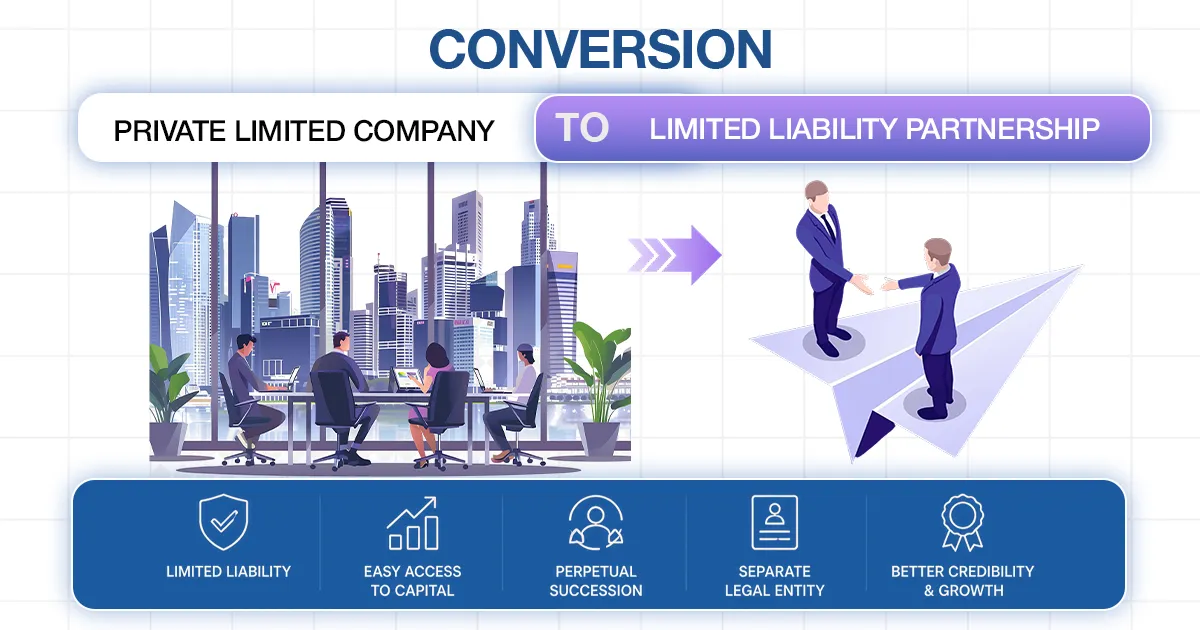
Yes, a registered partnership firm or eligible private or unlisted public company can convert into an LLP subject to the applicable requirements. The process involves filing the prescribed forms, obtaining required consents, and meeting conditions relating to assets, liabilities, and existing obligations.
Can an LLP carry out any type of business?
An LLP can conduct most trading, manufacturing, professional, and service activities, but certain regulated activities have specific entity requirements. For example, banking, insurance, and NBFC activities generally require a company structure under the applicable regulations. An LLP also cannot operate as a not-for-profit entity.
How is a partner's income from an LLP taxed?
A partner's share of the LLP's profit is exempt from tax because the LLP has already paid tax on that profit. However, remuneration and interest received from the LLP are taxable in the partner's hands, subject to the applicable provisions and limits under Section 40(b).
What is the difference between an LLP and a Private Limited Company?
Both an LLP and a private limited company provide limited liability and a separate legal identity, but an LLP has simpler compliance requirements and no minimum capital requirement. A private limited company can issue equity shares, making it better suited to businesses seeking external investment. LLPs often suit professional and service businesses, while companies suit ventures focused on raising equity. Although often searched as LLP registration, an LLP is registered under the LLP Act, 2008 and is not a company under the Companies Act, 2013.
What is the difference between LLP formation and LLP incorporation?
Both terms describe the same process. LLP formation covers preparatory steps such as DSC, name reservation and drafting the LLP agreement. LLP incorporation is the legal event when the Registrar issues the Certificate of Incorporation with the LLPIN.

Reviewed by
Joel DsouzaJoel Dsouza is a Chartered Accountant (CA) and compliance expert with over 7 years of hands-on experience in company registration, tax structuring, GST, ROC filings, and MCA compliance. As a qualified member of the Institute of Chartered Accountants of India (ICAI) and Co-Founder at RegisterKaro, he has personally advised more than 1,000 startups and SMEs across India, helping founders navigate incorporation, regulatory frameworks, and financial planning from Day 1. With deep expertise across all three levels of Finance and Portfolio Management, Joel is committed to promoting financial literacy and simplifying India's startup ecosystem through clear, actionable guidance that entrepreneurs can act on immediately.
Why Choose RegisterKaro for LLP Registration Services?
RegisterKaro has registered 2 Lakh+ businesses and knows exactly what the MCA looks for. Our in-house CAs, CSs, and legal experts file your LLP directly on the portal, catching the errors that cause rejections and delays, so your incorporation goes through right the first time.
- Expert Assistance: Experienced professionals handle each new LLP registration application across professional, trading and service sectors.
- Dedicated Professional: You get dedicated experts who guide you through the registration process and address your queries.
- MCA Compliance Support: Keep your LLP compliant with timely support for annual returns and other MCA filings.
- Customized Solutions: Choose registration and compliance support based on your LLP's structure, business activity, and requirements.
- Post-Registration Support: Get continued assistance with changes to partners, LLP agreements, registered office, and other business updates.

What Our Clients Say
View All
Mishthans
 Verified
RegisterKaro made our LLP registration straightforward and completely stress-free. Sincere thanks to Krishna for the fantastic support throughout the... Read more

Anand Kumar Singh
VerifiedMiss Tanu provided excellent support throughout the LLP registration process. She was professional, responsive, and guided me at every step. The regis... Read more

Anubhav Anand
VerifiedHad a great experience with Register Karo for my LLP registration process. Their team was professional, responsive, and guided me through every step s... Read more

Venkateswara Rao
VerifiedI wanted to take a moment to thank you for your support in completing the LLP registration process for our firm. We appreciate the effort and coordina... Read more

Gaurav Saini
VerifiedI have got my LLP registration and compliance done with the Registerkaro team. Everybody went above and beyond to get my process completed with their... Read more

Hariom Sharma
VerifiedI had a great experience with RegisterKaro for registering my business. The process was seamless, with helpful daily updates at the start and end of e... Read more

Aman Raj
Verified"I had incorporated my company with Suhani's assistance, and her professionalism and cooperative nature made the entire process smooth and stress-fre... Read more

Hirok jyoti Saikia
VerifiedExcellent service throughout the address change process. The team handled everything efficiently and kept me informed at every stage. Mehek , Rupali... Read more

Alok jain
VerifiedI had an good experience with theRegister Karo incorporation service. Mr Aakash from the member of my incorporating team made the entire registration... Read more

Riya Arora
VerifiedRegister Karo provides excellent services Their team is very cooperative and explains everything clearly, which is helpful for beginners. The process... Read more
Related Blogs
View All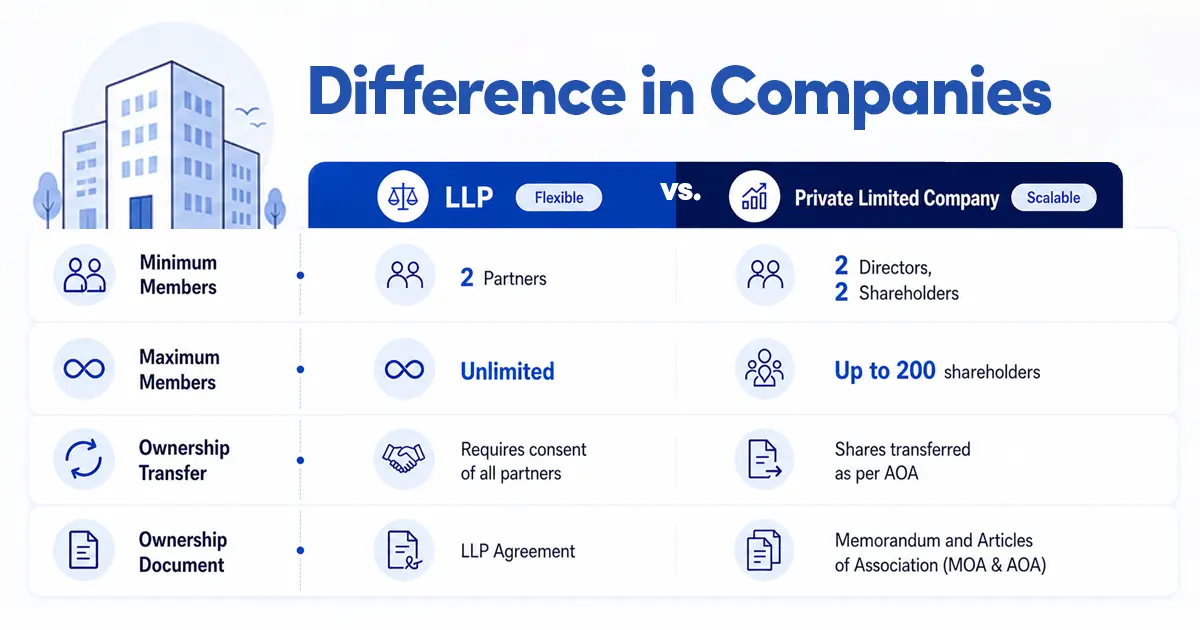
Difference Between Private Limited Company and LLP in India (2026)
How to Convert a Private Limited Company into an LLP in 2026: Process & Eligibility

Appointment of Auditor in LLP: Procedure & Rules 2026

MCA LLP Master Data: View Partners, LLPIN & Status on V3

LLP Partner Limit in India: Maximum & Minimum Partners

LLP Registration Fees in India (2026): Govt Costs & Stamp Duty Charges

Rights and Duties of LLP Partners: Roles and Liabilities

Partners’ Remuneration in LLP: Rules, Tax & Compliance

LLP Registration for NRIs & Foreign Nationals in India

What is the Minimum Capital Requirement for LLP in India?