AD Code Registration Online in India
Register your AD Code online in India with RegisterKaro. Get assistance with bank documentation, ICEGATE, export documentation, and post-registration updates for your designated bank account.
 Registration Through Your Authorized Dealer BankAD Code Registration on ICEGATEComplete Export Documentation SupportPost-Registration Compliance AssistanceAD Code Status Tracking & Correction Support


 What Sets Us ApartWhat Sets Us Apart
What is AD Code Registration?
An AD Code (Authorized Dealer Code) is a unique 14-digit number issued by a bank authorized by the Reserve Bank of India to handle foreign exchange transactions. The bank acts as an Authorized Dealer (AD) for foreign exchange under applicable RBI regulations.
AD Code registration links this bank account with your Import Export Code (IEC) in the Customs system. Exporters register the AD Code with Indian Customs through the ICEGATE portal to identify the bank account designated to receive export proceeds.
For most exporters, AD Code registration forms an important part of the export setup. It supports shipping bill processing, export proceeds tracking, and the processing of applicable export benefits and refunds. The requirement and procedure can vary based on the type of transaction and applicable customs requirements.
Why is AD Code Registration Required?
AD Code registration links your export-related bank account with your IEC in the Customs system. Exporters register the AD Code on ICEGATE to identify the bank account used for receiving export proceeds and to complete applicable customs and export procedures.
- Facilitates Export Customs Procedures: A registered AD Code supports the filing and processing of shipping bills for export shipments at the relevant Customs location.
- Links Export Proceeds to Your Bank Account: The AD Code identifies the Authorized Dealer bank account associated with your exports, helping Customs and the banking system track export proceeds.
- Supports Export Refunds and Benefits: Correct bank account details are important when claiming applicable export benefits, such as RoDTEP, duty drawback, and GST refunds, subject to the eligibility requirements of each scheme.
- Helps Meet Foreign Exchange Requirements: Exporters receive foreign currency through an Authorized Dealer bank. The AD Code connects the designated bank account with the export transaction and supports compliance with applicable RBI and FEMA requirements.
- Enables Smoother Export Processing: Registering the correct AD Code before shipping helps reduce issues caused by mismatched bank, IEC, or Customs details during export documentation and payment processing.
Role of AD Code Registration in Export
AD Code registration forms part of the export setup. The following steps show where it fits and what typically follows:
- Obtain an Import Export Code (IEC): Apply for an IEC through the DGFT system. The AD Code is linked to the IEC used for your export transactions.
- Obtain the AD Code from Your Bank: Your Authorized Dealer bank issues the 14-digit AD Code for the current account used for export transactions.
- Register the AD Code on ICEGATE: Submit the bank-issued AD Code and required documents through the ICEGATE portal for the relevant Customs location.
- File the Shipping Bill: Use the registered bank account details while completing the applicable export Customs procedures and filing the shipping bill.
- Claim Applicable Export Benefits: After completing the required export formalities, you can claim applicable benefits or refunds, such as RoDTEP, duty drawback, or GST refunds, subject to the respective eligibility conditions.
If you export products that require registration with an Export Promotion Council or commodity board, you may also need an RCMC registration or other applicable registration.
Conditions Required for AD Code Registration
Before registering an AD Code with Customs, make sure your business meets the following requirements:
- Valid IEC: You must have a valid Import Export Code (IEC) issued by the Directorate General of Foreign Trade (DGFT).
- Current Bank Account: You must maintain a current account with a bank authorized by the RBI to handle foreign exchange transactions.
- AD Code from Your Bank: Your Authorized Dealer bank must issue the 14-digit AD Code for the current account linked to your IEC.
- ICEGATE Registration: You must register the bank-issued AD Code with Customs through the ICEGATE portal for the relevant export location.
Who Needs AD Code Registration?
Exporters with a valid IEC who need to declare an authorized dealer bank account for export-related customs and foreign-remittance procedures need it. Specifically, the following can apply:
- Importers and exporters holding a valid Import Export Code (IEC).
- Companies with a current account in an RBI-approved bank for foreign exchange.
- Businesses that regularly receive or make payments in foreign currency.
- Firms involved in export, import, or both need smooth customs clearance for their shipments at any port or Inland Container Depot (ICD).
- Traders who want to access government export benefits and schemes.
If your business deals with cross-border trade or foreign currency, applying for AD Code registration is essential to stay compliant and ensure faster processing of transactions.
Documents Required for AD Code Registration
You generally need the following documents to obtain an AD Code from your bank and register it with Customs on ICEGATE:
| Document | Purpose / Requirement |
| AD Code Letter | Bank-issued letter on the bank's official letterhead containing the 14-digit AD Code and account details. |
| Import Export Code (IEC) Certificate | Confirms the IEC under which the AD Code will be registered. |
| PAN Card | PAN of the business, company, LLP, or proprietor, as applicable. |
| GST Registration Certificate | GST certificate, where the business is registered under GST. |
| Cancelled Cheque | Confirms the current account details linked to the AD Code. |
| Request Letter | Letter addressed to the bank requesting issuance of the AD Code, usually on the business letterhead. |
| Board Resolution | May be required from companies authorizing the AD Code application. |
| Identity and Address Proof | Identity or address proof of the proprietor, authorized signatory, director, or partner, where required by the bank. |
| Class 3 DSC | Digital Signature Certificate used for applicable submissions on the ICEGATE portal. |
| Business Address Proof | Utility bill, rent agreement, or other acceptable proof, if requested by the bank or Customs. |
| Additional Business Documents | Export House Certificate, manufacturing-related documents, or other supporting documents may apply in specific cases. |
The exact document set can vary by bank and business structure. Check the requirements of your Authorized Dealer bank before submitting the application to avoid requests for additional documents.
AD Code Letter Format
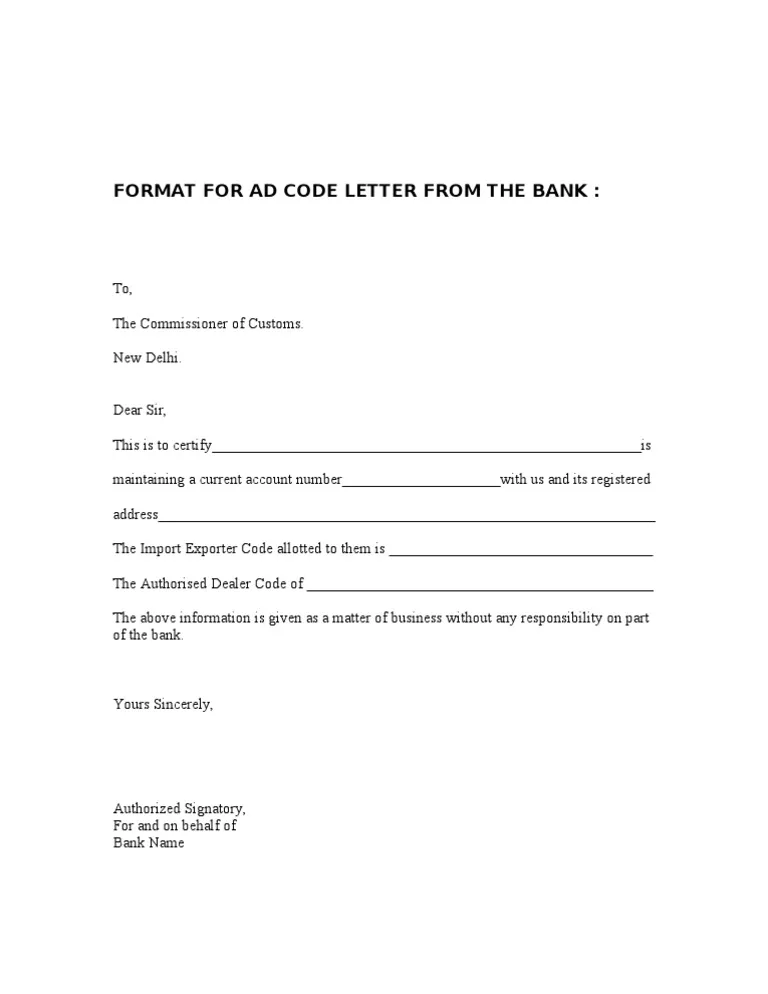
To avoid delays or rejection during AD Code registration on the ICEGATE portal, ensure your bank issues the AD Code letter on its official letterhead. The letter should include the following details:
- Business name and registered address
- Import Export Code (IEC) number
- 14-digit AD (Authorized Dealer) Code
- Current account number linked to the IEC
- IFSC code and branch details
Note: Although the AD Code is now pan-India, the bank account and IFSC details used for refund and export incentive processing may still need to be registered port-wise.
- Name of the authorized dealer bank
- Confirmation that the bank is authorized by the Reserve Bank of India (RBI) to deal in foreign exchange
- Authorized bank official's signature, name, designation, and bank seal
- Date of issue
Important Things to Remember for Documents:
- Self-Attestation: Most documents for AD code registration at customs need to be self-attested by the authorized person and often stamped with your company's seal.
- Clear Scans: When you're doing ICEGATE AD Code registration online, make sure all scanned documents are very clear, easy to read, and meet the required file size and type (usually PDF).
How to Register AD Code in India?
The AD Code registration process typically has two main parts: getting the AD Code from your bank, then registering it with Customs using the ICEGATE portal.
Part 1: Getting AD Code from your Bank
- Open a Current Account: Make sure you have a current account with an RBI-authorized bank that handles foreign exchange.
- Write a Request Letter: Prepare a formal request letter on your company's letterhead for your bank manager. Ask for an AD Code for your IEC. Clearly state the port(s) where you plan to register the AD Code.
- Submit Documents to Bank: Give the request letter and all needed documents (IEC, PAN, GST, cancelled cheque, etc.) to your bank. Many banks now let you submit these online through their trade services.
- Bank Issues AD Code: After checking your details, the bank will give you a 14-digit AD Code on their official letterhead.
Part 2: Registering AD Code with Customs (ICEGATE Portal)
- Go to the ICEGATE Portal: Visit the official ICEGATE website (icegate.gov.in).
- Log In with IEC Details: Sign in using your IEC credentials. If you don't have an account, you will need to register first using your Class 3 Digital Signature Certificate, preferably in the name of the IEC holder (Proprietor/Director/Authorized Signatory).
- Find AD Code Registration: Look for "Bank Account Management" or "AD Code Registration" in the services area.
- Enter AD Code Information: Type in the AD Code details exactly as your bank provided them.
- Upload Documents: Upload scanned copies of the required documents. This includes the AD Code letter from your bank, IEC, PAN, and GST certificate. Make sure the documents are clear and easy to read.
- Submit Application: Send your application. You might get a One-Time Password (OTP) for verification.
- Approval: The application is processed through the Customs system, and its status can be tracked online. If deficiencies are identified, additional action or resubmission may be required.
Note: Earlier, exporters generally registered AD Codes separately at individual ports. Under the current system, once an AD Code is registered against an IEC, it can be used for filing documents at other Customs locations. However, bank account and IFSC details can still have port-specific relevance for processing applicable export refunds and incentives.
AD Code Registration Fees
The AD Code registration fee, mandatory for exporting goods from India, is usually nil. There is no official government fee charged by the Customs Department for AD Code registration on the ICEGATE portal. However, you might have to pay ₹500 to ₹2,000 when obtaining the AD Code letter from your bank.
If you are using the help of an agent or service provider, professional charges may apply separately.
ICEGATE Portal Application Timeline & Validity
Once your documents are submitted correctly, the AD Code is usually registered on ICEGATE within 7–10 working days.
The AD Code itself does not expire. AD Code is registered once against your IEC and is valid across all Customs locations.
List of Ports / ICDs for AD Code Registration
The AD Code is registered against the IEC and can be used across Customs locations. You do not generally need to obtain a separate AD Code for each port. However, bank account and IFSC details may still have port-specific relevance for processing export refunds and incentives.
India has several seaports, airports, and Inland Container Depots (ICDs) that handle export shipments. Some major Customs locations include:
- Mumbai (JNPT, Sahar ACC)
- Chennai (Chennai Port, Chennai ACC)
- Kolkata (Kolkata Port, Kolkata ACC)
- Delhi (Delhi ACC, Patparganj ICD, Tughlakabad ICD)
- Bengaluru (Bengaluru ACC, Whitefield ICD)
- Ahmedabad (Ahmedabad ACC)
- Hyderabad (Hyderabad ACC, Sanathnagar ICD)
- Cochin (Cochin Port, Cochin ACC)
- Vizag (Visakhapatnam Port)
- Paradeep (Paradeep Port)
- Mundra (Mundra Port)
- Pipavav (Pipavav Port)
- Kandla (Kandla Port)
Need AD Code registration for a specific Customs location? Tell us your port or ICD, and we'll guide you through the applicable process. Fill the form now!
AD Code Registration Status
After submitting the AD Code through ICEGATE, you can check its registration status through the Bank Account Management section of your ICEGATE account. The system displays details such as the Customs location, bank name, AD Code, account number, and status with Customs.
How to Check the AD Code Registration Status?
Follow these steps to check the status of your AD Code registration:
- Visit the ICEGATE portal and log in to your registered account.
- Open the Bank Account Management section from your ICEGATE dashboard.
- Locate the relevant bank account and AD Code in the registered account list.
- Check the Customs status shown against the account. ICEGATE displays the applicable status, such as pending or approved.
- Take corrective action if required: If Customs rejects the application or identifies an issue, review the reason and follow the applicable resubmission or modification process.
ICEGATE's FAQ states that users can register an AD Code online through their ICEGATE profile. It also notes that an AD Code showing as Customs Pending may require additional processing time.
Note: Keep the AD Code letter issued by your bank and the relevant ICEGATE records for your business documentation. Do not describe an ICEGATE-generated acknowledgement or status record as an “AD Code Registration Certificate” unless the portal specifically provides such a document for your account.
How to Correct an Incorrect AD Code?
If you have registered an incorrect AD Code on the ICEGATE portal, you should correct it as soon as possible to avoid delays in shipping bill generation, export payments, or incentive claims.
Follow these steps to update your AD Code:
- Contact your authorized dealer (AD) bank and confirm the correct 14-digit AD Code linked to your current account.
- Log in to the ICEGATE portal using your registered credentials.
- Go to the Bank Account Management section and check your existing AD Code details.
- If the portal allows modifications, submit a request to update the AD Code along with the revised bank letter and supporting documents.
- If modification is not available online, contact the Customs authority at your original port of AD Code registration or seek assistance from your Customs Broker (CHA) to initiate the correction.
- Once Customs verifies the request, the corrected AD Code will be updated against your IEC.
Difference Between IEC and AD Code
The Import Export Code (IEC) and AD Code serve different purposes in India’s foreign trade system. The IEC identifies the importer or exporter, while the AD Code links the exporter’s bank account with Customs for handling export proceeds.
| Feature | Import Export Code (IEC) | AD Code |
| Issued By | Directorate General of Foreign Trade (DGFT) | Authorized Dealer Bank |
| Purpose | Identifies an importer or exporter for foreign trade | Identifies the bank account designated to receive export proceeds |
| Format | 10-digit code | 14-digit code |
| Main Use | Required for most imports and exports of goods | Used for applicable export customs procedures and bank account registration with Customs |
| Linked With | Importer or exporter | Exporter’s bank account and IEC |
| Registration | Obtained through the DGFT system | Issued by the bank and registered with Customs through ICEGATE |
| Validity | Remains valid unless surrendered, cancelled, or otherwise made inactive | Does not have a separate fixed expiry period, but bank account or other details may require an update |
In simple terms, the IEC identifies your business for international trade, while the AD Code identifies the Authorized Dealer bank account associated with your exports. An exporter may need both to complete the applicable Customs and foreign exchange formalities.
Connect with RegisterKaro and let our experts handle the legal hassle while you grow your business.
Frequently Asked Questions (FAQs)
Can we import without an AD Code?
While the AD Code is mainly required for exports, importers may also need it for certain foreign exchange transactions. However, the major impact of not having an AD Code is during exports; without it, you can’t generate a shipping bill, which is required for customs clearance.
What is the penalty levied for not registering for an AD Code?
If you don’t register an AD Code, your export shipments won’t clear customs. This can cause port delays, extra charges like demurrage, and lost orders. While there’s no direct fine just for not registering, the business impact can be severe and may lead to issues under FEMA.
Does the customs department use the AD Code?
Yes, customs actively uses the AD Code during export processing. It’s required for filing shipping bills, and customs uses it to confirm that the exporter is linked with an RBI-approved bank for foreign currency transactions.
Can any changes be made in the AD Code?
The 14-digit AD Code number doesn’t change unless you change your bank. However, if you switch banks or update account details, you must get a new AD Code letter and update the registration on the ICEGATE portal.
Is company registration required to get an AD Code?
You don’t need to be a Private Limited Company, but you must have a legally registered business, like a proprietorship, partnership, LLP, or company. Also, an Import Export Code is mandatory to get an AD Code.
How many AD Codes can a person get?
A business can have multiple AD Codes if it holds current accounts with different authorized banks. Each AD Code must be registered with customs for use at export ports.
How many digits is an AD Code?
An AD Code is a 14-digit number issued by an RBI-authorized bank.
What happens if the AD Code is wrong?
If your AD Code is incorrect or doesn’t match bank or customs records, your shipping bill will be rejected. This will delay your customs clearance until the correct code is submitted and accepted.
Is the AD Code different for each port?
No, the AD Code itself stays the same. Earlier, it had to be registered separately at each export port, but now, once linked to your IEC, it can be used across all customs locations via ICEGATE.
Which DSC is required for AD Code Registration?
A Class 3 Digital Signature Certificate is required for registering the AD Code and filing export documents on the ICEGATE portal.
What is AD Code registration?
AD Code registration links the 14-digit bank-issued AD Code with your IEC through the ICEGATE portal. The Authorized Dealer bank issues the code for the current account used for export transactions. Customs uses these details for applicable export procedures, including shipping bill processing and export proceeds-related formalities.
Is there a government fee for AD Code registration?
No, Customs does not charge a government fee for AD Code registration on ICEGATE. However, your bank may charge ₹500 to ₹2,000 for issuing the AD Code letter. If you use a professional service provider, separate service charges may also apply for documentation and registration assistance.
How do I check my AD Code registration status on ICEGATE?
You can check your AD Code registration status through the Bank Account Management section of your ICEGATE account. Log in, open the registered bank account details, and locate the relevant AD Code. ICEGATE displays the applicable Customs status, such as pending or approved, against the registered account.
Do I need to register the AD Code at every port?
No, you generally do not need to register the AD Code separately at every Customs port. The current system allows the AD Code to remain linked with your IEC across Customs locations. However, bank account and IFSC details may still have port-specific relevance for certain export refunds and incentives.
Is AD Code the same as IEC?
No, an AD Code and IEC serve different purposes in the export process. DGFT issues the 10-digit IEC to identify an importer or exporter, while an Authorized Dealer bank issues the 14-digit AD Code. Customs links the AD Code with your IEC and designated bank account for applicable export procedures.

Reviewed by
Joel DsouzaJoel Dsouza is a Chartered Accountant (CA) and compliance expert with over 7 years of hands-on experience in company registration, tax structuring, GST, ROC filings, and MCA compliance. As a qualified member of the Institute of Chartered Accountants of India (ICAI) and Co-Founder at RegisterKaro, he has personally advised more than 1,000 startups and SMEs across India, helping founders navigate incorporation, regulatory frameworks, and financial planning from Day 1. With deep expertise across all three levels of Finance and Portfolio Management, Joel is committed to promoting financial literacy and simplifying India's startup ecosystem through clear, actionable guidance that entrepreneurs can act on immediately.
Why Choose RegisterKaro for AD Code Registration?
Get your AD Code registered properly for smooth exports with RegisterKaro. Here's why exporters across India trust us:
- Step-by-step guidance: We help you understand the ICEGATE portal navigation clearly and handle all formalities on your behalf.
- Quick turnaround: Our team ensures fast AD Code registration, so your shipments aren't held up at the port.
- Accurate documentation: We check and prepare all documents to avoid errors and rejections.
- Port-specific assistance: We help you understand the applicable Customs location and bank account requirements for your export transactions.
- Trusted by exporters: Businesses across India rely on us for smooth AD Code handling.

What Our Clients Say
View All
Sumit Kumar
 Verified
RegisterKaro has been a reliable compliance partner for my business. They handled my GST filings, ROC compliances, and annual filings efficiently and... Read more

partha bhattacharjee
VerifiedI dealt with the registration process of the LLP being formed by my daughter and two other kins as they relied and asked me to help them. I suggested... Read more

Rishi Singh
VerifiedI almost delayed my registration because I thought it would be too expensive and complicated. A friend suggested RegisterKaro, so I gave it a try. The... Read more

Mithun P Basil
VerifiedRegisterKaro provided excellent support for my company incorporation. Their team, especially Kajal Chauhan, my SPOC, were knowledgeable and efficient.... Read more

Mystic Matrix
VerifiedThank you to the entire Register Karo team for providing excellent professional services to me and my company. We truly appreciate your patience and s... Read more

Tanishka Dobriyal
VerifiedOur experience with the executive Rashi, was good. However the sales team, accounts team, and operations team were not coordinated. I was getting mult... Read more

DHRUMIL DHOKAI
VerifiedRegisterKaro have been a Gamechanger to us in our approach to shape our brand and add value with their distintive services in incorporating our promin... Read more

CA Akash Parkhe
VerifiedIt's a good platform to register your company, their staff are very cooperative, and very supportive. I especially thanks to avantika, who coordinates... Read more

Sanjeev Saini
VerifiedThey were extremely efficient in handling the entire process, ensuring a smooth and hassle-free experience. Within just a few days, my company was suc... Read more

Saurabh Mishra
VerifiedThe service and support I received from the RegisterKaro team were outstanding. From day one until my registration was finalized, they were incredibly... Read more
Related Blogs
View All
How to Convert Sole Proprietorship to LLP in India (2026): Process & Fees

LLP Audit Applicability 2026: Statutory & Tax Audit Limits

How to Convert Proprietorship to Private Limited Company

LLP Form 8: Due Date, Late Fee, Filing Process, and Format

Trademark Class 35: Advertising & Business Services in India

Complete Overview of Can Director Give Loan to a Company

CEO Appointment in Private Limited Company: Procedure Guide

Debentures Under the Companies Act, 2013: Section 71 Explained

Deemed Public Company Under the Companies Act, 2013: Meaning and Compliance

Difference Between Brand and Company in India: 2026 Guide