

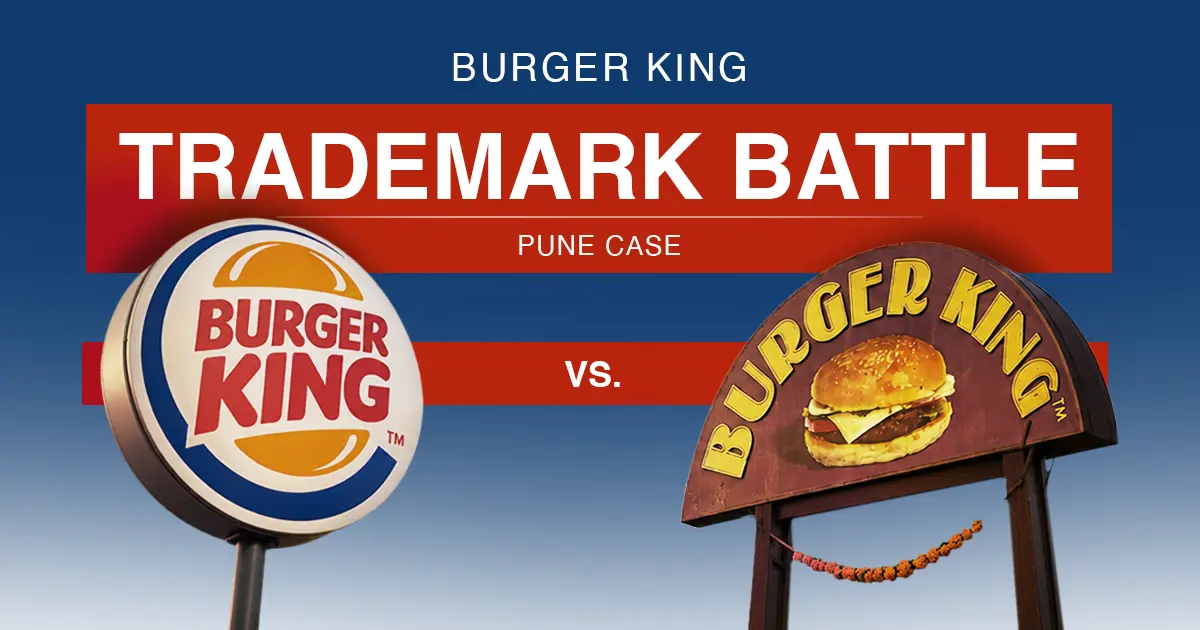
The 13-year-long Pune trademark battle involving Burger King (Anahita Irani v. Burger King Corporation) is one of India’s most-discussed intellectual property cases of the past decade. The case includes a conflict between an American fast-food giant with more than 13,000 outlets worldwide and a small family-run eatery in Pune operating in just two locations.
The Pune-based eatery has been going with the name “Burger King” since 1991-1992. Then, in 2011, Burger King (global brand) filed a case in the district court against the local restaurant, which initially won the case. The case is still pending in higher courts, but the principle it has established under Indian trademark law is already shaping how prior-use disputes are decided.
Here is what happened, why it matters, and where the case stands now.
The Background of the Burger King Pune Trademark Case
A small restaurant named Burger King has operated in Pune’s Camp area since 1992, run by Anahita Irani and Shapoor Irani. The Iranians built a loyal local following over decades, long before the global burger chain reached India (officially entered in 2014).
Burger King Corporation, the US-based fast-food giant, holds trademark registration for “Burger King” in India dating back to 1979. However, the corporation only opened its first Indian outlet in 2014 (some sources cite 2015 for the first Pune outlet).
In June 2009, Burger King Corporation sent a cease-and-desist notice to the Pune restaurant. When the Iranians refused to stop using the name, the corporation filed a trademark infringement suit in 2011 before the Pune District Court. It sought a permanent injunction and ₹20 lakh in damages, arguing that the local eatery’s use of the name caused consumer confusion and damaged the global brand’s reputation.
The Two Sides of the Argument in Pune District Court
Burger King Corporation argued that:
- It registered the “Burger King” trademark in India in 1979, decades before the Pune eatery existed.
- Its global reputation and goodwill extended to India even before its physical entry.
- Section 28 of the Trade Marks Act, 1999, gives it the exclusive right to use its registered mark.
- An identical local name caused consumer confusion and brand dilution.
The Pune restaurant owned by Iranians argued that:
- It had been using the name continuously since 1992, more than 20 years before Burger King Corporation entered the Indian market.
- Under Section 34 of the Trade Marks Act, 1999, a prior user’s rights stand even against a later registered proprietor.
- The corporation’s 1979 registration was originally limited and did not cover restaurant services from inception.
- There was no actual evidence of consumer confusion in Pune.
The Pune District Court Verdict (July 2024)
On 16 July 2024, District Judge Sunil Vedpathak of the Pune Commercial Court ruled in favour of the Iranis and dismissed Burger King Corporation’s suit. The judgment relied on three main findings:
- Prior Use: The Iranis proved continuous use of the name since 1992, well before the corporation’s commercial use of the mark in India.
- No Evidence of Confusion: The corporation failed to produce concrete evidence of consumers being misled.
- Procedural Lapses: The plaintiff’s affidavit, filed under Order 19 Rule 3(1) of the Civil Procedure Code, lacked proper verification, and the witness presented hearsay evidence.
The court also dismissed the Iranis’ counterclaim for ₹20 lakh in damages for mental harassment, citing insufficient proof. No monetary damages were awarded to either side. The Pune eatery simply got to keep its name.
The Twist: Bombay High Court and Supreme Court Intervention (2024–2025)
The case did not end in Pune. Burger King Corporation appealed to the Bombay High Court, which on 2 December 2024 granted an interim stay restraining the Pune eatery from using the name while the appeal was heard.
The Iranians then approached the Supreme Court of India. On 7 March 2025, a bench of Justices BV Nagarathna and Satish Chandra Sharma stayed the Bombay High Court’s restraint order. The Supreme Court noted that the Pune restaurant operated only two outlets, whereas Burger King Corporation runs a global chain. Additionally, it agreed that an interim ban would cause disproportionate harm during a lengthy appeal.
The Supreme Court’s order in Anahita Irani v. Burger King Corporation (SLP(C) 6282/2025) allows the Pune eatery to continue trading under the name until the Bombay High Court decides the appeal on merits. The appeal is currently pending as of May 2026.
Why Section 34 of the Trade Marks Act Was Decisive?
Section 34 of the Trade Marks Act, 1999 protects honest prior users of a trademark even against a later-registered proprietor. The provision says that nothing in the Act allows a registered proprietor to interfere with someone who has continuously used an identical or similar mark from a date earlier than:
- The registered proprietor’s use of the mark, or
- The date of registration of the mark.
In this case, the Iranians’ continuous use since 1992 predated both Burger King Corporation’s actual commercial use in India (2014) and the corporation’s registration for restaurant services. That made Section 34 a complete defence at the trial stage.
The court also drew support from the principle laid down in the Supreme Court’s ruling in Toyota Jidosha Kabushiki Kaisha v. Prius Auto Industries (2017): a foreign brand’s worldwide fame does not automatically translate into trademark rights in India. The proprietor must prove reputation within India before the local party adopts the mark.
What Burger King Pune Trademark Case Means for Indian Businesses?
The Burger King trademark battle in India sends a clear message about how trademark disputes work in this country:
- A registered trademark does not automatically defeat a genuine prior user.
- Documentation like tax invoices, advertisements, signboards, photographs, and customer testimonials carries real legal weight.
- Indian courts apply territorial principles. Global reputation is relevant only if the proprietor can show that the reputation existed in India before the defendant adopted the mark.
- Procedural rigour is non-negotiable. Even multinational plaintiffs lose cases on poorly verified affidavits and hearsay evidence.
The story is not over for both parties. The Bombay High Court appeal is still pending, and the final outcome could yet change.
The Burger King Pune case is a powerful reminder that trademark rights are built not only through registration but also through consistent and well-documented use. Whether you are launching a new brand or defending a name you have used for years, early trademark registration and proper legal strategy can make all the difference.
