FCRA Registration Online for NGOs and Trusts
Obtain FCRA registration to legally receive foreign contributions for your NGO, trust, or eligible organization. Get assistance with MHA requirements, application forms, documentation, and the approval process.
 FCRA Application and Documentation SupportAssistance With MHA Compliance RequirementsSupport to Receive Foreign Contributions LegallyForm FC-3A, FC-3B, and FC-6 AssistanceTransparent Pricing With No Hidden Charges


 What Sets Us ApartWhat Sets Us Apart
What is FCRA Registration?
The full form of FCRA is Foreign Contribution (Regulation) Act. FCRA registration is an approval granted by the Ministry of Home Affairs (MHA) under the Foreign Contribution (Regulation) Act, 2010, for eligible associations seeking to receive foreign contributions. It regulates how eligible organizations receive, use, account for, and report foreign contributions in India.
An organization generally needs valid FCRA registration or prior permission before accepting foreign contributions, unless a specific statutory exemption applies. The framework helps regulate the receipt and use of foreign funds and promotes transparency and accountability in their utilization.
FCRA Act: Legal Basis for Registration
The Foreign Contribution (Regulation) Act, 2010 (FCRA, 2010), provides the legal framework for regulating foreign contributions in India.
- It replaced the earlier Foreign Contribution (Regulation) Act, 1976, and came into force on May 1, 2011.
- The Act covers the acceptance and utilization of foreign contributions by specified individuals, associations, and companies, subject to its eligibility requirements and restrictions.
- The Foreign Contribution (Regulation) Amendment Act, 2020, introduced significant changes to the receipt, transfer, utilization, and administration of foreign contributions, including reducing the permissible administrative expenses cap from 50% to 20%.
- The Foreign Contribution (Regulation) Amendment Rules, 2025, notified on May 26, 2025, further amended the regulatory framework and related compliance requirements. The Foreign Contribution (Regulation) Amendment Rules, 2026, also introduced further changes to the FCRA framework.
- Organizations receiving foreign contributions must follow the applicable requirements for registration, designated bank accounts, utilization, accounting, and reporting under the FCRA framework.
Who Needs FCRA Registration?
An organization generally needs FCRA registration or prior permission to receive foreign contributions in India. Eligible recipients can include trusts, societies, and Section 8 companies that meet the applicable requirements under the FCRA.
- Trusts: A registered trust with permitted objectives can apply for FCRA approval if it meets the applicable eligibility conditions.
- Societies: A registered society carrying out eligible social, educational, cultural, religious, or economic activities can apply.
- Section 8 Companies: A Section 8 company with eligible objectives can seek FCRA approval to receive foreign contributions.
- Other Eligible Associations: Other associations established for permitted programs may qualify if they satisfy the FCRA requirements.
Who Does Not Need FCRA Registration?
An entity or individual does not need FCRA registration when the receipt falls outside the definition of foreign contribution or qualifies under a specific statutory exemption. Examples include:
- Payments for goods or services: Fees or payments received in the ordinary course of business, trade, or commerce do not generally constitute foreign contributions.
- Personal remittances from relatives: Personal remittances received from relatives abroad are generally excluded from foreign contribution, subject to applicable reporting requirements.
- Certain personal gifts: Gifts received for personal use may fall outside FCRA when they meet the prescribed conditions and value limit.
- Specified diplomatic payments: Certain payments received by diplomatic or consular officers from foreign sources are excluded under the Act.
Types of FCRA Registration: Regular & Prior Permission
There are primarily two types of FCRA registration that an organization can apply for:
- Regular FCRA Registration: This route is available to an association that has been in existence for more than three years and has spent at least ₹15 lakh in its chosen field. The registration is valid for five years and allows the organization to receive foreign contributions generally for its approved activities. Existing FCRA-registered associations must also file Form FC-6F within one year to declare the purposes for which they seek to retain registration and the States or Union Territories where they operate. The deadline for this filing is June 21, 2027.
- Prior Permission (PP): This route is available when an organization does not meet the requirements for regular registration, including newly established organizations. The approval is granted for a specific amount from a specific foreign donor for a specific project or purpose. The current FCRA portal states that the approved contribution must be received within three years and utilized within four years from the date of permission.
Benefits of FCRA Registration
Obtaining FCRA registration offers several benefits for NGOs and Trusts that receive foreign contributions:
- Legal Acceptance of Foreign Funds: FCRA registration allows your organization to legally receive foreign contributions for permitted activities, subject to the conditions of the FCRA.
- Enhanced Credibility and Trust: An FCRA registration certificate demonstrates that the organization has obtained the required government approval to receive foreign contributions under the FCRA framework.
- Access to a Wider Funding Pool: FCRA registration allows eligible organizations to receive foreign grants and donations from permitted foreign sources, subject to applicable requirements.
- Participation in National Development: Access to foreign contributions can help eligible organizations fund and expand activities in areas such as education, healthcare, social welfare, and other permitted fields.
- Assurance for Donors: FCRA registration allows foreign donors to contribute to an organization that has the required approval to receive foreign contributions under Indian law.
Eligibility Criteria for FCRA Registration
An organization must meet the requirements under the Foreign Contribution (Regulation) Act, 2010 (FCRA) and the applicable rules before applying for regular FCRA registration.
- Eligible Legal Entity: The applicant must be an association or entity established for a definite cultural, economic, educational, religious, or social program and registered under the applicable Indian law. This can include a trust, society, or Section 8 company.
- Minimum Period of Existence: For regular FCRA registration, the organization should generally have been in existence for at least three years and have undertaken activities in its chosen field.
- Demonstrable Activities and Expenditure: The organization must provide evidence of its activities and expenditure in the relevant period. The FCRA portal currently states that an applicant should have spent ₹15 lakh in its chosen field for regular registration. The Foreign Contribution (Regulation) Amendment Rules, 2026 (S.O. 3272(E)), notified on June 22, 2026, and effective from publication, introduced a separate reasonable-activity requirement for retaining or renewing an FCRA certificate. This requires utilization of at least ₹10 lakh of foreign contribution during the preceding two financial years.
- Definite Program or Objectives: The organization must have clearly defined objectives covering one or more permitted areas, such as social, educational, cultural, religious, or economic activities.
- Eligible Office Bearers and Key Functionaries: The organization and its office bearers, directors, trustees, and other key functionaries must satisfy the restrictions under Section 3 of the FCRA. Persons falling within prohibited categories cannot receive foreign contributions through the organization.
- NGO Darpan ID: The organization must obtain an NGO Darpan ID for FCRA registration and renewal through the NITI Aayog portal.
- FCRA Designated Bank Account: Before receiving foreign contributions, the organization must maintain the designated FCRA account with the State Bank of India, New Delhi Main Branch, as required under the FCRA framework. The organization can maintain utilization accounts with other permitted banks.
Documents Required for FCRA Registration in India
Prepare the required documents before filing Form FC-3A for FCRA registration. The Ministry of Home Affairs requires the following documents for a fresh registration application:
| Document | Purpose |
| Registration Certificate, Trust Deed, or Memorandum and Articles of Association | Establishes the legal status and constitution of the applicant organization. |
| PAN of the Organization | Establishes the organization’s tax identity. |
| Financial Statements and Audit Reports | Covers the last three financial years, including the balance sheet, receipts and payments account, and income and expenditure account. |
| Activity Reports | Provides year-wise details of the organization’s activities during the last three financial years. |
| Chartered Accountant’s Certificate | Required when the financial statements do not provide activity-wise expenditure for the last three financial years. |
| Affidavits in the prescribed format | Required for the persons specified in the FC-3A application. |
| Aadhaar Details of Key Functionaries | Required for the relevant office bearers and key functionaries under the FCRA application requirements. |
| Darpan ID | The organization must have a valid NGO Darpan ID for FCRA services. |
| FCRA Bank Account Details | Provide details of the designated FCRA account maintained for receiving foreign contribution. |
| Additional Documents, Where Applicable | Publication-related undertakings, a “Not a Newspaper” certificate, previous FCRA account statements, or other prescribed documents may apply based on the organization’s circumstances. |
For organizations applying for regular FCRA registration, MHA also requires additional documents where applicable, including an affidavit relating to capital investment when expenditure on the organization’s aims and objects is below the prescribed ₹15 lakh threshold. Applicants should upload the documents in the format and manner specified on the FCRA portal.
How to Apply for FCRA Registration?
You can apply for FCRA registration online through the Ministry of Home Affairs (MHA) FCRA portal. The application form depends on whether you seek Regular Registration or Prior Permission.
- Check Eligibility: Confirm that your organization meets the applicable requirements for Regular Registration or Prior Permission under the FCRA.
- Prepare the Required Documents: Gather the registration certificate, governing documents, PAN, activity reports, audited financial statements, details of office bearers, and other documents required for the applicable application. Regular registration requires documents covering the preceding three financial years.
- Obtain a Darpan ID: Enter the organization's Darpan ID in the FCRA application where required. The current Form FC-3A includes a field for the Darpan ID.
- Maintain the Designated FCRA Account: Arrange the designated FCRA bank account required for receiving foreign contributions before submitting the application. Foreign contributions must be received through the designated State Bank of India account at its New Delhi Main Branch.
- Select the Applicable Form: Apply through Form FC-3A for FCRA registration or Form FC-3B for Prior Permission, depending on your requirement.
- Complete the Online Application: Enter the organization's registration details, objectives, activities, office-bearer details, proposed use of foreign contribution, bank details, and other information requested in the form. Ensure that the information matches your supporting documents.
- Upload Documents and Submit the Form: Upload the prescribed documents in the required format and complete the online submission through the FCRA portal. The application must include the required declarations and supporting documents.
- Pay the Prescribed Fee: Pay the applicable government fee through the online payment facility provided on the FCRA portal. The current fee is ₹10,000 for registration and ₹5,000 for Prior Permission.
- Track the Application: Save the application details and monitor the FCRA portal for its status. The MHA may request additional information or clarification during processing.
- Respond to Queries: If the MHA raises a query, submit the required clarification or documents through the prescribed process within the specified time.
- Receive the FCRA Approval: If the application is approved, the MHA grants the applicable FCRA registration or Prior Permission. You can access the approval details through the FCRA portal.
Note: The FCRA 2.0 portal, compliance framework, and application forms have been updated in 2026. The current Form FC-3A includes additional fields relating to the organization's social media accounts, scope of registration, geographical area of operation, and activities undertaken during the last three financial years.
What are the Fees for FCRA Registration?
The government fee for FCRA applications depends on the type of application, with additional costs possible where an organization faces separate compliance proceedings.
| Type | Fee Amount | Details |
| Fresh FCRA Registration | ₹10,000 | For NGOs applying for initial registration (Form FC-3A) |
| Prior Permission (PP) Application | ₹5,000 | For one-time foreign contribution approval (Form FC-3B) |
| FCRA Renewal Application | ₹5,000 | Renewal every 5 years; apply 6 months before expiry |
Cancellation of FCRA Registration
The Ministry of Home Affairs can suspend or cancel a registration when an organization violates the FCRA Act, Rules, or conditions of its registration. Common grounds include failure to file the FC-4 annual return, misuse of foreign contribution, or non-compliance with applicable FCRA requirements.
The Foreign Contribution (Regulation) Amendment Rules, 2026, also introduced a reasonable-activity requirement under Rule 14A. An organization must have utilized at least ₹10 lakh of foreign contribution during the preceding two financial years to meet this requirement. Failure to satisfy this condition can affect the renewal or continuation of its FCRA registration.
Organizations should therefore maintain proper records, file required returns on time, use foreign contributions only for permitted purposes, and comply with the conditions attached to their FCRA approval.
FCRA Registration Validity and Renewal
FCRA registration is generally valid for five years from the date of registration. An association must apply for renewal within the prescribed period before the certificate expires to continue receiving and utilizing foreign contributions legally.
| Aspect | Details |
| Validity Period | 5 years from the date of grant of registration |
| Renewal Application | Submit Form FC-3C with the prescribed fee within the statutory renewal period |
| Renewal Fee | ₹5,000 |
| Renewal Process | File the renewal application online through the FCRA portal with the required documents and declarations |
| Consequences of Non-Renewal | The registration ceases to remain valid, and the organization cannot receive or utilize foreign contribution until the registration is renewed or fresh registration is granted, as applicable |
| Documents Required for Renewal | Prescribed affidavits, FCRA account details, and other documents required under the applicable rules and portal requirements |
The FCRA Rules specify the renewal procedure and ₹5,000 renewal fee.
Prohibitions under FCRA Registration
The FCRA Act strictly prohibits certain individuals and entities from accepting foreign contributions to prevent potential misuse or undue influence:
- Candidates for election
- Correspondents, columnists, cartoonists, editors, owners, printers, or publishers of registered newspapers
- Public servants (including judges, government servants, or employees of any corporation owned or controlled by the government)
- Members of any legislature
- Political parties or office-bearers thereof
- Organizations of a political nature
- Associations or companies engaged in the production or broadcast of audio news or audio-visual news, or current affairs programs
Furthermore, as per the FCRA Amendment Act, 2020, the transfer of foreign contributions to any other person or organization is strictly prohibited. The funds must be utilized by the organization that originally received them.
Exceptions under FCRA
While FCRA regulates foreign contributions stringently, certain transactions are specifically excluded from the definition of "foreign contribution" and therefore do not require FCRA registration:
- Salaries, Wages, or Payments in Ordinary Course of Business: Amounts received by way of fee or cost instead of goods or services rendered in the ordinary course of business, trade, or commerce.
- Gifts for Personal Use: Articles given as gifts for personal use, provided their market value in India on the date of the gift does not exceed ₹1,00,000.
- Payments by Diplomats: Payments received by way of fees or otherwise from a foreign source by any person who is serving as a diplomatic or consular officer of a foreign government.
- Remittances from Relatives: Personal remittances received from relatives residing abroad are not considered foreign contributions. However, if the amount exceeds ₹10 lakhs in a financial year, it must be reported to the Central Government in Form FC-1 within three months.
- Scholarships and Stipends: The FCRA contains specific provisions concerning scholarships, stipends, and similar payments from foreign sources.
FCRA Registration Certificate
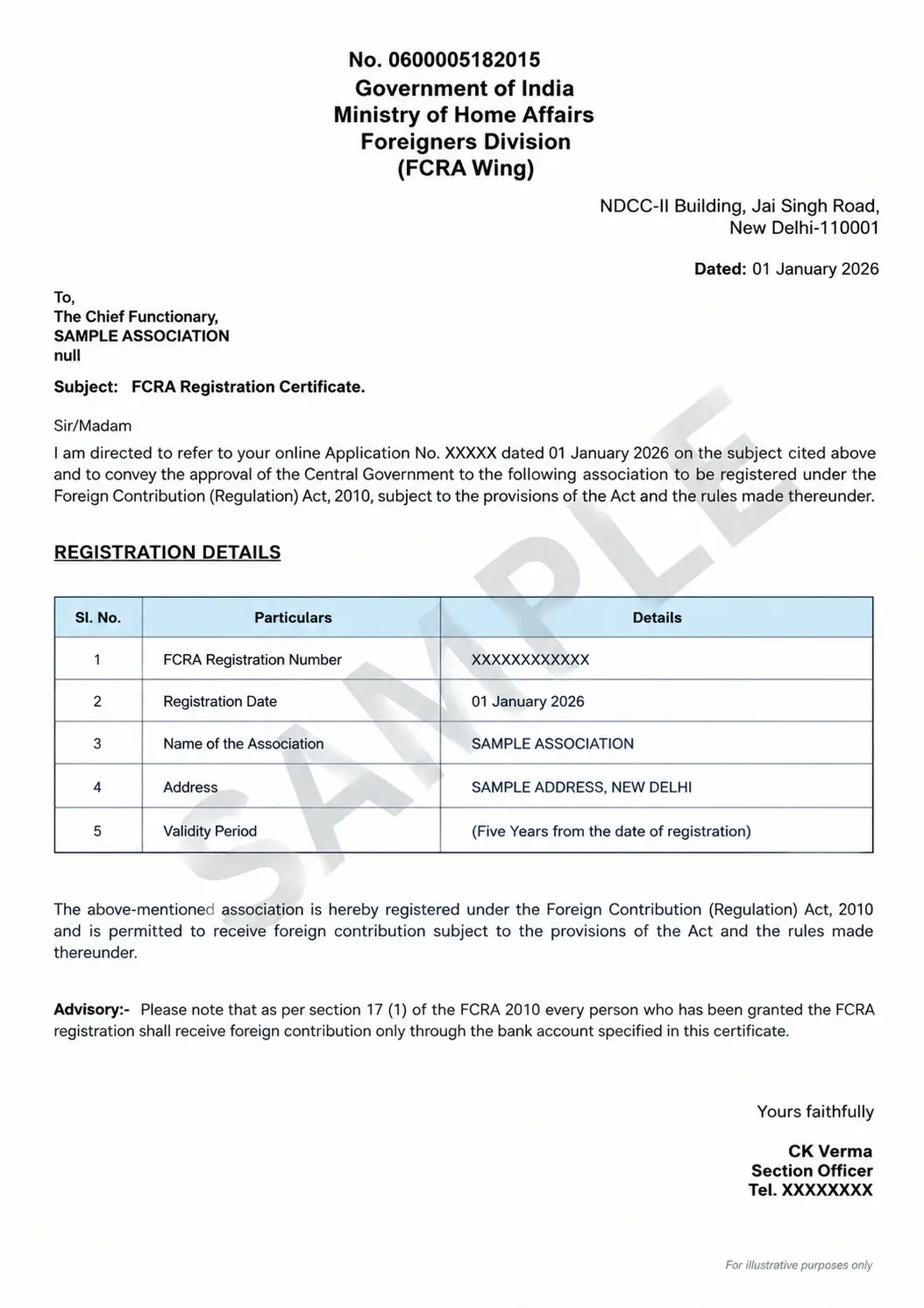
The FCRA certificate is issued by the MHA upon successful approval of your application. It legally authorizes your organization to receive foreign contributions and donations under the FCRA Act, 2010.
It contains your unique FCRA registration number, validity period, and details of the approved bank account for fund receipt. This certificate is mandatory for all NGOs, societies, and trusts receiving international donations.
How to Download the FCRA Registration Certificate?
Once your FCRA registration is approved, you can download your FCRA registration certificate directly from the FCRA online portal:
- Log in to your organization's account on the FCRA website.
- Look for the "View/Print Certificate" or a similar option under the relevant application status.
- You can then download the digital copy of your registration certificate in PDF format. This serves as your official proof of FCRA registration validity.
How to Check the Status of the FCRA Registration Certificate?
You can easily check the FCRA registration status of your application online:
- Visit the official FCRA website.
- Navigate to the "Status of Application" section.
- Enter your File Number (the 9-digit number generated upon submission of your application) or other relevant details.
- The portal will display your FCRA registration application status, indicating whether it's pending, approved, or has queries.
To verify another organisation's FCRA status, you can also search its FCRA registration number or name using the public search facility on the FCRA portal.
What are the FCRA Compliance Requirements?
FCRA-registered associations must maintain records and file annual returns to continue complying with the Act and Rules.
- File Form FC-4 Annual Return: Submit the annual return online for each financial year, along with the required financial statements and supporting documents. Form FC-4 captures foreign contributions received and utilized, unutilized balances, bank accounts, and other compliance information.
- Maintain Separate FCRA Accounts: Keep foreign contribution records and accounts separate from domestic funds and use the designated FCRA account for receiving foreign contributions.
- Follow the 20% Administrative Expense Limit: Administrative expenses generally cannot exceed 20% of the foreign contribution received. The 2024 amendment also permits eligible unspent administrative expenses to be carried forward to the immediately succeeding financial year, subject to the prescribed conditions and FC-4 disclosure.
- Use Funds for Approved Purposes: Use foreign contributions only for the purposes permitted under the registration or Prior Permission and maintain the required accounts, assets, and records.
- Report Changes and Maintain Records: Report applicable changes in the organization's details, office bearers, key functionaries, and bank accounts through the prescribed FCRA forms and maintain the supporting records. Non-filing of annual returns and other FCRA violations can affect renewal and compliance status.
Connect with RegisterKaro and let our experts handle the legal hassle while you grow your business.
Frequently Asked Questions (FAQs)
What is FCRA registration?
FCRA registration is approval from the Ministry of Home Affairs (MHA) that allows eligible associations to receive foreign contributions. The Foreign Contribution (Regulation) Act, 2010 regulates how organizations receive, use, account for, and report foreign funds. Organizations must follow the applicable FCRA conditions after receiving approval.
Who needs FCRA registration in India?
An association generally needs FCRA registration or prior permission before receiving foreign contributions in India. Eligible entities can include trusts, societies, and Section 8 companies that meet the applicable requirements. The organization must also have a permitted objective and comply with restrictions under the FCRA before accepting foreign funds.
What are the types of FCRA approval?
FCRA provides two main routes for receiving foreign contributions: registration and prior permission. Registration applies to eligible associations that satisfy the prescribed conditions for regular registration. Prior permission allows an eligible organization to receive a specified contribution from a specified donor for a specified project or purpose.
What is the difference between FCRA registration and prior permission?
FCRA registration provides continuing approval for eligible foreign contributions, subject to the Act and certificate conditions. Prior permission applies to a specific foreign contribution from a specific donor for a specific purpose or project. New organizations commonly use prior permission when they do not yet meet the requirements for regular registration.
What is the FCRA registration fee?
The government fee for fresh FCRA registration is ₹10,000, while prior permission costs ₹5,000. Renewal of FCRA registration also costs ₹5,000. Applicants pay these fees electronically through the FCRA portal when submitting the relevant application. The Ministry of Home Affairs confirms these prescribed fees in its official FAQ.
How long is FCRA registration valid?
FCRA registration generally remains valid for five years from the date of grant. The organization must apply for renewal within the prescribed period before the certificate expires. If the organization does not renew its registration, it cannot continue receiving or utilizing foreign contributions until its registration becomes valid again.
Which form is used for FCRA registration?
Applicants use Form FC-3A to apply for FCRA registration and Form FC-3B for prior permission. Registered organizations use Form FC-3C for renewal. Applicants must submit these forms online through the FCRA portal along with the documents and declarations required under the applicable rules.
Is an NGO Darpan ID required for FCRA registration?
Yes, applicants need an NGO Darpan ID for FCRA services. The Ministry of Home Affairs requires applicants to provide the Darpan ID when applying through the FCRA portal. Organizations should obtain the ID from the NITI Aayog Darpan portal before completing the applicable FCRA application.
Is an FCRA bank account mandatory?
Yes, an organization receiving foreign contributions must use the designated FCRA account with the SBI branch specified by the government for receiving those funds. The organization can maintain separate utilization accounts with permitted banks. It must ensure that foreign contributions enter the designated FCRA account before utilization.
Can an organization receive foreign donations without FCRA registration?
An organization cannot receive foreign contributions without valid FCRA registration or prior permission, unless a specific statutory exemption applies. The FCRA framework requires eligible recipients to obtain the applicable approval before accepting foreign contributions. Receiving funds without the required approval can result in regulatory action and penalties under the Act.
Can an NGO receive foreign donations from an NRI?
Yes, an Indian citizen living abroad can generally donate from personal savings without the donation being treated as a foreign contribution under FCRA. However, a donation from an Indian-origin person who has acquired foreign citizenship generally qualifies as a foreign contribution. Organizations should verify the donor's citizenship before classifying the receipt.
What happens if an FCRA registration expires?
If an FCRA registration expires without a valid renewal, the organization cannot receive or utilize foreign contributions. The organization may need to obtain renewal or apply for fresh registration, depending on the circumstances. Organizations should submit the renewal application within the prescribed period to avoid interruption in their FCRA compliance.

Reviewed by
Joel DsouzaJoel Dsouza is a Chartered Accountant (CA) and compliance expert with over 7 years of hands-on experience in company registration, tax structuring, GST, ROC filings, and MCA compliance. As a qualified member of the Institute of Chartered Accountants of India (ICAI) and Co-Founder at RegisterKaro, he has personally advised more than 1,000 startups and SMEs across India, helping founders navigate incorporation, regulatory frameworks, and financial planning from Day 1. With deep expertise across all three levels of Finance and Portfolio Management, Joel is committed to promoting financial literacy and simplifying India's startup ecosystem through clear, actionable guidance that entrepreneurs can act on immediately.
Why Choose RegisterKaro for FCRA Registration?
RegisterKaro provides structured assistance for FCRA registration, Prior Permission, documentation, and related compliance requirements.
- Assistance With FCRA Application: Get support with Form FC-3A, FC-3B, and other applicable FCRA forms.
- Document Preparation Support: Organize the registration documents, financial records, activity reports, declarations, and other required information.
- Support with Current FCRA Requirements: Get assistance based on the applicable FCRA rules, forms, bank account requirements, and portal procedures.
- Online Application Assistance: Complete the FCRA application and document submission through the official online process followed by the Ministry of Home Affairs.
- Application Status and Query Support: Monitor the application and assist with responding to clarifications or additional information requested through the FCRA portal.

What Our Clients Say
View All
Anandraj Jadhav
 Verified
I had a great experience with the team for the compliance process. The entire procedure was handled in a very professional, hassle-free, and timely ma... Read more

Taxmation Services
VerifiedIt was a great journey with Register Karo and ARYAN SINGH . They are very professional and the main reason is that they helped us to Incorporate our n... Read more

jaya agnihotri
Verified“Register Karo provided a seamless and efficient service. A big shoutout to Kanishk Singh Kakan for his prompt assistance and continuous support throu... Read more

Raghubir Singh
VerifiedRegisterKaro has been managing our company registration and compliance for the last two years very efficiently. Since Neha Kumari started handling our... Read more

Allanswer Private Li...
VerifiedI felt good about joining the Register Company. My private limited company was registered on time, and I really liked the staff's efficient behavior a... Read more

Vineet Panghal
VerifiedHad a great experience with Register Karo. Their team was professional, responsive, and guided me through the entire company incorporation process smo... Read more

Mahesh Ramani
VerifiedIts a nice company with good staff. My experience was positive with Rashmi and Mitushi. Mitushi Jain was the assigned person and had a quick approach... Read more

Bikramjeet Singh
VerifiedGetting my company incorporated through Registerkaro was a breeze. They were very helpful especially Anish. He made every possible effort from his sid... Read more

Perfect Studio
VerifiedBest team/company for the compliance and firm registration related query. Timely work and updation on services specially Divya she is best. Must recom... Read more

Shubham Jayant
VerifiedI discovered the service through Instagram, and I am very happy with the experience. Kudos to Mr. Aakash, who went above and beyond to help us with al... Read more
Related Blogs
View All
OPC Tax Benefits in India 2026: Rates, Deductions & Savings
Trademark Classes in India: Complete List of All 45 Classes

Private Limited Company Corporate Tax Rate in 2026: Key Insights and Updates

Complete Overview of What is a Dormant Company
Declaration Of Dividend As Per Companies Act 2013

Board Meetings In Company Law: Section 173 Of Companies Act 2013

Company Annual Compliance Cost – GST, and ITR Charges for a Private Limited Company

Difference Between Winding Up and Dissolution of a Company

Difference Between Strike Off and Winding Up of a Company in India
Modes of Winding Up of a Company: IBC & Companies Act