

The transfer of trademark ownership in India is the legal process of moving a trademark’s rights from one owner to another. It is most commonly triggered by a business acquisition, merger, or restructuring. However, it also applies to smaller deals between individual entrepreneurs. When Tata Motors’ UK subsidiary acquired the Jaguar brand, for instance, it wasn’t just buying a name; it was formally taking ownership of an established trademark, complete with its registered rights and market recognition. This process is governed by the same Trade Marks Act, 1999, that applies to a two-person trademark sale.
Trademark registration protects a brand’s name, logo, or symbol. However, the new owner’s rights are fully protected only if the transfer is recorded with the Trademark Registry, regardless of what the sale agreement says.
Key Takeaways
- Transfer happens via assignment (full ownership) or licensing (usage rights only).
- Assignments without goodwill require advertisement directions within 6 months (extendable by 3 months).
- Common triggers: business sale, owner’s death, division, name change, restructuring, court order.
- File Form TM-P for registered marks, Form TM-M for pending ones.
- Fees: ₹9,000/₹10,000 per class (registered), or ₹900 (pending, via TM-M).
- Includes a Trademark Journal publication step before finalization.
- Only the owner, joint owners, an authorized rep, or a company signatory can transfer a mark.
- Takes 3 to 12 months, depending on the Registry workload.
Common Triggers for Trademark Ownership Transfer
Several real-world situations require a trademark owner to transfer their rights to another party:
- Death of the Trademark Owner: When an individual trademark owner passes away, ownership must transfer to an heir or legal representative as part of the estate settlement.
- Sale of Business: Selling a business typically requires transferring all associated intellectual property, including trademarks, to ensure brand continuity under the new owner.
- Sale of Trademark: A business may sell a specific trademark separately from its other assets, transferring ownership while retaining the rest of its operations.
- Division of Business: When a business splits into separate entities, trademarks may need to be distributed among the new divisions based on their respective operations.
- Change of Owner’s Name: If an individual owner changes their name, or a company undergoes a name change, the trademark registration needs updating to reflect the new identity.
- Change in Business Structure: Converting from one structure to another, such as a sole proprietorship becoming a private limited company, requires transferring the trademark to the newly formed legal entity.
- Compliance with a Court Order: Legal disputes over trademark ownership can result in a court-ordered transfer as part of a judgment or settlement.
- Purchase of an Existing Business with Goodwill: Acquiring a business typically includes acquiring its trademarks and the associated brand goodwill and customer loyalty.
Trademark Assignment Agreement: Key Clauses and Sample Format
A trademark transfer agreement is the legal document that actually executes the transfer; it’s what gets referenced when filing Form TM-P with the Registry. At a minimum, it should include:
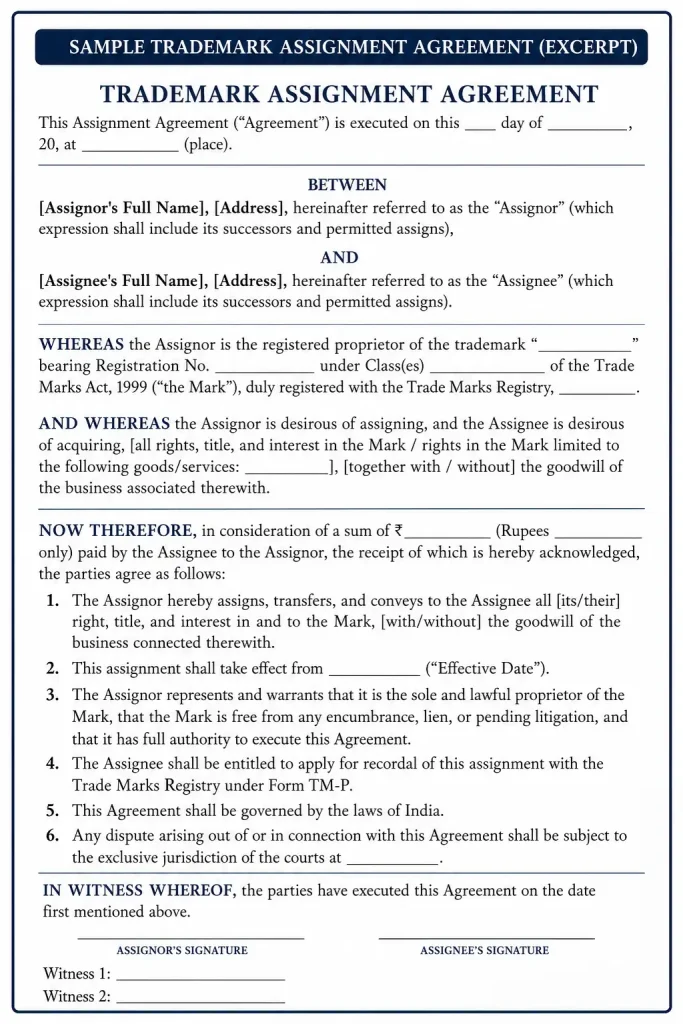
- Parties involved: Full legal names and addresses of the assignor and assignee.
- Trademark details: Registration number, class, and a clear representation of the mark being transferred.
- Type of assignment: Whether it’s with or without goodwill, and whether it covers all goods/services or only specific ones (segmental transfer).
- Consideration: The amount or value being exchanged, which can be nil in the case of a gift or internal restructuring.
- Effective date: When the transfer takes legal effect between the parties.
- Warranties: A statement confirming the assignor is the true owner, with no pending disputes or third-party claims against the mark.
- Signatures: Signed and witnessed by both parties, executed on the correct non-judicial stamp paper for your state.
Transfer Guidelines for Brand Name Authorization
In India, you can transfer trademark ownership legally under the Trade Marks Act, 1999. These legal transfer guidelines for brand name authorization cover the main routes available:
1. Assignment of Trademark: Assignment is the process of transferring the entire ownership of the trademark to another person. The transferee receives all rights to use, license, sell, and protect the trademark.
2. Assignment with Goodwill: When the owner assigns a trademark with goodwill, the purchaser receives the trademark. The transfer also includes the business reputation, subject to any conditions set by the purchaser. Buyers receive the trademark and the goodwill attached to it.
3. Assignment without Goodwill: Only the mark itself transfers, not the business reputation behind it, meaning the assignee can use the mark for goods or services unrelated to the assignor’s original business.
4. Segmental Transfer: Ownership can also be transferred for only some of the goods or services a trademark is registered under, rather than the entire registration. This results in both the original owner and the new owner holding rights over different, defined portions of the same trademark.
5. Transmission: Ownership can also transfer without a negotiated agreement through inheritance, insolvency, or other operation of law. For example, a trademark may pass to an heir after the owner’s death.
6. Licensing of Trademark: Licensing allows a licensed party to use the trademark without any transfer of ownership rights. The owner retains all the legal rights to the trademark, while the licensee can use the trademark within the conditions agreed upon.
- Exclusive License: A license for a single company/individual to use the trademark. It is used to keep the brand in the owner’s hands.
- Non-Exclusive License: Granting more than one company/individual to use the trademark. The owner keeps all the legal rights.
7. Recording with the Trademark Registry: Legally transferring the ownership of the trademark requires the owner to register the transfer with the Trademark Registry. This safeguards the rights of the new owner. The owner must register the transfer; otherwise, others can keep using the trademark without permission.
8. Filing Deadlines Under the Law: Section 45(1) sets no fixed deadline for straightforward assignments. However, assignments without goodwill must apply for advertisement directions within 6 months under Section 42, with a possible 3-month extension at the Registrar’s discretion.
Who Can Transfer a Trademark in India?
In India, not everyone can transfer the ownership of the trademark. Only the legal owner or an authorized person can do it legally. Under Sections 37 to 45 of the Trade Marks Act, 1999, only the following parties have the right to transfer the trademark:
1. Sole Owner: A sole owner can assign or license their trademark to another person or business. The agreement must clearly state whether the goodwill is included. The owner must sign the assignment document for the transfer to be valid.
2. Joint Owners: All joint owners must agree to the transfer. If one owner does not consent, the transfer cannot happen. Agreements may allow one owner to act on behalf of others.
3. Authorized Representative(s): The owner can appoint a representative with a Power of Attorney or written authorization. The representative must follow the owner’s instructions and cannot act independently.
4. Companies/Corporations: The company owns the trademark, not its employees or directors. The company grants authority through a board resolution or shareholder decision, and the authorized signatory (usually a director or secretary) signs the transfer documents.
After signing, the transfer must be recorded with the Trademark Registry using Form TM-P. The Registry updates its records, and the new owner’s rights are fully protected only after this update.
Pre‑Transfer Requirements for Trademark Transfer in India
Before you transfer trademark ownership, complete these checks:
- Check Trademark Registration Status: The owner can transfer both registered and pending trademarks; registered marks use Form TM-P, while pending applications use Form TM-M. An expired trademark cannot be transferred until it’s renewed or restored. The owner can check the trademark’s status on the Indian Trademark Registry website.
- Verify Ownership: You must make sure that the person transferring the trademark is the true owner. Check for co-owners of the trademark, any disputes over the trademark, or claims against the trademark before going forward with the transfer.
- Draft an Assignment or Licensing Agreement: Prepare a legal agreement for the transfer. If the trademark is being assigned, mention whether it includes goodwill. For licensing, clearly define the rights, scope, and duration. Include any payment or other conditions. These tiny steps would protect both parties in the long term.
- Clear Any Disputes or Legal Claims: Make sure the trademark is free from litigation, liens, or other legal claims. Any ongoing dispute can block the transfer process.
How to Complete the Trademark Transfer Process in India?
Transferring a trademark is an important step when selling, licensing, or reorganizing your business. Doing it correctly ensures the new owner can legally use and protect the trademark.
Here is the step-by-step process to complete a trademark transfer smoothly in India:
Step 1: Prepare the Transfer Agreement
- Decide if this transfer is an “assignment” (the transferee receives full ownership).
- Decide if this is a mere license (the transferee has permission to act).
- Specify whether goodwill is part of the transfer or not in your Transfer Agreement.
- State what rights are being transferred and any consideration that is being paid among the parties.
- Provide signature lines for both parties.
Keep a copy of your Transfer Agreement.
Step 2: Gather Required Documents
- A Trademark registration certificate as proof of ownership.
- Assignment or licensing agreement (signed by both parties).
- Power of Attorney, if someone is acting on behalf of the owner.
- Board resolution, if the trademark belongs to a company.
Check that all documents are complete and correct to avoid delays.
Step 3: File the Transfer with the Trademark Registry
- File the application online via the IP India Trademark Portal or offline.
- Use Form TM-P to record the assignment of a registered trademark, or Form TM-M if the underlying application is still pending.
- Attach all required documents and signatures.
Ensure the application details match the documents exactly.
Step 4: Pay the Government Fees
Government fees for trademark ownership transfer depend on whether the mark is registered or pending. Trademark ownership transfer fees are ₹9,000 per class online (₹10,000 physical) via Form TM-P for registered marks, or ₹900 via Form TM-M for pending applications.
Keep the payment receipt as proof.
Step 5: Examination by the Registry
- The Trademark Registry reviews your application and documents.
- If there are trademark objections or missing information, the Registry may request clarification.
Respond quickly to avoid delays in approval.
Step 6: Publication (Only for Assignments Without Goodwill)
- Assignments without goodwill trigger Section 42; the Registrar directs how and when the assignment must be advertised, within 6 months (extendable by 3 more).
- Assignments with goodwill skip this step entirely and proceed straight to recording.
- If an advertisement is required and no objections arise within the Registrar’s specified period, the application moves to final recording.
Step 7: Recording the Transfer
- Once the Registry approves, it officially records the transfer.
- The new owner’s name is updated in the Registry.
This new owner now holds full legal rights to the trademark.
Step 8: Confirmation and Certificate
- The Registry issues a confirmation notice for the transfer.
- The new owner can request an updated trademark certificate if needed.
- Keep this confirmation as proof of ownership.
The trademark transfer usually takes 3 to 12 months, depending on the Registry workload and clarifications.
Note: Always ensure all co-owners’ consents and documents are complete before filing. Missing approvals or incorrect documents can delay or even reject the transfer.
Common Challenges During Trademark Transfer and How to Avoid Them
Errors in documents, missing approvals, or legal issues often cause problems during a trademark transfer. Below are the most common challenges faced and ways to avoid them:
1. Lack of Consent from All Co-Owners: If owners co-own a trademark, disagreements over the terms or transfer can stall or prevent the transfer.
How to avoid it: Get written consent from all co-owners before transfer.
2. Existing Disputes or Legal Issues: Pending litigation, claims, or disputes on a trademark can prevent transfer.
How to avoid it: Make sure the trademark is free from legal issues. Resolve any disputes before filing.
3. Incomplete or Incorrect Documentation: Missing signatures, wrong details, or incomplete agreements may result in rejection by the Trademark Registry.
How to avoid it: Prepare a correct assignment or licensing agreement and include all supporting documents like registration certificates, Power of Attorney, and board resolutions if applicable.
4. Goodwill Confusion: Not specifying whether the transfer includes goodwill can create disagreements over value.
How to avoid it: Clearly state in the agreement whether goodwill is included and define the rights being transferred.
5. Delays at the Trademark Registry: The Trademark Registry may take time to examine and approve applications.
How to avoid it: Respond quickly to any queries from the Registry and track the application online.
6. Tax Implications: A trademark assignment attracts 18% GST on the consideration, and capital gains tax on the assignor’s proceeds. Following the Finance Act 2024, long-term capital gains on most assets, including intangible assets like trademarks, are taxed at 12.5% without indexation for transfers on or after 23 July 2024. Stamp duty also varies by state, ranging from ₹100 to ₹500 in some states to up to 5% of the consideration in others.
How to avoid it: Factor in GST and the applicable capital gains tax before agreeing on consideration, and confirm both the current rate and your state’s stamp duty before executing the deed.
Trademark Assignment vs Trademark Licensing
Below is a clear comparison between trademark assignment and licensing:
| Feature | Trademark Assignment | Trademark Licensing |
| Ownership | Full ownership of the trademark is transferred to the new owner. | Ownership remains with the original owner; the licensee only gets permission to use it. |
| Goodwill | Can be transferred along with the trademark if mentioned in the agreement. | Goodwill is not transferred; the licensee does not own the brand reputation. |
| Legal Rights | The new owner gains all legal rights to use, sell, and protect the trademark. | The owner retains full legal rights; the licensee must follow the agreed terms. |
| Exclusive/Non-Exclusive Use | Not applicable – ownership is complete. | Can be exclusive (one licensee) or non-exclusive (multiple licensees). |
| Registry Recording | Must be recorded with the Trademark Registry to be legally valid. | Must be recorded with the Trademark Registry to make the license official. |
| Revenue | Consideration is usually a one-time payment. | Consideration can be a fixed fee, royalty, or ongoing payments. |
Note: Always clearly define the terms in the agreement and record the transfer or license with the Trademark Registry. This ensures legal protection and avoids future disputes.
