

Form 1 for Partnership Firm: Purpose, Process, and Fees

Form 1 is the primary application required to legally register a firm in India under the Indian Partnership Act, 1932. A partnership firm is a type of business structure where two or more individuals come together to run a business, share profits, and bear losses jointly.
Filing Form 1 gives the firm legal recognition and enables it to:
- Enter into contracts
- Open bank accounts
- Protect the rights of partners
While registration of a partnership firm is voluntary, submitting Form 1 gives legal recognition. It also ensures that partners can enforce their rights in courts and maintain a formal business identity.
For businesses seeking a convenient method, Partnership Firm Registration provides a seamless way to submit Form 1. You can track the application and receive official certification without visiting government offices.
Legal Basis & Government Issuance of Form 1 For Firms
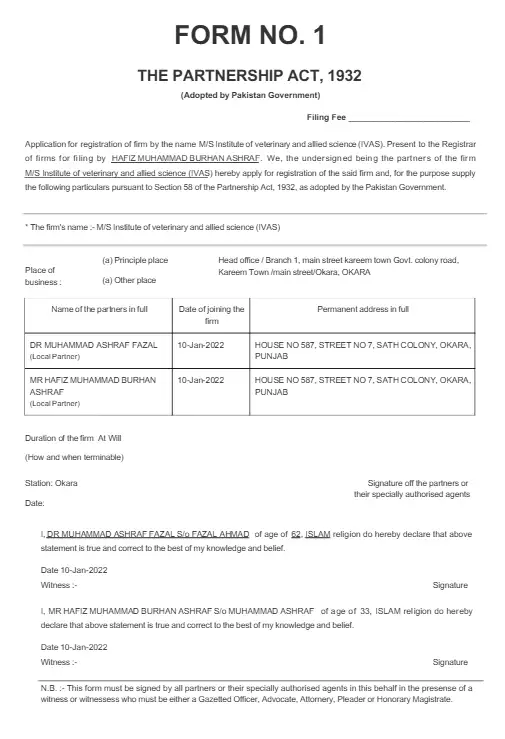
The government issues Form No. 1 under the Indian Partnership Act, 1932. This Act defines the nature of a partnership and the rights, duties, and obligations of partners. Registration under Section 58 allows firms to obtain legal recognition and enjoy the legal benefits of Partnership Firm Registration.
In addition to the central Act, each state follows its own Partnership (Registration of Firms) Rules. These rules regulate the format of Form 1, the filing procedure, the verification process, and the issuance of the registration certificate. Other applicable laws also influence partnership firm registration and operations, including:
- Income Tax Act, 1961: Treats a partnership firm as a separate taxable entity and requires it to file Income Tax Returns online.
- Goods and Services Tax (GST) Laws: File for GST registration online once your business crosses the turnover threshold specified under the GST Act.
- Indian Contract Act, 1872: Governs the validity and enforceability of the partnership deed and partner obligations.
The Registrar of Firms in each state examines the applications. The Registrar also ensures compliance with both central and state rules.
Eligibility Criteria for Filing Form 1 for Firm Registration
Not everyone can register a partnership firm in India. Certain eligibility criteria as per the Indian Partnership Act, 1932, must be met to file Form 1 successfully:
- A partnership firm must have at least two and no more than 50 partners.
- All partners must be adults (18 years or older) and legally competent to enter into contracts.
- Every partner must agree to form the partnership, and all partners’ signatures are required on Form 1.
- The business activity of the firm must be lawful under Indian law. Illegal businesses cannot be registered.
- The firm must have a principal place of business with a valid address. If the office is rented, a No Objection Certificate (NOC) from the property owner is mandatory.
- There is no mandatory requirement that one partner must be an Indian resident under the Partnership Act. However, foreign partners must comply with FEMA and RBI norms.
Always check the state-specific rules before filing the Form. Some states may require extra documents or follow slightly different procedures that could affect approval.
Where to Submit Form 1? State vs Central Portals
Form No. 1 for firm registration is submitted to the Registrar of Firms in the state of the partnership’s principal place of business, such as Bhubaneswar in Odisha. Depending on the state and convenience, it can only be filed via state portals. Unlike companies/LLPs, there’s no central/MCA portal for it.
Entrepreneurs in India submit Form 1 to their state Registrar of Firms where the firm’s principal place of business is located. These state portals allow entrepreneurs to:
- Submit Applications Online: The application for registration of firms Form 1 can be filled out and submitted directly through the official portal, eliminating the need for physical visits.
- Upload Required Documents: Partners can upload the partnership deed, identity proofs, address proofs, and other necessary documents online.
- Track Application Status: Most state portals provide real-time updates on the status of Form 1, helping applicants stay informed throughout the process.
Examples of state portals:
- Maharashtra – Maharashtra e-Registration Portal (maharashtra.gov.in)
- Karnataka – KAVERI Portal (kaverionline.karnataka.gov.in)
Note: Final registration is always issued by the state Registrar of Firms. Avoid non-official submission channels to prevent delays.
Documents Required for Filing Form 1
To successfully submit Form 1 for firm registration, the following documents must be prepared and attached:
- Partnership Deed: All partners must draft a partnership deed clearly defining roles, duties, profit-sharing ratios, and management rights.
- PAN Card of the Firm: Mandatory for income tax compliance and opening a current bank account in the firm’s name.
- Identity Proof of Partners (Self-Attested): Copies of Aadhaar card, PAN card, Passport, Voter ID, or Driving License.
- Address Proof of Partners (Self-Attested): Copies of Aadhaar card, Passport, recent utility bill, or bank statement.
- Registered Office Address Proof:
- If rented: Rent agreement, electricity or water bill, and No Objection Certificate (NOC) from the property owner.
- If owned: Sale deed, property tax receipt, or utility bill of the premises.
- If rented: Rent agreement, electricity or water bill, and No Objection Certificate (NOC) from the property owner.
- Photographs of Partners (if required): Recent passport-size photographs of all partners.
- Form No. 1 (Application for Registration): Contains the firm and partner details as required under the Indian Partnership Act, 1932.
- Affidavit or Declaration (if required): Confirms the accuracy and authenticity of the submitted information.
How to File Form 1 in India? Step-by-Step Guide
By following this step-by-step guide, you can ensure your Form 1 is accurate, complete, and processed quickly:
1. Choose a Name for the Firm
Select a unique and meaningful name for your partnership firm.
- Avoid names identical or similar to existing firms.
- Do not use prohibited or restricted words.
Check availability on your state Registrar of Firms portal and keep 2–3 alternative names ready.
2. Fill Form 1 Accurately
Download Form 1 from your state Registrar portal.
- Enter the firm name, principal place of business, partners’ names, and addresses.
- Specify the date of joining for each partner and the firm’s duration.
- Have all partners or authorized representatives sign the form.
3. Attach Required Documents
- Partnership Deed signed by all partners (with proper stamp duty as per state rules).
- PAN card of the firm.
- Identity and address proofs of all partners (Aadhaar, PAN, passport, or voter ID).
- Registered office proof (rent agreement, NOC from property owner, utility bill, or property deed).
- Any state-specific affidavits or declarations, if required.
4. Submit Form 1 to the Registrar
- Submit Form 1 and supporting documents online via the state portal or physically at the Registrar’s office.
- Pay the registration fee as per state regulations (typically ₹200–1,000).
5. Verification and Issuance of Registration Certificate
- The Registrar reviews Form 1 and the attached documents carefully.
- Once approved, the Registrar issues the Partnership Registration Certificate with a unique firm number.
- This certificate serves as legal proof of registration under the Indian Partnership Act, 1932.
Timeline: Processing of Form 1 for partnership firm registration usually takes 10–15 working days.
Fees and Penalties for Filing Form 1
The total cost of registering a partnership firm through Form 1 depends on government fees, professional charges, and optional services.
It also varies slightly by state, business type, and capital contribution. Below is a detailed breakdown:
| Fee Category | Item | Cost / Range (₹) | Notes |
| Government Fees | Partnership deed stamp duty | 200 – 2,000 | Varies by state rules and capital contribution |
| Registration fee | 200 – 1,000 | State-specific regulations | |
| Name search & reservation | 100 – 500 | Optional in some states, mandatory in others | |
| Professional Fees | Drafting a partnership deed | 3,000 – 8,000 | If using a CA, lawyer, or consultant |
| Legal consultation | 2,000 – 5,000 | Optional, recommended for complex firms | |
| Registration assistance | 5,000 – 15,000 | Optional service for online/offline filing | |
| Post-Registration | PAN card application | 110 (online) / 225 (physical) | Required for tax compliance and a bank account |
| TAN Registration | Free (online) | Required if deducting TDS | |
| Bank account opening | Varies by bank | Mandatory for firm transactions | |
| GST registration (if applicable) | Free + professional charges | Optional, depending on business turnover |
Tip: Including professional fees may increase convenience and reduce errors, but they are optional.
Penalties for Non-Compliance
Non-compliance with statutory requirements can lead to legal issues or fines. The real consequence of non-registration is the Section 69 disability, i.e. a loss of the right to sue instead of a monetary penalty.
Renewal & Changes in Form 1 for Partnership Firm Registration
Partnership firm registration is valid indefinitely under the Indian Partnership Act, 1932, and does not require renewal.
Any changes in the firm’s details, such as name, principal place of business, partners, or branch offices, must be reported to the Registrar. A nominal fee (₹100 per change) is applicable, and submission of an amended Form 1 and updated partnership deed is required.
How to Download Form 1 for Firm?
Once processed, you can download Form 1 as proof of registration for your partnership firm:
Steps to Download Form 1 for Firm Registration:
- Visit the State Registrar Portal: Go to the official state Registrar of Firms website, where Form 1 records and related documents are maintained.
- Select Form 1 Download Option: Look for options such as “Form 1 Download”, “Certified Copy (CC)”, or “Registered Firm Inquiry”, depending on your state portal.
- Enter Firm Details: Provide your firm registration number, firm name, or partner details exactly as submitted in Form 1.
- Verify Information: Ensure all entered details match the official records to avoid download errors.
- Download Form 1: Download the PDF copy of your Form 1 and store it safely for future use in banking, legal compliance, or administrative requirements.
Note: If Form 1 has not yet been submitted or processed, you must complete the application before attempting to download it.
Common Reasons for Rejection of Form 1
While filing Form 1 for partnership firm registration, errors or inconsistencies can lead to rejection by the Registrar of Firms.
1. Mismatch between the partnership deed and Form 1: If the details in Form 1 do not exactly match the partnership deed, such as firm name, partner names, or capital contribution, the application may be rejected. Always cross-check all information before submission.
2. Incomplete partner signatures: Form 1 requires the signatures of all partners. Missing signatures or unsigned sections can cause delays or outright rejection. Ensure every partner signs the form as required.
3. Incorrect business address proof: Providing invalid or mismatched address proof for the principal place of business can result in the application being returned. Use accurate documents such as utility bills, rent agreements, or property deeds.
4. Use of restricted or prohibited words in the firm name: Firm names containing restricted words or resembling government authorities may be disallowed. Choose a unique and compliant name to avoid rejection.
By carefully addressing these points, you can minimize errors and ensure a smoother registration process.
Form 1 vs Partnership Deed: Key Differences
Many people often confuse Form 1 with the partnership deed. While both are required for legal recognition, they serve different purposes and play distinct roles in a partnership setup.
| Aspect | Form 1 | Partnership Deed |
| Purpose | Serves as the official application to register a partnership firm with the Registrar of Firms. | Serves as a legal agreement between partners defining their roles, rights, and obligations. |
| Legal Requirement | Mandatory for registering the firm and obtaining legal recognition. | Mandatory for internal clarity among partners; required for smooth registration of Form 1. |
| Contents | Includes firm name, principal place of business, partners’ names and addresses, date of joining, and duration. | Includes profit-sharing ratio, capital contribution, duties of partners, dispute resolution, admission/retirement rules, and other internal agreements. |
| Issued By | Registrar of Firms (State Government). | Prepared and signed by all partners; notarization recommended. |
| Function | Acts as the official record with the government, enabling legal enforcement, banking, and compliance. | Acts as the internal governing document of the partnership, protecting partner rights and responsibilities. |
| Changes | Changes require resubmission or amendment of Form 1 with the Registrar. | Can be amended internally as per agreement, but major changes should be reflected in Form 1 for legal compliance. |
| Validity | Valid after approval by the Registrar; serves as proof of registration. | Valid as long as the partnership exists; enforceable among partners and referenced in legal matters. |
While the partnership deed governs internal operations, Form 1 is the legal record with the government.
