Sole Proprietorship Registration Online in India
Register your sole proprietorship online in India within 7–15 days. Our expert CAs handle GST, Shop Act, Udyam & current account setup smoothly; end-to-end, with transparent fees and zero paperwork.
 Business License & FSSAI HelpGST & PAN Registration AssistanceCurrent Account Opening & Udyam/MSME registrationSuitable for Local & Online BusinessesCompliance Support After Registration

 What Sets Us ApartWhat Sets Us Apart
Watch: How Sole Proprietorship Registration Works with RegisterKaro
Starting a sole proprietorship firm? This quick video walks you through the registration process, required documents, legal steps, and expert tips; perfect for freelancers, shop owners, service providers, and new proprietorship firm registration applicants.
Need help?

What is Sole Proprietorship Registration?
Sole proprietorship registration is the process of formally establishing a business owned, managed, and operated by a single individual under Indian law. It is the simplest form of company registration in India, where the owner has complete control over operations, profits, and decision-making, and is also personally liable for all business debts.
In practice, a proprietorship registration online refers to obtaining the set of licenses needed to legally run a single-owner business, typically GST, Shop & Establishment, Udyam (MSME), and a current bank account; because India has no separate 'proprietorship certificate' issued by any central authority. The combination of these registrations is what validates a sole proprietorship registration in India to banks, vendors, and marketplaces.
Objectives of Sole Proprietorship Firm Registration
The primary objective of sole proprietorship firm registration is to establish a legally compliant business structure that lets individual entrepreneurs operate with proper documentation and regulatory cover.
- Legal Business Identity: Set up a recognised one-person business identity; though the business is not legally separate from the owner.
- Regulatory Compliance: Get the licenses required for your trade and avoid penalties for unregistered operations.
- Banking Relationships: Enable opening a current business bank account and build proper financial infrastructure for transactions.
- Tax Compliance: File taxes on time and comply with Income Tax and GST regulations.
- Business Credibility: Build trust with customers, suppliers, and platform partners (Amazon, Flipkart, Zomato, Swiggy).
- License Eligibility: Qualify for trade licenses, FSSAI, pollution clearance, and sector-specific permits.
- Financial Access: Qualify for business loans, MSME credit facilities, and overdrafts from banks and NBFCs.
- Contractual Capacity: Enter enforceable contracts with clients and suppliers using your registered business name.
Laws and Legal Acts Governing Sole Proprietorship Registration
Sole Proprietorship company registration in India is not governed by a single statute. Instead, multiple Acts collectively define the framework for single-owner business operations:
- Income Tax Act, 1961
Governs income tax obligations for sole proprietors.
-
- Covers taxation on business profits and ITR filing
- Details procedures for PAN registration, advance tax, and TDS compliance.
- Goods and Services Tax (GST) Act, 2017
Mandates GST compliance for businesses exceeding specified turnover thresholds.
-
- GST registration is mandatory for service turnover above ₹20 lakh (₹10 lakh for special-category states) and for goods turnover above ₹40 lakh in most states.
- Requires monthly/quarterly and annual returns, plus timely tax payments.
- Shop and Establishment Acts (State-wise) Regulates the operation of commercial establishments.
-
- You must register your business premises under your state's Shop & Establishment Act.
- Covers working hours, employee rights, holiday rules, and operational guidelines.
- Labor and Employment Laws
Apply when a proprietorship employs staff or workers.
-
- Includes ESI, EPF, and the Payment of Wages Act.
- Ensures employee welfare and statutory benefits.
- Professional Tax Laws (State-wise)
State-specific tax applicable to professionals and trades.
-
- Sole proprietors may be liable for professional tax
- Rates and exemptions vary across Maharashtra, Karnataka, West Bengal, Tamil Nadu, and other states.
- FSSAI Registration (for Food Businesses)
Mandatory for all food-related business operations.
-
- Ensures food safety and hygiene compliance.
- Applies to manufacturers, traders, and food outlets.
- Environmental Clearances
Required for businesses with environmental impact.
-
- Necessary for manufacturing or polluting activities.
- Involves pollution board approvals and assessments.
- Industry-Specific Regulations
Applies based on the nature of the business.
-
- Covers sectors like pharmaceuticals, textiles, and chemicals.
- May include licenses, safety norms, and quality standards.
Why Choose Sole Proprietorship Registration in India?
Here's why sole proprietorship business registration is the right first step for most small businesses and solo founders:
- Easy to Start and Manage: The simplest business structure in India; basic IDs, GST (if applicable), and a local licence are usually enough. No MCA filing required.
- Complete Control and Decision-Making Power: The proprietor owns 100% of the business and can move fast without partner or board approval.
- Low Startup and Operational Costs: No mandatory incorporation fees; running costs stay low because compliance is minimal.
- Minimal Compliance and Regulatory Burden: No annual filings with the Registrar of Companies (ROC) and no statutory audit until turnover limits are breached.
- Simplified Taxation: Business income is taxed as personal income of the proprietor under individual slab rates — no separate corporate tax. Presumptive taxation under Section 44AD further simplifies this for turnover up to ₹3 crore.
- Quick Setup Process: You can go live within 7–15 working days, including GST, Shop Act, and Udyam registration.
Advantages and Disadvantages of a Sole Proprietorship
Consider the trade-offs of a proprietorship before choosing this structure:
| Advantages | Disadvantages |
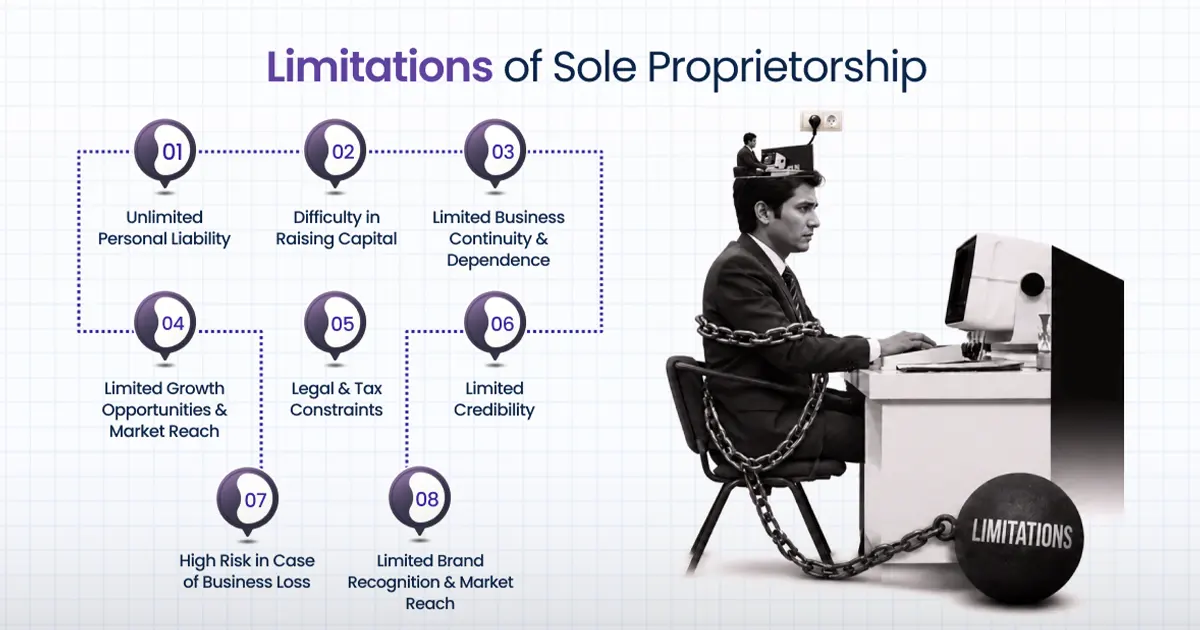
| Easy to start with minimal legal formalities | The owner is personally responsible for all business debts and liabilities |
| The single owner has full control over all decisions and operations | Difficult to raise large capital or attract investors |
| Registration and compliance costs are low | Business may not continue in case of the death or incapacity of the owner |
| No need to file annual returns with the ROC | Business growth is limited due to a lack of external funding sources |
| Income is taxed as personal income, which can lead to lower tax liability | May not be seen as credible by large clients or financial institutions |
| All profits belong solely to the proprietor | Selling or transferring the business is not easy |
| Decisions can be made quickly without waiting for approvals | Business and owner are not legally separate, so there is no limited liability |
| Suitable for small-scale businesses, local shops, or service providers | Access to government schemes or tenders may be limited for unregistered setups |
Types of Sole Proprietorship Registration in India with Examples
Sole proprietorships cover a wide range of businesses, typically grouped by the nature of activity and regulatory needs. Depending on your sector, the proprietorship registration process varies slightly.
1. Service-Based Sole Proprietorship
This covers businesses providing professional services, consultancy, or skill-based offerings to clients.
Example: A freelance graphic designer registers their sole proprietorship to offer design services to corporate clients and maintain proper business records.
2. Trading Business Sole Proprietorship
For businesses involved in buying and selling goods, whether retail or wholesale trading operations.
Example: An individual registers a sole proprietorship to operate a retail clothing store or an online marketplace business.
3. Manufacturing Sole Proprietorship
Covers small-scale manufacturing operations where an individual produces goods for sale in the market.
Example: A person starts a small food processing unit or handicraft manufacturing business under a sole proprietorship structure.
4. Online Business Sole Proprietorship
For digital businesses, e-commerce operations, or online service providers operating through digital platforms.
Example: An entrepreneur registers their sole proprietorship to operate an e-commerce website or provide digital marketing services online.
5. Professional Practice Sole Proprietorship
For licensed professionals providing specialized services requiring professional qualifications or certifications.
Example: A chartered accountant, lawyer, or doctor establishing their independent practice under a sole proprietorship structure.
6. Home-Based Business Sole Proprietorship
For businesses operated from residential premises, including small-scale operations and service providers.
Example: A person running a home-based catering service or tutoring centre registers as a sole proprietorship for legal compliance.
7. Freelance Business Sole Proprietorship
For independent contractors and freelancers providing specialized services to multiple clients on a project basis.
Example: A content writer or software developer registers their freelance business as a sole proprietorship for professional credibility.
Eligibility Criteria for Sole Proprietorship Registration
Before you begin the registration of sole proprietorship firm in india checklist, make sure you meet the following basic criteria under Indian laws:
- Individual Ownership Requirement: Only a person can establish and operate a sole proprietorship; corporate entities or groups cannot form this business structure.
- Age and Legal Capacity: The proprietor must be a major (18 years or above) with legal capacity to enter into contracts and conduct business.
- Indian Residency Status: While Indian citizenship is not mandatory, the proprietor should have legal residency status and necessary permissions to conduct business in India.
- PAN Card Requirement: A valid Permanent Account Number (PAN) is mandatory for tax compliance and business registration purposes. A proprietorship uses the owner's personal PAN as the business PAN.
- Aadhaar Card Documentation: Aadhaar card or equivalent identity proof is required for various registrations and compliance procedures.
- Business Address Proof: Valid address proof for the business location, whether owned, rented, or operated from residential premises.
- No Disqualification Status: The individual should not be disqualified under any law from conducting business or have been declared insolvent.
- Compliance Capability: Ability to understand and comply with applicable business laws, tax obligations, and regulatory requirements for the chosen business activity.
Documents Required for Sole Proprietorship Registration in India
Keep the following documents required for sole proprietorship registration ready before you start. The exact list depends on the licences you choose.
Identity and Address Documents
- PAN Card: Original and photocopy of the proprietor's Permanent Account Number.
- Aadhaar Card: Identity and address proof with current details.
- Passport: For identity verification and address proof (if applicable).
- Voter ID Card: Alternative identity proof acceptable for registration purposes.
Business Address Proof
- For owned premises: Property deed, tax receipts, or utility bills in the proprietor's name.
- For rented premises: Rent agreement along with the owner's NOC and property documents.
- For residential premises: Utility bills and residential address proof documents.
- Municipal permissions: Any required permissions for operating a business from the chosen location.
Business-Specific Registrations
- Shop and Establishment Certificate: Required for most business operations.
- GST Registration Certificate: Mandatory if turnover exceeds threshold limits.
- Trade License: From local municipal authorities for commercial operations.
- Professional Tax Certificate: State-specific registration for professional activities.
Bank Account Documentation
- Current Account Opening Forms: As required by the chosen bank.
- Initial Deposit: Minimum amount as specified by the bank's current account requirements.
- Business Registration Proofs: All obtained registrations and licenses for account opening.
- Passport-size Photographs: Recent photographs of the proprietor for bank records.
Industry-Specific Documents
- FSSAI License: For food-related businesses (Basic, State, or Central FSSAI license based on scale).
- Pollution Clearance: For manufacturing businesses that may impact the environment.
- Fire Safety Certificate: For businesses operating from commercial premises.
- Labor Department Registrations: If employing workers or staff members.
Financial and Tax Documents
- Income Tax Returns: Previous years' ITR if transitioning from employment to business.
- Bank Statements: Personal account statements showing financial stability.
- Investment Proofs: Documentation of initial business investment and capital.
- Audit Requirements: CA certification may be required during certain registrations, particularly for verifying financial documents or compliance details. Typically, a CA audit is conducted after registration, depending on the business’s turnover.
Additional Supporting Documents
- Business Plan: A Detailed plan outlining business activities and projections.
- Partnership NOC: If transitioning from a partnership firm or company structure to a sole proprietorship.
- Family Consent: In some states, spousal consent may be required for certain registrations.
- Educational Certificates: For professional service businesses requiring specific qualifications.
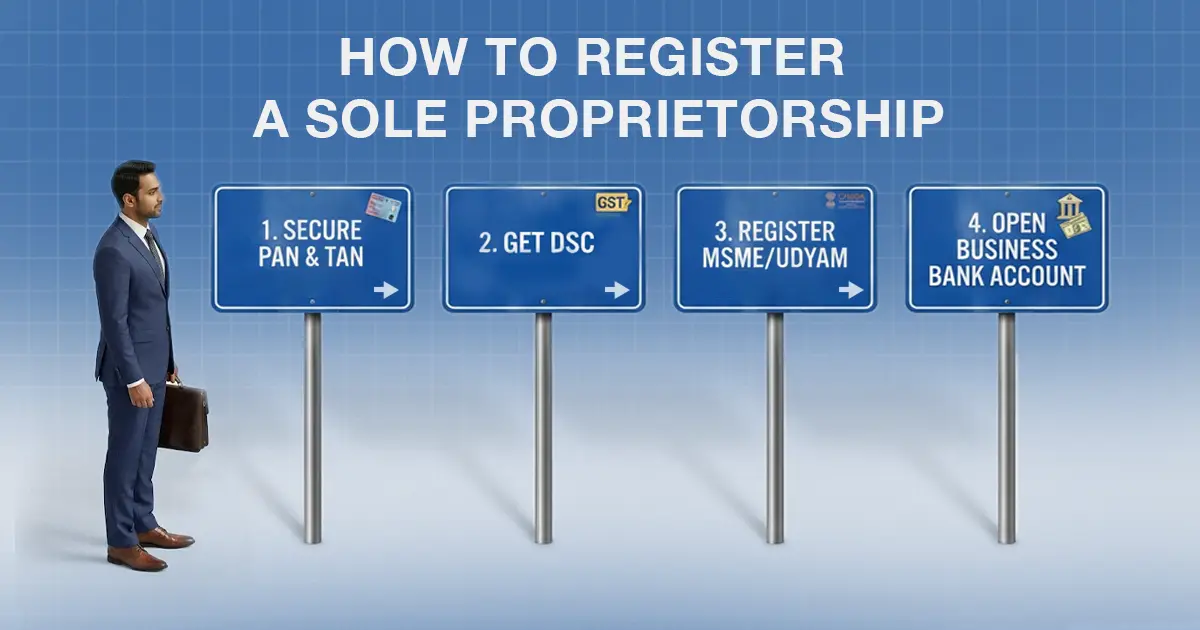
How to Register a Sole Proprietorship in India (Step-by-Step)
The sole proprietorship registration process is systematic, follow these 10 steps and you'll be fully compliant in 7–15 working days.
- Choose Business Name and Activity: Select an appropriate business name and clearly define your business activities, ensuring the name is not already in use by others in your area.
-
- Select a unique and appropriate name for your business.
- Clearly outline the nature of your business activities.
- Ensure the name is not already in use by checking local business listings or trademark databases.
Estimated Timeline: 1 day
- Obtain Required Identity Documents: Gather essential documents, including PAN and Aadhaar Card, Address proof (e.g., utility bill, voter ID) with Passport-size photographs.
Estimated Timeline: 1–2 days
- Secure Business Address Documentation: Secure documents for your business location, such as:
-
- Rent agreement (if rented)
- Property ownership documents (if owned)
- Utility bill (electricity, water, etc.) as supporting proof
Estimated Timeline: 1–2 days
- Register for GST (if applicable): GST registration is mandatory if:
-
- Your turnover exceeds Rs. 20 lakhs (Rs. 10 lakhs in special category states), or
- You’re involved in interstate supply or e-commerce.
Apply via the GST Portal. Businesses can also opt for the GST Composition Scheme (if eligible) to reduce compliance burden.
Estimated Timeline: 3–7 working days
- Obtain Shop and Establishment License: Apply for shop and establishment registration with local municipal authorities or the state labor department as required.
Estimated Timeline: 3–10 working days (state-wise)
- Open a Business Bank Account: Open a current account in your business name. Banks typically require:
-
- Proof of business identity (GST, Shop Act, etc.)
- PAN and Aadhaar
- Address proof
- Business registration certificates
Estimated Timeline: 1–3 days after document approval
- Apply for Professional Tax Registration: Register for professional tax with state authorities if applicable, based on your state's professional tax laws and business nature.
Estimated Timeline: 3–5 working days
- Obtain Industry-Specific Licenses: Apply for additional licenses like FSSAI for food business, trade license from local authorities, or other sector-specific permits.
Estimated Timeline: 7–15 working days
- Complete MSME Registration (optional): Consider registering under MSME (Udyam Registration) for benefits like easier loan access and government scheme eligibility.
Estimated Timeline: 1 day (online process)
- Set up Accounting and Compliance System: Establish proper books of accounts and a compliance management system for tax filings and regulatory requirements.
Estimated Timeline: 2–5 days
Total turnaround: Registering a sole proprietorship firm in India usually takes 7–15 working days. Actual time varies based on the licences you need and government processing.
How to Check the Status of Sole Proprietorship Registration Online?
To track the progress of your sole proprietorship registration, you can check the status via the relevant government portal based on the type of registration:
1. GST Application Status
- Go to the GST Portal.
- Click on Track Application Status.
- Enter the ARN (Application Reference Number) to view the current status.
2. Udyam Registration Status
- Visit Udyam Portal.
- Go to Verify Udyam Registration Number.
- Enter your registration number to check its validity and status.
3. Shops & Establishment Status
- Visit your state’s official Labour Department or Municipal Corporation website.
- Look for a license tracking or application status
- Enter your application number or reference ID to view the current status.
Sole Proprietorship Registration Fees in India
Total proprietorship firm registration fees typically range between ₹1,500 and ₹15,000 depending on which registrations you choose (GST, FSSAI, Trade Licence) and whether you use professional assistance. For a precise, line-item estimate use our MCA fees calculator.
One Time Proprietorship Firm Registration Charges
| Registration Type | Fees Range |
| GST Registration | Free (Online) / ₹100 (Offline) |
| Shop & Establishment License | ₹1,000 – ₹5,000 |
| Trade License | ₹500 – ₹2,000 |
| Professional Tax Registration | ₹300 – ₹1,000 |
| FSSAI Registration | ₹100 – ₹7,500 (based on license type) |
| Bank Account Opening | ₹500 – ₹2,000 |
| Professional Fees | ₹5,000 – ₹15,000 |
Recurring Compliance Costs
Ongoing operational costs and compliance expenses charged for maintaining a sole proprietorship business.
| Compliance Type | Fees Range |
| GST Return Filing | ₹1,000 – ₹3,000 (per quarter) |
| Income Tax Filing | ₹1,500 – ₹5,000 (annually) |
| License Renewals | ₹500 – ₹2,000 (annually) |
| Professional Tax | ₹200 – ₹2,500 (annually) |
| Accounting & Bookkeeping | ₹2,000 – ₹8,000 (per month) |
| Audit Fees | ₹10,000 – ₹25,000 (if applicable) |
| Legal Compliance | ₹5,000 – ₹15,000 (annually) |
A sole proprietorship is the most affordable business structure in India — minimal setup costs and flexible compliance spend based on the business's scale. For deeper break-ups read our cost of proprietorship firm registration guide.
A sole proprietorship registration certificate is the set of documents that together validate the legal existence of a business run by a single individual. Because a proprietorship is not a separate legal entity, India does not issue a single central certificate. Instead, authorities validate a proprietorship registration certificate through the following documents:
- GST Registration Certificate
- Shops & Establishment Licence
- Udyam Registration (for MSMEs)
- Trade Licence from the local municipal authority
How to Download Your Sole Proprietorship Registration Certificate Online?
The process to download your registration certificate depends on the type of registration you opted for. Here's how you can download the most common ones:
1. GST Registration Certificate
- Visit the GST Portal and log in using your GSTIN credentials.
- Go to Services → User Services → View/Download Certificates.
- Click the download icon next to your registration certificate.
2. Udyam (MSME) Registration Certificate
- Visit the Udyam Portal and click on Print/Verify.
- Enter your Udyam Registration Number and Aadhaar-linked mobile number.
- Download the certificate in PDF format.
3. Shops & Establishment Licence
- Visit your state government's labour department portal.
- Log in and navigate to the issued licences section.
- Download your certificate.
Taxes Applicable to a Sole Proprietorship Firm in India
Since a sole proprietorship is not a separate legal entity, the proprietor pays income tax on business profits at individual slab rates, not at a flat corporate rate. This is one of the biggest tax advantages of the proprietorship structure. You can pick between the new regime (default) and the old regime, and choose whichever gives you the lower tax liability each financial year.
New Tax Regime Slabs for Sole Proprietors (FY 2026-27 / AY 2027-28)
The new regime is the default option for sole proprietors and offers lower rates with minimal deductions. It's ideal if you don't claim heavy investment or housing-related deductions.
| Annual Business Income | Tax Rate |
| Up to ₹4,00,000 | Nil |
| ₹4,00,001 – ₹8,00,000 | 5% |
| ₹8,00,001 – ₹12,00,000 | 10% |
| ₹12,00,001 – ₹16,00,000 | 15% |
| ₹16,00,001 – ₹20,00,000 | 20% |
| ₹20,00,001 – ₹24,00,000 | 25% |
| Above ₹24,00,000 | 30% |
Key benefit: Sole proprietors with total taxable income up to ₹12,00,000 pay zero tax thanks to the enhanced Section 87A rebate of ₹60,000 under the new regime.
Old Tax Regime Slabs for Sole Proprietors (FY 2026-27)
The old regime works better if you invest heavily under Section 80C (LIC, ELSS, PPF), pay health insurance premiums (Section 80D), or claim a home loan interest deduction.
| Annual Business Income | Tax Rate |
| Up to ₹2,50,000 | Nil |
| ₹2,50,001 – ₹5,00,000 | 5% |
| ₹5,00,001 – ₹10,00,000 | 20% |
| Above ₹10,00,000 | 30% |
A Section 87A rebate of up to ₹12,500 is available for proprietors with taxable income up to ₹5,00,000 under the old regime.
Section 44AD: Presumptive Taxation Scheme for Small Proprietors
Small sole proprietorship firms with annual turnover up to ₹2 crore (or ₹3 crore if 95% of receipts are digital) can opt for the presumptive taxation scheme under Section 44AD of the Income Tax Act, 1961. Under this scheme:
- 6% of turnover is deemed as taxable profit for digital/banking receipts.
- 8% of turnover is deemed as taxable profit for cash receipts.
- No need to maintain detailed books of accounts.
- No tax audit required even if turnover is below ₹1 crore, as long as you declare profit at the prescribed rate.
This is one of the biggest tax reliefs available to small proprietors and is heavily under-utilized by first-time entrepreneurs.
Sole Proprietorship vs. Other Business Structures in India
| Feature | Sole Proprietorship | Partnership Firm (e.g., General Partnership) | Limited Liability Partnership (LLP) | One Person Company (OPC) | Private Limited Company (Pvt. Ltd.) |
| Governing Act | No specific Act (governed by various laws) | Indian Partnership Act, 1932 | Limited Liability Partnership Act, 2008 | Companies Act, 2013 | Companies Act, 2013 |
| Owner(s) | Single individual | Minimum 2, Maximum 50 | Minimum 2, No maximum limit | Single individual (who is both director & shareholder) | Minimum 2, Maximum 200 (shareholders) |
| Legal Identity | No separate legal identity (owner = business) | No separate legal identity (firm ≠ partners) | Separate legal identity | Separate legal identity | Separate legal identity |
| Liability of Owner(s) | Unlimited personal liability | Unlimited personal liability (joint & several) | Limited liability (to capital contribution) | Limited liability (to shares subscribed) | Limited liability (to shares subscribed) |
| Ease of Formation | Easiest, minimal formalities | Relatively easy, Partnership Deed required | Moderate complexity, requires MCA filing | Moderate complexity, requires MCA filing | Complex, significant compliances require MCA filing |
| Compliance Burden | Very low (PAN, Aadhaar, Shop Act/GST/Udyam if applicable) | Low to Moderate (Partnership Deed, PAN, GST if applicable, ITR-5) | Moderate (Annual filings with MCA, ITR-5) | Moderate (Annual filings with MCA, ITR-6, Audit mandatory) | High (Extensive annual filings with MCA, ITR-6, Audit mandatory) |
| Fundraising Ability | Difficult (relies on personal credit, limited options) | Moderate (can raise capital from partners, limited external options) | Moderate (can attract loans, some investor interest) | Moderate (can attract loans, limited equity options) | High (can raise equity funding, bank loans easily) |
| Perpetual Succession | No (business ends with the owner's demise/incapacity) | No (firm dissolves with the death/retirement of a partner unless otherwise agreed) | Yes | Yes | Yes |
| Transferability | Not easily transferable | Not easily transferable (requires a new deed) | Relatively easy (transfer of partnership interest) | Restricted (shares can be transferred, but rules apply) | Shares are relatively easily transferable |
| Credibility | Low (perceived as individual business) | Moderate | Moderate to High | Moderate to High | High (perceived as stable & professional) |
| Taxation | Taxed as individual income of the proprietor (ITR-3 or ITR-4) | Firm taxed separately at 30% flat + surcharge/cess (ITR-5). The partners' share of profit is exempt. | Taxed at 30% flat + surcharge/cess (ITR-5) | Company taxed at corporate rates (ITR-6) | Company taxed at corporate rates (ITR-6) |
| Audit Requirement | Not mandatory unless turnover exceeds GST/income tax audit limits | Not mandatory unless turnover exceeds GST/income tax audit limits | Mandatory, regardless of turnover | Mandatory, regardless of turnover | Mandatory, regardless of turnover |
Who Should (and Shouldn't) Choose a Sole Proprietorship
A sole proprietorship is a great fit for some founders and a poor choice for others. Use this quick decision guide before you register.
Choose a sole proprietorship if you are:
- A freelancer, consultant, or solo service provider with annual receipts under ₹1 crore.
- A local shopkeeper, home-based entrepreneur, or single-owner retailer.
- A first-time founder testing a business idea and unwilling to commit to MCA-level compliance.
- An online seller or content creator who needs only GST, Udyam, and a current bank account.
- A professional practising individually (CA, lawyer, doctor, architect) who doesn't need external investors.
Skip sole proprietorship and choose an LLP or Pvt Ltd if you:
- Plan to raise angel/VC funding — investors usually require a Private Limited Company.
- Want limited liability protection — look at OPC or LLP.
- Intend to onboard co-founders or employee stock options (ESOPs).
- Are entering a high-risk business (manufacturing, financial services, import–export) where personal liability is dangerous.
- Plan to sell the business later — transferring a proprietorship is harder than selling shares of a Pvt Ltd company.
Common Mistakes to Avoid in Sole Proprietorship Registration
Based on 40,000+ registrations handled by our team, here are the most common mistakes first-time proprietors make — and how to avoid them:
- Mixing personal and business finances: Always open a dedicated current account in the business name. It is the single biggest predictor of a smooth ITR filing later.
- Picking a business name that conflicts with an existing trademark: Run a free company name search and consider filing a trademark registration early to lock your brand.
- Skipping GST when inter-state or e-commerce sales start: GST becomes mandatory the moment you make inter-state supply or sell via marketplaces — threshold doesn't matter.
- Ignoring Udyam registration: Udyam is free and unlocks 45-day payment protection under the MSMED Act, lower-interest loans, and PSU tender eligibility.
- Not maintaining books under Section 44AD: Even if you opt for presumptive taxation, keep a simple bank-led records for future audits or loan applications.
- Delaying the switch to an LLP or Pvt Ltd: Once your turnover crosses ₹1 crore or you want funding, plan the conversion early — waiting increases tax and compliance costs.
Connect with RegisterKaro and let our experts handle the legal hassle while you grow your business.
Frequently Asked Questions (FAQs)
What is sole proprietorship registration?
−Sole Proprietorship Registration is the process of officially registering a business owned and managed by one person. Though not mandatory, registration helps with licenses, tax filings, and opening bank accounts.
Who can register a sole proprietorship in India?
+Is there any minimum requirement to start a sole proprietorship?
+What is the cost of registration of a sole proprietorship in India?
+What is the validity period of a sole proprietorship registration?
+Is GST registration mandatory for a sole proprietorship?
+What is the difference between a sole proprietorship and other business structures?
+Can a sole proprietorship operate under multiple business names?
+Can I register a sole proprietorship without a physical office?
+How long does a sole proprietorship registration take in India?
+What is the difference between proprietorship and proprietorship firm registration?
+Is a PAN card different for a sole proprietorship business?
+Can a sole proprietorship avail of business loans?
+What happens to a sole proprietorship after the owner's death?
+What are the annual compliance requirements for a sole proprietorship?
+Can foreign nationals register a sole proprietorship in India?
+Can a sole proprietorship claim business expense deductions?
+How do I check my sole proprietorship registration status?
+What is the closure process for a sole proprietorship?
+Can I operate a proprietorship from my house?
+What is the address proof for proprietorship?
+Is it mandatory to file an ITR for a proprietorship firm?
+How can a sole proprietorship be converted into a private limited company?
+What happens if taxes are not filed for a sole proprietorship?
+Is a Sole Proprietorship legally mandatory in India?
+
Reviewed by
Joel DsouzaJoel Dsouza is a Chartered Accountant (CA) and compliance expert with over 7 years of hands-on experience in company registration, tax structuring, GST, ROC filings, and MCA compliance. As a qualified member of the Institute of Chartered Accountants of India (ICAI) and Co-Founder at RegisterKaro, he has personally advised more than 1,000 startups and SMEs across India, helping founders navigate incorporation, regulatory frameworks, and financial planning from Day 1. With deep expertise across all three levels of Finance and Portfolio Management, Joel is committed to promoting financial literacy and simplifying India's startup ecosystem through clear, actionable guidance that entrepreneurs can act on immediately.
Why Choose RegisterKaro for Sole Proprietorship Registration?
Here's what makes RegisterKaro the trusted partner for sole proprietorship registration online:
- Specialist experts: Our in-house CAs and CSs have handled thousands of proprietorship, LLP, and Pvt Ltd setups across 500+ cities.
- End-to-end process: From business name search to GST, Shop Act, Udyam, and current account opening — handled under one roof.
- Transparent pricing: Fixed-fee packages with no hidden charges — see the exact line-item cost before you pay.
- Fast turnaround: Most proprietorships go live in 7–15 working days, with live WhatsApp/call support.
- Post-registration support: Ongoing GST return filing, ITR filing, TDS return filing, and book-keeping packages from ₹999/month.

What Our Clients Say
View All
Harshit Reja
 Verified
I am extremely satisfied with the services provided by Registerkaro! They helped me incorporate my LLP seamlessly and efficiently. Special thanks to T... Read more

Amit Sharma
VerifiedAmazing experience with them. Helped me with company, GST and IEC registration. The team is very helpful especially Isha, she has been a real help thr... Read more

Sumit Bisht
VerifiedI had the pleasure of working with Manish Tiwari during the process of registering our company, and I must commend his professionalism, knowledge, and... Read more

Sreekar P
VerifiedRegisterKaro offers reliable and quality services. While the initial phase of my company closure took some time, the compliance and closure teams mana... Read more

RAJU MOKA
VerifiedThe services given by Register Karo us excellent. Eventhough At initial stage of my company closure work bit delay was there, but later stage complian... Read more

Deepika Valyat
VerifiedWith Register Karo I have a very good experinence of Incorporation of a new Company and other services. The best part about the team is there Quick an... Read more

Varsha Vhasamane
VerifiedYour timely and expert assistance in company registration, clear communication, responsiveness, attention to detail, and problem-solving skills were i... Read more

Abrar Qureshi
VerifiedI had a great experience using RegisterKro for my company incorporation. The team was professional, responsive, and genuinely supportive throughout th... Read more

Deepak Chandran
VerifiedThe team was amazing. They helped us to register our company and the process was very smooth. Bhavesh Verma adjusted his work hours according to our b... Read more

Venu Lakshman
VerifiedI am a startup from Bangalore, we have been served by Muskan from Registerkaro for the past 6 months of GST filing and bookkeeping. All filings are do... Read more
Sole Proprietorship Registration Across India
Related Blogs
View All
Documents Required for Sole Proprietorship Registration in India: Complete Checklist 2026

Convert Sole Proprietorship to LLP in India: Process & Fees

Top 10 Sole Proprietorship Companies in India: 2026 List

Different Types of Sole Proprietorship in India: 2026 Guide
How to Register a Sole Proprietorship in India: Step-by-Step Guide

Sole Proprietorship Registration Fees in India: Cost Guide

Top Sole Proprietorship Examples in India: 10 Business Ideas

How to Open a Current Account for Sole Proprietorship in India
Limitations of Sole Proprietorship in India: Key Risks & Solutions (2026)

What Is Sole Proprietorship? Meaning, Definition & Features
Featured In