BIS Certification Online in India
Get BIS Certification online in India with RegisterKaro. Our experts handle ISI & CRS registration with complete support on complete documentation, cost, and compliance.
 End-to-End BIS Certification AssistanceExpert Guidance by BIS ProfessionalsEnhance Product Credibility & TrustEnsure Full Compliance with Indian StandardsTrusted by Over 20,000 Businesses

 What Sets Us ApartWhat Sets Us Apart
Overview of BIS Certification in India
India's fast-growing consumer market and strict quality rules make BIS certification more important than ever for businesses today. With products requiring mandatory BIS certification, compliance can be challenging for manufacturers, importers, and exporters. The process of receiving BIS certification often involves complex documentation, rigorous product testing, and meticulous factory inspections.
With increasing regulatory oversight and consumer awareness, BIS certification has become a symbol of credibility and compliance. It not only prevents substandard products from entering the market but also enhances your brand's credibility, opening doors to retail, e-commerce, and government tender opportunities across the country.
What is BIS Certification for India?
The full form of BIS certification is the Bureau of Indian Standards certification, which is issued by India’s national standards body to ensure the quality, safety, and reliability of products. Also known as BIS Registration, it serves as a third-party assurance that a product meets the required Indian standards. It is the national standards body of India, established under the BIS Act 2016, working under the Ministry of Consumer Affairs, Food & Public Distribution.
This BIS certification ensures that products adhere to specific Indian Standards (IS), providing confidence to consumers and streamlining trade. Manufacturers use the BIS certificate mark (like the ISI mark or R-number) on their products to signify compliance.
Products That Come Under BIS Certification in India
A wide range of products comes under BIS certification, categorized primarily by Quality Control Orders (QCOs) issued by various ministries. These QCOs make BIS certification mandatory for specific products to ensure public safety, health, and environmental protection.
As of March 2025, over 679 products have been brought under mandatory BIS certification in India, covering categories like electronics, automotive components, and construction materials. This number continues to grow as the government expands its focus on consumer safety and product quality.
Manufacturers, importers, and exporters dealing with these items must obtain BIS certification before selling in the Indian market. Staying compliant not only avoids legal issues but also enhances trust and market access.
For instance:
- Electronics
- Household appliances
- Cement
- Steel
- Automotive components
- Food products.
It is crucial for manufacturers and importers to regularly check the updated list of products under mandatory BIS certification to ensure compliance and avoid legal repercussions.
Types of BIS Registration Schemes in India
The Bureau of Indian Standards operates various schemes for BIS registration, catering to different product types and manufacturing locations. Understanding these schemes is vital for knowing how to apply for your BIS certificate.
BIS Registration Schemes for Manufacturers
The following are the schemes necessary for registration of BIS for manufacturers:
- Product Certification Scheme (ISI Mark)
-
- Applicable to domestic manufacturers for products like cement, steel, electrical appliances, packaged water, etc.
- Over 150+ product categories have been made mandatory under this scheme.
- After factory audits and product testing in BIS-approved labs, the ISI mark is granted.
- Valid for 1 or 2 years, renewable after compliance verification.
- Compulsory Registration Scheme (CRS)
-
- Covers 60+ categories of electronic and IT products, such as mobile phones, LEDs, TVs, and batteries.
- Manufacturers (Indian or foreign) must register with BIS before selling or importing.
- Products must be tested in a BIS-recognized lab and comply with specific Indian Standards (IS).
- No factory inspection is required, making it faster than the ISI route.
- Management System Certification
-
- Focuses on compliance with BIS-adopted ISO standards (e.g., ISO 9001, ISO 14001, etc.).
- Ensures quality management, environmental safety, and occupational health practices are followed.
- Helps manufacturers enhance internal efficiency and global acceptance.
BIS Registration Schemes for Importers
Below are the schemes specific to importers:
- Foreign Manufacturers Certification Scheme (FMCS)
-
- Designed for foreign manufacturers selling ISI mark-mandated products in India.
- Involves factory inspection by BIS officials, sample testing, and regular surveillance.
- Required for items like kitchen appliances, pressure cookers, industrial valves, etc.
- Importers must ensure that overseas suppliers are FMCS certified before shipping.
- Compulsory Registration Scheme (CRS)
-
- While manufacturers apply directly, importers are responsible for verifying that the products they bring in are registered under CRS.
- If products are unregistered, customs will block the shipment, and penalties may apply.
- Special Schemes (Product-Specific Certification)
-
- Some products may fall under sector-specific BIS regulations, such as food packaging, solar panels, and batteries.
- Importers must stay updated on product notifications from BIS and the concerned ministries.
BIS Registration Schemes for Exporters
These schemes are crucial for exporters:
- BIS Certification (For Indian Exporters Selling Domestically as Well)
-
- If a product is sold both in India and abroad, BIS certification is mandatory for the Indian market.
- Exporters can benefit from certification as it enhances credibility, simplifies government tenders, and allows e-commerce platform onboarding.
- Export to Countries with Their Own Regulatory Standards
-
- While BIS is not required for foreign markets, exporters often need certifications like CE (Europe), UL (USA), or CCC (China), depending on the destination.
- BIS can be a useful benchmark in documentation and audits for other global markets.
Key Differences:
| Criteria | Manufacturers | Importers | Exporters |
| Primary Role | Produce and certify products | Ensure imported goods comply with BIS | Comply with local sales, prepare for global |
| Relevant Schemes | ISI, CRS, Management System | FMCS, CRS, Special Schemes | BIS (if selling in India), global schemes |
| BIS Application | Directly applicable | Indirect, must check supplier compliance | Applicable only if the domestic sale is involved |
| Compliance Focus | Factory audits, lab tests | Product documentation, BIS checks | Market access, credibility, and global standards |
Governing Laws Behind BIS Certification in India
The framework for BIS certification in India is robust and continually evolving, primarily designed to safeguard public health, ensure product quality, and promote fair trade. The framework isn't governed by a single law. Instead, it's a combination of acts, regulations, and orders that empower the Bureau of Indian Standards (BIS) to fulfill its mandate.
Here are the governing laws and frameworks for BIS certification in pointers, with additional information:
- The Bureau of Indian Standards Act, 2016:
This is the foundational legislation that establishes the Bureau of Indian Standards (BIS) as the National Standards Body of India. The BIS Act, 2016, was notified on 22 March 2016 and came into effect on 12 October 2017, replacing the older BIS Act of 1986. This adaptation strengthened standardization, product certification, and consumer protection.
The Act empowers BIS to formulate Indian Standards, provide product and system certification, and enforce mandatory compliance for goods and services. It operates under the administrative control of the Ministry of Consumer Affairs, Food, and Public Distribution.
It also includes provisions for compulsory use of a Standard Mark (like the ISI mark or R-number) on certain products in the public interest, for consumer protection, or environmental safety. This Act also enables the government to introduce simplified conformity assessment schemes and mandates penalties for non-compliance.
- BIS (Conformity Assessment) Regulations, 2018:
These regulations are crucial as they detail the specific procedures and schemes under which BIS certification (or conformity assessment) is granted. They outline the application process, product testing requirements, factory inspection norms (where applicable), and the criteria for issuing licenses or Certificates of Conformity (CoCs).
The regulations define various schemes like Scheme I (ISI Mark), Scheme II (Compulsory Registration Scheme or CRS), and, more recently, Scheme X for machinery and high-risk equipment. They ensure a standardized and transparent approach to how BIS registration is achieved and maintained, providing the procedural backbone for the BIS certification process.
- Quality Control Orders (QCOs) issued by Various Ministries:
These are specific notifications issued by different ministries of the Government of India that make BIS certification mandatory for certain products. QCOs are critical because they define which products require a certificate to be manufactured, sold, or imported, with Section 16 of the BIS Act, 2016, empowering ministries to issue such QCOs.
For instance, the Ministry of Electronics and Information Technology (MeitY) issues QCOs for electronic goods under CRS, while other ministries issue them for cement, steel, toys, etc. These orders are regularly updated, requiring businesses to stay vigilant about products that fall under mandatory BIS registration.
- Specific Scheme Regulations (e.g., Hallmarking Regulations):
Beyond the general Conformity Assessment Regulations, BIS also issues specific regulations for particular schemes. For example, the BIS (Hallmarking) Regulations, 2018, govern the mandatory hallmarking of gold and silver jewellery, ensuring the purity of precious metals. These detailed regulations provide specific rules and procedures unique to each specialized BIS certification scheme, ensuring precise adherence to the standards.
Notably, gold hallmarking was made mandatory from 16 June 2021 to guarantee the purity and quality of gold jewelry sold in India.
- Foreign Trade (Development and Regulation) Act, 1992 (FTDR Act):
While not directly a BIS law, the FTDR Act, along with its associated rules and policies (like the Import Policy), plays a significant role in enforcing BIS certification for imported products. Customs authorities often refer to notifications under this Act to verify if imported goods comply with Indian Standards. This legal linkage ensures that foreign-manufactured goods adhere to Indian quality benchmarks, preventing the entry of substandard products into the market.
Benefits of BIS Certification in India
Obtaining BIS certification offers numerous advantages for manufacturers, importers, and consumers alike.
Manufacturers
- Enhances product credibility and builds consumer trust with the trusted BIS mark.
- Ensures compliance with Indian safety and quality standards, reducing legal risks.
- Opens access to government tenders and bulk procurement opportunities.
- Helps improve internal quality management and production processes through standardization.
- Facilitates smoother market entry and brand recognition across India.
Importers
- Guarantees that imported products meet Indian regulatory and safety standards.
- Avoids customs clearance delays and penalties by ensuring BIS compliance beforehand.
- Builds buyer confidence by importing certified, high-quality goods.
- Helps maintain market reputation by preventing substandard or unsafe products from entering India.
- Simplifies compliance with evolving government regulations for imported goods.
Exporters
- Adds credibility to products when selling both domestically and internationally.
- Enhances competitiveness in the Indian market by meeting mandatory certification requirements.
- Supports easier onboarding on e-commerce platforms and participation in tenders.
- Demonstrates commitment to quality, opening doors to premium buyers and markets.
- It can serve as a stepping stone to comply with other global certification standards.
Eligibility Criteria for BIS Certification in India
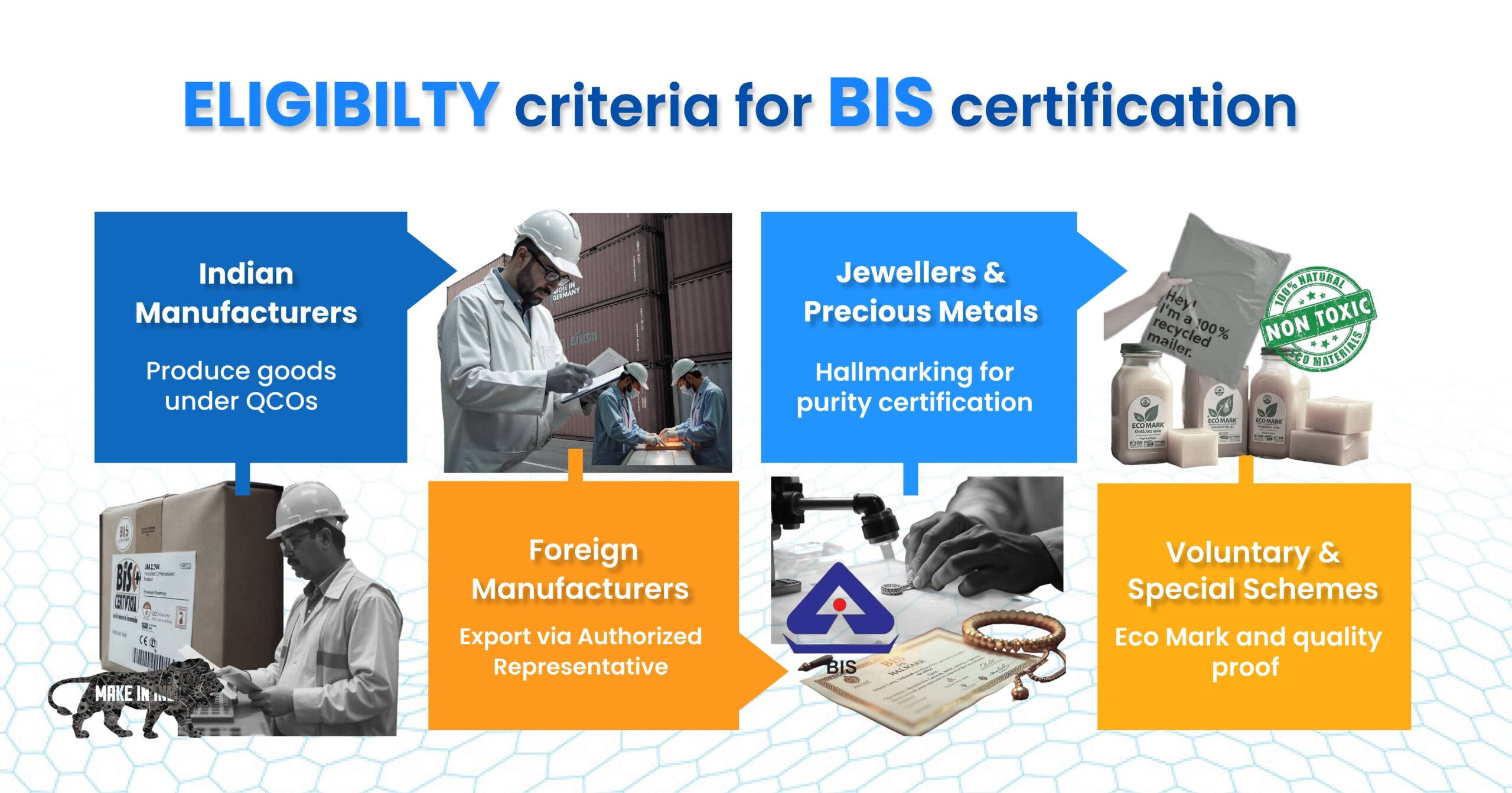
The eligibility for BIS certification isn't about specific pre-qualifications for the applicant company but rather the ability of the product and manufacturing process to meet the relevant Indian Standard.
Both domestic and foreign manufacturers can apply for BIS certification.
1. Indian Manufacturers
This is the most common category. Any Indian manufacturer producing goods that fall under a mandatory Quality Control Order (QCO) or who wishes to voluntarily certify their product to demonstrate quality can apply for BIS certification under schemes like:
- ISI Mark Scheme (Scheme I): This scheme is used for products that need to demonstrate compliance with Indian Standards through factory inspection and ongoing surveillance. It is mostly applicable to items like cement, steel, and household appliances.
- Compulsory Registration Scheme (CRS or Scheme II): This scheme covers electronic and IT products where manufacturers must register their products after testing in BIS-recognized labs. It does not require factory inspection but ensures safety and performance standards are met.
They must have established manufacturing facilities within India and demonstrate adherence to the relevant Indian Standard.
2. Foreign Manufacturers (Importers indirectly through them)
Foreign manufacturers who wish to export and sell their products in India are also eligible for BIS certification. They apply under the Foreign Manufacturers Certification Scheme (FMCS). Foreign manufacturers must appoint an Authorized Indian Representative (AIR), who is an Indian resident and acts as a local liaison with BIS, responsible for compliance. This ensures that imported products, often brought in by Indian importers, meet Indian quality and safety standards before reaching the market.
- Foreign Manufacturers Certification Scheme (FMCS): Foreign manufacturers whose products fall under mandatory BIS certification must apply through the FMCS before exporting to India. Certification must be obtained prior to export to ensure compliance with Indian quality and safety standards.
- Authorized Indian Representative (AIR): Foreign applicants must appoint an AIR, an Indian resident who acts as the official liaison with BIS and is responsible for ensuring the manufacturer’s compliance with all certification requirements.
3. Jewellers and Precious Metal Article Manufacturers
Manufacturers specifically dealing with products like gold and silver jewellery can apply for registration under the Hallmarking Scheme. This applies to jewellers who wish to certify the purity of their precious metal articles. Similarly, manufacturers of eco-friendly products can apply under the Eco Mark Scheme to highlight their environmental commitment alongside quality.
4. Any Manufacturer (Voluntary and Special Schemes)
Any manufacturer can apply for BIS certification, even if it’s not legally required for their product. It's a smart way to build customer trust and prove your commitment to quality. This also includes special schemes, like the Eco Mark for businesses that want to certify their products as environmentally friendly.
Documents Required for BIS Certification in India
The documents required for BIS certification vary slightly depending on the specific scheme (ISI Mark, CRS, FMCS) and the product. However, common documentation categories include:
- Company Registration Details: Proof of legal establishment, such as:
- i) Certificate of Incorporation
- ii) Memorandum of Association (MOA)
- iii) Articles of Association (AOA)
- iv) Partnership Deed
- v) Proprietorship Status.
- Third-Party Lab Test Reports: For CRS, product test reports from a BIS-recognized or empanelled laboratory are mandatory. For ISI, these reports are typically generated post-application.
- Quality Control Manual/System Documentation: Documents detailing the quality control procedures and checks implemented at various stages of manufacturing.
- Authorized Signatory Details: ID proof and authorization letter for the person authorized to sign the application.
- Details of Authorized Indian Representative (AIR): For foreign manufacturers under FMCS, details and an undertaking from their appointed AIR.
- Product Specifications: Technical drawings, circuit diagrams (for electronics), user manuals, and critical component lists.
- Undertakings and Affidavits: Various declarations confirming adherence to BIS norms and willingness to comply with surveillance.
- Miscellaneous or Additional Documents: This includes a manufacturing process flow chart illustrating each production step, a comprehensive list of machinery, and details of in-house testing equipment. It also covers certificates for equipment to ensure accuracy, along with test reports demonstrating product conformity to Indian Standards.
Step-by-Step BIS Certificate Registration Process in India
Navigating the BIS registration process might seem complex, but by following these steps, you can secure the certificate efficiently:
Step 1: Identify the Applicable Indian Standard (IS) and Scheme
Begin by determining which specific Indian Standard (IS) applies to your product. Research whether your product falls under the mandatory ISI Mark, CRS, or other schemes. This forms the foundation of your BIS certification journey, ensuring you meet the correct quality parameters.
Step 2: Prepare Documentation
Gather all the documents required for BIS certification, including company registration, manufacturing process details, quality control records, and product specifications. Accurate and complete documentation is crucial to prevent delays in the application submission.
Please refer to the above documents section for detailed information.
Step 3: Submit Application Online
Apply for BIS certification online through the BIS Manak online portal. Fill out the application form with all necessary details and upload the prepared documents. Ensure all information is consistent and accurate to facilitate smooth processing by BIS officials.
Step 4: Product Testing
For products under CRS, have your product samples tested at a BIS-recognized laboratory and obtain a test report that is less than 90 days old at the time of application.
For the ISI mark, samples may be drawn by BIS officials during factory inspection and sent to a BIS lab for testing. This step verifies that your product conforms to the relevant Indian Standard.
Step 5: Factory Inspection (for ISI Mark/FMCS)
BIS officials will inspect your manufacturing facility to assess your production processes, quality control systems, and in-house testing facilities. This step ensures your factory produces goods meeting BIS standards, with foreign manufacturers required to coordinate inspections under FMCS through an Indian representative or an agent.
Step 6: Scrutiny and Clarifications
BIS scrutinizes your application and audit reports. They may raise queries or request additional information or documentation. Respond promptly and accurately to all clarifications to keep the BIS registration process moving forward.
Step 7: Grant of License/Registration
Once BIS is satisfied that your product and manufacturing processes comply with the standard, they will grant you:.
- Certification acts as official proof of compliance with Indian standards, boosting product credibility and consumer trust.
- ISI scheme manufacturers receive a License Number to display the ISI mark on their products.
- Under the Compulsory Registration Scheme (CRS), a unique Registration Number (R-number) is provided to use the CRS mark.
- Foreign manufacturers certified under FMCS get a BIS license, allowing them to import certified products into India.
This allows you to apply the appropriate BIS mark on your products.
BIS Certification Costs & Penalties in India
The BIS certification cost in India is not fixed and varies based on several factors, while non-compliance carries significant penalties.
BIS Certification Costs In India
The total BIS certification cost depends on the specific scheme, product type, complexity of manufacturing, size of the organization, and whether you use a consultant.
i) BIS CRS Registration (Electronics & IT Products)
| Fee Type | Amount (Rs. ) | Notes |
| Application Fee | 1,000 | One-time, non-refundable |
| Processing Fee (includes 1 test report) | 25,000 | Additional test report: 10,000 each |
| Annual Registration Fee (2 years) | 2,000 (1,000 x 2) | For two years validity |
| Total (for 1 test report) | 28,000 + GST | |
| Inclusion (add new model/variety) | 15,000 + 10,000 per extra test report | |
| Renewal | 28,000 + GST | For 2 years |
ii) BIS ISI Mark Certification (Scheme I – Domestic Manufacturers)
| Fee Type | Amount (Rs. ) | Notes |
| Application Fee | 1,000 | Non-refundable |
| Audit/Inspection Fee | 7,000 per man-day | For factory inspection, the duration may vary |
| Sample Test Fee | As applicable | Varies by product and laboratory |
| License Fee | 1,000 | |
| Minimum Marking Fee | As per the IS Standard | Varies by product category |
| Annual License Fee | 1,000 | |
| Inclusion Fee | 5,000 | For adding new products under the same license |
iii) BIS FMCS (Foreign Manufacturer Certification Scheme)
| Fee Type | Amount (Rs.) | Notes |
| Application Fee | 1,000 | Non-refundable |
| Factory Inspection Charges | 7,000 per man-day | For the BIS officials’ on-site audit |
| Testing Charges | As applicable | Varies by product and laboratory |
| License/Certificate Fee | Varies | Depends on product and duration |
| Renewal Fee | Varies | Based on the validity period (1–5 years) |
| Marking Fee | As per the product |
4. Fee Variations by Business Size
- Large-scale business: Higher inspection (up to Rs. 12,000 per man-day) and license fees (up to Rs. 30,000).
- Micro, Small, Medium Enterprises (MSME): Lower inspection (Rs. 9,000 per man-day) and license fees (Rs. 15,000).
- Government organizations: Reduced application fees (Rs. 500).
5. Other Potential Costs
- Testing Charges: Vary widely by product and are paid directly to BIS-recognized laboratories.
- Marking Fee: Required for use of the BIS mark; varies by product.
- Travel/Stay: Applicants bear the cost of the auditor's travel and accommodation for inspections beyond 250 km.
- Penalties: Non-compliance can result in fines or license suspension.
Penalties for Non-Compliance
Selling products that are under mandatory BIS certification without a valid BIS certificate in India can lead to severe penalties:
- Imprisonment: Up to two years.
- Fines: Ranging from Rs. 2 Lakhs up to ten times the value of the goods sold or offered for sale.
- Product Seizure and Recall: Non-compliant products can be seized by BIS authorities, ordered for recall from the market, and manufacturing operations may be shut down.
- Damage to Reputation: Selling non-certified products, especially if they are found to be substandard or unsafe, can severely damage your brand's reputation and consumer trust, leading to long-term business losses.
- Suspension or Cancellation of Licenses: Non-compliance with BIS standards can lead to suspension or cancellation of your certification license, halting sales and disrupting market access until issues are resolved.
BIS Certification Timeline & Validity in India
Understanding the BIS certification timeline and validity is key to planning your market entry or continued operations.
1. Timeline
The time required to obtain a BIS (Bureau of Indian Standards) certificate in India varies depending on the certification scheme, product category, and documentation. Below is a detailed overview of typical timelines based on the latest available information:
i) BIS CRS Registration (Electronics & IT Products)
- Standard Timeline: If all documents and test reports are in order, BIS registration is generally awarded within 20 working days (about 1 month).
- Test Report Validity: Test reports must not be older than 90 days from the date of online application receipt.
- If Documentation is Incomplete: If there are deficiencies, BIS will issue a rejection notice. The applicant has 30 days to rectify shortcomings.
ii) BIS ISI Certification (Standard Mark/ISI Mark for Domestic & Foreign Manufacturers)
- Typical Timeline: The process, including product testing and factory inspection, usually takes 30–35 days (about 1 to 1.5 months), with testing itself requiring 15–20 days.
- Alternate Estimates: Some sources indicate the process can take up to 4 months for certain products, especially if a factory inspection is required or if the product is complex.
- For Foreign Manufacturers (FMCS): The timeline can extend to 5–6 months due to additional steps like factory inspection, overseas coordination, and compliance checks.
iii) Scheme-Based Timelines
| Certification Scheme | Typical Timeline | Key Notes |
| BIS-CRS Registration | 20 working days | Electronics/IT products, no factory audit required |
| BIS-ISI Certification | 30–35 days to 4 months | Factory audit required, more complex process |
| FMCS (Foreign Manufacturers) | 5–6 months | Includes overseas factory inspection |
2. Validity of BIS Certificate
The validity of a BIS certificate varies based on the type of certification. For most products under the Compulsory Registration Scheme (CRS), the certificate is typically valid for 2 years, while ISI Mark licenses are generally valid for 1 year and can be renewed for up to 5 years. In some cases, such as Scheme X, the certificate may be valid for 3 years.
To keep your BIS certification active, manufacturers must pay the annual renewal fees and comply with regular surveillance audits conducted by the Bureau of Indian Standards.
Contact our experts at RegisterKaro to help streamline this period and experience a seamless registration.
Post-Certification Compliance in India
After BIS certification, businesses must follow strict compliance measures, including proper use of the BIS mark and timely renewals to maintain certification validity.
- Regular Marking of Products: After certification, the BIS Standard Mark (ISI/CRS mark) must be clearly and permanently affixed to every unit of the certified product as per BIS guidelines.
- Annual License Renewal: Manufacturers must renew their BIS license annually by submitting the required forms, license fees, and compliance reports.
- Ongoing Product Testing: BIS may require periodic testing of certified products, either by in-house labs or BIS-recognized labs, to ensure continuous adherence to the relevant Indian Standards.
- Surveillance Audits/Inspections: BIS conducts routine surveillance inspections or surprise audits at manufacturing facilities to verify that production and quality control measures remain compliant.
- Record Maintenance: License holders must maintain detailed records of production, quality control checks, testing data, and complaints, which BIS authorities can audit at any time.
- Product Changes Notification: Any modifications to design, materials, production process, or manufacturing location must be notified to BIS and may require re-testing or fresh approval.
- Suspension or Cancellation Risk: Non-compliance with marking, testing, or audit requirements can lead to suspension or cancellation of the BIS license, along with penalties or legal action.
These audits verify that your manufacturing processes and products continue to meet the defined Indian Standards. Furthermore, you must apply for BIS certification renewal before your certificate expires.
BIS Registration Certificate in India
The BIS registration certificate is the formal document issued by the Bureau of Indian Standards. For products under the Compulsory Registration Scheme (CRS), this certificate grants the manufacturer the right to affix the BIS Standard Mark with a unique "R-number" on their product. It serves as undeniable proof of your commitment to quality, offering marketing leverage and demonstrating regulatory compliance. The BIS certificate includes vital details such as:
- Verify the organization's name on the certificate.
- Confirm that the specific BIS standard (e.g., IS 13428:2005) is listed.
- Check the scope of certification to match the product.
- Note the name of the certification body.
- Examine the effective and expiry dates of the certificate.
It also contains a unique certificate number and the issuing body’s accreditation marks.
How to Download a BIS Registration Certificate in India?
To download a BIS certificate, follow these steps:
- Visit the BIS official website: Go to bis.gov.in
- Navigate to the certification section: Choose the relevant scheme, like CRS (Compulsory Registration Scheme) or ISI (Standard Mark).
- Access the product or license database: Use the "Manakonline" portal or the "CRS dashboard" depending on the certification type.
- Search using details: Enter your application number, registration number (R-number), or license number.
- Download the certificate: Once your details appear, you'll have the option to view or download the BIS certificate in PDF format.
Connect with RegisterKaro and let our experts handle the legal hassle while you grow your business.
Frequently Asked Questions (FAQs)
What are BIS standards for?
−BIS stands for the Bureau of Indian Standards. It is the National Standard Body of India, established under the BIS Act, 2016. Its main function is to develop and formulate Indian Standards, provide product and system certification, and ensure the quality, safety, and reliability of goods sold in India. It aims to protect consumer interests and promote fair trade practices.
Who requires a BIS certificate?
+What documents are required for a BIS certificate?
+How long does the BIS certification process take?
+How much does BIS certification cost?
+Is BIS certification required for import?
+Is a BIS certificate required for all products?
+What is the BIS certification product list for imports?
+How to get a BIS certificate online?
+How to check a BIS certificate online?
+How to download a BIS certificate?
+Is a BIS certification mandatory?
+Which products require a BIS certification?
+What are the implications of selling our products without BIS certification in India?
+Is the BIS certification available to foreign manufacturers?
+Which is better, ISI or BIS?
+
Reviewed by
Joel DsouzaJoel Dsouza is a Chartered Accountant (CA) and compliance expert with over 7 years of hands-on experience in company registration, tax structuring, GST, ROC filings, and MCA compliance. As a qualified member of the Institute of Chartered Accountants of India (ICAI) and Co-Founder at RegisterKaro, he has personally advised more than 1,000 startups and SMEs across India, helping founders navigate incorporation, regulatory frameworks, and financial planning from Day 1. With deep expertise across all three levels of Finance and Portfolio Management, Joel is committed to promoting financial literacy and simplifying India's startup ecosystem through clear, actionable guidance that entrepreneurs can act on immediately.
Why Choose RegisterKaro for BIS Certification Services?
Navigating the complexities of BIS certification requires specialized knowledge and experience. RegisterKaro stands as your trusted partner, making the entire BIS certificate registration process easy and efficient.
- Expert Guidance: Our team of seasoned professionals possesses in-depth knowledge of all BIS certification schemes and requirements. We guide you through every step, from selecting the right standard to managing post-certification compliance.
- Streamlined Process: We simplify the often-complicated documentation and application procedures, minimizing your effort and time investment. We handle your BIS certification application process with expertise.
- Faster Approval: With our systematic approach and strong understanding of BIS protocols, we work to expedite your BIS certificate acquisition, helping you get your products to market sooner.
- Comprehensive Support: We provide end-to-end services, including gap analysis, liaison with BIS-recognized labs for product testing, support during factory inspections, and surveillance audits. We also offer clear insights into the BIS certification cost.
- Transparent Communication: You receive regular updates and clear communication throughout the BIS registration process, ensuring you are always informed. We make sure you understand every aspect of your BIS certificate verification.

What Our Clients Say
View All
Sakura Savor
 Verified
I am really grateful to Mr.Ankush for helping us thoroughly was there to help us solve our queries thoroughly so I would like to suggest you to go for... Read more

Kunal Dahake
VerifiedBest service and good response from the operation team to sale team , i really had a great experience with them they help me to register the company v... Read more

Mansi Meena
VerifiedI'm extremely satisfied with the services provided by Himanshu Kalwani for MANOVYATHA PRIVATE LIMITED. RegisterKaro's expertise and Himanshu's support... Read more

Soma Das
VerifiedI am thankful to Register Koro for Incorporation of INNOSPROUT Pvt Ltd under MCA. My immense thanks to Mr HARJEET SINGH for his cooperation and h... Read more

Murali Yoga
VerifiedThank you for all the efforts from RegisterKaro associates in helping Bittanica Softwares registered. Associates were very meticulous, courteous and d... Read more

Sonal Gakhar
VerifiedA big thank you for the outstanding support provided by your team, especially Mahima, Devesh and Kashish, in registering my company. Your team's dedic... Read more

Anitha
VerifiedI had a good experience collaborating with RegisterKaro for the company incorporation process. Rahul Gupta demonstrated exceptional commitment by foll... Read more

shubhi jain
VerifiedAmazing experience with Fahad on helping and guiding us on each step to help complete the process. He is very proactive and takes things to closure. H... Read more

Rajesh Siva
VerifiedOverall, my experience incorporating my business with Register Karo was positive. They responded quickly and provided me with frequent updates. In con... Read more

Aky Rahul
VerifiedA heartfelt thank you to Pranjal Srivastava from REGISTER KARO! She provided exceptional support throughout my company registration. Her clear communi... Read more
BIS Certification Across India
Related Blogs
View All
Top 10 CA Firms in Bangalore 2026: Best Chartered Accountants List

Startup India Certificate: How to Get, Download & Verify DPIIT Recognition (2026)

Startup India Registration Fees in 2026: Complete Cost & Charges Breakdown

Singapore Company Registration Fees in 2026: Cost Breakdown for Indians
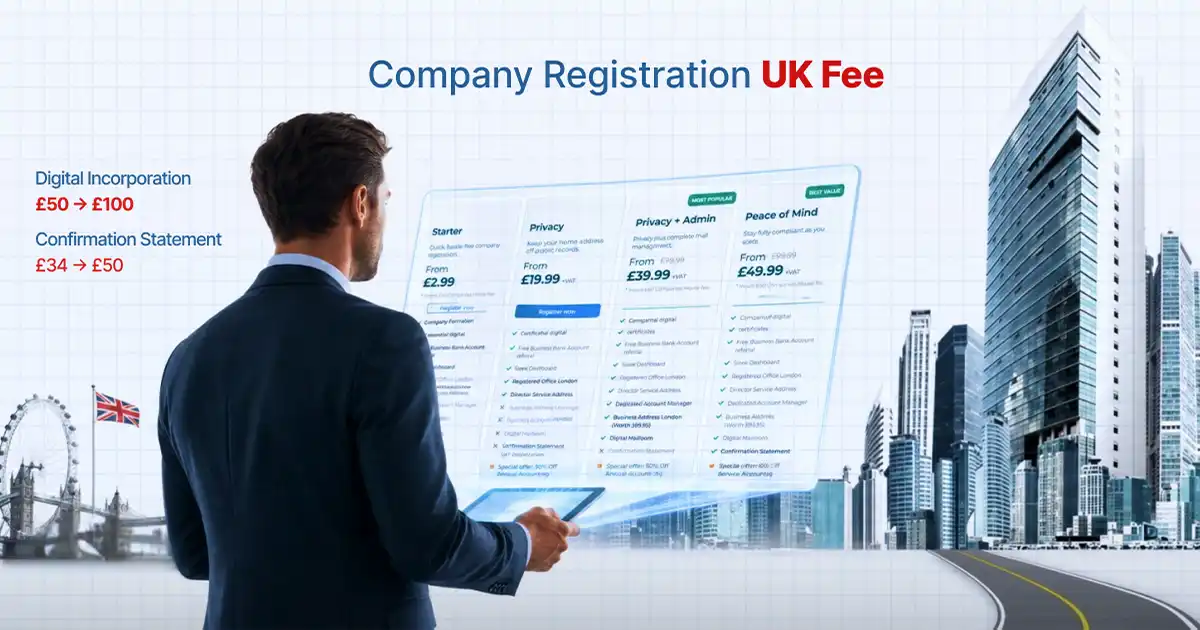
UK Company Registration Fees in 2026: Cost Breakdown for Indians

Nidhi Company Registration Fees in India: Govt Costs & Other Charges
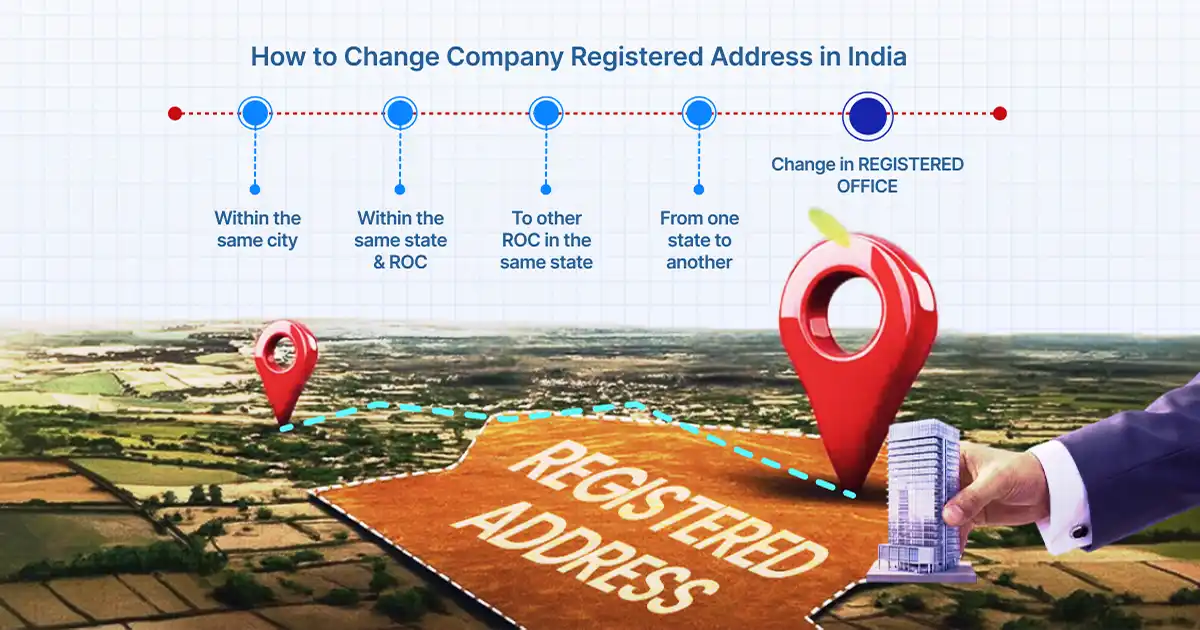
How to Change Company Registered Address in India: Complete Process
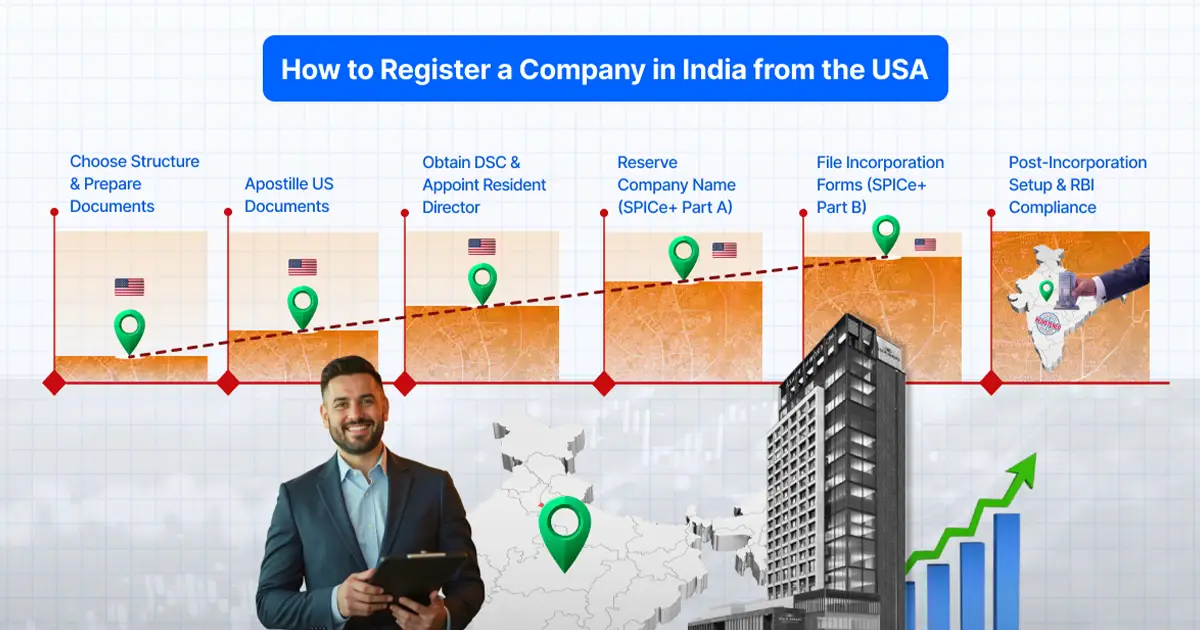
How to Register a Company in India from the USA: A Complete Guide

Documents Required for Sole Proprietorship Registration in India: Complete Checklist 2026
How to Set Up a Liaison Office in India: 2026 Guide
Featured In