

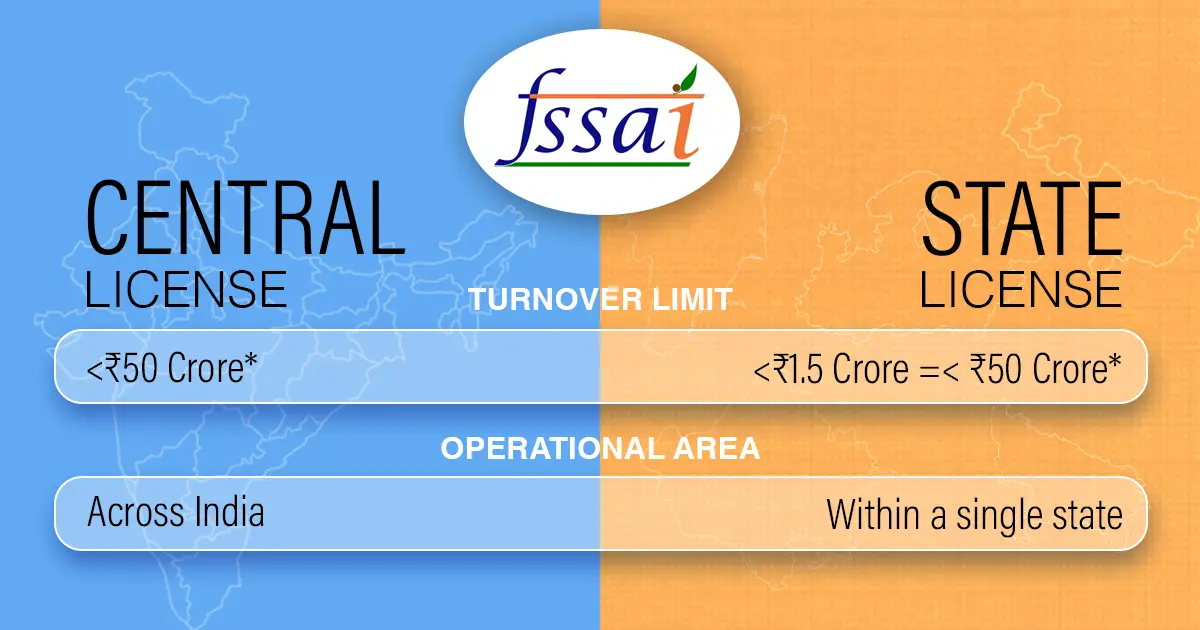
The difference between an FSSAI State and Central License mainly depends on your turnover, business activity, and operational reach. From 1 April 2026, businesses with turnover above ₹1.5 crore and up to ₹50 crore generally require a State Licence. Meanwhile, those exceeding ₹50 crore or falling into specified categories, such as importers, exporters, and certain multi-state businesses, require a Central Licence.
The distinction goes beyond turnover. Your business activity, operating locations, and licensing category can determine whether you need a State or Central Licence. Choosing the right licence from the outset keeps your food business properly authorized and helps you avoid compliance issues later.
Key Takeaways
- FSSAI has three tiers: Basic Registration up to ₹1.5 crore, State Licence above ₹1.5 crore to ₹50 crore, and Central Licence above ₹50 crore, under the revised limits effective 1 April 2026.
- The State Licence generally covers eligible businesses operating within one state, while the Central Licence covers larger businesses and specified national or international activities.
- Importers, exporters, 100% EOUs, certain multi-state operators, e-commerce food businesses, specified transport-hub premises, 5-star-and-above hotels, and certain nutraceutical businesses may require a Central Licence regardless of turnover.
- The prescribed annual fee is generally ₹2,000 for a State Licence and ₹7,500 for a Central Licence, depending on the applicable category.
What is the FSSAI State License in India?
The State FSSAI License is issued by the state licensing authority to food businesses that fall within the State License category. From 1 April 2026, it generally applies to businesses with annual turnover above ₹1.5 crore and up to ₹50 crore.
Key features of the State FSSAI License:
- State-level operations: Primarily covers eligible food businesses operating within a state.
- Medium-scale businesses: Generally applies to businesses with turnover above ₹1.5 crore and up to ₹50 crore.
- Capacity-based eligibility: Certain manufacturers, dairy businesses, meat processors, and storage units qualify based on prescribed production or storage capacity.
- State licensing authority: The application and licensing process is handled through the relevant state food safety authority.
The State License is generally suitable for medium-sized food businesses that do not fall into a category requiring Central licensing.
What is the FSSAI Central License in India?
The Central FSSAI License is issued by the Central Licensing Authority for large food businesses and activities that require central-level regulation. From 1 April 2026, it generally applies to businesses with annual turnover above ₹50 crore.
Key features of the Central FSSAI License:
- Multi-state operations: Required for certain businesses operating across multiple states, including eligible head offices.
- International activities: Mandatory for food importers, exporters, and 100% export-oriented units.
- E-commerce: Required for food businesses operating through e-commerce platforms under the applicable criteria.
- Specified businesses: Covers certain large manufacturers, 5-star-and-above hotels, and other categories specifically placed under Central licensing.
- Higher turnover: Generally applies to businesses with turnover exceeding ₹50 crore.
The Central License covers businesses with larger operations or activities that require regulation at the national or international level.
Key Difference Between Central and State FSSAI License
To help you choose the right license for FSSAI Registration, here is a simple and clear comparison between State and Central Licenses:
| Parameter | State Licence | Central Licence |
| Issuing Authority | State Licensing Authority | Central Licensing Authority under FSSAI |
| Annual Turnover | Above ₹1.5 crore to ₹50 crore | Above ₹50 crore |
| Area of Operation | Generally within one state | Multi-state or international operations, where applicable |
| Business Scale | Medium-sized businesses | Large businesses and specified categories |
| Annual Fee | Generally ₹2,000 | Generally ₹7,500 |
| Import/Export | Not applicable for businesses requiring Central licensing | Mandatory for food importers and exporters |
| E-Commerce | May apply depending on the business structure | Required for specified e-commerce food businesses |
| Special Categories | Eligible businesses falling under State licensing criteria | Importers, exporters, 100% EOUs, certain multi-state businesses, large manufacturers, and other centrally licensed categories |
| Application | Form B through FoSCoS | Form B through FoSCoS |
| Validity | Perpetual, subject to annual compliance | Perpetual, subject to annual compliance |
| Best Suited For | Mid-sized food businesses operating primarily within one state | Large, multi-state, international, and specially regulated food businesses |
Similarities Between FSSAI State and Central Licence
Despite their different eligibility criteria, both licences operate under the same FSSAI regulatory framework. State and Central FSSAI license:
- Submit their application through the FoSCoS portal.
- Authorize eligible food businesses to operate under FSSAI’s food safety requirements.
- Have perpetual validity, subject to applicable annual fees and compliance requirements.
- Require businesses to maintain food safety standards, records, and other applicable requirements.
- Are governed by the Food Safety and Standards Act, 2006, and applicable regulations.
Which to Choose: FSSAI State Licence vs Central Licence
The right FSSAI licence depends on your turnover, business activity, and area of operation. Use the following criteria to determine which licence applies:
- Choose the State Licence if your turnover is above ₹1.5 crore and up to ₹50 crore and you operate within one state.
- Opt for the Central Licence if your turnover is above ₹50 crore or your business falls under a Central licensing category, such as food import or export or specified multi-state operations.
- For businesses operating across states, licensing depends on the nature of each premises and its activity. The head office may require a Central Licence, while individual units may require separate State Licences or Registrations.
