

Women entrepreneurs are playing a growing role in India’s MSME sector, with over 3.07 crore women-led enterprises registered by February 2026. The government supports this growth through schemes that provide funding, credit guarantees, training, and other business support.
Several government schemes for women entrepreneurs in India help women start, expand, and manage businesses across different sectors. Key initiatives include PMMY, Stand-Up India, PMEGP, and Mahila Coir Yojana, along with state-level programs.
This guide explains the major government schemes for women entrepreneurs, their benefits, eligibility requirements, and available funding options.
Key Takeaways
- Government schemes provide funding, subsidies, training, mentorship, and market support to women entrepreneurs in India.
- Popular schemes include PMMY, Stand-Up India, PMEGP, Mahila Udyam Nidhi, Mahila Coir Yojana, TREAD, and Udyogini.
- Women entrepreneurs can access collateral-free loans, concessional interest rates, and credit-linked subsidies, depending on the scheme and eligibility.
- State-level initiatives in states such as Gujarat, Odisha, Telangana, Tamil Nadu, and Rajasthan provide additional financial and business support.
- The Women Entrepreneurship Platform (WEP) helps women discover government schemes, funding opportunities, mentorship, training, and networking resources.
- Applicants generally need documents such as Aadhaar, PAN, bank details, business address proof, a business plan, and Udyam registration, although requirements vary by scheme.
- Choosing the right scheme depends on the business type, investment requirement, location, eligibility, and stage of the venture.
- Government-backed funding and support can help women start, expand, and formalize their businesses while creating employment opportunities.
Top Central Government Schemes for Female Entrepreneurs in India
Some of the most popular central government schemes to promote women entrepreneurship are:
1. Pradhan Mantri Mudra Yojana (PMMY)
Launched in 2015, PMMY provides collateral-free loans under three categories:
- Shishu category: Provides loans up to Rs. 50,000 for businesses at the very early stage.
- Kishor Category: Loan provisions of above Rs. 50,000 up to Rs. 5 lakh for businesses that need more capital to expand operations.
- Tarun Category: Loan above Rs. 5 lakh up to Rs. 10 lakh for more established businesses aiming to scale further.
- Tarun Plus category: Loans above ₹10 lakh and up to ₹20 lakh for entrepreneurs who have successfully repaid an earlier Tarun loan.
Women entrepreneurs benefit from lower interest rates and easier approval. Many lenders reduce the interest rate by about 0.25 percentage points for women borrowers under Mudra loans. Additionally, some banks also offer a slightly reduced rate for women borrowers. This makes the scheme ideal for startups and micro-businesses led by women.
Eligibility: Any Indian woman running or planning a non-farm micro enterprise in manufacturing, trading, or services can apply through banks or Non-Banking Financial Company (NBFCs).
2. Stand-Up India Scheme
The Stand-Up India scheme was launched on April 5, 2016. It offers loans from Rs. 10 lakh to Rs. 1 crore to women entrepreneurs. Provisions for SC/ST women are also included, who are setting up first-time businesses in manufacturing, services, or trading. Banks provide women founders with structured guidance that helps them access large credit, giving priority to SC/ST women applicants to promote inclusive entrepreneurship.
Eligibility: Women above 18 years starting their first greenfield enterprise are eligible, with at least 51% ownership and control in the business.
3. Mahila Udyam Nidhi Scheme
This is a loan scheme for women entrepreneurs that supports loans of up to Rs. 10 lakh to women-owned MSMEs. It helps women start small businesses with flexible loan repayment and concessional interest rates.
Eligibility: Women entrepreneurs involved in small-scale or MSME projects with a viable business plan can apply through eligible financial institutions.
4. Mahila Coir Yojana
The Industrial Development Bank of India (IDBI) introduced the scheme in 1987, and the Small Industries Development Bank of India (SIDBI) has operated it since 1990. Mahila Coir Yojana supports women entrepreneurs in the coir sector by offering skill training and equipment subsidies. The scheme works well for rural women who are artisans or operate micro-industries. This allows them to generate income with low investment.
The coir sector involves the production and processing of coir, which is the natural fiber extracted from the outer husk of coconuts. Products from this sector include mats, ropes, brushes, mattresses, geotextiles, and handicrafts.
Eligibility: Women aged 18 years and above engaged in or planning coir-related activities can apply through the Coir Board.
5. TREAD (Trade Related Entrepreneurship Assistance & Development) Scheme
The TREAD scheme was launched in 1998 and was implemented through NGOs approved by the Ministry of Women and Child Development. The scheme aimed to empower women entrepreneurs by providing grants of up to 30% of the total project cost. It also offers up to Rs. 1 lakh per training program for NGOs or institutions that conduct skill-building sessions for women.
Targeting non-farm sectors, the scheme combines financial support with capacity building to promote sustainable business growth and long-term entrepreneurship.
Eligibility: Women entrepreneurs from non-farm sectors can apply through recognized NGOs participating in the TREAD program.
6. Prime Minister’s Employment Generation Programme (PMEGP)
Launched in 2008, PMEGP operates as a credit-linked subsidy scheme for micro and small enterprises. Under this scheme, women entrepreneurs receive 25% of the project cost in urban areas and 35% in rural areas as subsidy benefits for businesses in the manufacturing and service sectors. This helps them reduce the startup costs and generate new employment opportunities in the industry.
Eligibility: Women above 18 years with a new business proposal in manufacturing or services can apply through banks, KVIC, or state agencies.
7. Udyogini Scheme
Launched in 2007 by the Ministry of Rural Development, the Udyogini Scheme provides financial assistance and skill training to rural women entrepreneurs to start small businesses. The scheme focuses on women from self-help groups (SHGs) and provides loans with concessional interest rates to help them become self-reliant.
Eligibility: Rural women aged 18–45 years, preferably from SHGs, planning to start a small-scale enterprise, can apply through the implementing banks or agencies.
7. Annapurna Yojana
This scheme supports women entrepreneurs in the food sector, especially those running small-scale catering, food processing, or street food businesses. It provides subsidized loans and training to enhance skills and expand operations.
Eligibility: Women aged 18 years and above, running or planning a small food-related business, can apply through local banks or implementing agencies.
8. Stree Shakti Package
Introduced in 2000 by the State Bank of India, the Stree Shakti Package provides special banking support, collateral-free loans, and lower interest rates for women entrepreneurs to start or expand small businesses.
Eligibility: Women entrepreneurs above 18 years with a viable small business proposal can apply through participating banks.
9. Mahila Samriddhi Yojana
Launched by NABARD, this scheme offers credit-linked financial assistance, training, and guidance to women entrepreneurs for small-scale income-generating activities, particularly in rural areas.
Eligibility: Rural women above 18 years, individually or in groups, planning or running small-scale enterprises, can apply through banks, cooperatives, or SHGs.
These government schemes actively fuel women’s participation and growth in the entrepreneurship sector. They successfully increased women’s access to credit, training, and formal business support, which made women’s inclusion in the business world more efficient.
Additional Government Schemes for Women’s Empowerment
State governments have also actively supported the growth of women’s entrepreneurship. In fact, some of the most significant schemes have been launched by the state governments in India.
State-Level Initiatives for Women’s Empowerment
Major state-level initiatives include:
- Mission Shakti (Odisha): The state provides 0% interest loans to women self-help groups, helping them start and expand small businesses.
- Stree Nidhi (Telangana): This initiative offers quick microcredit to women entrepreneurs through SHGs to meet working capital needs.
- Tamil Nadu SHG Interest Subvention: The state reduces loan interest for women-led rural enterprises, improving business affordability and sustainability.
- Gujarat Industrial Policy: Gujarat offers an additional interest subsidy to women-owned MSMEs to encourage industrial participation.
- Rajasthan Vishwakarma Yuva Udyami Yojana: The state provides extra capital and interest subsidy to women entrepreneurs setting up MSMEs.
MSME and Startup Support for Female Entrepreneurs
Governments recognize the challenges faced by startups and new businesses. This is the reason they especially introduced several government schemes for startups for women entrepreneurs to support growth and innovation.
- Credit Guarantee Trust for Micro and Small Enterprises (CGTMSE): Launched on August 30, 2000, this scheme enables collateral-free credit for micro and small businesses. It benefits women entrepreneurs who have limited assets.
- Udyam Shakti: This initiative supports women MSMEs with training, mentorship, and market access, helping them improve skills and scale operations.
State-led schemes directly improved women’s income and strengthened business stability at the grassroots level. For example, under Odisha’s Mission Shakti, women SHGs reported income growth through 0% interest loans. While Telangana’s Stree Nidhi helped lakhs of women access quick microcredit for working capital.
WEP Portal: Government Support for Women Entrepreneurs
The Central and State governments in India have introduced several targeted schemes and programs to actively promote women entrepreneurship. This makes it easier for women to start businesses, even with low investments across various sectors. A key initiative is the Women Entrepreneurship Platform (WEP).
WEP portal is a one-stop portal designed to empower women entrepreneurs by connecting them to:
- Government schemes and funding opportunities.
- Mentorship and skill development programs.
- Networking and community support with other entrepreneurs.
- Resources for starting and scaling businesses, including access to Startup India programs.
How does the Women Entrepreneurship Portal (WEP) Work?
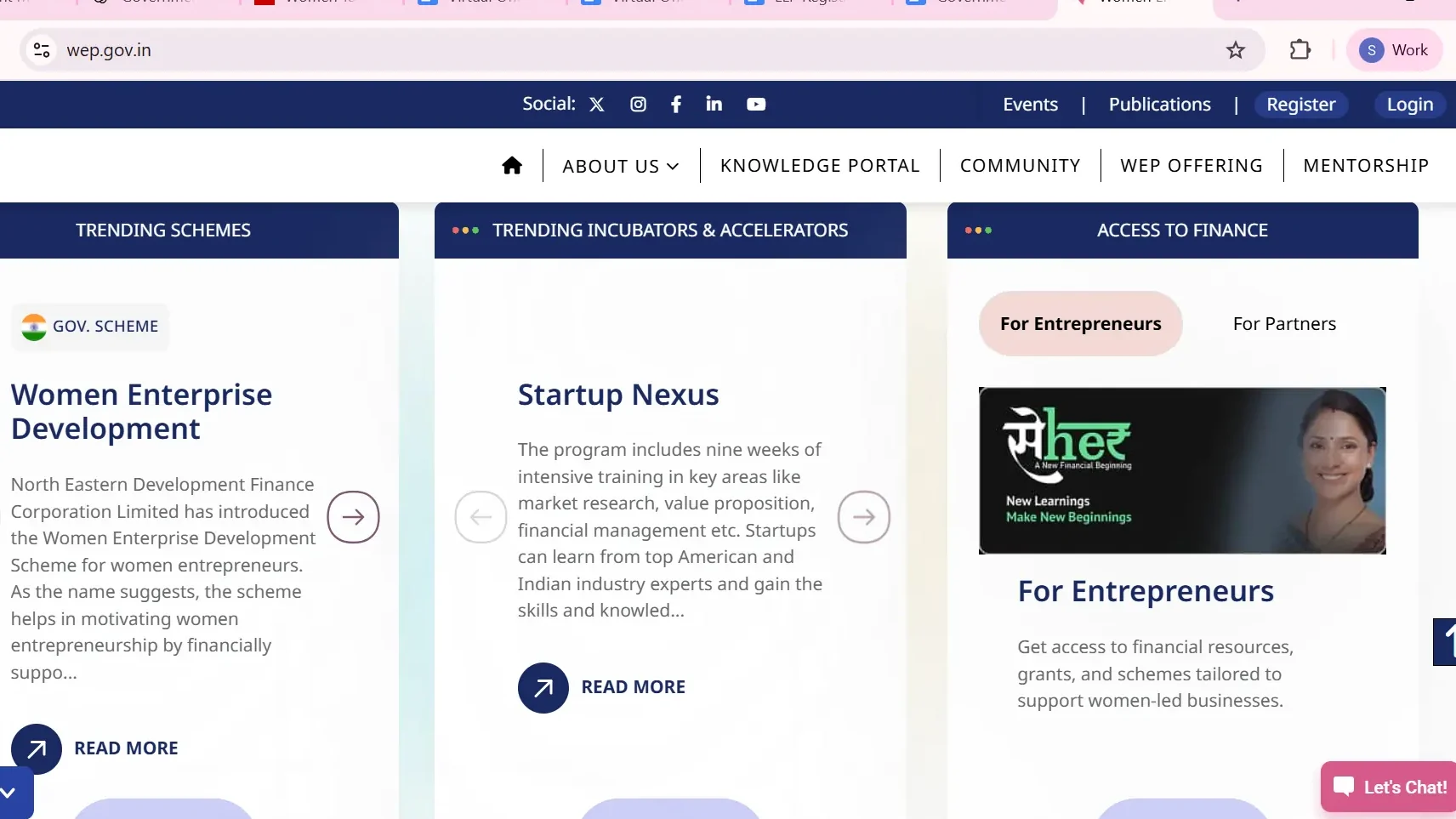
The Women Entrepreneurship Platform (WEP) connects women entrepreneurs to resources, support, and opportunities. Here’s how it works:
- Registration: Women entrepreneurs can create a free account on the portal.
- Access Government Schemes: They can explore and apply for central and state government programs for funding, loans, and subsidies.
- Mentorship and Training: WEP links them with experienced mentors and provides online courses, workshops, and skill-building programs.
- Networking and Community: Entrepreneurs can join forums and peer networks to share ideas, seek advice, and collaborate.
- Business Growth Support: The portal offers guidance on marketing, branding, technology adoption, and scaling businesses.
- Integration with Startup India: WEP connects women entrepreneurs with Startup India registration, incubation centers, and startup resources.
The portal effectively supports women entrepreneurs launching new ventures. It is a great platform to structure the foundations for your business and grow efficiently.
How to Apply for Government Schemes for Women’s Empowerment?
The step-by-step process to apply for government schemes for women entrepreneurs is:
- Identify the right scheme based on your business stage, loan requirement, and sector, such as manufacturing, services, or trading.
- Register on the Udyam portal to obtain an MSME registration certificate, which most schemes require.
- Prepare essential documents, including Aadhaar, PAN, bank details, address proof, and a basic business plan.
- Apply through the official portal or bank, such as Stand-Up Mitra, Mudra portal, Startup India, or a partnered bank or NBFC.
- Submit your application and documents online or at the bank branch, and clearly explain your business proposal.
- Respond to verification requests from the bank or authority to avoid delays.
- Track application status and follow up until loan sanction or scheme approval is completed.
Common Documents Required
Applicants usually submit these documents on the online portal to register for the schemes:
- Aadhaar card
- PAN card
- Business address proof
- Bank account details
- Basic business plan
- Udyam registration certificate
Some schemes may also require income proof or project cost details, so applicants should keep them ready.
Online Application Portals
Various government portals connect applicants directly with banks and government bodies. The following portals can be used to apply for the government schemes:
- Stand-Up Mitra: www.standupmitra.in
- The Mudra loan portal: www.mudra.org.in
- MSME Udyam Registration Portal: udyamregistration.gov.in
- The Startup India portal: www.startupindia.gov.in
Make sure to keep the documents complete and accurate. You must maintain a clear business plan, apply under the correct scheme category, and respond quickly to bank queries to avoid delays or rejection.
Benefits of Government Schemes for Women Entrepreneurs
The primary purpose of these schemes is to increase the involvement of women in entrepreneurship and to support aspiring entrepreneurs. Here’s how women entrepreneurs can benefit from the schemes:
- Financial Support & Credit Access: Schemes provide collateral-free or low-interest loans starting from Rs. 50,000, helping women start or expand businesses with minimal personal investment.
- Training & Mentorship: Women entrepreneurs gain access to skill-building programs, workshops, and expert guidance to manage operations efficiently.
- Subsidies & Marketing Support: Many schemes like PMEGP, Mahila Coir Yojana, and TREAD offer capital subsidies, equipment support, and help with marketing or government procurement to increase business visibility.
- Boosting Women-Led MSMEs and Startups: These combined grants for startups and benefits improve business sustainability, increase women’s participation in the economy, and generate employment opportunities.
Real Businesses Examples That Benefited from Government Schemes for Women
Real business stories demonstrate how government schemes drive real change, not just exist as policies on paper. These examples highlight how timely credit, training, and institutional support helped women turn small ideas into stable, income-generating businesses. Here are some examples for reference:
1. Hoopoe honey venture (Tamil Nadu): Two women, Priyashri Mani and Nishita Vasanth, used government loans under MSME support schemes to grow their honey harvesting startup in the Palani Hills. They scaled operations, hired more women, and built a sustainable business that connects rural producers to broader markets. This proved how scheme support can help a local enterprise expand.
2. Mission Shakti Mushroom Group (Uttar Pradesh): Neha Kashyap and her Ekta SHG started mushroom cultivation with just a small investment backed by state livelihood funds. The members of the initiative now earn Rs. 40,000-50,000 per month and have expanded into goat rearing and tailoring. This demonstrated how government‑linked SHG programs boost rural women’s income and entrepreneurship.
3. State SHG enterprise (Prayagraj): Sheela Devi transformed her life with the help of government livelihood programs. She launched a tent‑house business and expanded into Bijli Sakhi roles. She now earns a good income and employs over two dozen women through her business. This case highlights the scheme’s impact on self‑help and local economic change.
These examples show how government credit access, training, and funding help women turn ideas into income‑generating activities.
Conclusion
Government schemes have opened doors for women entrepreneurs across India. From collateral-free loans under PMMY and Stand-Up India to training and subsidies through PMEGP and Mahila Coir Yojana, women now have practical support at every business stage.
The key is to select the scheme that suits your sector, your stage, and your funding requirement, and then apply with the correct documents through the appropriate portal. You should complete your Udyam registration early, keep a clear business plan ready, and follow up on your application until it receives approval. With the right scheme and consistent effort, you can turn a small idea into a stable and growing enterprise.
