

Trademark Class 7 covers industrial and mechanical machines in India. It includes motors, engines, construction equipment, manufacturing tools, agricultural machinery, and other motor-driven equipment. If you manufacture or sell these products, registering your brand under Class 7 helps protect your name and logo.
The Nice Classification, established by WIPO under the 1957 Nice Agreement, divides goods and services into 45 trademark classes:
- Class 1-34: Goods, including machinery, industrial tools, and other products
- Class 35-45: Services, such as finance, education, and business support
Kirloskar is a well-known Indian Class 7 brand. It manufactures pumps, engines, and industrial machines.
Key Takeaways
- Class 7 covers industrial machines, construction equipment, manufacturing tools, agricultural machinery, and motor-driven equipment across sectors.
- Electric, motor-driven kitchen appliances, including household mixer-grinders, are Class 7, not Class 21. Only manual, non-motorized grinders or mixers belong under Class 21.
- It does not cover hand tools (Class 8), vehicles (Class 12), heating/cooling appliances like kettles and fans (Class 11), or measuring instruments (Class 9).
- Online filing costs ₹4,500 per class for individuals, startups, and MSMEs, and ₹9,000 per class for companies and other entities.
- A trademark remains valid for 10 years from the date of application, not the registration date, and renews indefinitely.
What is Trademark Class 7 in India?
Trademark Class 7 covers industrial and mechanical machines. It includes motors, engines, and construction and manufacturing tools. The Trade Marks Act, 1999 governs registration in India. The CGPDTM oversees the process through the Trade Marks Registry.
Registering under Class 7 gives machinery and industrial equipment brands exclusive rights to their name and logo. It also protects against imitation.
Who Should Choose Class 7 Trademark in India?
Businesses dealing with industrial machines, motors, and mechanical equipment should consider registering under Class 7. The following types of companies and sellers can benefit from Class 7 trademark protection:
- Industrial machine manufacturers: Motors, engines, pumps, and heavy machinery.
- Construction equipment brands: Excavators, loaders, concrete mixers, and bulldozers.
- Manufacturing tool companies: Machine tools for cutting, shaping, or finishing materials, lathes, drills, presses, milling machines.
- Agricultural machinery manufacturers: Tractors, harvesters, seeders, and ploughing equipment.
- Food and textile machinery makers: Industrial mixers, grinders, and textile spinning or weaving machines.
- Packaging and printing equipment brands: Bottling, labeling, and printing machines.
- Mining and earth-moving equipment companies: Industrial loaders, crushers, and mining machinery.
What Goods Fall Under Trademark Class 7?
Trademark Class 7 mainly covers trademark registration for machines, mechanical tools, and industrial equipment. This class includes devices used in manufacturing, construction, agriculture, food processing, and other industries.
The table below highlights the trademark class 7 goods list:
| Goods Type | Description | Examples |
|---|---|---|
| Industrial machines | Machines used in factories or production units | Motors, pumps, engines, assembly line machines |
| Construction equipment | Machines used in construction and civil work | Excavators, loaders, concrete mixers, bulldozers |
| Manufacturing tools | Tools and machines for shaping, cutting, or finishing materials | Lathes, drills, presses, milling machines |
| Agricultural machinery | Equipment for farming and crop production | Tractors, harvesters, ploughs, seeders |
| Food processing machines (electric) | Motor-driven machines for grinding, mixing, or preparing food, industrial or household | Industrial mixers, grinders, slicers, and electric household mixer-grinders |
| Textile and garment machinery | Machines used in textile production and garment manufacturing | Spinning machines, weaving machines, sewing machines |
| Packaging and printing machines | Machines for packaging, labeling, or printing products | Bottle fillers, labeling machines, printing presses |
| Mining and earth-moving equipment | Heavy machines for excavation and mining operations | Crushers, industrial loaders, mining shovels |
What is Not Covered in Trademark Class 7?
Many businesses assume certain equipment or tools fall under Class 7, but they actually belong to other trademark classes. The table below highlights goods not covered under Trademark Class 7 and their correct classes:
| Goods Type | Examples | Correct Class |
|---|---|---|
| Hand tools | Manual hammers, screwdrivers, wrenches | Class 8 |
| Household heating/cooling appliances | Electric kettles, fans, air conditioners | Class 11 |
| Vehicles and transport | Cars, motorcycles, bicycles | Class 12 |
| Measuring instruments | Scales, thermometers, gauges | Class 9 |
| Manual (non-electric) food processing tools | Hand-crank grinders, non-electric mixers | Class 21 |
| Office machinery | Printers, photocopiers, calculators | Class 16 or Class 9 |
| Safety and protective gear | Helmets, gloves, protective clothing | Class 9 or Class 10 |
Tip: Use RegisterKaro’s free Trademark Class Search Tool to find the right class for your goods.
How to Register a Class 7 Trademark in India?
Registering a Class 7 trademark protects your brand for machinery, engines, and other mechanical equipment.
Follow these steps to complete the registration process in India:
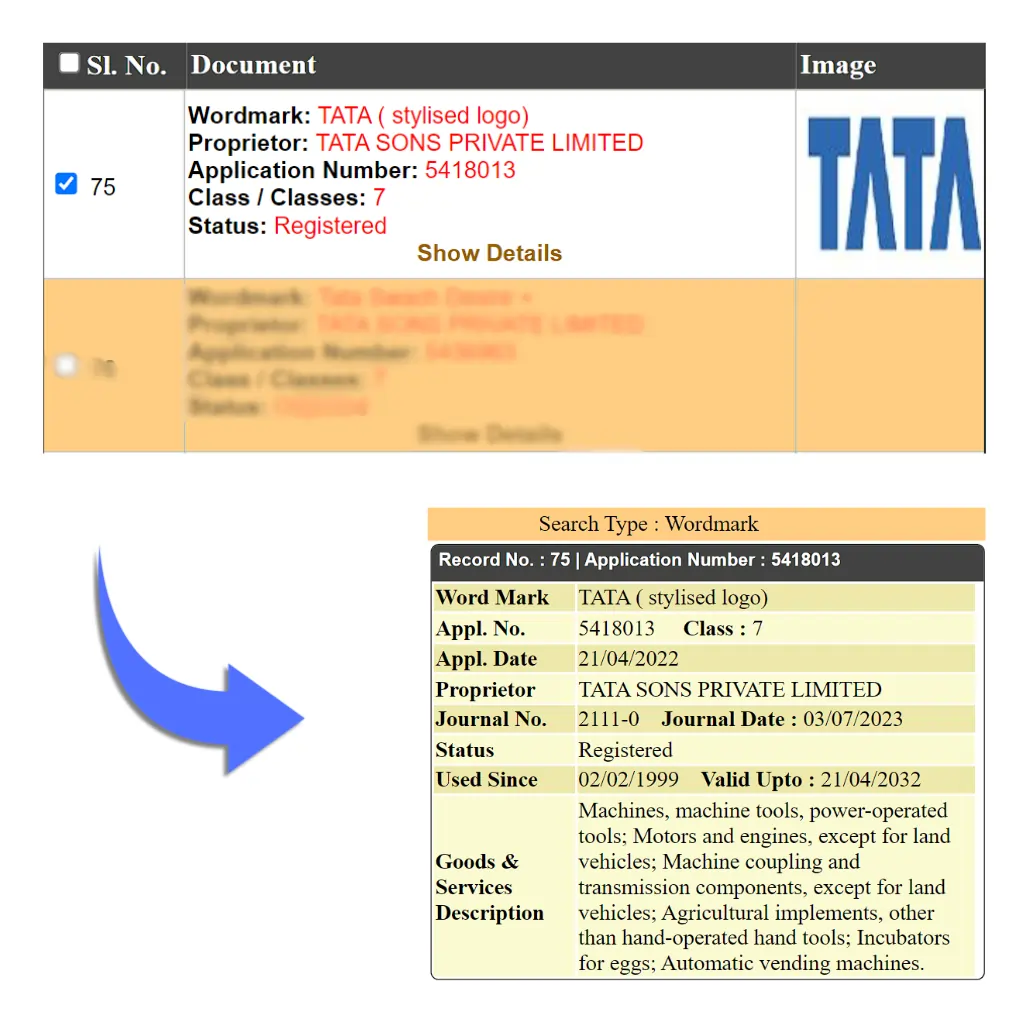
- Search first: Check the IP India portal or the RegisterKaro Trademark Search Tool to ensure your brand name or logo is not already registered under Class 7.
- Define product details: Clearly list your machines and equipment. This may include motors, industrial mixers, construction machinery, and agricultural tools. Avoid vague descriptions.
- File Form TM-A: Submit the application online through the IP India Trademark Portal. Choose a single-class application for Class 7 goods. If your brand covers other classes, you can file a multi-class application.
- Pay the government fee: The fee is ₹4,500 per class for individuals, startups, and MSMEs. For companies and other entities, it is ₹9,000 per class.
- Examination: The Trademark Registry checks the application for classification, distinctiveness, and similar marks. If issues arise, it issues an Examination Report. You must reply to trademark objections within 30 days.
- Publication and opposition window: Once approved, the mark is published in the Trademark Journal for four months. During this period, third parties can file a trademark opposition.
- Registration and renewal: Once registered, the trademark is valid for 10 years from the application date. Under Section 25 of the Trade Marks Act, 1999, you can renew it every 10 years.
Examination usually takes 6–12 months. The publication period takes another four months. If uncontested, the full process usually takes 12–18 months.
Common Mistakes While Registering for Trademark Class 7
Businesses often make several mistakes while registering a Trademark under Class 7 in India. These errors can cause objections, delays, or even rejection of the application.
- Choosing the wrong class: Manual tools fall under Class 8, and heating/cooling appliances fall under Class 11. But electric mixers and grinders belong in Class 7, not Class 21, despite common confusion.
- Using vague product descriptions: Broad terms like “machinery” or “industrial equipment” increase the chance of objections. Be specific.
- Skipping a trademark search: Filing without checking existing Class 7 trademarks risks conflicts with similar marks.
- Ignoring brand distinctiveness: Generic or descriptive names often face rejection. A Class 7 trademark must identify the brand, not just the machine type.
- Missing objection deadlines: Failing to reply to examination reports within 30 days can lead to abandonment.
- Not planning for future products: Registering only current machines may require fresh filings later as the business expands.
- Filing without professional guidance: Incorrect forms or documents delay approval.
