Public Limited Company Registration in Mumbai
Register your Public Limited Company in Mumbai online with RegisterKaro at affordable pricing. Get end-to-end expert support for MCA incorporation, ROC Mumbai-I approval, and complete compliance setup for smooth business operations.
 Fast SPICe+ Incorporation Under ROC Mumbai-I JurisdictionDedicated Assistance for SEBI-Ready DocumentationRegistered Office Compliance Support for Prime Mumbai Business LocationsMaharashtra Stamp Duty Guidance for MOA & AOAFull Post-Incorporation Compliance Support

 What Sets Us ApartWhat Sets Us Apart
What is a Public Limited Company in Mumbai?
A Public Limited Company (PLC) in Mumbai is incorporated under Section 2(71) of the Companies Act, 2013, through the ROC Mumbai-I. It allows companies to raise capital from the public while offering limited liability protection to shareholders. Shares are freely transferable, and the structure follows strict disclosure & governance requirements from the beginning.
In Mumbai, a PLC operates within India’s strongest financial and regulatory ecosystem, centered around BKC (SEBI and NSE), Dalal Street (BSE), and Lower Parel. ROC Mumbai-I incorporation places public limited companies close to SEBI headquarters, the BSE, and the NSE. This proximity shapes fundraising strategies and strengthens compliance readiness for capital-market participation.
A Public Limited Company in Mumbai is typically designed for institutional capital access and long-term scalability from inception. The city offers strong support from merchant bankers, auditors, and legal advisors across key business districts. Public Limited Company Registration is generally preferred by businesses planning large-scale fundraising, institutional investment, or future public listing.
Why Choose a Public Limited Company (PLC) in Mumbai?
As India’s financial capital, here’s why Mumbai remains the preferred destination for Public Limited Companies:
- Direct access to India’s stock exchanges: Public Limited Companies in Mumbai operate near the BSE (Dalal Street) and the NSE (BKC). This proximity improves access to merchant bankers, legal advisors, and institutional investors involved in IPO planning.
- Strong institutional investor access: Public Companies in Mumbai easily access LIC, SBI Mutual Fund, HDFC AMC, ICICI Prudential AMC, and FPIs. These institutions actively participate in IPOs, QIPs, and secondary markets.
- Deep IPO and merchant banking ecosystem: Mumbai hosts leading merchant bankers like Kotak Mahindra Capital, ICICI Securities, JM Financial, and Axis Capital. These firms regularly structure IPOs for Public Limited Companies across sectors.
- Faster regulatory coordination for public companies: Public Limited Companies benefit from proximity to the SEBI headquarters in BKC. This improves coordination for DRHP filings, IPO approvals, and regulatory clarifications.
- Strong BFSI regulatory ecosystem: Banking, NBFC, and insurance-focused Public Companies also gain easier access to RBI and IRDAI offices located in Mumbai. This simplifies licensing, approvals, and compliance processes.
- Higher credibility for Public Limited Companies: Mumbai-based public Companies gain strong investor trust when operating from BKC, Nariman Point, or Lower Parel. These hubs are closely associated with the listed companies.
- Strong legal and compliance support system: Mumbai has India’s top corporate law firms like AZB & Partners, Cyril Amarchand Mangaldas, and Khaitan & Co. They support Public Companies with audits, governance, and SEBI compliance.
- Global fundraising and listing access: Public Limited Companies can access international fundraising through GIFT City platforms like NSE IX and India INX. Mumbai-based advisors typically manage these structures.
Eligibility for Public Limited Company Registration in Mumbai
To register a Public Limited Company in Mumbai, you must meet requirements under the Companies Act, 2013:
- Minimum shareholders: At least 7 shareholders are required, with no upper limit on ownership.
- Minimum directors: A Public Limited Company must appoint at least 3 directors, up to 15 under normal provisions.
- Resident Indian director: At least one director must stay in India for 182 days in the financial year.
- DIN: Every director must have a Director Identification Number (DIN), allotted via SPICe+ for new incorporations.
- DSC: All directors and MOA subscribers must hold a Digital Signature Certificate (DSC) for mandatory MCA filings.
- No minimum paid-up capital: The Companies (Amendment) Act, 2015, removed the earlier ₹5 lakh minimum paid-up capital requirement for incorporation.
- Authorized capital declaration: Authorized share capital must be mentioned in the MOA based on the promoter's planning.
- Registered office in Mumbai jurisdiction: The company must maintain a registered office under the ROC Mumbai-I or Maharashtra.
- Proper name compliance: The company name must end with “Limited” and comply with MCA and trademark rules.
- No disqualified directors: Directors must not fall under Section 164 disqualification conditions under the Act.
- Minimum age requirement: Directors must be at least 18 years old and of sound mind.
- Foreign participation allowed: NRIs and foreign nationals can become directors or shareholders under FEMA and FDI regulations.
Authorities Regulating Public Limited Company Registration in Mumbai
Public limited company registration in Mumbai is governed by multiple central, state, and financial regulators. These include:
- Ministry of Corporate Affairs (MCA): As the apex authority under the Companies Act, 2013, the MCA manages incorporation, statutory filings, and compliance through the MCA portal (mca.gov.in).
- Registrar of Companies (ROC), Mumbai: This is the primary incorporation office for Mumbai, which issues registration certificates, processes filings, and maintains company records.
- Regional Director (Western Region): Based in Mumbai, it supervises ROC-level approvals, including interstate registered office shifts, compounding of offences, and special corporate permissions.
- Securities and Exchange Board of India (SEBI): Headquartered at Bandra Kurla Complex, Mumbai, it regulates IPO-bound and listed public limited companies under ICDR 2018 and LODR 2015 regulations.
- Bombay Stock Exchange (BSE) & National Stock Exchange (NSE): Located at Dalal Street and BKC, these exchanges regulate listing approvals, disclosure requirements, and continuous compliance for public companies.
- Reserve Bank of India (RBI): Headquartered at Mint Road, Mumbai, it governs foreign investment, ECBs, and FEMA compliance for companies with NRI or foreign shareholding.
- Income Tax Department (CBDT): The CBDT oversees corporate taxation, TDS, and income tax compliance for companies while issuing PAN and TAN during incorporation via SPICe+.
- Maharashtra Stamp Duty Authority: Collects stamp duty on MOA, AOA, and incorporation documents under the Maharashtra Stamp Act, 1958.
- Maharashtra GST Department: Handles GST registration through AGILE-PRO-S integration and monitors indirect tax compliance for companies operating in Mumbai.
- Brihanmumbai Municipal Corporation (BMC): Issues Shops and Establishments registration, trade licenses, and local business permissions for Mumbai offices.
- International Financial Services Centres Authority (IFSCA): Regulates cross-border fundraising and listings via GIFT City platforms such as NSE IX and India INX.
- NSDL & CDSL (Depositories): Maintain demat accounts and electronic shareholding records for public limited companies and listed entities.
- Ministry of Labour & Employment: Governs labour law compliance, including PF, ESIC, and employee welfare obligations.
- Trademark Registry (CGPDTM): Protects brand identity and trademarks under the Trade Marks Act, 1999, for scalable public companies.
Documents Required to Register a Public Limited Company in Mumbai
The MCA requires specific identity, address, and incorporation documents to complete the SPICe+ filing and approve company registration. These include:
| Category | Document | Requirement Details |
| Indian Directors & Shareholders | PAN Card | Mandatory for all directors and shareholders |
| Identity Proof | Aadhaar Card, Voter ID, or Passport | |
| Address Proof | Bank statement or utility bill not older than 2–3 months | |
| Passport Size Photo | A recent and clearly scanned photograph | |
| DSC | Mandatory for all directors and subscribers | |
| Mobile & Email ID | Required for OTP verification and MCA communication | |
| Foreign Directors & Shareholders | Passport | A notarized and apostilled copy is mandatory |
| Address Proof | Bank statement or utility bill not older than 2 months, notarized and apostilled | |
| Business Visa | Required if present in India during incorporation | |
| Registered Office (Mumbai) | Address Proof | Electricity bill, telephone bill, or property tax receipt (2–3 months old) |
| Rent Agreement | Required if the premises are rented | |
| NOC from Owner | Mandatory consent letter from the property owner | |
| Ownership Proof | A sale deed is required for self-owned property | |
| Company-Level Documents | Memorandum of Association (MOA) | Defines business objectives and the scope of the company |
| Articles of Association (AOA) | Defines internal governance and management rules | |
| Name Approval | SPICe+ Part A approval from MCA | |
| Form INC-9 | Declaration by subscribers and directors | |
| Form DIR-2 | Consent of directors to act in the company | |
| Declaration under Section 164 | Confirms directors are not disqualified | |
| Subscriber Details | Identity and address proof of all MOA subscribers |
How to Register a Public Limited Company in Mumbai?
Registering a Public Limited Company in Mumbai is a fully online process carried out through the MCA portal. Here’s the step-by-step process in alignment with the ROC Mumbai-I jurisdiction:
Step 1: Obtain DSC: Apply for Class 3 DSC for every proposed director and all MOA subscribers to digitally sign MCA forms. Use licensed certifying authorities such as eMudhra, Sify, or Capricorn.
Step 2: Reserve the Company Name: Log in to the MCA portal and file SPICe+ Part A. Use RegisterKaro’s free company name search tool to choose the desired name and submit up to two proposed names.
Step 3: File SPICe+ Part B: Fill SPICe+ Form, which handles company incorporation, DIN allotment (for up to three directors), PAN, and TAN. Fill in the details of the company, registered office in Mumbai, directors, and capital structure.
Step 4: Attach MOA, AOA, and Linked Forms: Prepare and upload e-MOA (INC-33) and e-AOA (INC-34). Attach AGILE-PRO-S form for GST, EPFO, ESIC, and bank account setup. Ensure all forms are digitally signed by a practicing CA, CS, or CMA before submission.
Step 5: Pay Government Fees and Stamp Duty: Calculate and pay MCA fees and Maharashtra stamp duty through the portal. The system automatically determines charges based on authorized capital. Complete payment online using net banking or UPI to proceed further.
Step 6: ROC Mumbai-I Verification: The ROC Mumbai-I reviews your application and documents. Respond quickly to any clarification or resubmission remarks and resubmit within the given timeframe to avoid rejection.
Step 7: Receive COI: Collect the Certificate of Incorporation issued by the ROC Mumbai-I once approval is granted. The CIN, PAN, and TAN are included in this certificate.
The entire process to register a public limited company in Mumbai takes around 15 to 21 days.
Public Limited Company Registration Fees in Mumbai
The total cost of incorporating a Public Limited Company in Mumbai varies based on authorized share capital, government levies, professional charges, and Maharashtra stamp duty. Here is a detailed breakdown:
1. Government Fees (MCA + ROC Mumbai-I)
Government charges include name approval, incorporation filing, and issuance of the incorporation certificate. These costs are linked to the authorized share capital, and lower capital structures generally attract minimal statutory fees.
Key components include:
- SPICe+ filing charges on the MCA portal
- Name reservation fee of ₹1,000 under SPICe+ Part A
- ROC Mumbai-I incorporation and processing charges
- Certificate of Incorporation issuance and related statutory filings
Note: New company formation in Mumbai is carried out through SPICe+ integrated filing. RUN is primarily used for name changes of existing companies.
2. Maharashtra Stamp Duty
Stamp duty is levied by the Government of Maharashtra on incorporation documents. It applies to the MOA and AOA and is auto-computed during the SPICe+ filing process based on authorized capital.
3. Professional Fees
Professional service charges depend on the consultant and the complexity of incorporation. These generally cover:
- Preparation and drafting of MOA and AOA as per legal requirements
- End-to-end SPICe+ filing and incorporation coordination
- DSC application support and documentation handling
- Certification by a practicing CA, CS, or CMA.
4. Post-Incorporation Compliance Costs
After incorporation, companies should also plan for ongoing compliance expenses, such as:
- GST registration and accounting system setup (where applicable)
- Statutory auditor appointment and basic bookkeeping setup
- Annual ROC filings and compliance management under the Companies Act, 2013.
Post-Incorporation Compliance for Public Limited Companies in Mumbai
Once ROC Mumbai-I issues the Company Registration Certificate, the Public Limited Company must complete time-bound compliances to remain legally active and operational.
Within 30 Days of Incorporation
- Hold the first Board Meeting, where directors approve initial actions, note share subscriptions, and authorize opening of the bank account.
- Appoint the first statutory auditor under Section 139(6), ensuring the appointment continues until the first AGM.
- File Form ADT-1 with ROC Mumbai-I within 15 days of auditor appointment to inform the authority.
- Record Form MBP-1 at the first Board Meeting to disclose director interests under Section 184.
- File Form DIR-8 to confirm that each director is not disqualified under Section 164.
- Submit Form INC-22 if you change the registered office address.
- Open a current bank account in the company’s name with any authorized bank in Mumbai.
Within 60 Days of Incorporation
- Issue share certificates to all subscribers under Section 56 within the prescribed timeline after incorporation.
- Pay Maharashtra stamp duty on share certificates as per applicable state rules.
Within 180 Days of Incorporation
- File Form INC-20A to declare the commencement of business under Section 10A.
Annual and Ongoing Compliances
- Hold the first AGM within nine months of the end of the first financial year.
- Conduct at least four Board Meetings every year, ensuring no gap exceeds 120 days.
- File Form AOC-4 within 30 days of AGM for financial statement submission.
- Submit Form MGT-7 within 60 days of AGM as the annual return for public companies.
- File Income Tax Return (ITR-6) by 31st October after audit completion.
- Complete DIR-3 KYC annually for all directors by 30th September.
- Maintain statutory registers at the registered office in Mumbai, including members, directors, charges, and contracts.
- Display company name, CIN, address, and contact details on all official documents and signage.
Note: The gap between two AGMs must not exceed 15 months. Subsequent AGMs are generally required to be held on or before September 30 each financial year.
Additional Compliance for Public Limited Companies
- Appoint independent directors as required under Section 149(4) for eligible or listed companies.
- Appoint a woman director if the company is listed, or has paid-up capital of ₹100 crore or more, or turnover of ₹300 crore or more.
- Appoint a Company Secretary if the company is listed or if the paid-up capital is ₹10 crore or more under Section 203 of the Companies Act, 2013, read with Rule 8 of the Companies (Appointment and Remuneration of Managerial Personnel) Rules, 2014.
- Conduct a secretarial audit if paid-up capital is ₹50 crore or more, or turnover is ₹250 crore or more, under Section 204, read with Rule 9 of the Companies (Appointment and Remuneration of Managerial Personnel) Rules, 2014.
- Form Audit, Nomination & Remuneration, and Stakeholder Relationship Committees for listed companies.
- Comply with SEBI (LODR) Regulations if listed on BSE or NSE.
- Obtain Professional Tax registration in Maharashtra within 30 days of hiring employees.
- Obtain Shops and Establishments registration from BMC for all Mumbai offices.
- Secure fire safety NOCs and trade licenses from BMC for regulated commercial areas.
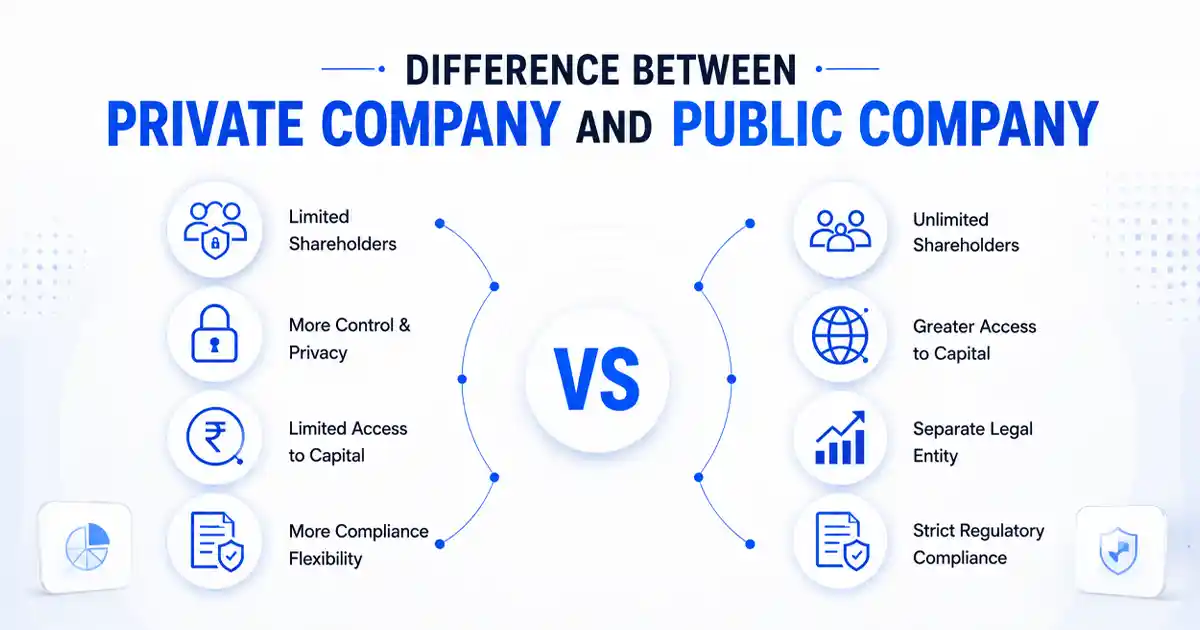
Public vs Private Limited Company in Mumbai: Key Differences
Choosing between a Public Limited Company and a Private Limited Company in Mumbai depends on your funding needs and long-term growth plans. Here’s a detailed comparison:
| Basis | Public Limited Company in Mumbai | Private Limited Company in Mumbai |
| Ownership | Open to public shareholders with freely transferable shares | Restricted ownership among private shareholders |
| Minimum Members | At least 7 shareholders and 3 directors | At least 2 shareholders and 2 directors |
| Fundraising | Can raise capital from the public and list on stock exchanges like BSE and NSE | Cannot invite public investment or list shares publicly |
| Compliance Level | High compliance with MCA, SEBI (if listed), and stricter governance norms | Moderate compliance under MCA with fewer disclosure requirements |
| Share Transfer | Freely transferable, subject to regulations | Restricted transfer, controlled by Articles of Association |
| Capital Raising Scope | Suitable for IPOs, QIPs, and institutional funding | Limited to private equity, loans, and internal funding |
| Board Structure | Mandatory independent directors and board committees for listed entities | No mandatory independent directors or committees |
| Regulatory Oversight | MCA, SEBI, RBI (if applicable), and stock exchanges | Primarily MCA with sectoral regulators if applicable |
| Credibility | Higher credibility with institutional investors and public markets | Preferred for startups and closely held businesses |
| Best Suited For | Large-scale businesses in Mumbai are targeting IPO and expansion | Small to mid-sized businesses and startups in Mumbai |
Connect with RegisterKaro and let our experts handle the legal hassle while you grow your business.
Frequently Asked Questions (FAQs)
How many people are required to register a public limited company in Mumbai?
−You need a minimum of seven shareholders and three directors to register a public limited company in Mumbai. At least one director must be a resident of India. A public limited company can have up to 15 directors under normal provisions, while there is no upper limit on the number of shareholders.
What is the minimum capital required for public limited company registration in Mumbai?
+How long does it take to register a public limited company in Mumbai?
+Where is the ROC office for public limited company registration in Mumbai located?
+Can a foreign national be a director in a Mumbai-based public limited company?
+What is the difference between authorized capital and paid-up capital for a PLC in Mumbai?
+Can a public limited company in Mumbai list on any stock exchange?
+What is Form INC-20A, and when must a Mumbai PLC file it?
+How much stamp duty applies to MOA and AOA in Maharashtra for a public limited company?
+Can I convert my private limited company in Mumbai into a public limited company later?
+
Reviewed by
Lokesh AgarwalWhy Choose RegisterKaro for Public Limited Company Registration in Mumbai?
Registering a Public Limited Company in Mumbai becomes simpler with RegisterKaro’s end-to-end expert support. We assist businesses across BKC, Nariman Point, Lower Parel, Andheri, and Navi Mumbai in building strong, compliant, and investor-ready corporate structures. Here’s why 50,000+ businesses trust us:
- Expert Guidance From Incorporation To Approval: Our corporate professionals manage the entire incorporation process under ROC Mumbai-I, including DSC, DIN, name approval, and SPICe+ filing with complete compliance support.
- Faster Incorporation With Fewer Rejections: We ensure accurate documentation and error-free filings to reduce resubmission risks at ROC Mumbai-I, helping companies get incorporated faster.
- Complete Maharashtra Compliance Assistance: Our experts handle Maharashtra stamp duty, registered office requirements, and jurisdiction-specific ROC Mumbai-I procedures for smooth approval.
- Post-Incorporation Compliance Support: We manage INC-20A filing, AGM compliance, and annual ROC filings to ensure your company stays fully compliant in Mumbai.
- Trusted By Mumbai-Based Growth Businesses: From fintech startups in BKC to manufacturing firms in Navi Mumbai, businesses choose us for reliable and structured public company registration support.

What Our Clients Say
View All
Jit
 Verified
Register Karo is the best platform to register your company, @kajal chowhan helped me a lot, to make the process smoothly. Thank you team registerkaro

Guru
Verifiedprofessional work, good team work by the team allocated to us, on time delivery for incorporation of my company, Ankit followed a good workflow throug... Read more

yayati
VerifiedI reached out to registerkro for company windup. Would like to give shout out to Astha gupta who was extremly helpful throughout the process. Kudos to... Read more

Vijay Azad
VerifiedHi It was pleasure to contact you@alka for company registration .Happy with the dedication and support during process and working beyond timeline...

aravind raj
VerifiedWe did startup registeration with their team, it was point to point approach and they were clear in those procedures and their followup is too good...

vinay kumar
VerifiedYour staff Ankita Matta is a polite person the way of handling the issues was good. I hope in future register karo team handle the issues in a same wa... Read more

Riya Singh
VerifiedRegister karo demonstrated professionalism and expertise in navigating complex legal and regulatory issues related to our industry. Special thanks Ank... Read more

ganesh patil
VerifiedHad a great experience with Register Karo. The LLP registration process was handled smoothly and everything was explained clearly. Highly recommended!

Ayush
VerifiedReally impressed with the service provided by Prayansh Jindal. He handled everything efficiently and ensured that all my queries were answered promptl... Read more

Sanjeev Rai
VerifiedRegister karo Helped me A lot in ICEGATE Registration Process, Highly satisfied with their Service , Kind and polite staff Overall Excellent Experienc... Read more
Related Blogs
View All
Annual Compliances for Public Limited Company in India: 2026-27 Guide

Conversion of a Public Company into a Private Company: Legal Requirements
Difference Between Private and Public Limited Company in India

Procedure for Public Company Registration in India