Startup Registration in Maharashtra
Register your startup in Maharashtra and secure Startup India DPIIT recognition. RegisterKaro handles incorporation, the recognition application, and MSInS scheme eligibility screening.
 Startup Eligibility & DPIIT Recognition GuidanceFounder KYC & Registered Office DocumentationSection 140 Tax Holiday Application SupportGuidance on MSInS & Maharashtra State Startup SchemesGST, ROC & Post-Registration Compliance Support

 What Sets Us ApartWhat Sets Us Apart
What is Startup Registration in Maharashtra?
Startup incorporation allows founders to establish their businesses across Maharashtra's growing startup hubs, from Mumbai and Pune to Nagpur, Nashik, Thane, and Chhatrapati Sambhajinagar. Together, these cities contribute to a statewide ecosystem of 35,992 DPIIT-recognized startups as of December 2025, the highest of any state, per DPIIT data.
Startup registration gives the venture a recognized legal identity and a formal base for entering contracts, raising capital, and growing the business. After incorporation, eligible businesses can separately apply for DPIIT recognition through the Department for Promotion of Industry and Internal Trade and explore MSInS programs, including the Maharashtra Virtual Incubation Centre, which supports founders across the state.
Benefits of Registering Your Startup in Maharashtra
Incorporating in Maharashtra and obtaining Startup India (DPIIT) recognition, where eligible, can provide access to a strong startup ecosystem, state incentives, tax benefits, procurement opportunities, and IPR support:
- Plug into India's largest startup ecosystem: Maharashtra hosts more DPIIT-recognized startups than any other state, giving founders access to a deep network of investors, mentors, and enterprise clients, particularly across Mumbai and Pune.
- Reach Mumbai's capital and Pune's talent: Mumbai offers a dense concentration of VCs, banks, and corporate headquarters, while Pune provides strong engineering talent and established SaaS, technology, and manufacturing capabilities.
- Access MSInS schemes: Incorporation provides the legal entity needed to apply for Maharashtra's state startup programs through the Maharashtra State Innovation Society (MSInS), subject to the eligibility and conditions of each scheme. Maharashtra's startup policy includes support such as procurement relaxations, quality-testing assistance, patent filing assistance, and other incentives.
- Claim the startup income-tax deduction: An eligible DPIIT-recognized startup can claim a 100% deduction of eligible profits for three consecutive tax years out of the first ten years under Section 140 of the Income-tax Act, 2025 (replacing Section 80-IAC of the Income Tax Act, 1961). The entity must be incorporated on or after 1 April 2016 and before 1 April 2030, be a Private Limited Company or LLP, and have turnover of not more than ₹100 crore in the year of claim. This is lower than the ₹200 crore DPIIT recognition limit (₹300 crore for deep-tech startups), so a startup can retain DPIIT recognition while falling outside the deduction's turnover condition. An eligible startup must also obtain the required certificate of eligible business from the Inter-Ministerial Board of Certification.
- Access public-procurement opportunities: DPIIT-recognized startups can receive relaxation from prior-turnover and prior-experience requirements in eligible government procurement, subject to applicable procurement rules, technical requirements, and the startup's ability to execute the contract. This can help startups access Maharashtra government and PSU procurement opportunities.
- Access IPR and certification support: Recognized startups can benefit from expedited patent processing and reduced statutory patent filing fees. Maharashtra's startup policy also provides for reimbursement of certain patent filing costs and quality-testing expenses, subject to the applicable scheme conditions.
Eligibility for Startup Registration and DPIIT Recognition in Maharashtra
Startup eligibility in Maharashtra is assessed at two stages: first when you incorporate the entity, and then when you apply for Startup India (DPIIT) recognition, which is the startup-specific stage.
Stage 1: To Incorporate the Entity
The incorporation requirements depend on the structure you choose:
- A Private Limited Company or LLP generally requires at least two members, with at least one India-resident director or designated partner.
- An OPC requires one member and a nominee.
- The entity must have a valid registered office address in Maharashtra.
Stage 2: To Qualify for Startup India (DPIIT) Recognition
DPIIT recognition has separate eligibility criteria. The entity must meet all of the following:
- Entity type: It must be a Private Limited Company, LLP, OPC, registered Partnership Firm, or a cooperative society. Sole proprietorships and HUFs are not eligible.
- Age of the entity: It must be within 10 years of incorporation or registration, extended to 20 years for recognized DeepTech startups, subject to the applicable DeepTech criteria and supporting documentation.
- Turnover ceiling: Its turnover must not have exceeded ₹200 crore in any financial year since incorporation or registration. For a recognized DeepTech startup, the limit is ₹300 crore.
- Innovation or scalability: It must work toward the innovation, development, or improvement of products, processes, or services, or operate a scalable business model with high potential for employment generation or wealth creation. A business engaged only in trading or reselling may not qualify if it does not meet these criteria.
- Originality: It must be a genuinely new entity and must not be formed by splitting up or reconstructing an existing business.
Documents Required for Startup India (DPIIT) Recognition in Maharashtra
Before applying for Startup India (DPIIT) recognition, you must incorporate the entity with the required company or LLP documents, including director KYC, registered-office proof, and Digital Signature Certificate (DSC). For the DPIIT application, keep the following ready:
- Certificate of Incorporation or Registration and the entity's PAN.
- Details of directors or partners, including names, contact details, and profiles.
- Startup innovation write-up: Explain how the product, process, or service is innovative, or how the business model is scalable. This is the key input and a common reason applications are returned for clarification.
- Supporting proof, where available: Website or pitch deck, product/demo video, and evidence of patents, trademarks, awards, funding, or incubation support.
- For deep-tech startups: Additional evidence of R&D spending and intellectual-property creation to support the 20-year recognition period.
Note: DPIIT recognition is assessed based on the startup's eligibility, innovation or scalability, and supporting evidence. The application should accurately explain the startup’s innovation, improvement, or scalability, and provide the supporting information requested by DPIIT.
How to Register a Startup Online in Maharashtra?
Registering a startup in Maharashtra involves two phases: incorporating the legal entity and applying for Startup India (DPIIT) recognition if the business meets the eligibility criteria.
- Incorporate the entity: Choose your business structure and file SPICe+ for a company or FiLLiP for an LLP. After approval, ROC Mumbai (I or II), Pune, or Nagpur, depending on your jurisdiction, will issue the Certificate of Incorporation (CoI), along with PAN and TAN. In Maharashtra, professional tax registration is integrated into SPICe+. Maharashtra is one of only three states where PTEC and PTRC can be applied for through AGILE-PRO-S during incorporation itself.
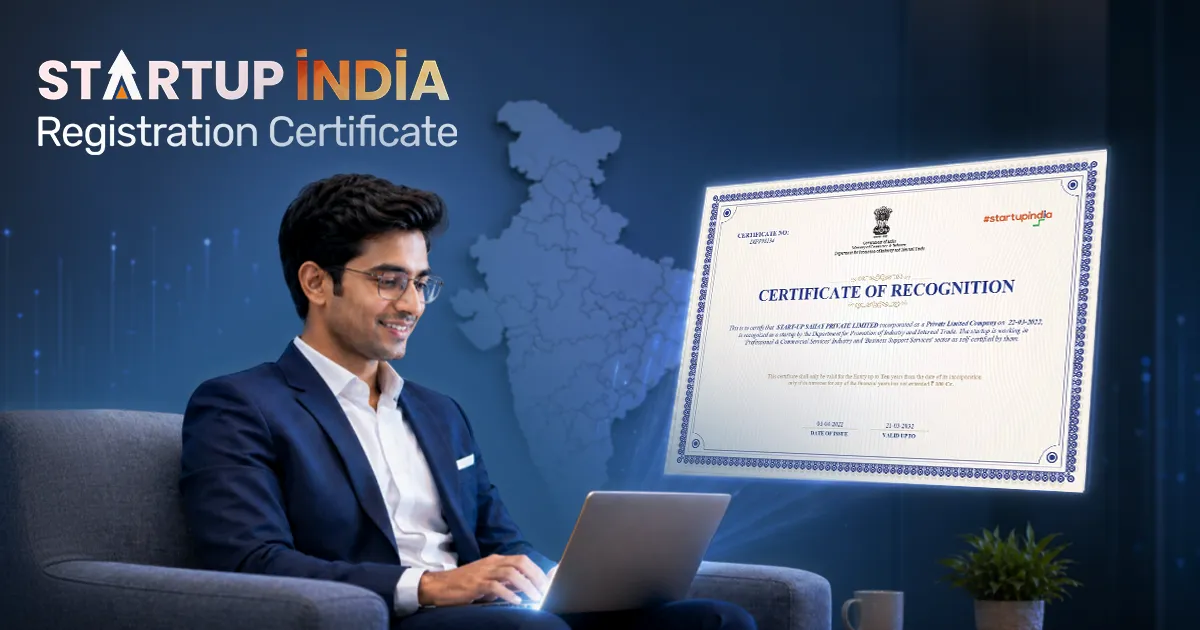
- Create your profile: Register on the Startup India portal (startupindia.gov.in) or use the National Single Window System (NSWS) and select Registration as a Startup under Central Approvals.
- Submit the application: Provide the CoI, entity PAN, and incorporation details, along with a brief explanation of the startup's innovation, development, improvement, or scalability and its potential for employment or wealth creation.
- Receive DPIIT recognition: After review, DPIIT issues the Certificate of Recognition if the startup meets the applicable criteria. The application may be returned for clarification if the information does not adequately establish eligibility or the startup's innovation and scalability.
For the complete filing sequence, required documents list, and Maharashtra-specific costs (including stamp duty breakdown), check out our Company Registration in Maharashtra guide.
Note: After incorporation, eligible startups can also register with the Maharashtra State Innovation Society (MSInS) to access state-level startup programs and incentives, subject to each scheme's eligibility and application requirements.
Startup Registration Fees in Maharashtra
The cost of registering a startup in Maharashtra depends primarily on the entity structure, authorized capital, and additional registrations or intellectual property filings. The main costs are:
| Item | Cost |
| Entity incorporation in Maharashtra | From ₹5,000, plus Maharashtra stamp duty (see below) |
| DPIIT recognition application | No government fee |
| Section 80-IAC of Income Tax Act, 1961 (Section 140 of Income Tax Act, 2025) tax holiday application | Nil; separate Inter-Ministerial Board approval required |
| Patent and trademark filing for recognized startups | Rebated statutory fees, payable at filing |
Note: In Maharashtra, company incorporation attracts a flat ₹1,000 stamp duty on the MoA under Article 39(a), 0.3% of the authorized share capital on the AoA under Article 10(c), capped at ₹1,00,00,000, and a flat ₹100 stamp duty on the SPICe+ form. Since DPIIT recognition requires an eligible incorporated entity, these incorporation expenses are a prerequisite and not a separate Startup India registration fee.
Government Schemes for Startups in Maharashtra
Maharashtra supports startups through the Maharashtra State Innovation Society (MSInS) under the state's Skill, Employment, Entrepreneurship and Innovation Department, alongside central Startup India schemes. The key incentives and programs include:
- Patent cost reimbursement: Eligible startups can receive an 80% reimbursement of patent filing costs, up to ₹2 lakh for Indian patents and ₹10 lakh for international patents, covering eligible expenses across the filing, prosecution, and grant stages.
- Quality-testing support: Startups can receive reimbursement of 80% of eligible quality-testing costs incurred at BIS-accredited facilities, helping product and hardware startups reduce testing expenses.
- Stamp duty and lease-cost relief: Eligible startups or incubators leasing premises can receive 100% reimbursement of stamp duty and registration charges for the first three years, followed by 50% reimbursement for the next three years, subject to the applicable conditions.
- Government procurement access: Eligible manufacturing startups receive relaxation from prior-experience and turnover requirements in state government tenders, subject to demonstrating technical capability and maintaining manufacturing in India.
- Fintech-sector incentives: Eligible fintech startups can receive additional reimbursements, including up to ₹3 lakh per year for internet and electricity, up to ₹4 lakh per year in SGST for startups with turnover below ₹5 crore, and up to ₹3 lakh per year for cloud hosting, with each incentive available for up to three years, subject to the applicable conditions.
- Maharashtra Startup Week: This MSInS program gives 50 selected startups an opportunity to pilot their solutions with government departments and agencies, with eligible startups receiving work orders of up to ₹15 lakh.
- Maha-Fund Allocation: A ₹500 crore corpus targeting 25,000 grassroots and early-stage entrepreneurs chosen from a pool of 5 lakh youth through a three-stage selection process. It typically provides financial assistance (such as loans ranging between ₹5–10 lakh), mentorship, and incubation support.
- Maharashtra Virtual Incubation Centre (MVIC) and incubator network: MSInS-supported incubation programs provide virtual incubation, mentoring, market access, and other support to startups, including those outside Mumbai and Pune.
- Startup India Seed Fund Scheme (SISFS): DPIIT-recognized startups that meet the scheme's eligibility conditions can receive up to ₹20 lakh as a grant for proof of concept, prototype development, or product trials, and up to ₹50 lakh as investment for market entry, commercialization, or scaling through convertible debentures, debt, or debt-linked instruments. The funding is provided through eligible incubators.
- Incubation support across Maharashtra: The Maharashtra Startup, Entrepreneurship & Innovation Policy 2025 provides up to ₹5 crore per incubation center over five years, supporting the expansion of the state's startup network beyond established hubs such as Mumbai and Pune into Tier-II and Tier-III cities.
- Fund of Funds and Credit Guarantee Scheme for Startups (CGSS): The central Fund of Funds supports startup financing through SEBI-registered Alternative Investment Funds, while CGSS provides credit guarantees for eligible startup loans. These schemes operate separately from Maharashtra's state-level incentives.
Connect with RegisterKaro and let our experts handle the legal hassle while you grow your business.
Frequently Asked Questions (FAQs)
What is the difference between startup registration and Startup India registration in Maharashtra?
Startup registration generally means incorporating your business as a Private Limited Company, LLP, OPC, or Partnership Firm. Startup India registration refers to applying for DPIIT recognition after incorporation, which can provide access to central tax, IPR, and procurement benefits. You incorporate first and then apply for recognition if eligible.
Which business structure is best for a startup in Maharashtra?
A Private Limited Company suits startups seeking equity investment, which is common in Mumbai and Pune. An LLP works well for partner-led or service businesses, while an OPC suits a solo founder. However, for DPIIT recognition, the eligible entity types are Private Limited Companies, LLPs, OPCs, registered Partnership Firms, and cooperative societies.
Is Startup India (DPIIT) recognition free in Maharashtra?
Yes, DPIIT recognition has no government application fee. You only bear the cost of incorporating an eligible entity first, along with any applicable professional charges.
What are the eligibility criteria for DPIIT recognition in Maharashtra?
The entity must be a Private Limited Company, LLP, registered Partnership Firm, OPC, or cooperative society, and generally must be within 10 years of incorporation or registration. The turnover must not have exceeded ₹200 crore in any financial year, or ₹300 crore for a recognized DeepTech startup. It must also work toward innovation, improvement, or a scalable business model with potential for employment or wealth creation and must not be formed by splitting up or reconstructing an existing business.
Do I need a physical office in Maharashtra to register a startup?
You need a valid registered office address in Maharashtra, but it does not necessarily have to be commercial premises. A residential or compliant virtual office may be used where permitted, with the required address proof and owner's NOC.
What tax benefits can a DPIIT-recognized startup claim in Maharashtra?
An eligible DPIIT-recognized startup can apply for the Section 140 tax holiday, which provides a 100% deduction of eligible profits for three consecutive financial years out of the first ten years from incorporation, subject to the applicable conditions. Only a Private Limited Company or LLP can claim this benefit. The startup must have been incorporated after 1 April 2016, and separate eligibility and approval requirements apply.
The Section 56(2)(viib) angel-tax provision was abolished for all investors from AY 2025-26.
What state schemes can startups in Maharashtra access?
Through MSInS, eligible startups can access programs such as Maharashtra Startup Week, which has offered government work orders of up to ₹15 lakh, and virtual incubation through the Maharashtra Virtual Incubation Centre (MVIC). Maharashtra also provides support for eligible patent and quality-certification costs and procurement opportunities. Startups can additionally explore central schemes such as the Startup India Seed Fund Scheme (SISFS) and the Fund of Funds for Startups.
What startup incubators operate in Maharashtra?
Maharashtra has a network of startup incubators supported by MSInS, including the Maharashtra Virtual Incubation Centre (MVIC), which provides virtual incubation and mentoring to founders beyond Mumbai and Pune. The state also supports physical incubation centers, while DPIIT-recognized startups can access the Startup India Seed Fund Scheme (SISFS) through approved incubators.

Reviewed by
Joel DsouzaJoel Dsouza is a Chartered Accountant (CA) and compliance expert with over 7 years of hands-on experience in company registration, tax structuring, GST, ROC filings, and MCA compliance. As a qualified member of the Institute of Chartered Accountants of India (ICAI) and Co-Founder at RegisterKaro, he has personally advised more than 1,000 startups and SMEs across India, helping founders navigate incorporation, regulatory frameworks, and financial planning from Day 1. With deep expertise across all three levels of Finance and Portfolio Management, Joel is committed to promoting financial literacy and simplifying India's startup ecosystem through clear, actionable guidance that entrepreneurs can act on immediately.
Why Choose RegisterKaro for Startup Registration in Maharashtra?
RegisterKaro supports founders across Maharashtra from entity incorporation to DPIIT recognition and state startup schemes, with assistance at each stage:
- Maharashtra-wide support: We handle registration whether you operate from Mumbai, Pune, Nagpur, Nashik, Thane, or Chhatrapati Sambhajinagar.
- Incorporation and DPIIT support: We help with structure selection, DSCs, DINs, name approval, MCA filings, and the Startup India (DPIIT) recognition application, including guidance on the Section 140 (previously Section 80-IAC) tax holiday.
- MSInS and scheme guidance: We explain eligibility for Maharashtra Startup Week, the Maharashtra Virtual Incubation Centre, and central schemes such as SISFS and the Fund of Funds.
- Innovation write-up support: We help frame your innovation and scalability narrative around the criteria assessed by DPIIT, which is a key part of the recognition application.
- Post-registration compliance: We manage GST, trademark protection, annual ROC filings, and ongoing compliance after incorporation.

What Our Clients Say
View All
Tirth Bhavsar
 Verified
I had a great experience incorporating my company through Register Karo. The entire process was smooth, transparent, and professionally handled. Speci... Read more

Satya prakash Singh
VerifiedHad a great experience with RegisterKaro. The process was smooth and straightforward, and the team was professional and helpful throughout. They expla... Read more

Pooja Kumawat
VerifiedThe entire process was handled very professionally. I received timely updates, and the team was always available whenever I had any questions. Everyth... Read more

Yogendrasinh Rajput
VerifiedI registered my LLP with Register Karo. Though it was my first registration, i didn't feel any hassle. They assigned me a contact person (Tanu in my c... Read more

jaya pillai78
VerifiedThank you so much,Mr.Ishu Kapoor. We received the GST number incredibly quickly, and we appreciate all your hard work on our GST application. Your pro... Read more

Hamza Rehman
VerifiedGreat Service, specifically Mr Pratham cordinate and dine good job to registered my comlany. Great job done and I really appreciate to all staff top t... Read more

Parth Budhiraja
VerifiedSmooth and professional experience with RegisterKaro! Niharika Sharma was incredibly helpful throughout the company registration process—quick, reliab... Read more

Manoj Kumar
Verified"Thank you for your outstanding support! Your prompt responses and expert guidance made all the difference. I truly appreciate your dedication to help... Read more

Smruti Mishra
VerifiedAmazing experience of registering company with RegisterKaro team. Especially the support from Ashish Kumar and Tejaswi in the complete process is comm... Read more

Abhinav Anand
VerifiedA huge thanks to the REGISTERKARO team for successfully completing my APEDA Registration. Special appreciation to Saloni for her constant support and... Read more
Startup Registration in Maharashtra Cities
Startup Registration in States Near Maharashtra
Other Business Services in Maharashtra
Related Blogs
View All
How to Start a Masala Business in India?

How to Raise Funds for Startup in India: Sources and Stages

How to Start a Recycling Business in India: Complete Guide for 2026

How to Start a Security Service Business in India

Kerala Startup Incubators List with their Contact Information

How to Invest in Startups in India? 2026 Complete Guide

Government Schemes For Women Entrepreneurs in India: Funding Options
Difference Between Seed Funding and Series A Funding in India
Difference Between Seed Funding and Angel Funding for Indian Startups
Startup India Certificate: How to Download (2026)