MD-42 License for Medical Devices in India
Get your MD-42 license online in India with RegisterKaro. Ensure CDSCO compliance, accurate documentation, and smooth approval to legally sell or distribute medical devices without delays or regulatory issues.
 End-to-end MD-42 License Application SupportPreparation & Verification of Regulatory DocumentsCDSCO SUGAM Portal Filing & SubmissionHandling Deficiency Notices & Authority ResponsesSupport for Renewal & Ongoing Compliance

 What Sets Us ApartWhat Sets Us Apart
What is the MD-42 License for Medical Devices in India?
An MD-42 license is a Registration Certificate that allows businesses to sell, stock, distribute, or exhibit medical devices in India. The State Licensing Authority issues this certificate under Form MD-42 as per the Medical Devices Rules, 2017. The Central Drugs Standard Control Organization (CDSCO) regulates this license framework across the country. From 30 September 2022, this license became mandatory for all entities involved in the sale or distribution of notified medical devices in India.
The MD-42 license authorizes businesses to handle medical devices, including In-Vitro Diagnostic devices, within the regulated Indian healthcare market. The SLA grants this certificate under Rule 87A after verifying compliance with all regulatory and operational requirements.
Businesses must follow a structured process that begins with submitting Form MD-41 to the appropriate State Licensing Authority. Authorities review the submitted application carefully and conduct inspections to verify infrastructure, storage conditions, and regulatory compliance. After successful verification, the authority issues Form MD-42 as the official Registration Certificate for the business premises.
The MD-42 license applies to businesses dealing in medical devices on premises across four risk categories, which include:
- Class A includes low-risk devices such as thermometers, bandages, and surgical masks used for basic medical purposes.
- Class B includes low-to-moderate risk devices such as blood pressure monitors and syringes used in routine medical procedures.
- Class C includes moderate-to-high risk devices such as orthopedic implants and infusion pumps requiring stricter regulatory oversight.
- Class D includes high-risk devices such as pacemakers, dialysis machines, and MRI equipment used in critical medical treatments.
Every business selling any device from these classes must obtain a separate MD-42 license.
What is Medical Device Registration in India?
Medical device registration in India ensures that authorities monitor the safety, quality, and performance of devices sold across the country. The government regulates this Medical Device Registration process under the Drugs and Cosmetics Act, 1940, along with the Medical Devices Rules, 2017. The Central Drugs Standard Control Organization (CDSCO), under the Ministry of Health and Family Welfare, manages and enforces these regulatory requirements. Authorities use this system to ensure that every medical device meets defined standards before businesses sell or distribute it.
Before introducing the Medical Devices Rules, 2017, authorities regulated only a limited number of devices under the older legal framework. The 2017 rules created a single system that brought all medical devices, including IVDs, under one regulatory structure. The government strengthened this framework through the Medical Devices Fifth Amendment Rules, 2022, by introducing Rule 87A for stricter compliance. This rule made the MD-42 Registration Certificate mandatory for all sellers and distributors of medical devices.
Medical Device License for Wholesalers
A wholesale license for medical devices in India is the same as the MD-42 Registration Certificate. Any wholesaler, distributor, stockist, or retailer of medical devices must obtain Form MD-42 from the SLA of the state where the business operates. Each business location requires a separate MD-42 license. A company with three warehouses in three different locations must hold three separate MD-42 licenses, one for each premises.
Online sellers of medical devices are not exempt. Any e-commerce platform selling medical devices requires the seller to upload a valid MD-42 license before any product listing is approved. This applies to sales through platforms such as Amazon, Flipkart, and any other marketplace operating in India.
Who Needs an MD-42 License?
The MD-42 license is required by every entity in India that is involved in the following activities related to notified medical devices:
- Retailers selling medical devices directly to consumers, hospitals, clinics, or diagnostic centers.
- Wholesalers distribute medical devices in bulk to retailers or other distributors.
- Stockists and distributors maintain an inventory of medical devices for onward supply.
- Importers who have obtained an import license (Form MD-14 or MD-15) and also sell or stock devices within India.
- Exhibitors displaying medical devices for sale at trade events or exhibitions.
- Online sellers listing medical devices on e-commerce platforms.
There is one important exemption under Chapter XI of the Medical Devices Rules, 2017. Class A non-sterile and non-measuring devices do not require a license under the MD-42 framework. However, for all other devices, including Class A sterile devices, Class B, Class C, and Class D devices, the MD-42 license is mandatory without exception.
Entities holding Form 20B or Form 21B wholesale licenses do not need a new MD-42 license immediately. However, they must obtain this license when they add devices covered under the Medical Devices Rules, 2017.
Benefits of the MD-42 Medical Device License
Holding a valid MD-42 license provides significant practical and business advantages beyond legal compliance. Key benefits include:
- Legal authorization to sell medical devices in India: The MD-42 license allows businesses to operate legally, preventing penalties and enforcement action by authorities.
- Enhanced supply chain credibility: Manufacturers, importers, and hospitals prefer working with licensed distributors, viewing them as professional and compliant.
- Access to e-commerce platforms: Online marketplaces require businesses to provide a valid MD-42 license before approving medical device listings.
- Protection from enforcement actions: Licensed entities can present their documentation during CDSCO inspections, while unlicensed operators risk product seizure or prosecution.
- Consumer confidence: The license assures healthcare providers and patients that the business follows regulatory standards and sells authentic, safe devices.
- Opportunities for business expansion: Licensed companies can apply for additional product endorsements, expand into new regions, and supply government hospitals and health departments.
A valid MD-42 license serves as a legal requirement, ensuring that a business operates safely and within regulatory standards. It also acts as a strategic business asset, building market trust and supporting long-term growth in India’s medical device industry.
Eligibility Criteria for the MD-42 License
The State Licensing Authority evaluates the following eligibility criteria before granting the MD-42 Registration Certificate:
- Business registration: The applicant must be a legally registered entity, such as a Proprietorship, Partnership, LLP, Private Limited, or Public Limited Company. Valid PAN and GST registration are mandatory.
- Premises compliance: The business premises must have adequate storage space for the medical devices to be distributed. Devices requiring cold storage, such as certain diagnostic kits, must be stored in temperature-controlled environments. The premises must be clean and organized in a manner that prevents contamination or damage.
- Competent Technical Staff (CTS): The applicant must appoint a Competent Technical Staff member to supervise all sales and distribution activities. The CTS must be one of the following:
- Option 1: A person holding a degree in science, pharmacy, or a related field from a recognized university.
- Option 2: A registered pharmacist.
- Option 3: A person who has completed 10+2 in Science (Intermediate) with at least one year of experience in medical device sales.
- Quality Management System (QMS): The business must have a documented QMS covering how devices are received, stored, tracked, and dispatched. This includes records of purchase and sale invoices with device batch numbers, which must be maintained for a minimum of two years from the date of the last entry.
- Manufacturer authorization (for distributors): Distributors must submit an authorization letter from the medical device manufacturer or importer confirming that the applicant is an authorized distributor.
These eligibility criteria ensure that every business seeking medical device registration in India operates safely, transparently, and professionally.
Documents Required for MD-42 License Registration
The following documents must be submitted along with Form MD-41 on the CDSCO SUGAM portal:
Business and Identity Documents:
- Company Registration Certificate
- Partnership Deed
- GST Registration Certificate
- PAN card of the entity
- Aadhaar card or government-issued identity proof of the applicant or proprietor
Premises Documents:
- Rental agreement, sale deed, or property ownership papers for the business premises
- Site Master File describing the storage layout, temperature controls, and handling procedures
- Photographs of the storage area showing shelving, temperature monitoring equipment, and the overall condition of the premises
Personnel Documents:
- Educational qualification certificates of the appointed Competent Technical Staff
- Experience certificate of the CTS (if relying on experience rather than a degree)
- Appointment letter of the CTS
Compliance Documents:
- Self-certification of compliance with Good Distribution Practice (GDP) guidelines.
- Affidavit of compliance with the Medical Devices Rules, 2017.
- Manufacturer or importer authorization letter (for distributors and resellers).
- List of medical devices to be covered under the license, with their CDSCO registration or notification numbers.
How to Apply for the MD-42 License in India?
The entire application is submitted digitally through the CDSCO SUGAM portal at cdscoonline.gov.in. The process follows a defined sequence:
Step 1: Register on the CDSCO SUGAM Portal
- Create a business account on the SUGAM portal.
- Enter the entity name, address, contact details, GST number, and PAN.
- Upload identity proof for account verification.
- Once the account is active, log in and navigate to the MD-41 application section under the Medical Devices category.
Timeline: 1–2 working days
Step 2: Fill Form MD-41
The applicant must complete Form MD-41 with accurate details about the business entity, premises, Competent Technical Staff, and the list of medical devices to be covered. Every field must match the supporting documents exactly to avoid rejection.
The form must include:
- Business entity details, including name, address, and registration information.
- Premises details where medical devices will be stored or distributed.
- Details of the appointed Competent Technical Staff.
- List of medical devices proposed to be covered under the license.
Timeline: 5–7 working days
Step 3: Upload All Required Documents
The applicant must upload scanned copies of all required documents in the prescribed format, such as PDF or JPEG. All documents must remain clear, legible, and current to avoid delays.
Documents must meet the following conditions:
- Files must be clear and readable without distortion or missing information.
- Documents must remain valid and not expire at the time of submission.
- All required documents must be uploaded completely without omission.
Timeline: 1–2 working days
Step 4: Application Scrutiny by the State Licensing Authority
The State Licensing Authority reviews the application after submission and may issue a deficiency notice for missing details or clarifications. The applicant must respond within the specified timeline to avoid rejection.
During scrutiny, the authority checks:
- Accuracy and consistency of all submitted documents and application details.
- Completeness of information provided in Form MD-41 and supporting records.
- Compliance with regulatory requirements under the Medical Devices Rules, 2017.
Timeline: 10–15 working days
Step 5: Physical Inspection of Premises
A Drug Inspector from the State Drug Control Department conducts a physical inspection of the business premises. The inspection covers the following:
- Adequacy of storage space for the types of devices being distributed.
- Availability and functioning of temperature-controlled storage where required.
- Condition and organization of the storage area.
- Presence and availability of the appointed Competent Technical Staff at the premises.
- Existence of a functioning record-keeping system with purchase and sale invoices.
If the Drug Inspector identifies deficiencies during the inspection, the applicant receives a written notice specifying the issues to be corrected. The applicant must rectify the deficiencies and confirm compliance before a re-inspection is scheduled.
Timeline: 10–20 working days (including re-inspection if needed)
Step 6: Grant of the MD-42 Registration Certificate
After the application is approved and the premises pass inspection, the State Licensing Authority issues the MD-42 Registration Certificate. The certificate is issued digitally and must be downloaded from the SUGAM portal. The licensee must display the MD-42 certificate at a prominent place on the premises, visible to the public.
The MD-42 license approval typically takes 30 to 60 working days, including document preparation, SLA scrutiny, inspection, deficiency resolution, and certificate issuance. The timeline depends on the State Licensing Authority and the completeness of the application. Applications with missing documents or failed inspections may take 60 to 90 days, but accurate submissions and expert guidance can significantly speed up the process.
MD-42 License Fees in India
Businesses must pay the following fees to obtain or renew an MD-42 license:
| Fee Component | Amount |
| Government application fee (per premises) | ₹3,000 (as per the Second Schedule of the Medical Devices Rules, 2017) |
| Renewal fee (per premises) | ₹3,000, the same as the initial application fee, is applicable every 5 years. |
| Professional/consultant fees (optional) | ₹5,000 to ₹25,000, depending on complexity and the consultant |
| State-specific additional fees | Some states levy minor administrative charges; verify with the SLA of the relevant state |
The government fee of ₹3,000 per premises is fixed under the Medical Devices Rules, 2017. It does not vary based on the number of devices or the risk class of the devices to be distributed. A business with five premises across different states must pay ₹3,000 for each premise separately.
Validity and Renewal of the MD-42 Medical Device License
The MD-42 Registration Certificate is valid for a period of 5 years from the date of issue. The license must be renewed before it expires to avoid a lapse in the legal authority to sell or distribute medical devices.
The renewal application must be submitted in Form MD-41 on the SUGAM portal, along with updated documents and the renewal fee of ₹3,000 per premises. The SLA may conduct another inspection at the time of renewal. If the renewal application is submitted before the expiry date and is pending approval, the license is treated as valid during the processing period until the SLA makes a decision.
If the license expires without renewal, the business must apply for a fresh MD-42 license following the complete process. Selling or distributing medical devices with an expired license is treated as operating without a license and attracts the same penalties as non-licensing.
Compliance Requirements for Medical Device Wholesalers
Holding the MD-42 license comes with ongoing compliance obligations that must be maintained throughout the validity period. A Drug Inspector or Medical Device Officer may conduct a surprise inspection at any time to verify compliance. Key compliance requirements include:
- Display of license: The MD-42 Registration Certificate must be displayed at a prominent, publicly visible location on the business premises at all times.
- Sourcing from licensed entities: Medical devices must be purchased only from licensed manufacturers, registered importers, or other licensed entities. Sourcing from unlicensed suppliers is a direct compliance violation.
- Record maintenance: All purchase and sale records must be maintained with device names, batch numbers, quantity, source, and destination. These records must be available for inspection and must be retained for at least two years from the date of the last entry.
- Storage conditions: Adequate space and proper storage conditions must be maintained at all times. Cold chain devices must be stored in functioning refrigerated storage. Devices must be protected from contamination, damage, and temperature excursions.
- Adverse event reporting: Report any device-related adverse events, including failures, patient injuries, or quality issues, to CDSCO or SLA within 15 days for serious incidents and 30 days for non-serious incidents.
- Good Distribution Practices (GDP): All handling, transportation, and storage activities must comply with CDSCO's GDP guidelines for medical devices.
Penalties for Operating Without a Medical Device License
Operating without a valid MD-42 license is an offense under Section 27 of the Drugs and Cosmetics Act, 1940. The penalties are serious and apply to both the business entity and its responsible officers:
| Offence | Penalty |
| Selling or distributing medical devices without an MD-42 license | Fine up to ₹5 lakh and/or imprisonment under Section 27 of the Drugs and Cosmetics Act, 1940 |
| Repeat offence after first conviction | Imprisonment up to 5 years with a fine |
| Selling spurious or adulterated devices | Imprisonment of a minimum of 3 years up to 10 years, with a fine of ₹1 lakh to ₹3 lakh |
| Non-compliance with post-license conditions | Suspension or cancellation of the MD-42 license by the SLA |
| Failure to maintain records or allow inspection | Seizure of devices, prosecution, and license cancellation |
CDSCO conducts regular market surveillance to identify unlicensed operato₹Drug Inspectors have powers to enter and inspect any premises where medical devices are stored or sold, seize products, examine records, and initiate prosecution. An unlicensed business discovered during surveillance faces immediate product seizure followed by criminal proceedings.
Connect with RegisterKaro and let our experts handle the legal hassle while you grow your business.
Frequently Asked Questions (FAQs)
What is an MD-42 license, and why is it mandatory for medical device businesses in India?
−The MD-42 license is a Registration Certificate issued by the State Licensing Authority that allows businesses to sell, stock, exhibit, or distribute medical devices, including IVDs, in India. Authorities made this license mandatory during 2022–2023 to ensure compliance with safety standards and regulatory requirements.
Who must obtain a medical device wholesale license in India?
+How can a business apply for an MD-42 license in India?
+What does medical device registration in India involve?
+What are the steps involved in the MD-42 license process?
+How long is an MD-42 license valid, and how can it be renewed?
+What documents are required to obtain an MD-42 license?
+What penalties apply for selling medical devices without an MD-42 license?
+Does each business premises need a separate MD-42 license, including online stores?
+Can businesses with an existing Form 20B or 21B drug license skip applying for an MD-42 license?
+
Reviewed by
Joel DsouzaJoel Dsouza is a Chartered Accountant (CA) and compliance expert with over 7 years of hands-on experience in company registration, tax structuring, GST, ROC filings, and MCA compliance. As a qualified member of the Institute of Chartered Accountants of India (ICAI) and Co-Founder at RegisterKaro, he has personally advised more than 1,000 startups and SMEs across India, helping founders navigate incorporation, regulatory frameworks, and financial planning from Day 1. With deep expertise across all three levels of Finance and Portfolio Management, Joel is committed to promoting financial literacy and simplifying India's startup ecosystem through clear, actionable guidance that entrepreneurs can act on immediately.
Why Choose RegisterKaro to Get an MD-42 License Online?
Obtaining an MD-42 license requires precise document preparation, portal registration, premises verification, and coordination with the State Licensing Authority. Even a single missing document or inconsistency can trigger a deficiency notice, delaying the approval process by several weeks. RegisterKaro simplifies this process and ensures businesses receive their licenses efficiently.
Key advantages of choosing RegisterKaro include:
- End-to-end support: We handle every step of medical device registration in India, from document preparation to final license issuance.
- Correct document preparation: We prepare and format all documents according to CDSCO standards to avoid rejection or deficiency notices.
- Portal registration and follow-up: We register your application on the CDSCO SUGAM portal and respond to SLA deficiency notices on your behalf.
- Multi-location management: For businesses with multiple premises, we manage all applications simultaneously, minimizing delays.
- Post-license support: We provide guidance on renewals, Good Distribution Practices (GDP), and adverse event reporting to maintain ongoing compliance.
Contact us today to obtain your MD-42 medical device wholesale license efficiently and avoid delays or compliance issues.

What Our Clients Say
View All
King
 Verified
Great experience working with them for my company incorporation. The entire process was smooth, well-explained, and handled professionally. They were... Read more

Karthik Prabhu
VerifiedI have had an excellent service with Register Karo. They are very diligent in their processes, and they have been sincere in completing every task req... Read more

Daddy Mercury
VerifiedI had a great experience with RegisterKaro. The team was professional, responsive, and guided me clearly through the entire process. Everything was co... Read more

Deepansh Sharma
VerifiedRegistering my company - YWSM EVENT PRIVATE LIMITED was made easy by Aditya at Registerkaro. The process was smooth, and I was kept informed at every... Read more

ashfaq
VerifiedJust wanted to give a big shoutout to Anjali Chauhan for making the incorporation process of our LLP so smooth and hassle-free. She was super helpful... Read more

Preeti Choudhry
VerifiedI wanted to take a moment to personally thank you @YASH MEHRA for the exceptional service you provided. Your professionalism, attention to detail, and... Read more

Karingula Pranay
VerifiedIf you’re looking for reliable Startup India registration support, RegisterKaro is a great choice. Ms. Ayushi managed my case efficiently, answered al... Read more

Dharmendra Sahani
VerifiedRagiter karo join may 2025 I had made the payment, my work was not done due to lack of documents but today my work was done after submitting all the d... Read more

POOJA BURUD
VerifiedHad a good experience with RegisterKaro for GST compliance. The team is professional, responsive, and keeps everything well managed without constant f... Read more

DHRUMIL DHOKAI
VerifiedRegisterKaro have been a Gamechanger to us in our approach to shape our brand and add value with their distintive services in incorporating our promin... Read more
Related Blogs
View All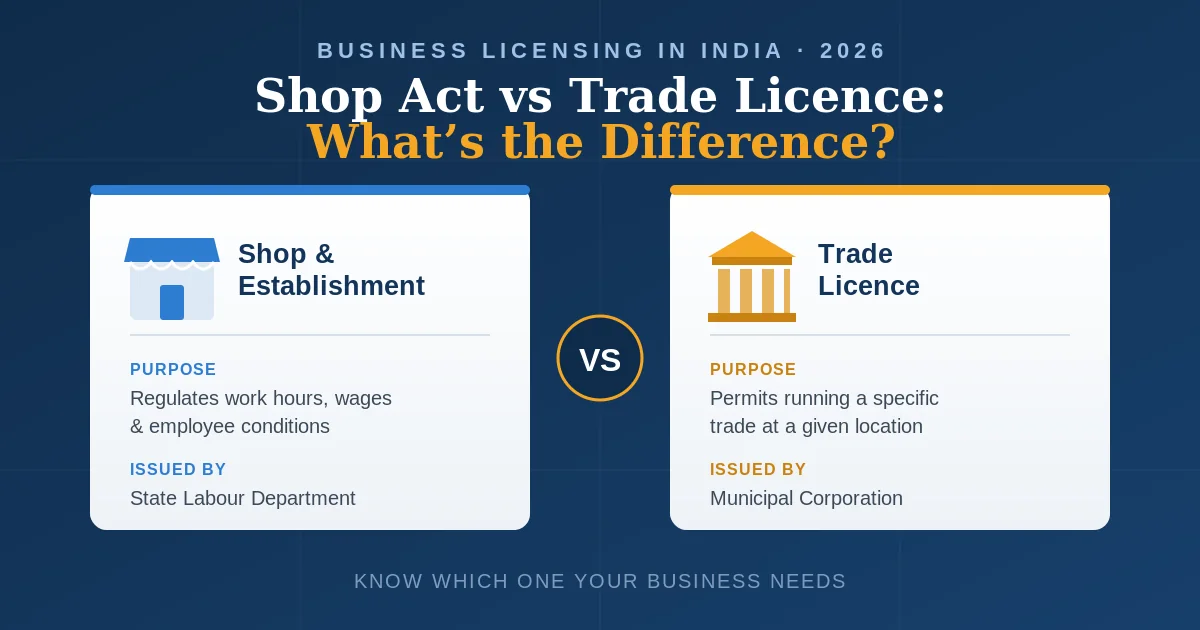
Difference Between Shop and Establishment License & Trade License

Mukhyamantri Yuva Udyami Yojana: Apply, Benefits & Status
How to Download the FSSAI Certificate Online? 2026 Guide

What are CDSCO Guidelines for Medical Devices?

What are the Documents Required for a Trade License?
What is a Trade License? Eligibility, Types & Process
Why is CDSCO Form 44 Important for New Drug Approval?

How to Get a Trade License for a Dental Clinic?

Trade License Fees in India: City-Wise Cost Breakdown
How to Download a Trade License Certificate Online in India?