One Person Company (OPC) Registration Online
OPC registration online lets solo founders incorporate a One Person Company in India under the Companies Act, 2013. RegisterKaro's CA-led team handles DSC, DIN, name approval, and SPICe+ filing.
 Incorporation in 10–15 Business DaysCompany Name Approval with MOA & AOA DraftingPAN & TAN Issuance with Incorporation CertificateDIN Allotment for the Company DirectorDSC Tokens with Complete Support & Shipping

 What Sets Us ApartWhat Sets Us Apart
How to Register a One Person Company Online in India — Step-by-Step
This short video explains how OPC registration online works in India under the Companies Act, 2013, including DSC, DIN, name approval, and SPICe+ incorporation filing.
Watch how RegisterKaro guides solo founders from document submission to the Certificate of Incorporation.
Still have questions?

What is a One Person Company (OPC)?
A One Person Company (OPC) is a private limited company incorporated by a single individual under Section 2(62) of the Companies Act, 2013. Introduced in April 2014, it lets a solo founder operate as a separate legal entity with limited liability, perpetual succession, and corporate credibility — without the two-director, two-shareholder requirement of a regular private limited company.
A defining feature of an OPC is the mandatory nominee, who steps in as the member if the original owner dies or becomes incapable of contracting. With no minimum paid-up capital, exemption from many board meetings and AGM formalities, and the option to scale into a private limited company at any time, OPC registration is built for freelancers, consultants, and solo founders who want corporate protection without partners.
Note: All SPICe+ filings, including OPC registration, are processed centrally by the Central Registration Centre (CRC) under MCA notification G.S.R. 99(E). A One Person Company registration application is processed by the same authority regardless of the state from which you file.
Who Can Register a One Person Company in India?
Eligibility for OPC registration was significantly relaxed by the Companies (Incorporation) Second Amendment Rules, 2021 (effective April 2021). Here's what applies today:
Who can register an OPC:
- Any natural person who is an Indian citizen, including Non-Resident Indians (NRIs). The earlier "resident in India" requirement was removed effective April 2021.
- A person who has stayed in India for ≥120 days during the immediately preceding financial year qualifies as a resident for OPC purposes.
- The proposed sole member must appoint a nominee at incorporation. The nominee must also be a natural person who is an Indian citizen.
Who cannot register an OPC:
- A minor (under 18) cannot be a member or nominee, nor hold beneficial interest in OPC shares.
- A person already a member of one OPC cannot incorporate or be a member of a second OPC.
- A person already a nominee in one OPC cannot be a nominee in a second OPC.
- Any person disqualified under Section 164 of the Companies Act, 2013.
Benefits of One Person Company Registration
Online OPC registration gives solo founders corporate credibility with the simplicity of a single-owner setup. The benefits that matter most in practice:
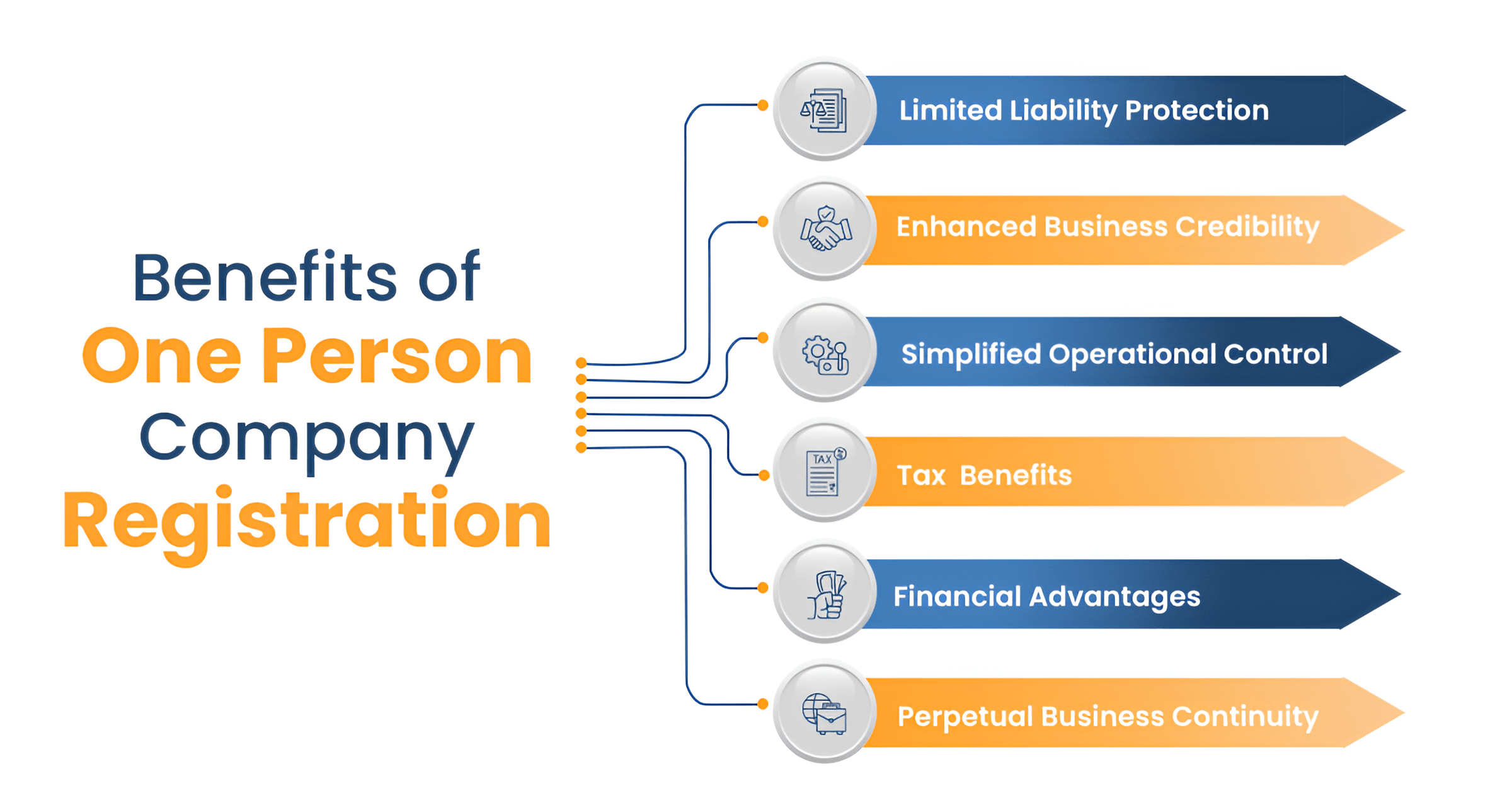
- Limited liability protection: Personal assets are insulated from business debts; liability is capped at the unpaid share value.
- Single-owner control: One person holds 100% ownership and decision-making authority, with no co-founder dilution or partner disputes.
- Perpetual succession: The nominee automatically becomes a member on death or incapacity; the company continues without dissolution.
- Lower compliance burden: OPCs are exempt from the AGM requirement, mandatory cash-flow statement, and many board-meeting formalities applicable to private limited companies.
- Reduced penalties under Section 446B: Penalty caps are lower for OPCs and small companies (₹5,000 plus ₹500/day for continuing default).
- Easier credit and corporate-grade trust: Banks, vendors, and enterprise clients onboard registered companies far more readily than sole proprietorships.
- Tax structuring: OPCs are taxed at corporate rates and can deduct director salary, depreciation, and business expenses, often producing a lower effective tax burden than personal-slab taxation at higher profits.
Fact: As of April 30, 2025, India had 67,168 active One Person Companies, with 1,531 incorporations in that month alone.
Types of One Person Company Registration in India
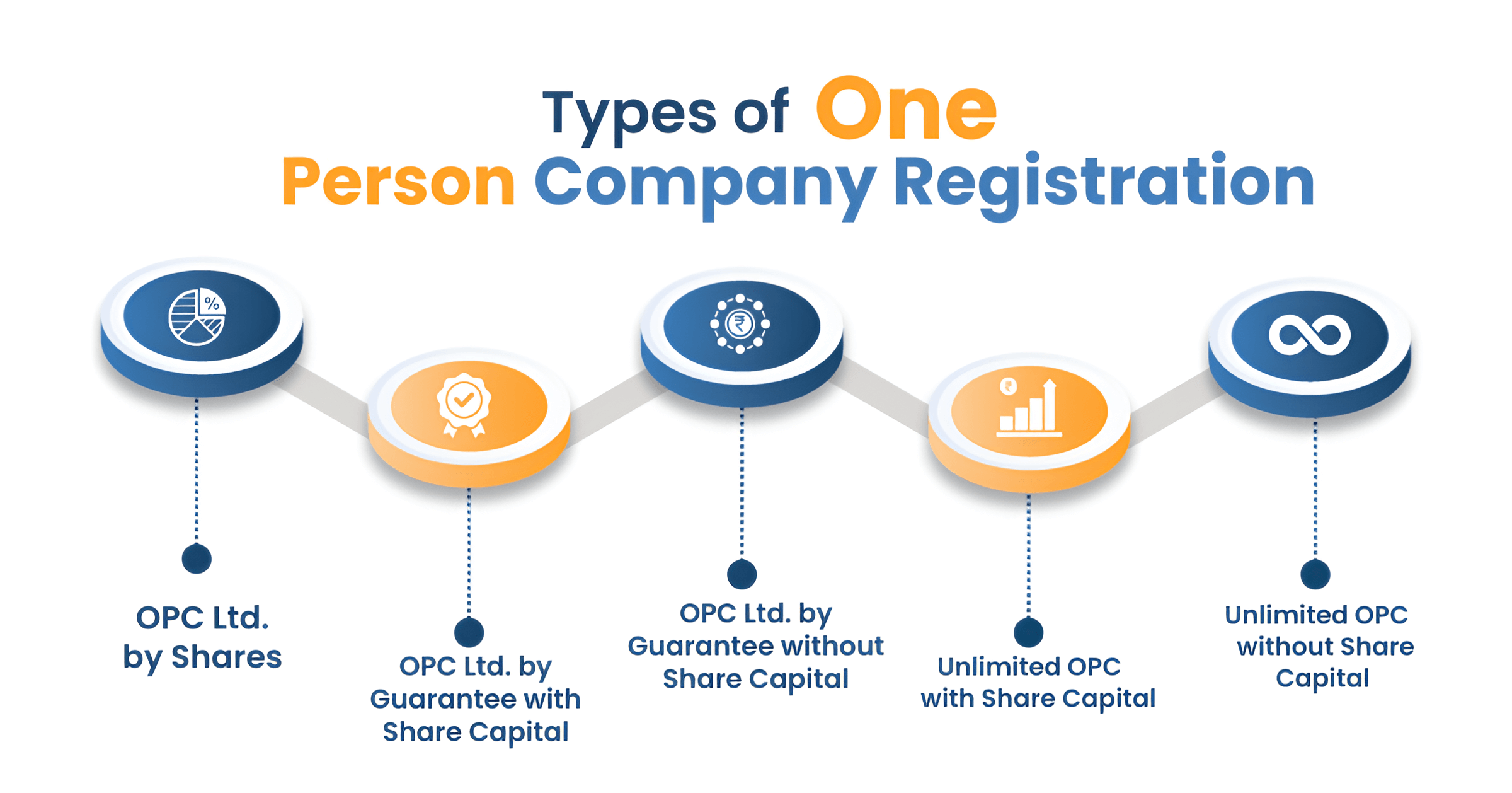
The Companies Act, 2013, permits five OPC structures based on liability and capital, but in practice, almost every OPC registration in India is filed as Limited by Shares. The other forms are legally available but rarely used.
| Structure | Liability | When it's used |
| OPC Limited by Shares | Limited to the unpaid share value | Default form — used in the overwhelming majority of OPC registrations |
| OPC Limited by Guarantee with Share Capital | Unpaid share value + guarantee | Rare; used where flexible capital + guarantee is needed |
| OPC Limited by Guarantee without Share Capital | Guaranteed amount only | Rare; permitted under Section 2(21) |
| Unlimited OPC with Share Capital | Unlimited personal liability | Rarely chosen — defeats the purpose of incorporation |
| Unlimited OPC without Share Capital | Unlimited personal liability | Theoretical only |
Documents Required for OPC Registration in India
Documents fall into four buckets — member/director, nominee, registered office, and statutory documents filed with SPICe+. Below is the full checklist.
| Category | Documents required |
| Member / Director |
|
| Nominee |
|
| Registered Office |
|
| Statutory (filed with SPICe+) |
|
How to Register a One Person Company Online in India — Step-by-Step Process
The one person company registration online process is filed through the MCA's SPICe+ form (Part A and Part B) and typically takes 10–15 business days end-to-end. Here is exactly what happens, day by day.
Step 1. Apply for DSC (Day 1)
Get a Class 3 Digital Signature Certificate for the proposed director. RegisterKaro initiates DSC issuance on Day 1; tokens are delivered within 24 hours.
Step 2. Reserve the Company Name (Days 2–4)
Submit up to two preferred names through SPICe+ Part A. The name must end with "(OPC) Private Limited." We run an MCA + trademark availability check using our free company name check tool before submission to reduce rejection risk.
Step 3. Draft MOA, AOA & SPICe+ Part B (Days 4–7)
We draft the Memorandum and Articles of Association tailored to your business activity, prepare INC-9 (director declaration) and INC-3 (nominee consent), and pre-fill SPICe+ Part B, AGILE-PRO, and the linked PAN/TAN application.
Step 4. File SPICe+ on the MCA Portal (Days 7–9)
The combined application is filed with the Central Registration Centre. DIN for the director is allotted automatically through SPICe+ — no separate DIR-3 application is required.
Step 5. CRC Verification (Days 9–13)
The CRC reviews the application and may issue resubmission queries. RegisterKaro responds to MCA queries within 24 hours to keep the timeline tight.
Step 6. Certificate of Incorporation, PAN & TAN (Days 13–15)
On approval, the MCA issues the Certificate of Incorporation with a unique Corporate Identity Number (CIN), formatted as state code + year + entity type + ROC code + sequence. PAN and TAN are issued together, and EPFO/ESIC registrations are activated through AGILE-PRO.
What you receive on Day 15: Certificate of Incorporation, CIN, PAN, TAN, DIN, DSC, MOA & AOA, and Director KYC pack.
Want to know the detailed process? Check our comprehensive guide on How to Register a One Person Company (OPC) in India.
OPC Registration Fees in India: Cost Breakdown
OPC registration cost depends on three components: government filing fees, state-wise stamp duty, and professional fees. Under the MCA's zero-fee scheme, government filing fees are waived for OPCs with authorized capital up to ₹15 lakh — making the total a function of stamp duty and professional charges.
| Fee component | Approximate amount | Notes |
| Government filing fees | ₹0 up to ₹15 lakh authorized capital; from ₹1,000+ above that | Waived under MCA's zero-fee scheme for low-capital OPCs |
| DSC (Class 3) | ₹1,000 – ₹2,000 | One token for the proposed director |
| DIN allotment | ₹500 | Allotted free through SPICe+ — no separate DIR-3 fee |
| State-wise stamp duty (MOA + AOA) | ₹100 – ₹15,000+ | Varies sharply by state — Delhi, Odisha, West Bengal lowest; Maharashtra, Punjab, Kerala highest |
| Professional / consultancy fees | ₹5,000 – ₹15,000 | Drafting, filing, MCA query handling, and post-incorporation kit |
| Typical total (cap up to ₹15 lakh) | ₹6,500 – ₹17,500 | Bundled fixed pricing available with RegisterKaro |
State-wise stamp duty drives most of the variance. Delhi, Odisha, and West Bengal sit at the low end (often under ₹500 combined for MOA + AOA at low capital). Maharashtra, Punjab, and Kerala charge percentage-based stamp duty on AOA and tend to be the highest. RegisterKaro factors in your state of incorporation in the final quote.
How Long Does One Person Company Registration Take?
End-to-end One Person Company Registration online takes 10–15 business days when documents are clean, and the CRC raises no resubmission queries. Stage-wise breakdown:
| Stage | Estimated time |
| Name approval (SPICe+ Part A) | 1–3 business days |
| Document preparation (MOA, AOA, INC-3, INC-9) | 2–4 business days |
| Filing SPICe+ Part B with the CRC | 1 business day |
| CRC verification and MCA approval | 5–7 business days |
| Issue of Certificate of Incorporation, PAN & TAN | 1–2 business days |
| Total | 10–15 business days |
OPC vs Sole Proprietorship vs Private Limited Company
If you're a solo founder choosing between structures, the differences below drive the decision.
| Parameter | Sole Proprietorship | OPC | Private Limited |
| Legal status | Same as owner (no separate entity) | Separate legal entity | Separate legal entity |
| Owners required | 1 | 1 member + 1 nominee | Min 2 shareholders + 2 directors |
| Liability | Unlimited personal liability | Limited to the unpaid share value | Limited to the unpaid share value |
| Compliance burden | Very low (ITR only) | Moderate (ROC + ITR, AGM exempt) | High (AGM + full ROC + ITR + audit) |
| Taxation | Personal slabs (up to 30%) | Corporate rate (22% under 115BAA + S&C) | Corporate rate (22% under 115BAA + S&C) |
| External funding | Very difficult | Limited (loans, not VC equity) | Investor-friendly |
| Conversion to Pvt Ltd | Migrate via new incorporation | Voluntary, anytime (since 1 Apr 2021) | N/A |
| Best for | Lowest setup, side business | Solo founder wanting protection + credibility | Funded startups, multi-founder businesses |
In short: pick a sole proprietorship for the lowest setup cost and zero compliance, an OPC if you want corporate protection without a co-founder, and a private limited if you plan to raise external funding or onboard partners.
Restrictions on OPC Activities
An OPC cannot legally undertake the following:
- Non-banking financial activities, including investment in securities of any body corporate.
- Conversion into a Section 8 (non-profit) company.
- Incorporation by a minor or any person disqualified under Section 164 of the Companies Act, 2013.
- Holding membership in more than one OPC — the same restriction applies to the nominee.
These restrictions are statutory and cannot be relaxed by amending the AOA. If your business model requires NBFC registration or non-profit status, register a private limited or Section 8 company instead.
Annual Compliance After OPC Registration
Once incorporated, an OPC must maintain ongoing ROC and tax compliance. The mandatory filings are:
| Form | What it covers | Due date | Penalty |
| AOC-4 | Audited financial statements | Within 180 days of FY end (typically 27 Sep) | ₹100/day |
| MGT-7A | Abridged annual return for OPCs/small companies | Within 60 days of signing AOC-4 (typically 28 Nov) | ₹100/day |
| ADT-1 | Auditor appointment for 5 years | Within 15 days of the first board meeting | Filing fee + late fee |
| DIR-3 KYC | Director KYC | By 30 September each year | ₹5,000 + DIN deactivation |
| DPT-3 | Return of deposits / exempted deposits | By 30 June each year | ₹100/day |
| ITR-6 | Income tax return | By 31 October (subject to audit applicability) | Up to ₹10,000 + interest |
| GST returns | If turnover exceeds the threshold | Monthly / quarterly as applicable | ₹50/day + interest |
Late filing of AOC-4 or MGT-7A attracts ₹100 per form per day with no upper cap. RegisterKaro's annual compliance plan covers all five ROC filings (AOC-4, MGT-7A, ADT-1, DIR-3 KYC, DPT-3) and your ITR-6 for a fixed annual fee. GST return filing is added on if your turnover crosses the registration threshold.
Government Schemes Available to OPCs
Solo founders incorporating an OPC can access the same government programs as larger companies:
- Startup India / DPIIT Recognition: 3-year tax holiday under Section 80-IAC, self-certification for labor and environmental laws, fast-track patent applications (subject to innovation/scalability criteria).
- Udyam (MSME) Registration: Priority lending, 25% reservation in government tenders, subsidized patent and trademark filing, and protection under the MSMED Act for delayed payments.
- Zero MCA filing fees: Government incorporation fees are waived for OPCs with authorized capital up to ₹15 lakh.
- Section 446B reduced penalties: OPCs and small companies face penalty caps of ₹5,000 plus ₹500/day for continuing contraventions — significantly lower than large-company penalties.
State startup policies — Karnataka, Maharashtra, Tamil Nadu, Telangana, and West Bengal offer additional incentives such as co-working subsidies, GST reimbursement, and marketing grants for OPCs registered or operating in their state.
Download Your OPC Registration Certificate & Check Application Status
Once the CRC approves your application, the Certificate of Incorporation is emailed by the MCA and is also downloadable from the MCA portal. The certificate includes the company name, CIN, date of incorporation, and registered office — store it safely; you'll need it for the bank account, GST registration, and every contract.
How to download the OPC Registration Certificate online:
- Visit mca.gov.in and log in.
- Go to MCA Services → View Public Documents (or Get Certified Copies).
- Search by company name or CIN.
- Pay the certified-copy fee if applicable and download the PDF.
How to check your OPC registration status:
- On the MCA portal, go to MCA Services → Track SRN / Transaction Status.
- Enter your Service Request Number (SRN) issued at filing.
- View real-time status — Pending, Under Resubmission, Approved, or Rejected.
If your application is in Resubmission, you have 15 days to respond before it lapses. RegisterKaro tracks the SRN daily and handles resubmissions on your behalf.
Connect with RegisterKaro and let our experts handle the legal hassle while you grow your business.
Frequently Asked Questions (FAQs)
What is One Person Company (OPC) registration?
−OPC registration is the process of incorporating a private limited company under Section 2(62) of the Companies Act, 2013 with a single member and director. It gives a solo founder a separate legal entity, limited liability, and perpetual succession — without needing a co-founder or partner.
Who is eligible to register an OPC in India?
+Can an NRI or foreign national register an OPC in India?
+How many OPCs can one person form?
+What documents are required for OPC registration?
+How long does OPC registration take in India?
+How much does OPC registration cost in India?
+Is there a minimum capital requirement for OPC registration?
+Can I use my home address as the registered office for an OPC?
+What naming rules apply to an OPC?
+What is the role of a nominee in an OPC, and is it mandatory?
+Can an OPC have multiple directors?
+Are OPCs required to hold board meetings?
+What is the tax rate applicable to an OPC?
+What annual compliances does an OPC need to file?
+Is an OPC required to convert into a private limited company?
+Can an OPC issue shares to the public or distribute dividends?
+How can I close my OPC if I no longer want to operate it?
+
Reviewed by
Joel DsouzaJoel Dsouza is a Chartered Accountant (CA) and compliance expert with over 7 years of hands-on experience in company registration, tax structuring, GST, ROC filings, and MCA compliance. As a qualified member of the Institute of Chartered Accountants of India (ICAI) and Co-Founder at RegisterKaro, he has personally advised more than 1,000 startups and SMEs across India, helping founders navigate incorporation, regulatory frameworks, and financial planning from Day 1. With deep expertise across all three levels of Finance and Portfolio Management, Joel is committed to promoting financial literacy and simplifying India's startup ecosystem through clear, actionable guidance that entrepreneurs can act on immediately.
Why Choose RegisterKaro for One Person Company Registration Online?
Here's why we are the trusted choice for one person company registration online services:
- Our specialized compliance experts have extensive experience in navigating OPC in India across standards.
- We provide step-by-step guidance through the entire OPC registration process, from standard identification to license issuance and maintenance.
- Our CA & CS led team combines technical expertise with regulatory knowledge to create efficient compliance strategies tailored to your specific products and manufacturing setup.
- We offer transparent pricing with no hidden costs for OPC mark certification, ensuring you know exactly what you're paying for throughout the certification journey.

What Our Clients Say
View All
Deborah Menezes
 Verified
I had a really smooth and reassuring experience working with Jiya from Razorpay Rize. From the start, she was proactive, reaching out personally, guid... Read more

Joel Joy
VerifiedWe had the pleasure of working with Tanvish Nagpal to register our company and handle the incorporation process. From start to finish, his expertise a... Read more

Vikash Kumar Singh
VerifiedI recently used RegisterKaro for my company incorporation, and I am extremely satisfied with the service I received. The team was very professional an... Read more

Vidhya Panzade
VerifiedI had the pleasure of working with Shruti Pandey for incorporating my company, and the entire experience was excellent. She handled the process with c... Read more

Joseph Crentsil
VerifiedExcellence services by Registerkaro team at the eventual part, though it was slow initially but later part they have paid more attention towards my st... Read more

Antony Varghese
Verified"I am thoroughly impressed with the exceptional service provided by Register Karo. They handled every step of the process seamlessly, ensuring all doc... Read more

Indrapal Yadav
VerifiedI had a great experience during the incorporation process of our company, and I’d especially like to highlight the support provided by Manish Tiwari.... Read more

Bippin G Salvi
VerifiedThis people are prompt. Of course the work gets done immediately but if it doesn’t the. They escalate the matter to seniors. And they are way with tim... Read more

Sanjam Singh
VerifiedI am immensely pleased with the exceptional service provided by RegisterKaro. Their performance has far exceeded my expectations. Special thanks to Ga... Read more

TUMULURI SS CHANDRA...
VerifiedEfficient and reliable business registration service! RegisterKaro.in made the process seamless with their user-friendly platform and exceptional cust... Read more
One Person Company Across India
Related Blogs
View All
GSTN Advisory for OPC Registration: Process & Guidelines

Appointment of Auditor in One Person Company (OPC) in India

Procedure for Conversion of Private Company into OPC (2026 Guide)

Top 10 One Person Companies in India: 2026 List
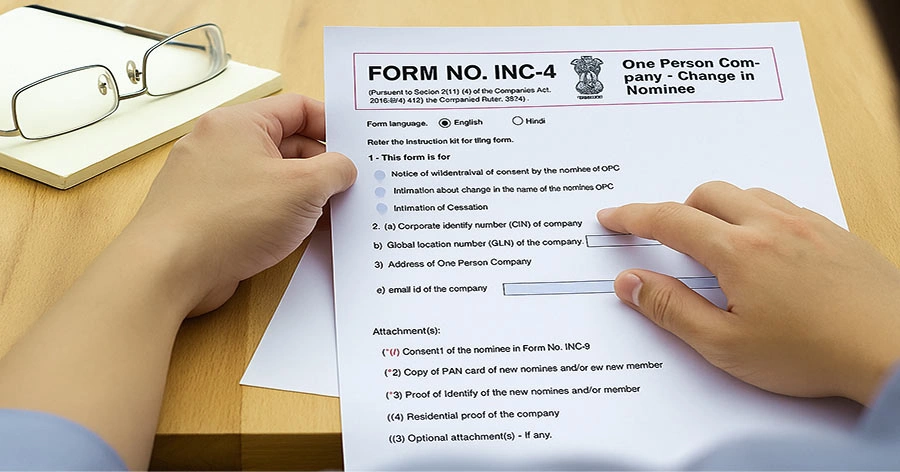
What is Form INC-4? Change in Nominee/Member of an OPC
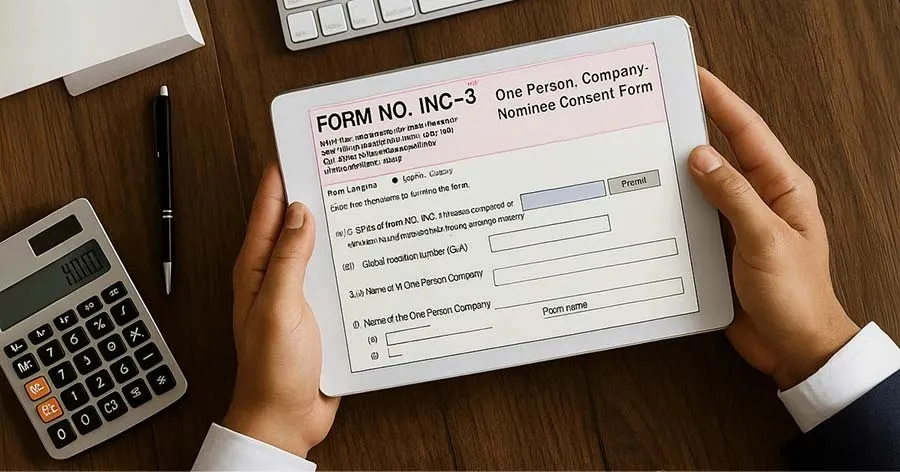
What is Form INC-3 & Why It’s Important for OPC in India

How to Register an OPC Without a Physical Address in India?
What are the Fees of Registering an OPC in India?

What are the Documents Required for OPC Registration in India?

OPC Directors: Maximum Limit
Featured In