LLP Registration Online in India
Register LLP online in India from ₹1,499 + govt fees. RegisterKaro manages new LLP registration, covering name approval, FiLLiP filing, PAN, TAN, DSC and DIN, with CA/CS-verified accuracy.
 LLP Incorporation Certificate in 10–15 DaysName Approval, MCA Filing & Incorporation CertificateDSC, DIN, PAN & TAN RegistrationPost-Incorporation LLP Agreement & Compliance SupportLLP Agreement Drafting & MCA Filing


 What Sets Us ApartWhat Sets Us Apart
Choose the Best LLP Registration Package for Your Business
Basic
Standard
Premium
Overview of LLP Registration in India
Once registered, an LLP becomes a separate legal entity, distinct from its partners. This means it can own assets, take on loans, and enter contracts in its own name, while each partner's liability stays limited to their agreed contribution. On successful incorporation, the MCA issues a Certificate of Incorporation with a unique LLP Identification Number (LLPIN) that serves as proof of the LLP's legal existence.
In India, LLPs are popular among professional firms, service businesses, consultancies, and startups seeking formal structure and limited liability with fewer compliance requirements. As partners can define their roles, contributions, and profit-sharing through the LLP Agreement, the structure offers a level of internal flexibility that companies following stricter statutory rules (Pvt Ltd) cannot match.
Requirements to Register an LLP in India
Before LLP formation, the business must meet these requirements under the Limited Liability Partnership Act, 2008:
- Minimum partners - At least two partners are required to form an LLP (individuals or bodies corporate). The LLP Act sets no maximum number of partners.
- Designated Partners - A minimum of two designated partners who are individuals, with at least one being a resident of India. At least one of them must have stayed in India for at least 120 days during the financial year.
- Age requirement - All partners and designated partners must be at least 18 years of age.
- No maximum limit - There is no maximum limit on the number of partners in an LLP.
- DSC and DIN - All designated partners must possess a valid Digital Signature Certificate (DSC) and Director Identification Number (DIN).
- Prohibited sectors - LLPs cannot be registered for non-profit activities or in sectors prohibited by the government.
Documents Checklist for LLP Registration Online
Before starting online LLP registration in India, keep these documents ready to avoid rejections and processing delays. The required documents are as follows:
| Category | Required Documents / Details |
| 1. For Partners and Designated Partners | PAN card (mandatory for Indian partners) |
| Aadhaar, passport, or voter ID as identity proof | |
| Address proof, such as a recent utility bill, bank statement, or rental agreement | |
| Recent passport-size photographs | |
| Valid Digital Signature Certificate (DSC) for each designated partner | |
| 2. For Registered Office | Recent utility bill for the premises |
| No Objection Certificate (NOC) from the owner or ownership documents, if owned by a partner | |
| Rent or lease agreement, if the premises are rented | |
| 3. Business and Financial Documents | LLP Agreement |
| Statement of each partner's capital contribution, supported by bank statements | |
| Business plan or project report for certain regulated activities | |
| Professional certifications for professional LLPs, such as CA or CS firms | |
| 4. For Foreign Partners or Investment | Passport and address proof, apostilled or notarized as applicable |
| Foreign investment (FDI) approval, where required | |
| 5. If a Partner is a Company or LLP | Certificate of Incorporation of the partner company or LLP |
| Board resolution (or partners' resolution) approving the contribution and naming the nominee | |
| PAN, identity proof, and address proof of the nominee | |
| Consent of the nominee to act as designated partner in Form 9 |
Note: Certain regulated business activities may require additional pre-approvals or sector-specific licenses alongside the LLP registration procedure, before or after incorporation. For example, a food business needs an FSSAI license, financial or lending activities need RBI approval (such as an NBFC registration), and insurance needs IRDAI approval.
For a full checklist, read our complete guide on the documents required for LLP registration in India.
Download LLP Incorporation Sample Documents & Forms
| Documents | File (PDF) |
| NOC for Business Address | Download |
| Certificate of Incorporation | Download |
| LLP Form - FiLLiP | Download |
| LLP Agreement | Download |
| Consent to act as designated partner (Form 9) | Download |
| Reserve Unique Name for LLP (RUN) | Download |
| Subscriber Sheet | Download |
How to Register an LLP in India?
The LLP registration process runs fully online on the MCA portal in four steps, from getting a DSC to receiving the Certificate of Incorporation.
Step 1: Obtain a Digital Signature Certificate (DSC)
Get a Class 3 DSC for each designated partner so they can digitally sign all documents on the MCA portal (mca.gov.in). Apply through a licensed Certifying Authority such as eMudhra, Sify, or NSDL.
Note: DPIN is now merged with DIN and is no longer issued for LLPs.
Step 2: Reserve LLP Name
Every LLP must have a unique name before incorporation, approved by the MCA. To register an LLP name, file the RUN-LLP form on the MCA portal. You can file up to two name options in order of your preference. Under Section 15 of the LLP Act, the name must end with "Limited Liability Partnership" or "LLP". An approved RUN-LLP name stays reserved for 3 months.
You can check your LLP name availability for your LLP to avoid any conflict and a possible re-filing.
Note: If the MCA rejects your name application, you can resubmit once within 15 days without an additional fee. A second rejection requires a fresh RUN-LLP application with the ₹200 fee.
Step 3: File the FiLLiP Form and Other Incorporation Documents
To incorporate an LLP online, submit Form FiLLiP (Form for Incorporation of Limited Liability Partnership) along with necessary documents, including the Subscriber Sheet and the consent of designated partners (Form 9). The Subscriber Sheet is signed by the first partners to confirm their agreement to form the LLP.
The subscriber sheet also shows the initial ownership structure of the firm.
Step 4: Receive the LLP Incorporation Certificate
Once the Registrar approves your filing, the MCA issues the Certificate of Incorporation (COI), the LLP registration certificate that officially confirms your LLP's registration. It includes the LLPIN, registered office address, and partner details and establishes the LLP as a separate legal entity.
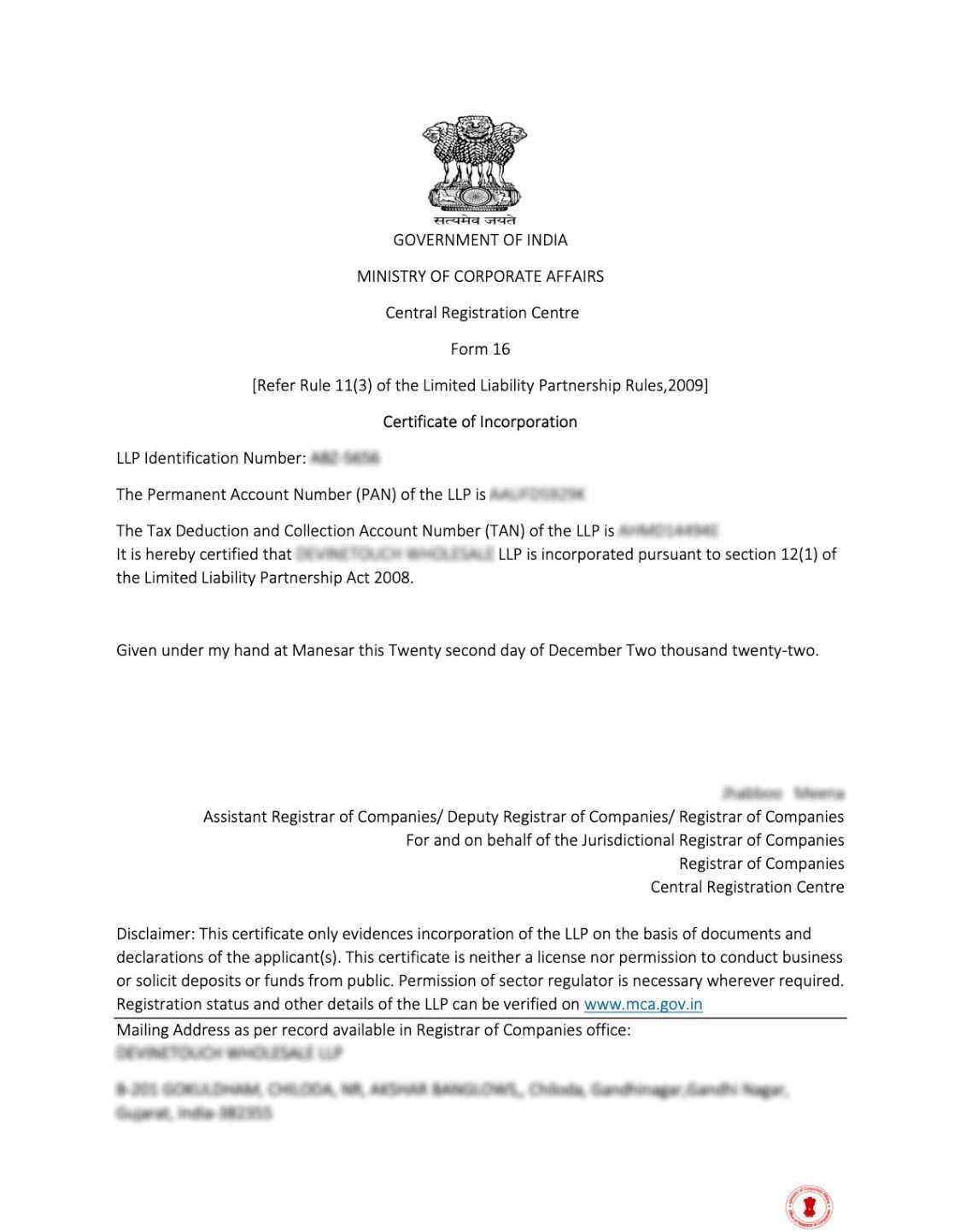
This completes the LLP incorporation procedure, and the LLP's PAN and TAN are allotted along with the certificate.
Post-Incorporation Step: File the LLP Agreement
The LLP Agreement is a legal document that governs the internal functioning of the LLP. Draft a detailed LLP Agreement and file it through Form 3 on the MCA portal within 30 days of incorporation. The agreement should outline:
- The partners' rights and duties
- The profit-sharing ratio
- Capital contribution and other key operating terms
It ensures clarity among partners and serves as a reference for resolving disputes. Note that Form 3 and the LLP Agreement are billed separately.
What is an LLP Registration Number (LLPIN)?
After your LLP is incorporated, the MCA assigns a unique LLP Identification Number (LLPIN) or LLP registration number. The LLPIN is a 7-character alphanumeric identification number, such as AAB-1234, and appears on the firm’s Certificate of Incorporation.
LLPIN serves as an identifier for Limited Liability Partnership firms in India and is often used for MCA filings, official verification, and regulatory requirements. You can also use it to identify and verify an existing LLP’s registration details on the MCA portal. LLPs in India often use their LLPIN when filing forms with the MCA and can also provide it when dealing with banks, tax authorities, and other government departments.
How Much Time Does It Take to Register an LLP?
LLP registration online on the MCA portal (MCA21) usually takes around 10 to 15 working days. The exact timeline depends on how quickly you submit documents, how soon the name is approved, and how efficiently the government processes the application.
LLP Incorporation Process Timeline Breakdown
- Apply for DSC: 1–2 days
- Name reservation via RUN-LLP: 1–3 days
- Filing incorporation forms (FiLLiP) with the MCA: 3–5 days
- Certificate of Incorporation issued: 2–5 days
Note: These timelines are indicative and may exceed 15 days if the proposed name is rejected, documents contain errors or mismatches, or the MCA takes longer to process the application.
Fees for LLP Registration in India
The cost of LLP registration usually starts from ₹7,500 (for 2 partners) and rises with the capital contribution, the number of DSCs, and state stamp duty.
| Fee Component | Approximate Amount |
| Name reservation (RUN-LLP) | ₹200 |
| Incorporation fee |
|
| DSC (per partner) | ₹2,500 |
| DIN application (for each designated partner beyond the first two allotted by FiLLiP) | ₹500 |
| Stamp duty on LLP Agreement | Varies, depending on state |
| Professional fees | ₹1,499 (Our Charge) |
Note: These LLP registration fees are indicative and can vary with your state, capital contribution, and the service provider you choose. LLP Agreement drafting is handled later by our professionals too, after registration. For an exact figure based on your specific details, use the LLP incorporation fees calculator or speak to an expert before you file, so there are no surprises later.
Post-Incorporation Compliance Requirements for an LLP
After registering the LLP, complete annual and event-based filings under the LLP Act, 2008, and applicable tax laws to keep it compliant and avoid penalties.
Annual Compliance
Every financial year, an LLP must complete these key filings:
- Form 11 (Annual Return): Due 30 May 2027 (within 60 days of the financial year-end). A
- Form 8 (Statement of Account & Solvency): Due 30 October 2027.
- Form 3: File an LLP Agreement via Form 3 within 30 days of incorporation.
- DIR-3 KYC: Every three years on 30 June of the applicable financial year.
- Income Tax Return (ITR-5): Due 31 August 2027 if no audit applies, or 31 October 2027 if an audit applies.
- Tax Audit: The audit report is due by 30 September 2027.
- GST Returns: LLPs registered under GST file GSTR-1 and GSTR-3B monthly or quarterly, with the annual GSTR-9 due by 31 December 2027.
Tip: To keep track of these dates and avoid missing a deadline, use our compliance calendar.
TDS on Payments to Partners (Section 393(3), earlier Section 194T)
LLPs must deduct 10% TDS under Section 393(3) of the Income-tax Act, 2025 (Section 194T of the 1961 Act until 31 March 2026) on payments such as partner remuneration, interest, commission, or bonus when the aggregate amount paid or credited to a partner exceeds ₹20,000 in a tax year.
Tip: Account for this requirement when structuring partner payments and managing your LLP compliance obligations.
Event-Based Compliance
Certain changes like changes in partners, the LLP agreement, or the registered office also require filings with the MCA. Missing MCA filing deadlines can result in ₹100 per day per form, with no maximum cap for Forms 8 and 11. Continued non-compliance can also affect the LLP's ability to obtain loans, enter contracts, and maintain good standing with the ROC.
Key Benefits of LLP Formation for Your Business
These LLP registration benefits combine the liability protection of an entity with the flexibility of a partnership:
- Limited liability protection: Each partner's liability is generally limited to their agreed contribution, protecting personal assets from the LLP's business liabilities.
- Separate legal entity: An LLP exists independently of its partners. It can own assets, take on loans, and sign contracts in its own name.
- No minimum capital: An LLP has no prescribed minimum capital requirement. Partners can contribute any agreed amount, recorded in the LLP Agreement, and change it later as the business grows. Many LLPs start with a nominal contribution of around ₹10,000, which is enough to open a bank account and begin operations.
- Tax efficiency: An LLP pays income tax at a flat 30% on its profits for the tax year 2026-27, plus a 12% surcharge above ₹1 crore of income and 4% health and education cess. A partner's share of the LLP's profit is exempt from tax in the partner's hands, so the same profit is not taxed again at the partner level.
- Lower compliance burden: LLPs face fewer compliance requirements than private limited companies. A statutory audit becomes mandatory when turnover exceeds ₹40 lakh or contribution exceeds ₹25 lakh.
- Perpetual succession: The LLP continues regardless of partners joining, leaving, retiring, or passing away, so the business carries on without disruption.
- Operational flexibility: Partners can decide the firm’s management, responsibilities, rights, and profit-sharing through the LLP Agreement. They can also add or remove partners according to its terms.
- Credibility and scalability: A registered LLP builds trust with clients and lenders, improving access to credit, and can take on an unlimited number of partners as it grows.
LLP vs Private Limited Company vs Partnership Firm
Founders often compare LLP company registration with a private limited company or a partnership firm before choosing a structure.
| Basis | LLP | Private Limited Company | Partnership Firm |
| Governing law | LLP Act, 2008 | Companies Act, 2013 | Indian Partnership Act, 1932 |
| Minimum members | 2 partners | 2 shareholders and 2 directors | 2 partners |
| Maximum members | No limit | 200 members | 50 partners |
| Liability | Limited to agreed contribution | Limited to unpaid share capital | Unlimited |
| Separate legal entity | Yes | Yes | No |
| Statutory audit | Above ₹40 lakh turnover or ₹25 lakh contribution | Mandatory every year | Not required under partnership law |
| Issue of shares | Not allowed | Allowed | Not allowed |
| Annual MCA filings | Form 8 and Form 11 | AOC-4 and MGT-7 or MGT-7A | None |
Connect with RegisterKaro and let our experts handle the legal hassle while you grow your business.
Frequently Asked Questions (FAQs)
What is the LLP registration fee in India?
The government fee to register an LLP includes:
- RUN-LLP: ₹200
- FiLLiP: ₹500 for contributions up to ₹1 lakh.
The charges for DSC, stamp duty, and Form 3 are additionally added as per requirement. RegisterKaro's professional fee starts at ₹1,999.
Can one person start an LLP?
No, an LLP requires at least two partners at all times. It must also have at least two designated partners, and the same individuals can serve as both partners and designated partners. If you want a single-owner structure with limited liability, consider a One Person Company (OPC).
What happens if an LLP is left with only one partner?
If an LLP operates with just one partner for more than six months, that sole partner becomes personally liable for the obligations the LLP incurs during that period, losing the protection of limited liability. To avoid this, you get a six-month window to appoint a second partner, so as long as you bring one in within that time, the LLP continues normally with its liability protection intact.
What is a small LLP?
A small Limited Liability Partnership (LLP) is defined as one that has partner contributions of up to ₹25 lakh and a turnover of up to ₹40 lakh in the preceding financial year. This type of LLP benefits from reduced filing fees for certain forms and lower penalties. The status as a small LLP is reviewed annually and will cease if either limit is exceeded.
Can an LLP raise funds from investors or issue shares?
No, an LLP cannot issue shares or equity. It can raise funds through partner contributions or loans. Since angel investors and venture capital firms generally invest for equity, a private limited company may be more suitable if external equity funding is part of your plans.
Can a company or another LLP be a partner in an LLP?
Yes, a company or another LLP can partner with an LLP under Section 5 of the LLP Act, 2008. However, the body corporate must nominate an individual to serve as a designated partner on its behalf. Additionally, there must be at least two designated partners who are individuals.
Does an LLP need to report its significant beneficial owners?
Yes, according to the LLP (Significant Beneficial Owners) Rules, 2023, an individual who meets the ownership or control test must file Form LLP BEN-1 with the LLP. Following this, the LLP must file Form LLP BEN-2 with the Registrar of Companies (ROC) within 30 days.
Can NRIs or foreign nationals become partners in an LLP?
Yes, NRIs and foreign nationals can become partners or designated partners, provided the LLP has at least one designated partner who is resident in India. Foreign investment is permitted under applicable FEMA rules and FDI conditions.
Can an LLP get Startup India recognition?
Yes, an LLP can apply for DPIIT startup recognition if it meets the age, turnover, and innovation criteria. A recognized startup LLP also pays penalties capped at half of the normal amount under the LLP Act, 2008.
Is a minimum capital required to start an LLP?
No, an LLP has no minimum capital requirement. Partners can agree on the contribution amount and record it in the LLP Agreement. They can also increase the contribution later as the business grows.
Can an LLP be registered at a residential address?
Yes, you can register an LLP at a residential property and use it as the registered office. You generally need a recent utility bill and the property owner's NOC. If you own the property, you can provide the required ownership or consent documents instead.
Do all LLPs need to be audited?
No, a statutory audit is required when an LLP's annual turnover exceeds ₹40 lakh or its contribution exceeds ₹25 lakh. LLPs below both thresholds do not require a statutory audit but must still complete their applicable annual filings.
Can an existing partnership firm or company be converted into an LLP?
Yes, a registered partnership firm or an eligible private or unlisted public company can convert into an LLP subject to the applicable requirements. The process involves filing the prescribed forms, obtaining required consents, and meeting conditions relating to assets, liabilities, and existing obligations.
How is a partner's income from an LLP taxed?
A partner's share of the LLP's profit is exempt from tax because the LLP has already paid tax on that profit. However, remuneration and interest received from the LLP are taxable in the partner's hands. The LLP can deduct them only within the limits under Section 35 of the Income-tax Act, 2025 (formerly Section 40(b)).
What is the difference between an LLP and a Private Limited Company?
Both an LLP and a private limited company provide limited liability and a separate legal identity, but an LLP has simpler compliance requirements and no minimum capital requirement. A private limited company can issue equity shares, making it better suited to businesses seeking external investment. LLPs often suit professional and service businesses, while companies suit ventures focused on raising equity. Although often searched as LLP registration, an LLP is registered under the LLP Act, 2008 and is not a company under the Companies Act, 2013.
What is the difference between LLP formation and LLP incorporation?
Both terms describe the same process. LLP formation covers preparatory steps such as DSC, name reservation, and drafting the LLP agreement. LLP incorporation is the legal event when the Registrar issues the Certificate of Incorporation with the LLPIN.
Is registration of LLP compulsory or not?
Yes, registration of an LLP is compulsory. An LLP comes into existence only through incorporation by registration under Section 12 of the LLP Act, 2008. Unlike a partnership firm, whose registration is optional, an LLP cannot operate or claim limited liability until the Registrar issues its Certificate of Incorporation.
Registration of LLP is granted by whom?
Registration of an LLP is granted by the Registrar of Companies (ROC) under the Ministry of Corporate Affairs. The Registrar approves Form FiLLiP and issues the Certificate of Incorporation with the LLPIN.

Reviewed by
Joel DsouzaJoel Dsouza is a Chartered Accountant (CA) and compliance expert with over 7 years of hands-on experience in company registration, tax structuring, GST, ROC filings, and MCA compliance. As a qualified member of the Institute of Chartered Accountants of India (ICAI) and Co-Founder at RegisterKaro, he has personally advised more than 1,000 startups and SMEs across India, helping founders navigate incorporation, regulatory frameworks, and financial planning from Day 1. With deep expertise across all three levels of Finance and Portfolio Management, Joel is committed to promoting financial literacy and simplifying India's startup ecosystem through clear, actionable guidance that entrepreneurs can act on immediately.
Why Choose RegisterKaro for LLP Registration Services?
RegisterKaro has registered 2 Lakh+ businesses and knows exactly what the MCA looks for. Our in-house CAs, CSs, and legal experts handle your MCA LLP registration directly on the portal, catching the errors that cause rejections and delays, so your incorporation goes through right the first time.
- Expert Assistance: Experienced professionals handle each new LLP registration application across professional, trading, and service sectors.
- Dedicated Professional: You get dedicated experts who guide you through the registration process and address your queries.
- MCA Compliance Support: Keep your LLP compliant with timely support for annual returns and other MCA filings.
- Customized Solutions: Choose registration and compliance support based on your LLP's structure, business activity, and requirements.
- Post-Registration Support: Get continued assistance with changes to partners, LLP agreements, registered office, and other business updates.

What Our Clients Say
View All
GlobiSky
 Verified
I’m very happy to share my experience with RegisterKaro for our LLP registration. A special thanks to Tanvish Nagpal for his constant support througho... Read more

Sanjana Ragu
VerifiedI had a great experience with RegisterKaro for my LLP registration. The entire process was handled smoothly, professionally, and completed on time wit... Read more

Mishthans
VerifiedRegisterKaro made our LLP registration straightforward and completely stress-free. Sincere thanks to Krishna for the fantastic support throughout the... Read more

jatin kumar
Verified"I had a very smooth experience with the LLP incorporation process. Special thanks to Sumit Kumar, who was my SPOC throughout the journey. He was high... Read more

Anubhav Anand
VerifiedHad a great experience with Register Karo for my LLP registration process. Their team was professional, responsive, and guided me through every step s... Read more

Sachin Gaikwad
VerifiedGood Service Provide by Registered Karo ...Mr Manish has coordinated well in just 7 Days my Private Limited company incorporated by team .Thanks Regis... Read more

Pranay Shah
VerifiedAvailed their services for incorporation. It was a smooth and structured process. Amazing support and special mention to Ritesh Rajput who took up our... Read more

Ayush Singh
VerifiedI had the pleasure of working with Piyush Jamwal for my company's registration, and the experience was seamless. Piyush's expertise, dedication, and p... Read more

Satyajit Dey
VerifiedI am very much satisfied with the services of Register Karo. I want to especially appreciate Ms. Samriddhi for her expertise & professionalism. Her at... Read more

Chandra Prakash Agra...
VerifiedThe service provided by Register Karo is excellent. Concern people related activities are very polite and helpful. Services provided by them promptly.