Pvt Ltd Company Registration Online in India
Private limited company registration gives your business a separate legal entity under the Companies Act, 2013. RegisterKaro’s CA-led team handles DSC, DIN, name approval, and SPICe+ filing from ₹1,499 + govt fees.
 Company Incorporated in 7 to 10 Business DaysName Approval & Filing Handled by Qualified CAs & CSPAN, TAN, DIN, DSC, MoA, AoA & Certificate of IncorporationComplete Package from ₹1,499 + Govt. Fees, No Hidden ChargesTrusted by 2 Lakh+ Startups & Entrepreneurs Across India


 What Sets Us ApartWhat Sets Us Apart
Choose the Best Pvt Ltd Company Registration Plan for Your Business
BASIC
₹1,499
+ Govt FeesWhat you'll get
- Company name help
- SPICe+ form in 2–3 working days
- Company PAN + TAN
- MOA + AOA
- PF and ESIC registration
- Incorporation certificate in 7–10 days
- DSC preparation in 3–4 days
- DIN for directors
- Expert assisted process
- INC 20A / Business commencement certificate
- Not included: MSME Registration
- Not included: Startup India Registration
- Not included: Digital signature certificate
- Not included: Company DSC
- Not included: Trademark Registration
STANDARD
₹6,499
+ Govt FeesWhat you'll get
- Company name help
- SPICe+ form in 2–3 working days
- Company PAN + TAN
- MOA + AOA
- PF and ESIC registration
- Incorporation certificate in 7–10 days
- DSC preparation in 3–4 days
- DIN for directors
- Expert assisted process
- INC 20A / Business commencement certificate
- MSME Registration
- Startup India Registration
- Not included: Digital signature certificate
- Not included: Company DSC
- Not included: Trademark Registration
PREMIUM
₹8,499
+ Govt FeesWhat you'll get
- Company name help
- SPICe+ form in 2–3 working days
- Company PAN + TAN
- MOA + AOA
- PF and ESIC registration
- Incorporation certificate in 7–10 days
- DSC preparation in 3–4 days
- DIN for directors
- Expert assisted process
- INC 20A / Business commencement certificate
- MSME Registration
- Startup India Registration
- Digital signature certificate
- Company DSC
- Trademark Registration
Overview of Private Limited Company Registration
A Private Limited Company offers a separate legal identity, limited liability, and a clear ownership structure. Under Section 9 of the Companies Act, 2013, it also enjoys perpetual succession, continuing to exist regardless of changes in its shareholders or directors.
This structure suits startups, family businesses, and growing SMEs that want to raise equity, offer ESOPs, and build credibility with banks and investors. These features, along with additional taxation advantages, make Private Limited Company Formation the most popular route to company registration in India among other options.
Key Features of a Private Limited Company
Beyond the ability to trade, hire employees, and earn profits, a Private Limited Company also has these distinct features:
- Limited liability: Shareholders’ liability is limited to the unpaid amount on their shares, helping protect their personal assets from the company’s debts and liabilities
- Perpetual succession: The company continues even when shareholders or directors leave, transfer shares, or pass away.
- Ownership in its own name: The company owns property, opens bank accounts, signs contracts, and files suits in its own name.
- Minimum members: It needs at least 2 shareholders, who can be individuals or corporate bodies.
- No minimum capital: Founders can start with any amount of paid-up capital.
- Equity funding and ESOPs: The company can issue shares to angel investors and venture capital funds, and it can offer ESOPs to retain key staff.
Who Should Register a Private Limited Company? Is It Right For You?
Private Company registration suits businesses that need limited liability and room to grow. It works best for:
- Startups planning to raise funds: Angel investors and VCs invest through shares, which a Private Limited Company can issue.
- Businesses offering ESOPs: The structure allows employee stock options to attract and retain key talent.
- Family businesses: Perpetual succession keeps the company running across generations, with transfers controlled through the AOA.
- Growing SMEs: Audited accounts and a company structure improve access to bank credit, tenders, and enterprise contracts.
- NRIs and foreign investors: Most sectors allow 100% foreign ownership through an Indian Private Limited Company.
Quick Checklist to Register a Private Limited Company
Before filing SPICe+ for Pvt Ltd Company Registration, founders should use this checklist to incorporate early and avoid rejections:
- At least 2 directors, with one resident in India.
- At least 2 shareholders, with the shareholding split agreed.
- A Class 3 DSC for every director and subscriber.
- PAN, Aadhaar, and recent address proof for each director and shareholder.
- A registered office address, with a utility bill not older than 2 months and the owner’s NOC.
- Two proposed company names, checked against MCA records and the trademark registry.
- A clear description of the main business activity for the objects clause.
- Decided authorized and paid-up capital.
- An active email address and mobile number for each director.
Private Limited Company Registration Requirements in India
Before applying for incorporation of a Private Limited Company through the MCA portal, founders must finalize the company name, registered office, and people involved. The key Pvt Ltd Company requirements are:
| Requirement | What is Needed | Range or Options | Key Condition |
| Directors | At least 2 directors | Up to 15, or more through a special resolution | One director must stay in India for 182 days or more during the financial year (Section 149(3)) |
| Shareholders | At least 2 shareholders | Up to 200 | Current and former employees who became members and continue to hold shares are excluded from the 200-member limit under Section 2(68). Directors can also be shareholders. |
| Registered office | An address in India for official mail | Commercial space, residence, or virtual office | A recent utility bill as address proof and a NOC from the owner |
| Company name | A unique name approved by the MCA | Must end with “Private Limited” | Must follow MCA naming rules. Check availability first with our free company name search tool |
Note: Foreign nationals, NRIs, and foreign companies can also start a Private Limited Company in India. In most sectors (such as manufacturing, IT services, and renewable energy), they can hold up to 100% of the shares under the automatic route. The company still needs one director resident in India. When an overseas parent company is the shareholder, the Indian entity is set up as a wholly owned or partly owned subsidiary. It also carries FEMA and RBI reporting, such as Form FC-GPR, after shares are allotted
Documents Required for Pvt Ltd Company Registration
The Pvt Ltd Company registration documents for each category are listed below:
For Directors and Shareholders (Indian Nationals)
- PAN Card (mandatory for all directors and shareholders)
- Aadhaar card, passport, voter ID, or driving license as identity proof
- Recent passport-size photographs
- Address proof, such as a utility bill or bank statement not older than 2 months, driving license, or voter ID
- Digital Signature Certificate (DSC) for each director and subscriber
Note: Each director and shareholder also needs an active email address and mobile number. The MCA sends OTPs to both for verification during filing.
For Foreign Directors/Shareholders (Additional Documents)
- Valid passport (mandatory identity proof)
- Address proof from home country (utility bill, bank statement, or driving license)
- Recent passport-size photographs
- DSC issued in India against the passport
Note: In countries that are party to the Hague Apostille Convention, foreign documents must be notarized and then apostilled. In other countries, they must be notarized and then attested by the Indian embassy or consulate.
For Corporate Shareholders
- Certificate of Incorporation of the shareholding company
- Board resolution approving the investment and naming an authorized representative
- Identity and address proof of the authorized representative
- For a foreign company, the same documents apostilled or consularized
For the Registered Office
- Utility bill (electricity, gas, water, or telephone) not older than 2 months, showing the office address and the owner’s name
- No Objection Certificate (NOC) from the property owner
- Notarized rent agreement and a rent receipt (if requested) for rented premises
- Proof of ownership, such as a sale deed or property tax receipt for owned premises
Incorporation Documents Filed With SPICe+
- Memorandum of Association (MOA) in e-form INC-33
- Articles of Association (AOA) in e-form INC-34
- Form INC-9 declaration by subscribers and directors, generated automatically and signed with DSC
- Form DIR-2 consent from each proposed director
Tip: The documents required for Private company registration depend on who the directors and shareholders are and how the registered office is set up. Foreign directors, corporate shareholders, and rented offices may require additional paperwork.
How to Register a Pvt Ltd Company in India: Step-by-Step Process
The step-by-step Private Limited Company registration process starts with obtaining DSC and ends with getting the COI issued. You can register as a Pvt Ltd Company by following these steps:
Step 1: Get Digital Signature Certificates (DSC)
Obtain a Class 3 DSC for each proposed director and MOA subscriber to digitally sign the incorporation documents filed with the MCA.
Our team arranges the DSC for each director and subscriber at just ₹2,500 per director/shareholder. We check the details against PAN and Aadhaar before issuance, helping you avoid mismatches when signing the SPICe+ incorporation forms.
Timeline: 1 to 2 days
Step 2: Reserve Your Unique Company Name
Complete your Pvt Ltd company name registration by reserving through SPICe+ Part A on the MCA V3 portal. You can submit up to two name options in order of preference for a government fee of ₹1,000. Your company name must follow a set of guidelines, including being unique, ending with a “Private Limited” suffix, and not containing offensive words.
If the CRC rejects both names, you get one chance to resubmit without paying again. If the resubmission is also rejected, you must file a fresh SPICe+ Part A application and pay ₹1,000 again. Once approved, the name stays reserved for 20 days, within which you must complete the incorporation filing. If you need more time, Rule 9A of the Companies (Incorporation) Rules, 2014, allows you to request an extension (40 days from approval for ₹1,000, 60 days for an additional ₹2,000, or ₹3,000 for a direct extension) before the reservation expires.
Timeline: 2 to 3 working days
Step 3: Prepare and Draft Key Documents (MOA & AOA)
Prepare and finalize the documents filed with the incorporation application. These include MOA, AOA, INC-9, etc. Errors or mismatched information can lead to resubmission requests and delays. Our experts draft the MOA and AOA around your business activity and funding plans, with appropriate provisions for share transfers and future investors.
Timeline: 1 to 2 days
Step 4: File the SPICe+ Incorporation Form
File the SPICe+ form online through the MCA V3 portal to complete Private Limited Company registration online. Together with its linked AGILE-PRO-S form, this single application covers multiple registrations, namely GST registration (if needed), EPFO and ESIC registration, Professional tax registration, and Shops and Establishment registration.
Before submission, a practicing Chartered Accountant, Company Secretary, or Cost Accountant must certify the SPICe+ form.
Tip: Small errors in SPICe+, such as a mismatched name, a wrong NIC code, or a missing attachment, can lead to a resubmission request. Our team prepares and files SPICe+ and AGILE-PRO-S together, and sets the authorized capital to keep government fees as low as possible.
Timeline: 1 to 3 working days
Step 5: Receive Your Certificate of Incorporation (COI)
After the CRC verifies and approves the application, it issues the Certificate of Incorporation (COI), also called the Company Registration Certificate. This document confirms your company’s legal existence and records its name, Corporate Identification Number (CIN), date of incorporation, PAN, and TAN.
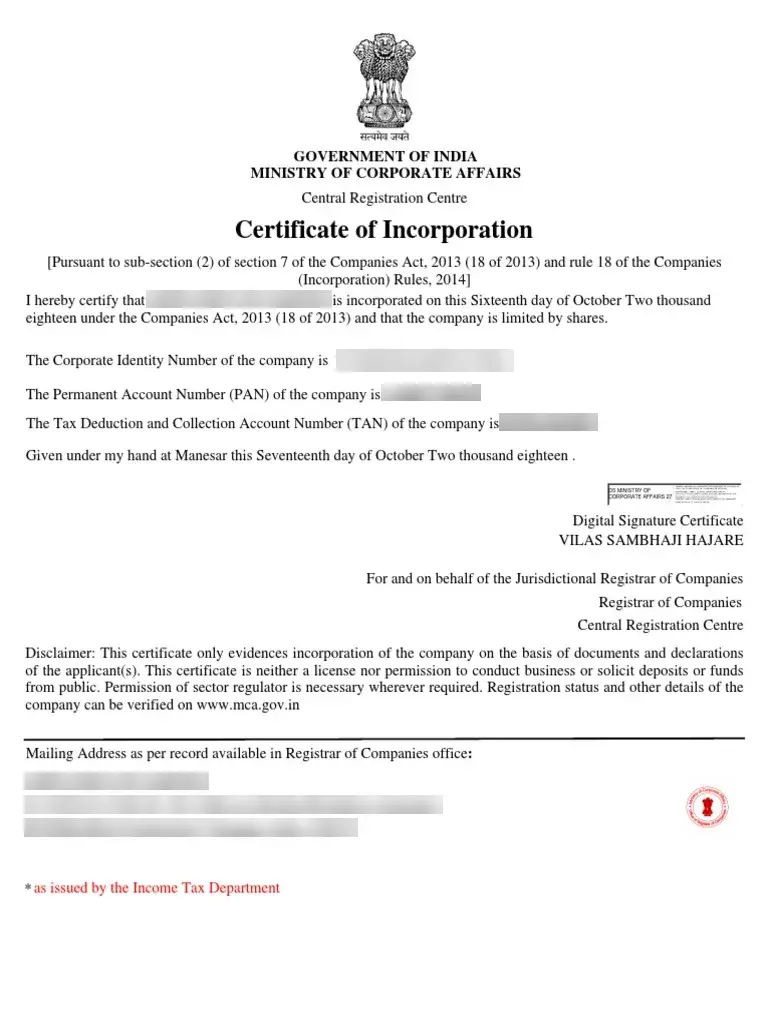
From the date mentioned on the COI, your company is a legal entity.
Timeline: 3 to 5 working days
Tip: Receiving your COI is an important milestone, but your compliance obligations continue after incorporation. You must file Form INC-20A within 180 days of incorporation to declare that the subscribers have paid for their shares. The company cannot commence business or exercise borrowing powers until it files this declaration. We track INC-20A and other post-incorporation deadlines to help you meet your compliance requirements on time.
If all the documents are in order, new Private Limited Company registration usually takes 7 to 10 working days from the DSC application to the Certificate of Incorporation.
Fees for Registration of Private Limited Company in India: RegisterKaro Pricing
The Pvt Ltd Company registration cost in India with RegisterKaro starts at a professional fee of ₹1,499. The MCA charges no incorporation filing fee for companies with authorized capital of up to ₹15 lakh, although name reservation and state-specific stamp duty involve separate costs.
The table below breaks down the main expenses for registration of a Private Limited Company:
| Fee Category | Item | Cost |
| Government fees | Name reservation (SPICe+ Part A) | ₹1,000 |
| SPICe+ incorporation fee | Nil for authorized capital up to ₹15 lakh. Above ₹15 lakh, slab-based fees apply under the Companies (Registration Offices and Fees) Rules, 2014. | |
| Stamp duty on MOA and AOA | Varies by state and authorized capital | |
| PAN and TAN | ₹143 (issued through SPICe+) | |
| Professional fees | DSC | ₹2,500 per DSC |
| Service charges (MOA, AOA drafting and filing) | ₹1,499 for Indian clients; varies for foreign and NRI clients | |
| Post-registration costs | Company seal and stationery (optional) | ₹500 to ₹1,500 |
| Bank account opening | Varies by bank | |
| GST registration | Nil government fee |
Note: Stamp duty and government fees differ by state and rise with authorized capital, so no two companies pay the same amount.
For a full breakdown, read our comprehensive guide on company registration fees in India.
What is a Private Limited Company Registration Number?
The Corporate Identification Number (CIN) is what most founders mean by the company registration number. It is a unique 21-character code that the CRC assigns during incorporation. It appears on the COI and identifies the company in its filings. Anyone can also use it to check the company’s details on the MCA register.
The CIN contains specific information about the company:
| Part | What It Indicates |
| Listing status (1 letter) | Whether the company is listed (L) or unlisted (U) |
| Industry code (5 digits) | The company’s primary business activity |
| State code (2 letters) | The state of the registered office |
| Year of incorporation (4 digits) | The year the company was incorporated |
| Company type (3 letters) | The company type, such as PTC for Private Limited Company |
| Registration number (6 digits) | The unique number assigned by the ROC |
For details on how to find a company’s CIN and where to use it, read our guide to the CIN number.
Benefits of Registering a Pvt Ltd Company in 2026-27
Registering a Private Limited Company also gives a business these benefits:
- Limited liability: Protects personal assets, limiting shareholders’ liability to their unpaid share capital under Section 2(22) of the Companies Act, 2013.
- Separate legal entity: The company can own assets, enter contracts, and sue or be sued independently of its owners.
- Lower corporate tax: Eligible companies can opt for a 22% tax rate under Section 200 of the Income Tax Act, 2025. Other eligible companies may qualify for the 25% rate.
- Investor-ready structure: Share-based ownership makes it easier to attract angel investors and venture capital funding.
- Easier access to loans: Audited accounts and financial records can improve eligibility for bank and NBFC loans.
- 100% FDI allowed: Most sectors permit 100% foreign investment through the automatic route.
- ESOP benefits: Companies can offer employee stock options to attract and retain talented professionals.
- Higher credibility: Registration builds trust with customers, vendors, banks, and investors and improves access to business opportunities.
- Easy ownership transfer: Shares can be transferred subject to legal requirements and the company’s Articles of Association.
- Perpetual succession: The company continues to exist even when shareholders change, leave, or pass away.
- Startup benefits: Eligible companies can obtain free DPIIT Startup India recognition, access government incentives, and potentially claim a three-year tax holiday under Section 140 of the Income Tax Act, 2025, subject to eligibility.
Post-Incorporation Compliance for a Private Limited Company
After incorporation, a Private Limited Company has a few one-time filings to complete, followed by yearly ROC and tax filings. Missed deadlines bring penalties on both the company and its directors:
| Compliance | Form | Deadline | Penalty for Default |
| Registered office verification | Form INC-22 | Within 30 days of incorporation, if the address was not verified in SPICe+ | ₹1,000 per day, up to ₹1 lakh on the company and each officer in default (Section 12(8)) |
| First board meeting | N/A | Within 30 days of incorporation | ₹10,000 plus ₹1,000 per day, up to ₹2 lakh on the company (Section 450) |
| First auditor appointment | ADT-1 | Within 30 days of incorporation (Section 139(6)) | ₹25,000 to ₹5 lakh on the company (Section 147 (1)) |
| Share certificates | SH-1 | Within 2 months of incorporation | ₹50,000 on the company and every officer in default (Section 56(6)) |
| Commencement of business | INC-20A | Within 180 days of incorporation | ₹50,000 on the company, plus ₹1,000 per day on officers, up to ₹1 lakh (Section 10A) |
| Board meetings | N/A | 4 a year (2 for a small company) | ₹10,000 plus ₹1,000 per day, up to ₹2 lakh on the company (Section 450) |
| Annual general meeting | N/A | First AGM within 9 months of the first financial year end | Fine up to ₹1 lakh, plus up to ₹5,000 per day of continuing default (Section 99) |
| Financial statements | AOC-4 | Within 30 days of the AGM | ₹10,000 plus ₹100 per day, up to ₹2 lakh on the company (Section 137) |
| Annual return | MGT-7 / MGT-7A | Within 60 days of the AGM | ₹10,000 plus ₹100 per day, up to ₹2 lakh on the company (Section 92) |
| Return of deposits | DPT-3 | June 30 each year, for amounts outstanding as of March 31 | ₹5,000, plus ₹500 per day of continuing default (Rule 21, Companies (Acceptance of Deposits) Rules, 2014) |
| MSME dues return | MSME-1 | October 31 and April 30 for each half-year, if dues to micro or small suppliers exceed 45 days | ₹20,000 on the company, and ₹20,000 plus ₹1,000 per day, up to ₹3 lakh, on each officer (Section 405(4)) |
| Director KYC | DIR-3 KYC | Once every 3 years by June 30; within 30 days of any change in details | DIN deactivated until filed, with a late fee |
| Income tax return | ITR-6 | October 31 each year | Late fee up to ₹5,000, plus interest on unpaid tax (Section 428, Income Tax Act, 2025) |
Our Private Limited Company compliance page covers each filing in detail, and the first year’s compliance can be bundled with incorporation. To track deadlines for your company now, use our Compliance Calendar.
Common Mistakes That Delay Your Pvt Ltd Company Application
Most SPICe+ resubmissions happen due to a few common errors. Avoid these mistakes to prevent delays and rejection:
- Choosing a similar company name: A name that conflicts with an existing company, LLP, or trademark may get rejected. Search the MCA database and trademark registry before submitting your proposed name.
- Drafting an incorrect objects clause: If the objects clause doesn’t match the proposed name or the actual business, the CRC raises an objection. Draft it to clearly cover the intended business activities.
- Submitting incorrect address proof: Old utility bills, address mismatches, or missing NOC from the property owner can delay approval. Submit a recent utility bill, valid ownership/rental documents, and owner consent wherever required.
- Providing inconsistent details: Mismatches in director names, DIN, PAN, Aadhaar, DSC, or application details can result in resubmission. Verify all personal and company details across documents before filing.
- Using an invalid DSC: An inactive or incorrect Digital Signature Certificate can prevent successful form submission. Ensure every proposed director and subscriber has an active Class 3 DSC before filing SPICe+ forms.
- Making capital structure errors: Incorrect authorized capital, paid-up capital, or subscriber shareholding details can lead to corrections. Confirm capital details and share allocation with all subscribers before submission.
Comparison Between Different Types of Company Registration in India
The right business structure depends on the liability protection, tax rate, compliance load, and funding a business needs. Here’s how Private Company Registration compares with other structures:
| Feature | Private Limited Company | One Person Company (OPC) | Limited Liability Partnership (LLP) | Partnership Firm | Sole Proprietorship |
| Legal status | Separate legal entity | Separate legal entity | Separate legal entity | No separate legal entity | No separate legal entity |
| Liability | Limited to the shares held | Limited to the shares held | Limited to the agreed contribution | Unlimited | Unlimited |
| Minimum members | 2 directors and 2 shareholders | 1 member and 1 director | 2 designated partners | 2 partners | 1 proprietor |
| Maximum members | 200 shareholders | 1 member | No limit | 50 partners | 1 proprietor |
| Income tax rate | 25% (22% optional under Section 200) | 25% (22% optional under Section 200) | 30% | 30% | Individual slab rates |
| Compliance | High: annual MCA filings and mandatory audit | Moderate: annual MCA filings, mandatory audit, no AGM | Moderate: annual MCA filings, audit only above set limits | Low: income tax filings | Low: income tax filings |
| Equity funding | Best suited for angel and VC investment | Limited; must convert to raise equity | Limited; cannot issue shares | Not suitable | Not suitable |
| Governing law and authority | Companies Act, 2013 (MCA) | Companies Act, 2013 (MCA) | LLP Act, 2008 (MCA) | Indian Partnership Act, 1932 (State Registrar of Firms) | No specific law or registrar |
| Ideal for | Startups and businesses planning to raise funds | Solo founders who want limited liability | Professional and service firms | Small businesses with shared ownership | Small traders and local businesses |
Register a Private Limited Company in Your City
Connect with RegisterKaro and let our experts handle the legal hassle while you grow your business.
Frequently Asked Questions (FAQs)
Can a salaried person become a director of a Private Limited Company?
Yes, the Companies Act, 2013, does not prohibit salaried employees from becoming directors or shareholders. However, their employment contracts may restrict outside business activities, so they should check the terms and obtain their employer’s NOC if required.
Can a government or PSU employee register or hold shares in a company?
Government employees can hold shares as private investments, subject to applicable conduct rules. Under Rule 15 of the Central Civil Services (Conduct) Rules, 1964, they generally need prior government sanction to promote, register, or manage a company. PSU employees must follow their respective service rules.
Can I use a virtual office or co-working space as my registered office for Private company incorporation?
Yes, a virtual office or co-working space can serve as your registered office if it meets the legal requirements and supports official correspondence. You may need a recent utility bill, the property owner’s NOC, and a rent or service agreement. The ROC may also verify the address.
Can another company or LLP hold shares in my Private Limited Company?
Yes, a company or LLP can hold shares in a Private Limited Company, subject to the applicable authorization and documentation requirements. However, only an individual can be appointed as a director, not another company or LLP.
Does a Private Limited Company need a company secretary?
A Private Company with paid-up share capital of ₹10 crore or more must appoint a whole-time company secretary under Rule 8A of the Companies (Appointment and Remuneration of Managerial Personnel) Rules, 2014. Smaller companies may engage a practicing company secretary for professional support.
Can NRIs or foreign nationals hold 100% of an Indian company?
Yes, NRIs and foreign nationals can hold 100% of an Indian company’s shares in many sectors under the automatic route, subject to applicable FDI rules. Some sectors have investment caps or require government approval. Investments from countries sharing a land border with India are also subject to additional approval requirements. The company must have at least one resident director.
How much does Private Limited Company registration cost?
The cost of Private Limited Company registration starts at a professional fee of ₹1,499. Additional expenses include the ₹1,000 name reservation fee, ₹2,500 per Digital Signature Certificate (DSC), and applicable state stamp duty. The MCA charges no incorporation filing fee for authorized capital up to ₹15 lakh.
How to start a Private Limited Company in India?
Obtain DSCs for the proposed directors and subscribers, reserve your company name through SPICe+ Part A, and prepare the MOA and AOA. Then file SPICe+ with AGILE-PRO-S through the MCA V3 portal. Once the CRC approves the application, it issues the Certificate of Incorporation with the company’s PAN and TAN.
Why Choose RegisterKaro for Private Limited Company Registration?
RegisterKaro’s Private Limited Company registration services cover everything from the first name check to the compliance that follows incorporation. Here’s what that includes:
- End-to-end incorporation: Our Chartered Accountants and Company Secretaries handle your DSC, name reservation, MOA and AOA drafting, and SPICe+ filing, along with DIN, PAN, and TAN allotment.
- 7 to 10-day turnaround: We check every document before filing and respond to any CRC resubmission remarks within 24 hours.
- Name screening before you pay: We check every proposed name against MCA records and the trademark registry before you pay the ₹1,000 reservation fee. That cuts the risk of rejection and refiling.
- A dedicated CA or CS: We assign one professional to your application from name approval to the Certificate of Incorporation, reachable by call, WhatsApp, and email.
- First-year compliance bundle: We can bundle INC-20A, ADT-1, AOC-4, MGT-7 or MGT-7A, and ITR-6 into one plan instead of billing each filing separately.
- Deadline reminders: We send reminders for MCA, tax, and annual compliance dates, so your company never misses a filing.

Client Reviews for Private Limited Company Registration
See what founders and business owners say about their Private Limited Company Registration experience with RegisterKaro.

Jinal Agghi
 Verified
I am really happy with the services provided by the team, especially Vandana Rawat, for her exceptional support in streamlining my experience of incor... Read more

Moses David
VerifiedTruly an exceptional find, to register our new company, Serrata Essentials Pvt Ltd. We were blessed to work with Anukul, Chahat, Simran and Himanshi w... Read more

Tj m
VerifiedMr. Anish handled our two pvt ltd companies GST registrations. There were many hiccups along the process from every stakeholder including us and it to... Read more

Soma Das
VerifiedI am thankful to Register Koro for Incorporation of INNOSPROUT Pvt Ltd under MCA. My immense thanks to Mr HARJEET SINGH for his cooperation and h... Read more

N. Vishwanath
VerifiedI have subscribed and paid in advance for the complete Pvt ltd registration process, Anchal from the execution team was handling my case, initially th... Read more

Ayush Chand
VerifiedI am blessed that my company has been suss Incorporated, the process was easy and hassle free, Manish Bisht helps in eash step of opening my company w... Read more

Perfect Studio
VerifiedBest team/company for the compliance and firm registration related query. Timely work and updation on services specially Divya she is best. Must recom... Read more

Adhibalan P
VerifiedMy experience with RegisterKaro has been very good. There was a minor delay at the beginning of the company closure process, but the compliance and cl... Read more

Ayush Sharma
VerifiedMy experience of incorporating a company through Registerkaro was seamless. Everything was taken care of by the Registerkaro employees, specially Ayus... Read more

EK GAMER
VerifiedVery good experience with the team., they are very patient specially in my case cause I was not available a lot of the time. And a special thanks to b... Read more